Back
ABA Careers

Season 5: Episode 2 – Field of ABA

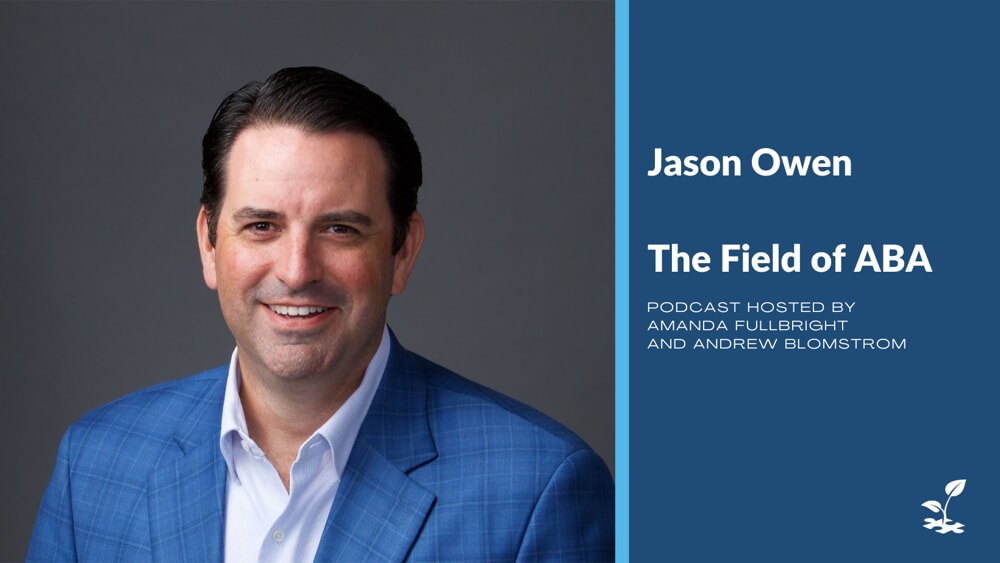
Hosted by Amanda Fullbright, MEd, BCBA, LBA, ANDREW BLOMSTROM, BCBA, Jason Owen, LBA, MEd
March 21, 2024

Listen now:

or listen on your preferred platform:

Episode Description

We are proud to welcome Jason Owen, President and CEO of BlueSprig Pediatrics, to the podcast, where he discusses his journey into the world of ABA and shares his thoughts on the future of ABA. Join us on our journey to learn more about the field of ABA.

CEU Site Link for Episode Promo Code: https://bcbaceu.bluesprigautism.com/

Full transcript

0:08 Tim Crilly: Hello and welcome back to another episode of ABA Unfiltered. I’m your host, Tim Crilly, and today we are joined by the Chief Clinical Officer at Trumpet Behavioral Health, Dr. Amber Valentino. Now, Amber and I have met each other a few times here and there. We sort of run in the same circles, but I don’t really know her that well. So I’m excited to have a conversation about a recent publication of a book that she’s she’s she’s written as it relates to research in our field. And we’re going to get to that in a minute, but I’m excited to learn a little bit about Amber right along with you all. So Amber, with that, um could you go ahead and introduce yourself and give us a little sense of how you got into this industry and your journey to where you are today?
0:56 Dr. Amber Valentino: Absolutely. Well, thank you so much for having me. It’s an absolute joy to be here. And uh so a little bit about me. As you mentioned, I’m the chief clinical officer with Trumpet Behavioral Health. And it’s really funny for me to say this out loud, but I will have been with Trumpet for 10 years this summer. Um and I I just can’t believe that when it comes out of my mouth and I hear it. But it’s true. I joined the organization early in its development as a senior clinician and had a caseload and um uh we spent a lot of time supervising other BCBAs and then just over the course of that decade have um moved and transitioned. We’ll say decade.
1:37 Tim Crilly: That makes it sound even longer. You can’t do that.
1:39 Dr. Amber Valentino: Yeah, come on. That 10 years, that 10-year period.
1:42 Tim Crilly: Yeah, that 10-year period. Yeah.
1:44 Dr. Amber Valentino: Um, and and now I and to where I am today, and I I I love the work, I love uh what I’m doing, and uh it’s it’s just a beautiful, beautiful mission. But you know, part of my story is uh what fueled the book because uh across those 10 years I’ve been able to uh remain a pretty productive researcher, even though that’s never been a formal part of my job.
2:05 Tim Crilly: So don’t tell your bosses that you’ve been doing all the side work of right.
2:10 Dr. Amber Valentino: Well, let’s put it integrates really nicely, which uh, you know, again, we’ll talk about in the book, but uh a lot a lot of times that they go hand in hand, the work that you’re doing as a clinician and and research.
2:20 Tim Crilly: So it’s attracted you to the field in the first place.
2:25 Dr. Amber Valentino: I have a story that’s very similar to most people’s story.
2:28 Tim Crilly: Um accidentally became a BCBA?
2:30 Dr. Amber Valentino: Kind of, yeah. I was 18. So, you know, just a couple of years ago.
2:37 Tim Crilly: One decade ago.
2:38 Dr. Amber Valentino: You know, uh I uh had a work study job uh that the money ran up and I needed to find a job because I was paying for expenses in undergrad as an undergrad. I was an English major. Um don’t know what I was gonna do with that, but you know, it came in handy later in life as I as I uh have been writing.
2:57 Tim Crilly: That’s true.
2:58 Dr. Amber Valentino: But uh I was looking for a job and this was old school. This was not any internet or anything where you saw job postings. This was a legit poster on a uh on a billboard, okay, a bulletin board. Um, and I saw it and it I didn’t even know if the position was paid. It just said, we’re looking for people to come into our home to work with this kid with autism. I’m like, what the heck is autism? But you know, let’s do it. Called, started, three-year-old, um, and that was it. And I’ve been doing it ever since. Okay. So it’s fell in love.
3:28 Tim Crilly: It changed your your your educational trajectory there.
3:31 Dr. Amber Valentino: Yep, sure did.
3:32 Tim Crilly: Okay, and you just kept going back to school.
3:34 Dr. Amber Valentino: Everybody has that first kid, you know. I love those stories. Everybody has that, that first kid. And he’s uh still very important in my life.
3:42 Tim Crilly: So I was I was teaching kindergarten, which kind of was a revelation in in last week’s episode, but I was um teaching kindergarten and I had an undiagnosed guy in my class that made life challenging, but also I found myself sort of focused on him and forgot about the others, and it led me to to um you know, sort of pursue this this line of work and someone I thought I was gonna be a teacher and just I just ended up here. Now I have a weird podcast on a, you know, you know, so it’s you know, life is a strange, strange thing. So I I do want to thank you for coming on and I think it’s important, and we were talking about this before we started, but you know, some people might think it’s counterintuitive for you know, someone from your group, you know, Trumpet, and you know, to come on and and and talk with us over over here at BlueSprig. But I I have found you guys specifically, Trumpet, to be one of the more let’s figure this out together kinds of groups. And that goes back to my time when I was at Magellan and uh you know, certain people like you know, Jonathan Mueller would would call and and you know politely yell at me and you know, but sort of help educate me a little bit more on what was going on in in the real world as it related to our our interactions with with insurance and and all those things and how it related to to care in home centers and around the country. Uh and I always just found Trumpet to be one of those groups that it I could look to them and say, okay, this is how they’re doing it. It’s probably the right way or pretty darn close to the right way. So I really do appreciate the relationship we’ve had um over the years. I mean, not necessarily me and you, but like with with Josh, you you know, the CEO and you know, former, former folks over there. So I think it it speaks volumes to to you to just to come on and and for for you know, frankly, to pat myself on the back for for saying, yeah, come on, let’s talk, because what you’re doing is important and it should be shared. And I want to learn about it. And you know, if people aren’t gonna come work for us, then I guess it’s okay if they want to go work for you. So I’ll leave it at that. You can be second fiddle.
5:50 Dr. Amber Valentino: I love, you know, we’ll take that. And uh, it’s true, we’re all in this together. We’re all in this together.
5:55 Tim Crilly: Yeah, okay. So that’s kind of brings me to sort of the main topic here. And and I think, you know, as an industry, um, you know, I think people don’t realize it, but we are pretty young in relative terms. Now we’ve we’ve done a lot of growing, but to your point, you answered a post thing on a bulletin board and were sort of a random stranger welcomed into the home to go work with a client. I know my first day on the job, I was on the job. I, you know, yeah, there wasn’t training, there wasn’t this, there wasn’t, you know, it was the you know, a regional center of Orange County, uh California case, and you just kind of like, hey, you you get plopped in there here, take this data, blah, blah, blah. So it in those terms we have grown a lot, regulation and oversight and on all those things. But I do feel like we are in a position as an industry where we sort of are just kind of spinning our wheels, continuing to do the same things over and over as it relates to, you know, sort of fee-for-service models with with clients, um, sort of the way we train and bring up the next generation of clinicians. Uh, and you know, part of that is the topic of research. And this is really, I want to, you know, really hear what you’ve been thinking about and writing about, because I think it’s an important thing that we all talk about, we all wish we could do, but I don’t know if the current structure of the way that that we work and and sort of operate in that interaction between the health plans or you know, funding sources in general and our families, where’s the room? How do we make that happen? So tell us a little bit about the book, how it came to be, and and sort of you know what what you’d like to uh share and impart with us on that.
7:42 Dr. Amber Valentino: Sure, absolutely. So the book really is uh intended for that population that you just described, which is the busy practitioner, right? The person who wakes up, maybe drives to a school, does an observation, drives back to a center, does a training, goes to another home, um, you know, meets with a parent, uh, comes home, maybe has a couple of hours of report writing, and you know, their days, their days are very busy. The book is it is not intended for somebody who sits behind a desk all day. Now, that’s not to say there isn’t stuff in there that would be important and helpful to them, but the book is intended for the busy practitioner to learn how to integrate good research practice into their clinical work and to do so in a way that serves the client very well, um, but also happens to answer an interesting question that could contribute to the literature. And so I feel strongly about this. Um, and that’s why the book came about, because that’s actually what I’ve done. I’ve never had a research job. I’ve never had a job where research was a part of my position uh or it was expected, meaning I could drop it anytime, but yet I I still continue to do it. And you’ll you’ll laugh at this because uh I graphed my publications per year and the times that I had the busiest caseload, the most kids on my case, my caseload um were the times I was the most productive researcher. Wow. And so I thought there’s something there.
9:17 Tim Crilly: There’s something well, it’s also the fact that you’re graphing that says a lot about you as a person.
9:24 Dr. Amber Valentino: And then, you know, there’s a there’s this, so there’s that piece of it that is a big bulk of the book, but then there’s this whole host of other avenues for contributing to the literature. I don’t think practitioners think about very often. So literature reviews, um, practice models, you know, uh getting some data around these systems and processes that people have in place at their organizations, you know, those don’t have to be written by people in academia. Yeah, they can be written by practitioners.
9:50 Tim Crilly: It’s a really good point, you know. And I think part of part of the problem, I would imagine, and this is just an assumption, is we have a very young uh workforce at the moment. And it’s as you and I get older, it gets bigger and younger. And you know, I don’t know if anyone is really instilling that level of confidence in that group of people early on to say, no, you can do this, you should go do this. Uh, because I think we we we just get into the cycle like I was alluding to before, where it’s you come in, you bill, you have a caseload, and that that’s that’s your life, you know. And it’s like, oh, we’ll we’ll get to that down the road. So, but before we get to my question, you haven’t even said the title of the book, and you should probably do that at some point.
10:36 Dr. Amber Valentino: We should, um it’s a mouthful. The the big the first part of it is easy to remember, which is Applied Behavior Analysis Research Made Easy. So most people get that. The second part is A Guide for Practitioners Conducting Research Post-Certification. Okay, so it’s a pretty um informative title.
10:56 Tim Crilly: Okay, and we’ll um, you know, I’m sure we can get a link and all that stuff. What we’ll we’ll put up there. So if if you’re listening and you want to check it out, we’ll have a we’ll we’ll get a link to you. Um but okay, so so back to that. How if if I’m uh if I’m a young, new or sort of semi-seasoned BCBA, where do I start? What how do I go about initiating a research project, idea, concept?
11:20 Dr. Amber Valentino: Oh my gosh, that’s a big question. I a good one though. So you so there’s a couple of pieces. There’s sort of the individual work that you do, there’s also the organization that you work for and the infrastructure that needs to be in place. And so you might have two kind of to-do lists, like what do I need to do with my organization to set us up to do this ethically and responsibly? Um, and then what do I need to do as a practitioner? So I can I’ll focus on the latter first, which I think is, you know, what do you do as a practitioner? Um, I make a whole lot of recommendations in the book, but I think the first thing to that is gonna propel you along on your research journey is to start thinking about your clinical questions as research questions. Okay. Right. Um, and so uh, you know, practitioners do this every day. We problem solve, we manipulate variables, we make changes to programming. We just don’t think about it as research. As research is really good. That doesn’t mean every single one of them is gonna turn into a publication, but I bet you a couple few of them will. So start that process, start thinking about things, right? Um, I’m uh trying to remember a couple examples I give in the book, but uh here’s one, and this actually turned into a research publication. Um a couple of years ago, we had several kids in our center in Dublin who needed to learn how to ask uh to man for information using why. And if you’ve ever taught that before, you know that it’s a very kind of odd WH question to teach. It is odd, it’s really got to be controlled by a particular MO, right? And so the way you set that up has to just it has to make you have to be sure you set it up so it’s actually a man and not something else. And so um we looked to the literature, there was nothing there. There was no no literature on how to teach the mand for information. Why? So we designed it, and uh, we were planning on teaching those kids that anyway, um, but we needed to do so in a systematic way, and that actually got published in 2018 in the analysis of verbal behavior. But that’s a really good example of what I just described, which is you’re a practitioner, think about that, right? Think about that research question as a clinical, clinical question.
13:40 Tim Crilly: You know, that it kind of makes sense that there wouldn’t be a lot of information out there on that specific thing because you know, how, where, when, those are more tangible things. The why is just really not a tangible thing that you can put your your finger on. And you think about a lot of you know, sort of neurotypical two-year-olds, that’s their favorite question. Yeah, and I think it does, you know, why, why, well, why? And you’d probably probably yeah, making up excuses, but it helps form some of their understanding of not only communication, but just sort of why, you know, the the cause and effect of of certain things that that happen. And, you know, well, because dad said so, you know, is finally where it where it eventually ends.
14:22 Dr. Amber Valentino: So I can confirm the accuracy of your statement because I in fact do have a two-year-old at home who asked why all day long.
14:30 Tim Crilly: Yes. So that that’s one of those things. But that’s that’s a really I I I like that that concept of, you know, you’re already doing it, you’re just not maybe coursing, you know, writing it down or you know, sort of keeping track of of certain things. So just sit back and and review some of your supervision notes from the the week, and you might see something that that maybe there’s a theme or or a you know correlation between things that you’re doing, and and boom, there’s a there’s a question and there’s a research opportunity.
15:02 Dr. Amber Valentino: Yeah, and as long as you stay in that space, right? As long as you stay in, I want to answer this question for the client. I always tell, I tell these people all every day this these words come out of my mouth. Even if this never gets published, even if you never present this, you’ve answered a valid question for that client in a systematic way that’s going to propel their programming along. That’s just good clinical work. Now, you know, sometimes you get into a space where it’s like you want to do something a little bit more experimental, maybe you’re doing something for the sake of research, that can fit into clinical practice. But that’s where I recommend those institutional supports, have a research review committee, make sure there’s um informed consent specific to that project. Um, you know, think about the time that you’re using and the resources that you’re using. It’s doable. Um, but it’s when you start to ask questions that maybe are a little bit outside of what you would do clinically, then it just it’s just a different research process. But like I said, still doable in a in a private uh organization. I just have to be more thoughtful about it. But most of the things that people do are what we just talked about, demand for information using why, the, you know, this kid’s eating too quickly, and I need to slow him down so he doesn’t choke. Let’s find a way to do that, you know? Um, and that stuff is all just really clinical.
16:19 Tim Crilly: Yeah, it’s true. I think, you know, when you when you sit there and you think about my your own research as a as a person, you think it has to be this like crazy earth-shattering ground. And that’s just not really what it needs to be, because those things are few and far between and not really that that helpful. It it is, can you make a case for someone that’s that’s looking for help in their particular program or a series of their programs that they’re running? And boom, here’s an article, here’s some information, here’s some tips. Those things are so important because going back to some of the earlier things we were saying, you know, you never know where a BCBA comes from. They’re only as sort of solid as maybe their confidence, their training, you know, and everyone has a sort of a different path. And, you know, just because you passed that exam and you’re out there doesn’t necessarily mean that you have all the answers. And I I I don’t know how you you you see it, but it does feel like there are people that are a little bit more um hesitant to raise their hand and say, I don’t know. Um, you know, and is if there’s more, there’s more research out there, if there’s more uh, you know, information that people can can reference that’s just going to have such a valuable impact across you know the entire um country. Sorry, something just fell off a chair behind me and startled me. Uh Andrew, I say we leave it in.
17:45 Dr. Amber Valentino: I love it.
17:48 Tim Crilly: It was horrifying. It was my work, my work backpack just took a dive off the chair.
17:52 Dr. Amber Valentino: That was a little concerned for you, but you looked fine. I know the the audience can’t see you, but I’m just making sure you didn’t fall.
17:57 Tim Crilly: Yeah, my hair, my hair is standing straight up. Um okay, so I don’t even remember what I was saying, but I think it was a really good point. I think is where I left off.
18:05 Dr. Amber Valentino: Yeah, definitely very good point. You know, I mean, behavior analysis is we’re in this really unique position in that the same procedures and designs that we use for clinical practice are the same ones we use for research. This doesn’t exist in other professions, right? And so, you know, when you think about, well, why would I utilize a multiple baseline design? Well, I want to make sure if I’m about to invest a bunch of time and energy into training a bunch of people on uh this intervention that it’s actually working. Well, how do you determine that? You determine that using good experimental design, right? A multiple, okay, let me just make sure this is the mechanism. This is what’s causing the change that I’m seeing. Um, and that’s that’s as important for clinical practice as it is for research. And so uh, you know, we’re just fortunate as a as a profession to have that luxury. Not all professions can do that. Research and practice are very divided, they’re very different things, but there’s a decent amount of overlap um in ABA, which is cool.
19:05 Tim Crilly: So, what are some of the barriers that you’ve come across for for folks out there? Um there has to be there has to be a some. So just maybe touch on a few of those, and maybe if you have any suggestions for overcoming said barriers.
19:21 Dr. Amber Valentino: I do. So there is a whole chapter dedicated to obstacles and barriers um in the book. So definitely read it. Uh, you know, I I made this differentiation in the book. I’m not sure how helpful it is, but it it’s true to what we were talking about earlier, which is you know, I consider um uh the obstacle to be things that are more institutional, right? You have to rely on other people to help you uh overcome that obstacle, and then barriers to be things that are sort of your own stuff, like what do you need to overcome in order to progress? And so there’s a lot, obviously. I could talk uh about a couple of the most common. Uh so I’ll talk about the the number one barrier, which by the way, is also the barrier that was noted to be most common in a research article that we published in BAP that actually kind of fueled this book along. So uh Jessica Wanico and I in 2020 published a big survey study asking people about the barriers that prevent them from doing research. And do you have any guesses about what the number one is? I bet I bet you that’s it. That’s it. That’s are you seeing right? There’s no surprise. Uh time. And so here’s what I will say to people is you’re you’re never gonna wake up one day and suddenly have a bunch of free time. Never gonna happen. And so, and this is true for anything in life. And so if you want the time, you have to make it. And that might mean saying no to some things, that might mean more protection of your schedule, that might mean adding a little time in on you know, your days where maybe you end uh a little earlier than you normally would. But if it’s important to you, think through what you’re gonna do to make it happen and and you have to make the time for it. That’s there’s no easier answer than that, but it’s just like with anything, right? It’s just like with exercise or healthy eating or reading, you know, whatever it is that you want to do that you feel like you don’t have time for, it’s the same thing. But yeah, time is a huge, huge barrier for people. And I get it, I do.
21:25 Tim Crilly: Yeah, I mean, and I think that’s it’s the pressure of the current structure in the way you know programming is is required. You probably don’t even have enough time to get to the things that are on your list anyway. But like you said earlier, it’s about can you make this a combo? Can you, you know, do two things at once while you’re just doing one thing?
21:49 Dr. Amber Valentino: Yeah.
21:49 Tim Crilly: Um, that’s that’s the key.
21:50 Dr. Amber Valentino: And I guess that’s the key.
21:53 Tim Crilly: And I guess one of the other sort of barriers would be can you get sort of buy in from the the the the Place that you you you’re working at, you know, and and how do you get them to say, yeah, let’s let’s do this.
22:05 Dr. Amber Valentino: That’s right. Yeah. So I think uh you have to have a partner, right? Um, you can’t just go off and start running your research protocols without your organization knowing about it. But um, in my experience, and you know, I’ve talked to other organizations about this too, I I think most organizations see this as a value add. It engages your your workforce, um, it gives them opportunities to learn and grow. And let’s face it, if you’re a good researcher, or even just a researcher generally, you’re a better practitioner because that means you’re reading the literature. That means you’re thinking um systematically about how you uh address that case and think about that clinical concern. And so your clinical work is better. And I don’t know any business out there that doesn’t want their clinical care to be high quality. We talk about that all the time. High quality clinical care. Well, that’s fueled by research, right? So um, yeah, you you you gotta get a you gotta get partner. Um, I do recommend ways in the book that if you don’t have an organization that is supportive or can be supportive right now, it doesn’t mean you have to give up. Um, you just have to be a little bit more creative about who you reach out to and who you coordinate with to make that happen.
23:10 Tim Crilly: But it’s so basically those people should find employment at BlueSprig or Trumpet.
23:15 Dr. Amber Valentino: There you go. Well, you said it, not me. But yes, I believe that that might be an appropriate option. I think I say that in a you know one like subtle way. Yeah.
23:26 Tim Crilly: Well, good for you because this is I mean, it’s important to believe in the group that you work for. Um, you know, and there’s a lot out there. It’s not there’s not a scarcity of opportunities, but finding a place, you know, that you can settle in for you know 10 years or you know, or or longer, I’m sure you’re gonna go a little longer than 10 at this point. But if you can find those opportunities and and be a part of something that you feel really solid about, uh goes a long way. Uh, you know, and you know, I I found that at BlueSprig. And you know, I was at um ACES uh previous to that before my Magellan time, I was there for 10 years. And you know, it’s weird to think that this summer I’m coming up on being gone from ACES as long as I was at ACES. It’s like, well, how old am I? Jesus, how’d that happen so fast? But you know, finding where you belong is is really important, and it, you know, and it sounds like you know, groups like like you guys really offer that opportunity for your for your staff to not just, you know, okay, go out there and do the work, the work, the work, but also kind of look for opportunities to do the things that are going to make you you happy um and and be feel like you’re contributing beyond just to the the families you work with, but to the greater good of this, this, this community.
24:45 Dr. Amber Valentino: Absolutely. Yeah, we have um, as I’m sure you guys do too, you know, we have a an active research culture. We have a group that meets regularly. And here’s what I think is really cool is that people are at different phases. So there’s some people who are ready to write. They’re strong writers, they can jump in, they maybe had a very strong background. Um, and so they jump on projects and they they help write them or they come up with them on their own sometimes. Um, you know, there’s other people who they want to learn. They they want to uh learn and they want to participate in understanding research, but they’re not quite there yet. And so those people might set goals for themselves simply to consume the literature for several months before they even think about um doing a study. But you got to meet people where they are. Uh, and I will say that survey study that I mentioned, people are motivated. So it’s some somewhere, I don’t remember the exact statistics, but in the high 80s, something like 87, 88% of people who answered our survey said they absolutely want to conduct research or be part of it in some way. So people want to do it. So then you’re right, it’s about finding an environment where that’s gonna be something that you can do long term.
25:51 Tim Crilly: You know, and I think for us, you know, obviously everyone sort of had to refocus over the last two years. Um, but that’s something that is is re-emerging because that was an important um, you know, purpose for us. You know, BlueSprig is coming up, we’ll be five years old this year. So, you know, like half our life has been uh COVID. So, you know, some of the best laid plans, you know, as they say. So I think, you know, for for folks over here or are looking at opportunities here, that is also a priority that is is being refocused. So hopefully there’s going to be more of us out there, you know, sort of supporting that that next generation of go-getters.
26:29 Dr. Amber Valentino: Absolutely. If I could just add one more tip for the time management piece, there are two books that I highly recommend people read, and they’re not written by behavior analysts, if you can believe it. Um, the first one is called How to Write a Lot by Paul Silvia. Uh, he uh is at a University of Kansas, he’s a psychologist, not a behavior analyst, but he writes uh it’s a short people laugh because it’s called How to Write a Lot, but it’s a really small. But he uh he’s not a behavior analyst, but you would think he is. And he basically just talks about completing a task analysis and putting time on your schedule and setting small, reasonable goals for yourself regularly. And so that book really kind of transformed the way that I write. Um, and then another one that’s more recent, there’s an author named Cal Newport, and he wrote a book called Deep Work, and it’s sort of all about what we’re talking about, which is how do you make the space and the time for something big and you know, the the work that takes you thinking and really sitting down and not having distractions and focusing? Um, and so I read that book after Paul Silvia’s a few years later, and it sort of just took me to the next level with my time management related to well, everything, but research tasks and things.
27:44 Tim Crilly: How do you sit down and write a book? Is it literally chapter one, you know, dark and stormy night, and you just get going? Or did you outline, okay, these are the 10 things I want to talk about and sort of build a flow from there?
27:56 Dr. Amber Valentino: Oh my gosh, yeah. So I was lucky to partner with New Harbinger uh publications. Uh they uh reached out to me to this day. I still don’t know how they got my name, but they did. And I was very pregnant with my son. And I said, No, I’m not gonna write a book. I’m about to bring a baby into this world. And they said, please. And I said, no, and I kept saying no. And then they finally said, Well, it’s not a big deal. We work with people who have full-time jobs and families all the time. Like, we’ll set the goals and the deadlines accordingly, and it’ll be at a pace that you can operate with it. I said, Now now you’ve sold it. I said, I can do that. And so they were great. So they really kind of facilitated the whole process and said, come up with a table of contents. Okay, now draft out your first chapter. Okay, you know, and so they they did that, but it’s what you just described, which is you know, um, breaking it down and having measurable goals now. Independently, I uh I think I’m kind of known for this. Most people know this about me, but in case you don’t know, I’ll share it. Uh, I’m uh I have come up with a very great system for writing and I uh wake up very early. I um am up and writing by 4 a.m. Oh, okay. That’s really helpful. I go to bed super early, so I get all my sleep. It works for me. I’m a morning person, my brain is focused. So I wake up, I literally throw on my sweatpants, I get a really great strong cup of coffee, and I sit down. I don’t turn on social media, I don’t look at my phone, I don’t turn on my email, and I and I go. And what I do is when I’m finished with my I do, I write for about an hour, five days a week. So five hours a week. When I’m done with that goal, I look at my task list and I set my goal for the next day. So I have this 24 hours where I’m thinking about what I’m gonna do. And I just do that every day. And I’ll tell you that it’s like slow productivity, it’s just a little bit every day. Sometimes I sometimes I finish my goal in 10 minutes. Sometimes I finish it in exactly that hour. But I think that’s the key. Sometimes you hear people who will take like months off and then they’ll try and spend, they’ll cancel everything for the day and they’ll try and write a paper. You’re not gonna be productive that way.
30:06 Tim Crilly: Yeah, it sounds like a good idea. Yeah, but it’s like, oh, clean out the garage this weekend and you get like one corner done, you know.
30:13 Dr. Amber Valentino: Yeah, exactly.
30:15 Tim Crilly: And you’re spent.
30:16 Dr. Amber Valentino: So yeah, so it it felt, I know this sounds hilarious, but um, I it felt very manageable because I was just doing a little bit every day, and then two years later you have a book written.
30:25 Tim Crilly: Yeah. So you’re are you working on something new?
30:29 Dr. Amber Valentino: I am not working on a book uh right now, a couple of book chapters. So I’m working on a book chapter on supervision for Jim Luiselli. Uh, and then uh probably our biggest paper that we’re working on is one on positive supervision. So more of a discussion paper related to how we think about the work we do as supervisors from a positive framework, similar to like the PBS movement and things like that. So, no, I I would like to write another book. I don’t know about what, but I think we’re gonna see how this one does. And if it does well, hopefully New Harbinger will say, Amber, what’s next?
31:03 Tim Crilly: How about like how about more like a um it’s like a you know, some nonfiction, like a um no, I mean some fiction where it’s like a BCBA that sort of solves crimes or something like that. You know, yeah, something along those lines.
31:17 Dr. Amber Valentino: You know, you’re honest, I’ll put you in touch with new harbinger.
31:21 Tim Crilly: There’s some TV show concepts, but I don’t know if I can write a book.
31:24 Dr. Amber Valentino: You know, and I have to say to you, when they when they reached out to me, we didn’t have a topic in mind either. And they were reaching out and saying, Well, how about something on ethics and supervision? You know, but I said, you know, there’s a lot of people doing that. There’s a lot of people doing that stuff. I don’t know that I need to enter into that space. And we were kind of surprised nobody had written a book like this.
31:42 Tim Crilly: Yeah, I think it’s really cool. I I think you know, I saw, you know, you you you posted something on LinkedIn about it, and I just said, you know what, that’s cool. Like who, you know, like a how-to guide, like why not? I think it’s it was a really cool concept. Um, so I I I hope I I’m gonna get my hands on it and and I’ll I’m gonna make sure people see it um around the water cooler. But um, are you uh are you presenting anywhere upcoming that you wanna?
32:08 Dr. Amber Valentino: You know, um I’m I’m calling this my gap here.
32:11 Tim Crilly: Okay.
32:11 Dr. Amber Valentino: We didn’t quite know what was going on in the world. And as my as with everybody, I I see all the people out there at conferences and uh it’s amazing. I’m so happy they’re doing it, but we kind of just chilled, you know. We didn’t know what the world was gonna be like, so we’re not presenting anywhere this year, but I’m quite confident we’ll be back in time.
32:27 Tim Crilly: Are you going anywhere that if people see you in the hallways, they should stop and say hello?
32:32 Dr. Amber Valentino: Yeah, so we we should have a pretty good presence at ABAI this year, coming up in Memorial Day. Um, Calaba, we just had Calaba, that’s our other big one because I live here. And um, let me think what else. Uh, those are probably the big ones that I can think of right now. Uh to my knowledge, no, I don’t think it’s on the CASP, but that one is coming up too. Yeah, it’s in May. ABAI is the best.
32:53 Tim Crilly: That’s Boston, Boston this year.
32:55 Dr. Amber Valentino: Boston.
32:56 Tim Crilly: Yeah, it’s too far.
32:58 Dr. Amber Valentino: They’ve spoken like a true Californian.
33:01 Tim Crilly: Uh well, I I appreciate this. Is really this is really cool. Um, you know, just the thought of sitting there and writing a book just sounds too overwhelming. So congratulations for just doing that. I mean, right with a new baby and pregnant and everything. That’s insane.
33:19 Dr. Amber Valentino: Pretty few can do anything if you put your mind to it.
33:22 Tim Crilly: I guess so. Um, so thank you. You know, when you’re when you’re ready to come on and talk about something else, let us know. We’d love to have you have you back. Um you know, and hopefully we’ll um we’ll cross paths at at some some point in in actual person.
33:36 Dr. Amber Valentino: Absolutely. Well, thank you so much for having me. This is a joy, and I uh appreciate our partnership so much. And uh it was it was lovely to chat.
33:44 Tim Crilly: Yeah, I I I agree with you. It’s it’s good to have you know friends out there and people that you can that that can call and talk. You know, Josh is is great. He’s just um hey, let’s yeah, I I have an opinion on that. Let’s let’s see what you think. And you know, he’s had a couple conversations with some folks over here just about the landscape and where it’s going. And you know, we’re all in this together. And you know, if if more people are sort of aligned with doing things the right way, it’s just gonna, you know, you know, raise the tide for all boats or you know, whatever that expression is. But I think it’s it’s important for for for groups to to communicate and and and and play well in the sandbox.
34:21 Dr. Amber Valentino: Absolutely, totally. Well, thank you so much. Okay, thanks, Amber.
34:24 Tim Crilly: Um, and thank you again for tuning in to another episode of ABA Unfiltered. Uh, we hope you enjoyed it as much as we enjoyed making it. And please subscribe, share all those things, and and be on the lookout for that link uh to Amber’s book.
34:44 Tim Crilly: Um

Find a center near you.