Episode Description
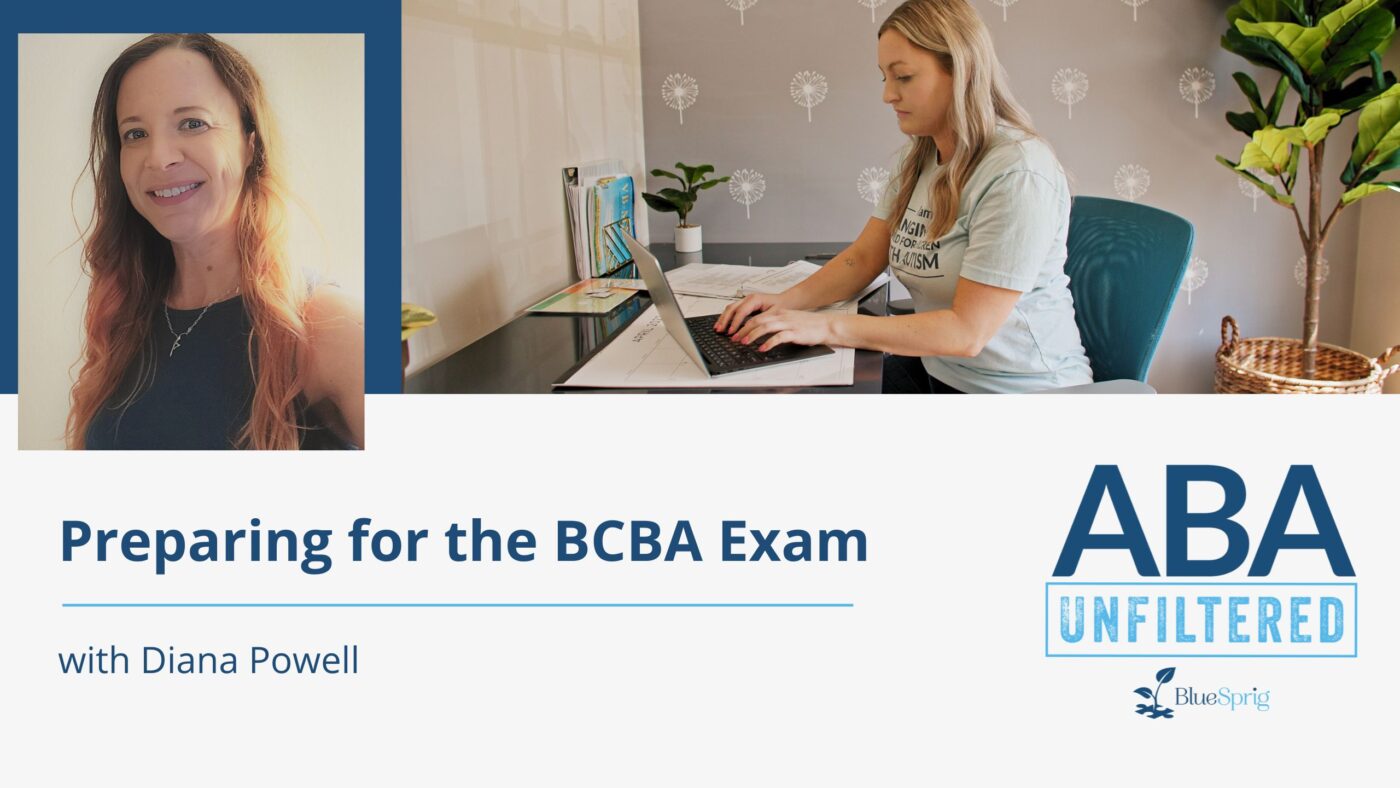
In episode 7 of Season 5, hosts Amanda & Andrew are joined by BlueSprig’s own Clinical Initiatives Manager, Diana Powell. Diana joins the podcast to discuss how to build a meaningful relationship between supervisor and mentee, as well as share useful tips for those preparing for the BCBA exam. Listen now to hear valuable tips to building a lasting and effective supervisory relationship.
BlueSprig CEU Website: Use Promo Code “Podcast” to get $5 off
Full transcript
0:14 Andrew Blomstrom:
Hello everyone, this is Andrew Blomstrom along with Amanda Fullbright, and you are listening to ABA Unfiltered, where each episode we interview guests from around the world of ABA. Whether you’re a BCBA, RBT, or just interested in ABA, you are sure to pick up some actionable advice you can utilize on your journey. And without further ado, we would like to welcome on to ABA Unfiltered Diana Powell, the Clinical Initiatives Manager at Blue Sprig Pediatrics. Diana, why don’t you tell us a little bit about yourself?
0:46 Diana Powell:
Hi, and thank you so much for having me. As Andrew mentioned, my name’s Diana Powell. I am a BCBA. I’ve been a BCBA since 2011. Started my career with Blue Sprig in 2018 as a clinical director in the Portland, Oregon area, and joined the LPD in late 2021. So coming up on my year and a few month anniversary there.
1:09 Amanda Fullbright:
Awesome. So welcome, Diana. We’re excited. Yeah, we’re so excited to have you on the podcast.
1:16 Diana Powell:
Thank you. I’m excited to be here.
1:19 Andrew Blomstrom:
Hopefully, we’ll learn some fun things about supervision.
1:22 Diana Powell:
I’ll make it as fun and informative as possible.
1:27 Andrew Blomstrom:
Speaking of supervision, I was wondering if you could kind of touch on a little bit about what you do at Blue Sprig in regards to supervision for people becoming BCBAs across the organization.
1:39 Diana Powell:
Yeah, of course. So at Blue Sprig, one of the initiatives that I help manage is our internship program. So that being said, I meet quarterly with each center leader that has a center overseeing interns. Some of it is like a documentation review, making sure that their documentation would pass an audit if they get audited down the road by the BACB. But a lot of it is really talking with the responsible supervisor to help ensure that the interns are really having a good, meaningful functional learning experience during their internship to help prepare them to be a successful BCBA. And sometimes kind of troubleshooting or talking through, you know, just barriers that can happen during that process, whether it’s, you know, needing time off of work and not getting enough hours accrued in enough time, or the person’s not gaining the skills, maybe at the speed that we would like them to see. Or if there are issues with like timeliness, ongoing documentation, et cetera.
2:42 Andrew Blomstrom:
Very nice. And I know you also oversee the clinical supervisor training at Blue Sprig. Do you think, you know, that relationship you build with the interns during that process, how do you think that affects your relationship with them when they come to you for the clinical supervisor training?
2:59 Diana Powell:
Definitely helpful. I’ve definitely noticed a difference between clinical supervisors that are internally promoted at Bruce Blue Sprig from that intern position as compared to people that are promoted that haven’t gone through the internship, as well as those external hires. I get a lot of like, oh, it’s nice to put a face to a name, et cetera. Um, I think too, it just kind of helps uh like they they know my name, they know my face. So there’s a little bit of rapport built in there, um, which means um I’m often the first person they reach out to with questions, which is great because then I’m there to answer those questions for them.
3:32 Andrew Blomstrom:
Awesome.
3:35 Amanda Fullbright:
Since starting in this role of uh kind of helping to guide and coach supervisors, uh, what do you think are the biggest areas that you spend your time in when working with those responsible supervisors?
3:53 Diana Powell:
Definitely think the most, the time we spend the most areas in has to do with uh feedback delivery. And uh in general, feedback delivery when maybe the person’s not quite where we would expect them to be at this point in their internship. So what we don’t want to see happen, but it happens sometimes, is kind of their number of accrued hours is kind of exceeding their skill set a little bit. Um they’re not quite meeting expectations with where we would like them to be. And um then the supervisor’s wondering like, what do I do at this point? When do I put the internship on hold? How do I give the feedback to this person, et cetera, et cetera? Um, and it really, I think, comes back to like you’ve got to determine that at the beginning. You’ve uh really got to set those expectations at the beginning. So it’s it’s not just going through and signing that internship contract right away. It’s actually going through each little bullet point and kind of establishing, like, this, you know, the supervisor saying, This, this is the expectation I want to see. This is how I’m gonna measure it. And how do you want to receive feedback, be it positive or corrective, um, to help make sure that that person, number one, is gonna expect feedback and get it in their kind of preferred feedback delivery. Um the biggest bump in the road I see is telling an intern that there’s areas for growth. And I mean, really, we should expect that there’s areas for growth because they’re learning and growing into this new position. But I think sometimes people see constructive feedback as like hurting someone’s feelings. They’re not quite sure how to deliver it. But really, when you’re looking at like the function of feedback, like we’re we’re giving information to make you a better employee so that we have better outcomes for our kids. Like we’re all on the same team and want those better outcomes. So, even constructive feedback, we should see that as a gift and really just learn like, how does this person like to receive the feedback? What’s their preferred methods so that we can deliver both that positive and corrective feedback in a way that’s not making us nervous and not making the other person feel like they’re bad at their job. Because just because you receive constructive feedback doesn’t mean you’re bad at your job. It’s just saying, you know, uh, here’s where you are and here’s where we want you to be, and how can we help you get there?
6:02 Andrew Blomstrom:
Yeah, I agree. If you’re not getting feedback, you don’t know what you’re doing right or doing wrong. So you’ve got no room to grow.
6:08 Diana Powell:
Exactly. Yep. And I think that this is definitely ABA is an area where you’re getting more feedback than you probably ever got at any other job before. Um, just the amount of feedback that you’re getting is much more frequent. And so I think it’s super important to really establish how the person likes to receive feedback and how it’s gonna be effective from them really early on when you’re first starting that supervisor-supervisee relationship.
6:33 Amanda Fullbright:
Right. And you you hit on this, but by nature of being a trainee or a supervisee, you’re learning, you’re in the learning zone, and you you gotta have feedback to be able to learn and and to grow and to improve your skill set without that feedback. What are you doing here?
6:55 Diana Powell:
Yeah, absolutely. And I think too, you know, on the interns or the trainees from their standpoint, they’ve got to feel too safe enough and vulnerable enough that they can make mistakes when they’re in that learning zone. Um, you know, uh, because mistakes is how how we’re gonna learn sometimes, making that mistake and then getting getting feedback and having kind of a plan in place so that same mistake doesn’t happen again down the road. And so I do think it’s really important that um supervisors and supervisees are really maintaining that rapport over time and that the supervisee feels comfortable and vulnerable enough to receive some of that constructive feedback and also to provide feedback to their supervisor as well, as far as what’s working, what’s not working, et cetera.
7:39 Amanda Fullbright:
Yeah. That relationship is a long-term relationship in most cases. So you have to be able to, you know, have that two-way street in the relationship. Absolutely. Diana, you keep talking about, you know, setting expectations really early on. What if you didn’t? What about what if one of our listeners is a supervisor who maybe didn’t do that and now is like, okay, I need to course correct. What would your advice be?
8:14 Diana Powell:
My advice would be set a one-on-one meeting and reset expectations as soon as possible. So if expectations weren’t clearly set at the beginning, um, I would say better late than never. So don’t just not do it because it wasn’t done. Um, but really have a one-on-one meeting with them in person would be better than teams if that’s anything, you know, possible uh to actually meet in person rather than over the web. And uh to really just kind of have a conversation about what the expectations are and what they look like, really also making sure that the trainee or the intern um understands those expectations and agrees to those expectations. I mean, being an intern or a trainee, it’s it’s a lot. You’re going to school probably full time, you’re probably working full time, and then you’ve got all these, you know, applied assignments and meetings and feedback that you’re getting on top of it. Um, so it’s not just uh something I’m gonna do in my spare time, right? And I think it’s, you know, super important for an intern success down the road for them to really understand those expectations and agree to them. And if they’re not in agreement, then maybe it’s a different conversation to have about, you know, well, what do you want your future in ABA to look like, right? Um, because if we can’t agree to these uh these expectations just as an intern, kind of during your field work process, we’re probably gonna have a pretty hard time um making it in the field as a BCBA down the road.
9:37 Amanda Fullbright:
So related scenario, but different. And it happens a lot if I am a new supervisor to you, but you’ve been supervised for you know several hundred hours before, and I’m different than your last supervisor. Like, how would you advise people to start that relationship?
9:59 Diana Powell:
Um, again, I think it comes back to having kind of an initial meeting where we’re starting to build and establish that rapport, really discussing uh communication expectations, um, frequency, modality, um, what’s going to work best for the trainee. Um, and, you know, also just the supervisor kind of talking about expectations as far as their communication style and teaching style as well. Um, I think it’s important that the supervisor and supervisee are on the same page moving forward. And if there’s any disconnect, they should hold off on starting that relationship and either have further conversations until there is that kind of connected piece, or maybe the intern and that supervisor aren’t a match and they should look elsewhere for someone that’s um able to kind of give that experience that they’re expecting. Good advice.
10:47 Amanda Fullbright:
Good advice. So outside of feedback and all of all that that entails, what are some of the other kind of bumps in the road that that you’ve seen?
11:00 Diana Powell:
Um, definitely looking to just to help ensure that like skill set is lining up with the number of hours accrued. So um the supervisor, I feel like really should be mindful before they sign that monthly verification form every month to really say, like, yes, this trainee or intern has been meeting expectations across the month. They’re, you know, the assignments I’m giving them or when I’m observing them with a client, um, they’re where they should be at this point in their internship. And if they’re starting to see any types of red flags, like, oh, they didn’t really run that token economy accurately. Um, and I’m asking them to design a token system, like that might not have been the best choice, like really stopping giving that feedback right away. And if we’re not seeing that growth and change in performance, it’s tough to do, but to sometimes say, like, I really can’t sign this form this month because you haven’t quite met expectations as far as where where we need you to be. Um, I think we owe that to the trainee so that they have a clear picture of where they are and where they need to be. But I think it’s also something that we really owe to the field of ABA. Um, lots of people are good test takers, but not only do they need to pass that exam, we need them to be really exhibiting that behavior to be a successful BCBA. And if a supervisor is just signing off hours every month without seeing that increase in skills, we’re sending people out there in the field that aren’t ready, um, which um is not great for Blue Spring’s reputation, but also not great for ABA’s reputation, especially with as much scrutiny as the field is under right now with insurance companies. Yeah.
12:32 Amanda Fullbright:
So we do have at Blue Sprig, you know, a curriculum, if you will, you know, some guides for what skills to work on when. And we we have um it broken down into some levels so that there’s some benchmarks in there. But what if I’m a supervisor at a company that doesn’t have that, or I’m a supervisor, you know, on my own and I’m providing supervision to to trainees. What advice do you have about how to structure supervision for them to know that they’re meeting those skills that you were just talking about?
13:09 Diana Powell:
Yeah, that’s definitely a lot more work on a supervisor that doesn’t have a set curriculum to work from. Um, I definitely say start with the task list. Um, we need to go above and beyond teaching the task list, but start with the task list. And I am a big fan of competency checklists. Um, so wherever you can develop or don’t reinvent the wheel, there’s a lot of good ones out there. Um start start with a created one and kind of modify it to meet your needs. But competency checklists, I feel like, are a really good way to give nice objective feedback as to where performance is being met and where it’s not. So it kind of takes the performer out of it. It’s not not subjective, not saying you’re doing a good or a bad job. It’s just saying, here are the steps to do this. These steps were independent, these steps still needed some prompts. So guess what? I’m not gonna sign off that skill as competent yet. Um, I do think there’s there’s gonna be a lot of heavy work on the front end as far as like how to kind of divide the task lists because kind of want to start to teach on those foundational skills first so you can build upon those. Um, but then you know, utilizing competency checklists where you’re able, and then obviously just a lot of behavior skills training. Right, right.
14:17 Andrew Blomstrom:
You kind of hinted on this with, you know, if you don’t believe your intern uh is kind of meeting those expectations, having those conversations with them. You know, a lot of research shows that a lot of um, you know, younger supervisors have an issue with conflict uh and will avoid having those conversations. Um, and I know the field of ABA is fairly young, so a lot of our supervisors are on the younger side. What advice would you have for new supervisors to go about having those conversations that might not be comfortable with those awkward, potentially you know, conflict uh types of conversations?
14:54 Diana Powell:
Yeah, I mean, those conversations are never fun. Um, I’ve been supervising several years, and sometimes when I give constructive feedback, I still get like the butterflies in my tummy. It’s you get nervous, like you don’t want to tell someone that they’re not meeting expectations. It can be kind of hard news to deliver. So um, I definitely think a few things to help make the conversation go better is number one, talk to them, talk to a mentor, uh, talk to another CD, talk to a DCO who’s done this before, um, get some tips from them. Um, and I know this probably isn’t the answer most people want to hear, but rehearse it. Like write a script out, record yourself on your phone, giving that feedback because you’ll notice your facial expressions, you’ll notice what your voice and body is doing, and actually like rehearse that script so that you’re feeling a little more fluent and comfortable going into the conversation. And then really just listen. Listen to how the person responds, watch their body language, see how they’re accepting the feedback, and uh really remind them that you’re doing this to help them better themselves so that we’re creating better outcomes for our clients, that it’s not a personal attack, um, that we still think you’re a wonderful person. This is just the skill that we’re not seeing. And ask a lot of questions to see what barriers might be and how we can help the person get there. Um, sometimes those reflective questions too might make the person kind of say, you know what, I love ABA, but I don’t think I want to be a BCBA. Maybe I want to go more into the research side of things, or maybe I I want to work with animals, you know, something along those lines. Um, and and that’s okay. Um, you know, sometimes we’re we’re finding our own paths. And and if the supervisee decides, like, actually this this isn’t for me, better for us to decide that now than after they’ve gone through all their coursework and completed all their hours.
16:37 Andrew Blomstrom:
Definitely. Thank you.
16:40 Amanda Fullbright:
Yeah. I want to shift gears for just a second and talk about documentation. Documentation. Gosh, the the BACB has some um pretty, you know, clear-cut rules around documentation. However, I I see that people continue to kind of struggle in that area. What have you seen?
17:06 Diana Powell:
Um, I think that you’re right, the majority of people struggle with the documentation. Um, and I don’t I don’t know if it’s just something that tends to get lost in the shuffle because they’re very busy people doing lots of different things. Um, but I I I basically see all over the place. So I see, you know, I audit some field work logs that are like to a T. They’d have no trouble passing an audit if they were audited by the board. Um, I see some where just kind of days and times are entered, no summaries of activities, no supervisor feedback where I’m like, uh, I really hope this person doesn’t get audited. Um, so I think it’s really important. Number one, as I said, um establish those expectations at the beginning. Um, really make it clear that like these are the board’s requirements. I’m not making you write this stuff down just to keep you busy. Like this is what the board’s gonna require. Um audits are scary, and we want to make sure that you pass an audit because I mean, worst case scenario, you could accrue hours that end up not counting. Um, and that’s something that no one wants is putting a lot of work in for something that doesn’t count. Um, so I do really encourage if there’s ever a question, like check that BACB handbook. Um, there’s lots of information on what to include in that documentation. And I’d say err on the side of caution. Go above and beyond. Include the task list number as well as kind of the activity that you performed. Um, put some kind of system in place so that your supervisor is getting into your log frequently and providing feedback and signatures, whether you’re giving them a task on central reach or a task on Outlook, something like that. Um, but a real really establishing those expectations at the beginning from both sides and then putting some checks and balances in place as well. Like maybe perhaps the responsible supervisor doesn’t sign the MBF until they see that that field work log for the month is on it ready, basically. A lot of it too is gonna be systems for the trainee. Like they’ve got to have systems in place to make sure that they’re keeping up on it regularly. So, like one recommendation I have is don’t wait till the end of the month. At the end of your day, every day, get in there, update your log. It’s gonna save you time in the long run. But again, having some sort of system in place just to ensure that that stuff is happening on a regular basis.
19:14 Amanda Fullbright:
Yeah, it’s it’s so laborious. And you know, at the end of the day, you’re tired and you don’t wanna write people lesson notes to write too. And right, but it’s it’s you know, a couple years of your life of investment. Um, well, then if you provide supervision to others later, it’s you know, I mean, get used to it, I guess. Maybe it’s my advice.
19:41 Diana Powell:
Yeah, definitely. I mean, documentation doesn’t go away once you become a BCBA. So another good point. Get in that good practice now early so that it becomes habitual over time. Right.
19:52 Andrew Blomstrom:
And like you mentioned earlier, if that’s something you absolutely hate and don’t want to do, maybe that lets you decide. Maybe this is something I don’t want to do.
20:01 Amanda Fullbright:
Right, right, exactly. Yes, documentation is such a huge part of our jobs. Um you do kind of gotta learn to, you might not have to learn to love it, but you gotta learn to do it.
20:12 Diana Powell:
Yeah, gotta learn to have some sort of system in place to do it and and make it as at least as easy as possible for you. Pair it, pair it with something. Put on a good TV show or listen to some music while you’re working on your daily documentation, um, things like that. There you go.
20:27 Amanda Fullbright:
There you go. Well, that that that brings me to a to a good segue then. Um thinking about any uh trainees, any people working on their field work right now that might be listening, um, any advice like for self-management kind of tips for for them to keep themselves on track through their their field work. I know we’ve we’re talking a lot about supervisor behavior, but let’s talk about the trainee behavior for a minute.
20:54 Diana Powell:
Yeah, for sure. Um definitely have some system in place, whether it’s putting daily reminders on your phone so that at six o’clock every night it tings and reminds you to like update your fieldwork log. Um, I think too, again, the the bidirectional feedback’s gonna be super important. So really speaking up if you’re needing anything from your supervisor. Maybe you shared your log with them and there’s no feedback documented yet, it’s okay to gently nudge them and be like, remember, this is part of my rules for documentation. I need some feedback on there. Um, you know, gentle reminders to have them kind of complete that. And then um really just having that open line of communication for what’s working and what’s not. So if a if a trainee or an intern is having trouble keeping up on that level of documentation, I would say reach out to your supervisor and see if you guys can kind of create um an action plan um to help with that behavior. I mean, we’re we’re all behavior analysts or aspiring behavior analysts. So, what kind of plan might be we able to put in place to increase documentation? Um, Maybe it’s establishing a weekly reinforcer for doing your documentation on a daily basis. Maybe it’s uh making sure that you can like pull up your log on your iPad instead of your computer because you’re on your iPad more at home than you are on your computer. Um, little antecedent-based strategies like that. And then um imagine that dumpster fire six months down the road. So doing kind of a pre-mortem analysis and saying if I don’t keep up on my documentation, what reasons might there be to prevent me from doing this? And kind of putting plans in place now to help prevent that from happening. Like, oh, it’s night and I’m just too tired. Well, what kind of contingency could we put in place to help ensure that you’re doing this before turning the TV on and watching your daily shows or whatever it might be?
22:43 Andrew Blomstrom:
I’ll get to that tomorrow. It’s strong. Yeah.
22:45 Diana Powell:
Yeah.
22:45 Amanda Fullbright:
Hot tips. Hot tips, y’all. Awesome. Um, Diana, you do a monthly test prep for those that are kind of gearing up to take the the ABA, the BCBA exam rather. And I know you have just amassed a wealth of tips and tricks and things, um, wisdoms to share with uh those that are getting ready to take the test. I’m wondering if you could maybe share some of your top hot tips.
23:18 Diana Powell:
Yeah, of course. Um, and thank you to those that have already attended the webinar. They’re lots of fun. Hope you guys can make it. Um I generally start that webinar with just how to how to develop an individualized study plan. So, again, not a one-size-fits-all approach. Um, but step one is going to be establish your baseline. Um, so get on the Learn Upon resources. We have a free mock exam that you can take. You can go to an external provider, but you’ll probably have to pay for it. So get the free one and establish your baseline.
23:46 Amanda Fullbright:
And that’s a benefit of working at Blue Sprig. But if if you’re not working at Blue Sprig, there are a wealth of them out there online, right?
23:56 Diana Powell:
Definitely a wealth of them out there online. Yeah. And if you can’t take a mock exam, then even consider maybe taking the quizzes at the end of each chapter in the Cooper book. But kind of get your baseline, kind of figure out what areas of the task list am I stronger on versus weaker on, and then cross cross-reference kind of those lower scoring sections into a weekly study plan. Um, again, not one size fits all. If you’re one that uh does better with like reading and writing notes, go back to that Cooper book. Uh, read the glossary, you know, look at the summaries at the end of each chapter. Um, I was a SAF meds person. So um you might consider kind of separating your SAF meds into piles where here’s my proficient fluent five pile, uh, here’s my brand new terms of pile that I need to work on fluency, and here’s here’s the ones that are in between that haven’t quite reached fluency. And then with SAF meds, you got to do it every day. It stands for say all fast, admitted every day shuffled. So you can’t just do SAF meds once a week. You got to do it every day, keep track of your data, keep track of your fluency.
24:58 Amanda Fullbright:
Um you pause real quick. And I know you just started, you you you told a tippy tip of of what SAF meds are, but there are a lot of people who don’t know that term or don’t know what that is. So can you maybe take us one step back and tell us a little bit more about that? I know they’re your jam.
25:13 Diana Powell:
They’re my jam because my one of my undergraduate professors um actually did a lot of the early research um on SAF meds. But basically, they’re little flashcards. You’ve got your term on one side, your definition on the other. Um, and the thought is uh you use a standardized unit of time every day. Um so it’s, you know, say all fast a minute every day. I used to do 20-second increments, but basically you want to achieve a fluency of 17 correct every 20 seconds or 51 correct in a minute. Um, not enough to just say it in your head. You’ve got to say it out loud. So you’re looking at the definition, saying the term, you flip it over, you see if you’re correct or incorrect, you start creating two piles, my correct pile, my incorrect pile. Um, I graphed on a standard acceleration chart. You could use a frequency chart if you wanted to, but you should keep track of your number of correct per minute as well as your number of incorrect per minute. Um, and again, uh you’re saying them out loud. Your goal is to go really fast, say all fast, um, a minute every day. So timed units. And then when I did my 20 seconds, I usually did that three to five times. Um, so kind of repeating that. And then you shuffle the deck in between so that you’re not kind of getting that like that history effect of knowing what order that they’re in. Um, but then that’s really showing you where am I most versus least fluent. And as you’re increasing fluency with some of that terminology, that’s just gonna help you. Um it’s gonna be that much easier for kind of dissecting some of those difficult test questions because you don’t have to think back to what the concept is. It’s fluent, it’s right there. So it really gives you more time to kind of drum down what is the question um asking and kind of choosing that best answer. Follow-up question.
26:52 Amanda Fullbright:
And thank you for that. Of course. Follow-up question. A lot of the uh the young kids these days, um they do Quizlet and other like electronic flashcard type platforms. Can you do SAF meds with those platforms?
27:14 Diana Powell:
Um, I’ve never tried and I don’t know what the research says, but I’m gonna say in my experience, the tangible cards are gonna be better. Um, just because you’re ensuring that you’re shuffling between piles. Also, the SAF meds research recommends, um, as I suggested, having kind of your fluent pile, your working on pile and your brand new pile. I don’t know how well you could do that with Quizlet. Um, I do think, you know, there’s a lot of great electronic resources out there. Um, ABA Wizard is an app that like you can filter test questions by task list category, things like that. Um, but I think if if SAF meds is an area that you’re choosing to help with your study plan, I know it takes a little bit of extra time, but I I would recommend having those tangible flashcards ready to go. Um, it’s it’s just gonna help with really getting that accurate fluency. Um, I’ve never seen two with Quizlet, like if we can sort into correct versus incorrect. Um so again, I I’d have to check the research to be sure, but anecdotally, I would recommend actually having a tangible flashcard for doing SAF meds.
28:17 Andrew Blomstrom:
And follow-up, I do know that there are some places where people can download or purchase SAFMED cards. Would you suggest somebody studying to do that? Or would you do you believe it’s more beneficial for them to write it out themselves to also have that connection?
28:33 Diana Powell:
Um, I think, you know, everyone learns a little bit differently. For myself, it would be useful for me to write it out. Um, that’s how I learned all through college and grad school is I would go to class and take notes, and then I would transcribe those notes again when I got home because that repetition helped me. Um, I do know that some learning research shows that your brain needs to kind of see or hear three things for it to stick or hear things three times for it to stick. Um, so I definitely think there’s value in creating your own SAF meds because you’re writing out that information, which means you’re moving a little slower. So you’re definitely kind of digesting those content that content and um giving your brain kind of a refresh of that same material.
29:10 Andrew Blomstrom:
Awesome. Thank you.
29:13 Amanda Fullbright:
All of the SAF med maker sellers just started crying. They did. Sorry. Sorry, they did. Sorry about that, but yeah. Um, I’m so sorry, Diana. I I took you way down a rabbit hole, but I think that it’s really important for um all of our listeners to hear that, even if you’re your supervisor or if you’re in field work, you know, yourself, because supervisors can suggest that to their trainees. But continue down your your test prep hot tips.
29:42 Diana Powell:
Yeah. So get that baseline, know your strongest and weakest areas, and then um use that information to kind of develop a weekly or bi-weekly study plan, whether it’s I’m gonna review this chapter in the Cooper book, or I’m gonna download this app and uh do some practice questions from this task list area, um, et cetera, et cetera. And then what you want to do again is repeat your um mock exam. So I know a lot of people take the mock exam just once or twice. I would say take it three, four, even five or six times, um, and then compare your new score to that baseline score because that’s gonna kind of tell you is my study plan working or not? If your scores aren’t improving, just like with our kids, like we wouldn’t keep doing the same thing if we’re not seeing the data change in the direction we want. So if your scores aren’t improving, it means we’ve we’ve got to change something about that weekly study plan. Maybe staff meds aren’t working for you and you need to move to quizzes, or maybe we need to increase our weekly study time, or maybe um maybe doing some think alouds with the supervisor um will help a bit as well. But I think a good key is gonna be you’ve got to take ongoing data, compare that to baseline, and then adjust your study plan accordingly. So if scores are improving, great. Keep doing do keep doing what you’re doing. But if they’re not improving, then take a look back at that study plan and see what I can maybe tweak to help these scores improve.
31:07 Amanda Fullbright:
Would you recommend always doing timed mock exams?
31:12 Diana Powell:
Absolutely. I would um just to help kind of plan for generalization, I would take the mock exam under conditions as similar as possible that you can to the testing center. So do it on a computer. Don’t do paper pencil. Um, put a timer on because you’re gonna be timed at the Pearson Center. Um, don’t have any paper or pencil available to take notes on because they’re gonna give you a whiteboard and an expo marker. So learn to take notes on a whiteboard. Um know that if you have to go to the bathroom or go blow your nose, that that timer is gonna keep going. You’re not gonna pause your timer, et cetera, et cetera. That way when you do get to the Pearson Testing Center, you’re kind of ready for some of those conditions. Um, because at least in my experience, those centers are intimidating. Um, the workers aren’t the friendliest people in the world. So you’re already nervous going in to take a test. They don’t make it any easier. So being as prepared as you can by kind of practicing in those of those test conditions, um, I think can make a big difference.
32:08 Amanda Fullbright:
Yeah, yeah. These are great tips, very good tips. I mean, we have found through our kind of informal study of our mock exam and how they go on to perform at the actual exam that it really comes down to fluency and number of correct responses per minute. So, you know, getting used to answering and answering quickly with that fluency again, coming in from your your staff med suggestion, uh it is really, really important. And and getting fluent with just the conditions of taking that test are unlike what you know many people have to have taken before.
32:51 Diana Powell:
Yeah, absolutely. That fluency is really important. I can’t remember the number exactly off the top of my head, but I I want to say that like given the number of questions on the exam and the time that you’re given to take it, you’ve got like 30 to 90 seconds per question that you’ve got to go to answer it and hopefully go back and review to make sure that um that’s the answer that you want to go with. So just something to keep in mind where if you’re not fluent on that terminology, um, you’re probably gonna have a hard time finishing in time.
33:20 Amanda Fullbright:
Yeah, and and it maybe a lot of um people have taken the RBT exam. So maybe it’s not brand new environment to them, but I know for me it was because the RBT did not exist at that time, but it was intimidating.
33:34 Diana Powell:
It was very intimidating, yeah, yeah.
33:37 Amanda Fullbright:
Take me back to what you said about the think aloud procedure with um your supervisor. Tell us about that.
33:44 Diana Powell:
Yeah, so the think aloud procedure is um basically a procedure where you’re just kind of narrating your thought process. So most of us when we see a test question, we answer it right away. Um and this is kind of taking a step back and not answering it right away, but it’s really taking a look at the question. Um, our mind’s gonna be the most focused after we read that question. So, like read the question and don’t even look at the answers. Okay. And then what the think aloud process is is you’re kind of identifying the question and what it’s asking. You’re identifying everything you know about that topic, and then you’re kind of going back to the question and saying, okay, now how will this relate? And then you’re um creating a solution and evaluating that, and then kind of look at the answers. Um, my hunch is that um if your prediction is one of the answers listed, you can probably be pretty confident that you’ve got the right answer. Um, but it’s actually doing that whole process of looking at the question, really reading the question, paraphrasing it two or three times so you really know what that question is um asking, and then narrating your thought process in your head. Um, now before you take the test, when you’re doing this, uh we do kind of say like do it with a supervisor. That way, if you start going down the wrong lane or the wrong road, they can bring you back. Like if you have a question on, you know, I don’t know, differential reinforcement of other behavior and you start talking about what you know about a DRO, if you start talking about like a DRI, your supervisor can stop you and say, Whoa, whoa, whoa, hold on, let’s get back on track here. So definitely recommend doing it with a supervisor as you’re first starting to learn. Um, but then during that test taking process, really do that think aloud process before you even look at the answers and try to predict what the answer would be.
35:29 Amanda Fullbright:
And so if I’m a supervisor, why is why would that maybe be an advantageous procedure to use with my supervisees? Because it’s really gonna help you see what they do and don’t understand.
35:43 Diana Powell:
So it’s really gonna help you see what are where are they most fluent, and then it’s gonna help you identify early on if there is any confusion, like if they’re confusing concepts or um if they think a concept is something that it’s really not. Um it kind of helps you um well, it helps you kind of find the root of the problem there. So rather than doing additional behavior skills training and discussion, um, that might not be needed if they’re having just a basic misunderstanding of of the concept. And so this as the supervisor, it’s gonna really allow you to see um that that person’s kind of knowledge base and fluency with each of the terms or concepts.
36:21 Amanda Fullbright:
So would it be fair to say that you’re having your your supervisees kind of tact their thinking process or their private events? You’re you’re getting it from out here out into the open to observable so that you can help guide it better.
36:34 Diana Powell:
Very much so. So, yeah, an example might be you, you know, maybe the supervisor pulls up a mock exam, they ask a question, but they don’t even give the answers yet. And they just say, you know, okay, this question is asking about token economies. Tell me everything you know about a token economy. And then the supervisor starts talking about how, you know, it’s a generalized conditioned reinforcer and um the number of tokens is gonna work towards some sort of tangible, whatever that might be. But again, if they start going off track, the supervisor is gonna be able to catch that really early on and um help correct them so that they’re not making that same mistake down the road so it doesn’t become a habit. Then you’ve got to unteach, right? We don’t want that to happen.
37:15 Amanda Fullbright:
And can you do that outside of just test taking scenarios?
37:19 Diana Powell:
Oh, of course, yeah. Um, I think in our in our uh internship program, we have some supervisor resources, and one of those is think alouds that go along with the task list. So it’s basically here’s a bank of think aloud questions. Um actually review this during your supervisor meetings, make them do it out loud. I know it can it can feel a little funny, funny kind of you know, narrating your um your thought process, but um the research does indicate that um it really results in good long-lasting learning as well as uh retention of material.
37:50 Andrew Blomstrom:
I know we suggest it as well to a lot of our supervisors when they’re onboarding a new BT or RBT, uh, when they have challenges with some of those concepts. That’s one of the things we also suggest.
38:02 Diana Powell:
Yeah, yeah. And once you start doing it, it gets easier. Once you start getting used to narrating your thought process, it’ll get a little easier. Just like anything, right? Yeah, yeah, yeah. And the supervisor can model first to try to make it, you know, break the ice a little bit, kind of model what it’s gonna look like. Um, and with anything, it’ll it’ll get easier with practice. Awesome.
38:22 Amanda Fullbright:
Awesome, very cool.
38:25 Andrew Blomstrom:
So, Diana, I did have a question for you talking about supervisors. What advice do you have to not only make supervising manageable, but also to make it meaningful for the people that they’re supervising?
38:45 Diana Powell:
Yeah. Um, so manageable, you’ve got to have some kind of system in place. And again, systems are not one size fits all. Um, but whether it’s like monthly reminders for, hey, I need to go sign these forms after I review that all the documentations in place, um, going in with a plan to your supervision meetings, whether it’s client observation or kind of one-on-one meetings to discuss concepts, definitely go in with a plan, go in with an agenda. But also, you know, have have the trainee help in that plan and agenda as well. Maybe they help create your meeting agenda by identifying some concepts that they’re having some trouble with. Um, and I think that kind of goes to your second part of the question is how do we make this meaningful for the supervisee? Bidirectional feedback and communication. So, yeah, we’ve we’ve got a task list that we’re working off of, and um we’re we’re teaching some supplemental skills there as well. But by really asking the trainee or the intern, what are you struggling with? What do you want to learn more about? What are they covering in courses that’s just not clicking, just not sinking in? Um, and then the the supervisor listening to that information can then kind of work with the supervisee to create opportunities to make those meaningful. Whether it’s a, hey, let’s read this article together to talk more about this concept, or hey, you’ve actually never had practice doing an FBA. Let’s practice this together using behavior skills training. But I think a lot of that is gonna kind of come from the supervisee and and their preferences, which means that that bi-directional communication and feedback has to be happening all the time.
40:17 Andrew Blomstrom:
Awesome.
40:20 Amanda Fullbright:
Well, this has been such a good conversation, Diana. I’m really glad that we get to that you get to share some of your hottest tips for both supervisors and supervisees, you know, working on field work. And I think that a lot of it is transferable to, you know, supervising RBTs or BTs, like uh, like Andrew said. So thank you for taking the time to to share your wisdom and like real life in the trenches applicable experience with us. I I think that’s really beneficial. Oh, thank you. It’s my pleasure. But before you go, will you please play question of the week with us? I would love to.
41:03 Amanda Fullbright:
Okay.
41:04 Andrew Blomstrom:
Awesome. So I’m gonna go ahead and ask you three questions. Two of them are the same question we ask every guest on the podcast. The third question, I’ll pull up a wheel here in a minute, and uh, we will let the wheel spin to determine uh the third question we will ask. Um, for question one, though, you know, being in the learning and performance development department, we love to learn. Um so we are always interested to kind of learn what our guests are learning. So if you wouldn’t mind, would you kind of tell us something that you have learned or are learning right now or lately?
41:39 Diana Powell:
Sure. Um, my recent learning deep dives have been in the area of coaching. Um, there’s a lot of information out there on coaching and hundreds of different coaching models. Um, so what I’m really trying to do is kind of compile information as far as how can we as supervisors use coaching to help improve our supervisor-supervisee relationships. Um, a lot of the research really indicates that, you know, coaching shouldn’t take a long time. It’s about 10 minutes a week, but it can really result in more engaged employees that are really um passionate about what they’re doing, but also it’s really um ensuring that we’re like pulling the best out of each employee. So I always go back to the title of Aubrey Daniels’ book, like bringing the best out of people or bringing out the best in people. Um, so I’m really trying to kind of condense all of the coaching information I found into how can we use that as supervisors at Blue Sprig to help kind of bring the best out of each employee um to help fulfill our mission.
42:42 Andrew Blomstrom:
Awesome. Yeah, I love that. Those were some of my favorite uh the coaching courses I took were some of my favorite courses in my programs. So that’s awesome you guys are doing that you’re doing that.
42:50 Diana Powell:
It’s exciting, yeah. A lot of information, but I’m looking forward to it.
42:56 Andrew Blomstrom:
So next question. You find your, let’s say today, instead of 24 hours in the day, you’ve got 25. What are you doing with your extra hour?
43:07 Diana Powell:
Um, with my extra hour, if it wasn’t listening to Dave Matthews band, it would probably be, I’d spend a little more time in my garden, I think. I’ve got a little indoor garden on my windowsill, and then I’ve got an outdoor garden as well. Um, and especially with the weather getting a little bit nicer up here in the Pacific Northwest, um I would spend a little extra time tending to my garden.
43:32 Andrew Blomstrom:
Do you have a favorite? Do you like working in the indoor garden or the outdoor garden more?
43:37 Diana Powell:
Oh, that’s tough. Um I really do like them both, but I do really like my outdoor garden because you know it’s it’s kind of neat when you grow food and herbs, and then you can like use them in your recipes. So um, I do really enjoy that piece. And we’ve got a couple like fruit bushes and things like that, so that’s fun.
43:56 Andrew Blomstrom:
Awesome. Thank you. Are you ready? For the third and final wild card question.
44:03 Diana Powell:
I’m ready.
44:05 Andrew Blomstrom:
All right. So what I’m going to do here is I am going to go ahead and share my screen. And we’ve got the lovely wheel here for you. What I’m going to do is I’m going to go ahead and start spinning this wheel momentarily. And what I’d like you to do is whenever you are ready, is after I started spinning this wheel, if you could go ahead and tell me when to stop. It’ll stop on one of these one through 12. Each one of these numbers is corresponding with a question in front of me. And that will determine the third question that we ask you for today. So I’m going to go ahead and hit play, and you just let me know when you’d like to stop.
44:50 Diana Powell:
All right. Sounds good.
44:52 Andrew Blomstrom:
Here we go. Stop. All right. So we have question 10. What’s a piece of advice someone gave you that you would want to pass on?
45:10 Diana Powell:
Oh so deep. We’ve never had this one. We have no piece of advice. Um I think a really good piece of advice from a former colleague of mine is to kind of um give yourself and others grace and space to make mistakes and to learn from them. Nobody’s perfect. Um we’re all that’s something that’s always been hard for me. Um phrase that’s always been hard for me to say is I was wrong. So something I’m really working on. Um, mistakes are gonna happen. Um, so use them as part of your learning experience. What can you do moving forward to make sure that same mistake is not made again? So learn from those mistakes. And then as always, just an ongoing theme is just to be kind, be kind to yourself, be kind to others.
46:05 Amanda Fullbright:
What a wonderful way to end this podcast. And what a great tie-in to our conversation today. I’m so glad we had number 10. Yeah, that was fun. Thank you very much, Diana. Thank you. Two takeaways, two big takeaways I have are is if you’re a supervisor or supervisee, get a system. But it’s all it’s not one size fits all. So get a system that works. Use data to tell you it’s working. Awesome. Yep, yep. Very good. Sage advice from Diana Powell. Thank you so much for joining us today. And uh hope to see you again. Uh, you know, we we know where you work, so we’ll see you again really soon.
46:49 Diana Powell:
So Well, thank you again for having me. This was a lot of fun.
46:52 Andrew Blomstrom:
Thank you for joining. Bye. If you or someone you know is looking for some CEUs, head over to https://bcbaceu.bluesprigautism.com/ and use the promo code podcast to get five dollars off any CEU in the catalog. A link to the site can be found below in the description. Thanks again for tuning in, and we’ll see you next time.