Back
ABA Careers

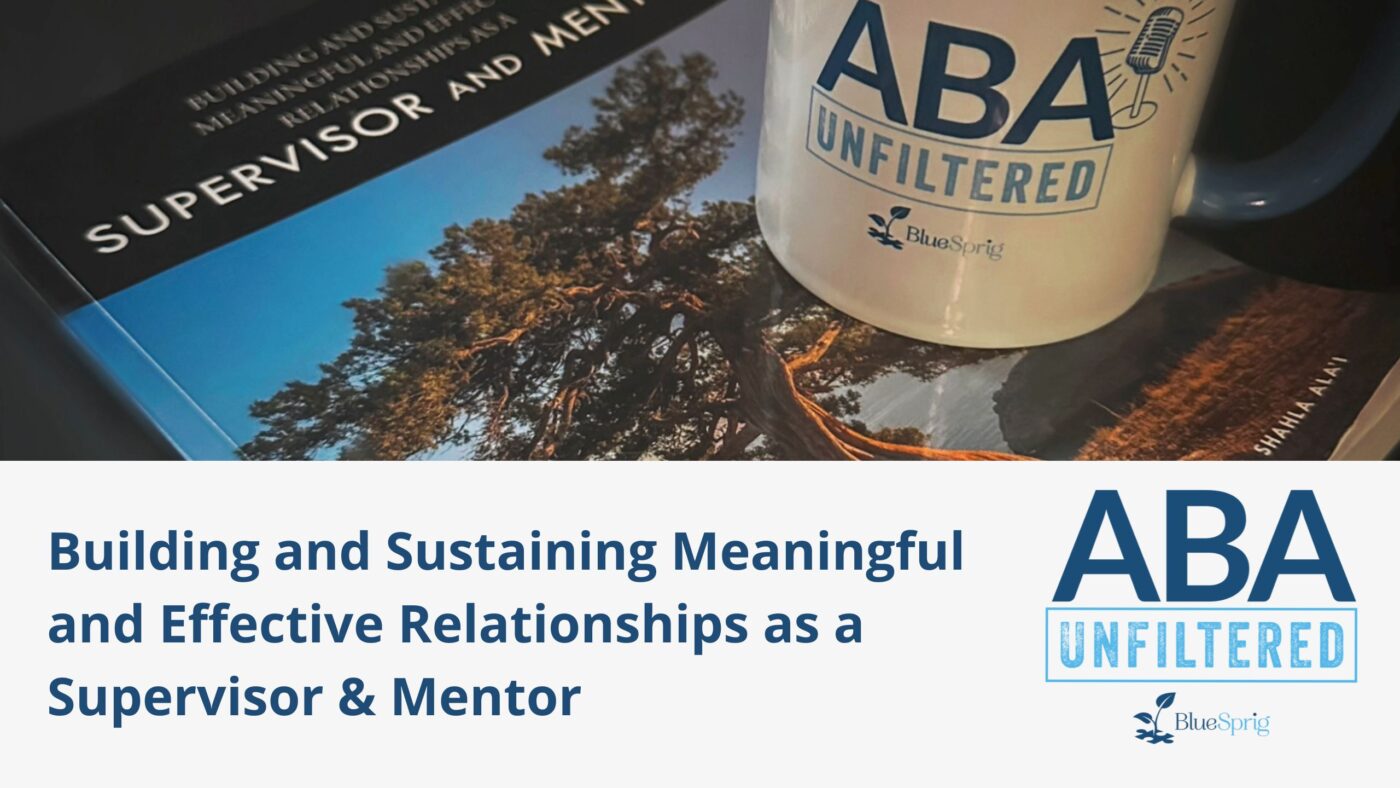
Season 5: Episode 6- Building and Sustaining Meaningful and Effective Relationships as a Supervisor and Mentor

Hosted by Amanda Fullbright, MEd, BCBA, LBA, ANDREW BLOMSTROM, BCBA, Dr. Shahla Ala'i Rosales, LBA, Linda LeBlanc, MEd, Tyra Sellers
March 21, 2024

Listen now:

or listen on your preferred platform:

Episode Description

In episode 6 of Season 5, hosts Amanda & Andrew are joined by Tyra Sellers, Linda LeBlanc, and Shahla Alai-Rosales. Tyra, Linda, and Shahla join the podcast to discuss their book Building and Sustaining Meaningful and Effective Relationships as a Supervisor and Mentor. Come join us to hear valuable tips for building a lasting and effective supervisory relationship.

Full transcript

0:14 Andrew Blomstrom: Hello everyone, this is Andrew Blomstrom, along with Amanda Fullbright, and you are listening to ABA Unfiltered, where each episode we interview guests from around the world of ABA. Whether you’re a BCBA, RBT, or just interested in ABA, you are sure to pick up some actionable advice you can utilize on your journey. Now, without further ado, we would like to welcome our guests, Shahla Ala’i-Rosales, Linda LeBlanc, and Tyra Sellers. Why don’t you start by telling the listeners a little bit about yourself? We’ll go ahead and start with you, Shahla.
0:45 Shahla Ala’i-Rosales: Hi, yeah, um, I’m Shahla, and I am currently an associate professor at the University of North Texas. I uh I’m also the mother of two amazing children and one grandchild, and I live in Denton, Texas.
1:02 Andrew Blomstrom: Very nice. Happy to have you on. Tyra, why don’t you go ahead and introduce yourself?
1:08 Tyra Sellers: Hello, everyone. I’m Tyra Sellers. I am currently the CEO of the Association of Professional Behavior Analysts. I also am the mother of two lovely children. Um, and I live in Colorado.
1:23 Andrew Blomstrom: Very nice. And last but not least, Linda.
1:27 Linda LeBlanc: Hi, everyone, I’m Linda LeBlanc, and I have my own consulting company, LeBlanc Behavioral Consulting. And uh I’m the mother of one lovely child and one lovely multi poop.
1:42 Andrew Blomstrom: Very nice. Well, thank you guys for joining us today. We’re very excited to have you on this episode of the podcast.
1:49 Amanda Fullbright: Yes, thank you so much. I cannot believe we got three incredible uh women, busy women, uh together at one time for this podcast. So we’re we’re incredibly blessed uh to have you guys here. Uh I want to talk a lot about your book today. Uh Building and Sustaining Meaningful and Effective Relationships as a Supervisor and Mentor. Oh, my background here. Uh tell us, who is this book originally written for?
2:20 Tyra Sellers: For me, because I really needed it. Past me baby Tyra, new supervisor from you know 20 years ago. Um honestly, it’s it’s really ultimately has become uh for anyone, but I think when Linda and I first, well, when I first started poking Linda about the idea, it was primarily for newer folks, um, you know, folks that are a little newer to supervision. Um, but then it it it morphed over time, particularly just because the process of writing the book was iterative, and Linda and Shela had so many incredible insights. And I think we never had a meeting that didn’t have about 50, yeah, but or what if, or we need. So, but uh exactly. But I think initially for newer folks, is that right, Linda and Shahla?
3:19 Linda LeBlanc: I think so. And I think um the the process of writing the book with every activity, we did it first. We had some conversation and we began to realize that we were benefiting significantly from writing the book, and um that might mean reading the book could also be beneficial to someone who’s a little more senior to experience differently what they’re doing every day and have a better understanding of why they’re doing it. So I think we began to see it as um maybe at least twofold that you could read this at one point in your career and get value from it, come back five years later and really get a different perspective and value. Come back 10 years later, same thing.
4:21 Shahla Ala’i-Rosales: Yeah, and in fact, I think upon Linda’s encouragement, we did a little bit of that zooming in and out as we were working. Where were we when we first started? Where are we now? What were those transitions like? And also recognizing the field has grown so quickly that everyone out there is at such different places and in different contexts. And and so I think as the book evolved, the feeling was to think deeply about where everyone would like to be, and then how we could help support supervisory practices to get there.
5:02 Amanda Fullbright: I love what you said, Linda, and I totally agree. When this book was, when we first got our hands on it, which was 2020, I believe a couple of colleagues and I had a like a book club around it, and uh the same colleagues and I were chatting about it last week, and we were like, why didn’t we do this? Uh why didn’t we use this piece in this way? And like totally looked at it with a different lens. So I love going back to to all kinds of text and looking at it through a different lens of experience or whatever project you’re working on.
5:33 Linda LeBlanc: I think, and I think we felt like certain chapters were gonna really resonate with people at this level, and other chapters were gonna really resonate with people at a different level, you know, that maybe had more experience. And so it’s like hopefully anyone who reads it is going to benefit from the majority of it. But um, for example, some of the chapter 12 and 13, where it’s looking back at the supervisor you’ve been and you know, nurturing your continued interest in the field for another decade, like that’s gonna really sit differently with people that have been doing this a while.
6:23 Amanda Fullbright: So I’m super curious, what was the process like for three very busy professionals to find time to write a book together?
6:35 Tyra Sellers: Um well, you know, listen, I’m I’m not gonna lie and say it was easy, but I don’t want to give the impression that it was problematic. Certainly there were periods where we struggled to find a common time to meet, but um, I don’t know if you feel differently, Linda and Shahla, but we had a variety throughout the writing process of, you know, email back and forth check-ins, remote meetings, live meetings where you know, Shahla and I committed to going out to stay. I was not living in Colorado at the time. So we both would fly out and stay um in Colorado, and we all would work for several days. And I think having a variety of ways to connect was helpful. Um, and you know, I think we understood how important this content was. Now, there were times I know for me personally when I was like, oh dang, I have to rush to get this draft to whoever I said I was gonna get it to. But um, but it it really came together pretty well. We each sort of had different chapters that we owned, and then we assigned a primary and then a backup, right? So, like a chapter I was writing might go to Shahla first. She would do a deep edit, give me ideas as I was writing it. We would go back and forth. Um, and then Linda would do a review after. So we tried to be really respectful of each other’s time and use our resources well. Is that I could totally be that could just be my perspective. Let’s hear Shahla and Linda Holy.
8:12 Shahla Ala’i-Rosales: It was horrible. No, no, I think that’s great. I I do think one thing, and this is something I’ve appreciated even back in the days before we wrote the book, where we were working on the, you know, the supervision in ethics and helping support people in the field. And that’s one of the places we all first started working together. I think one of the things um that that was important to me in that and in finishing the book was about organization and talking about these things beforehand, having things mapped out. Not that you always follow the map, but but to have a plan and to arrange your environment so you’re more likely to have success. And that’s actually something we talk about a lot in the book, too. Um, and we all know is really important for clinical practice. You know, it’s very hard to be effective in helping support someone’s success if you’re not organized in that process. So, and I really feel like um especially Linda has articulated how to do that really well. Um, and I’ve learned from that. And and I also think that kind of being organized but flexible, which I was so good at, like it’s it’s really, you know, I think sometimes we discount how important a good organization is. Um you know, just think about a chef. If you have all your tools in order, if everything is set up for maximum efficiency, but also to bring out the best in the food, it’s always better. And I think, you know, I feel like that was the process with the book is that we figured out how to bring out the best and and and have fun. Like and and like Tyra said, sometimes there may have been difficulties, but there’s a lot of laughter and some crying. That last chapter is a killer, I think. But um anyway.
10:08 Linda LeBlanc: Yeah, I I agree. And to extend the chef analogy, um, it’s all about the museum plus. You gotta kind of for each chapter, we outlined it. And, you know, we’d get maybe a one-page outline and we might work on that a little bit together and then decide we’re totally changing it or we’re combining two chapters. But long before there was a real narrative text, we bounced the flow of ideas off of each other. And I think it it helped. I typically was like list maker in chief. And then, like, sometimes you don’t do the list or you change the list. And I think that we just all were okay with that and the divide and conquer, you know, each person take a crack at the chapter first. And um I think there was also we just couldn’t always be in the same place at the same time. That was really rare. And so, but we made the most of it when we could. And um, we intentionally would kind of set our hours and we’re gonna be here and we’re gonna work this long, and then we’re gonna go out and eat great food and have fun and have one of those tableside smoking cocktails and you know, just celebrate that we’re getting to do this thing. I think that’s what keeps the energy going.
11:40 Tyra Sellers: And I I do think, I do think for me, the fact that it was way more fun than it ever was anything else, and that I trust Shahla and Linda 100%. So there was no micromanaging or power struggles or anything like that. And that was a really lovely, beautiful thing. Um, and we really truly had so much fun, you know. And I think so many terms got coined during that writing process that I still use. Like, I’m pretty sure that the term beefy outline came from writing with you two, because we I would someone would say, like, I don’t have time to write a draft, but I can get you a beefy outline, which just meant, you know, more than bullet points. Um, but yeah, it it was actually for me, especially as you know, like Shahla and Linda are my mentors. I learned from that. Friend tour. Friend tour also came out of this. Your friend mentor mashup. Friend tour did come out of it. Um, but for me, I I was just so in awe of both of them and lucky to be writing with them. Um, but yeah, I think I don’t know, we did it. Like it’s just everything came together magically.
12:56 Shahla Ala’i-Rosales: I also think it was important that we were busy. We were busy out there supervising people, we were busy out there teaching people about supervision, we were busy out there trying to think about the ethics of supervision, you know, and I think that although we were busy and that meant a whole lot of, you know, juggling and organization and planning how to have fun, um, it also meant that every time we were going through something, we were genuinely thinking about and seeing and playing with how things would be responded to and used, especially during this period. I think um the focus on relationships, I think is something we’ve all in the fields across all of us have been learning so much about. And I think because that was such a big theme throughout the book, we we would write and then go out and and have relationships and think about it and then come back. So um so I think maybe busy was a good thing also that that we have a lot going on.
14:00 Linda LeBlanc: It took two years to write the book, and if it would have been a very different book if it had taken three months, and I don’t think it would have been as rich or good a book, and I know the experience would have been a cruddy one because that’s I don’t know it’s so we spaced it out, um, and you know, uh that notion of relationships being so central. I can remember a conversation we had at some point. This may have even been with our editor, Bill, where he was like, Can we get a shorter title? And we were like, Well, you want to call it supervision and mentorship, don’t you? Except we want to change the narrative to anchor those ideas to relationships.
14:56 Amanda Fullbright: Remember that? I love that you did. I love it, even though it is a mouthful. I have to look back at it.
15:04 Linda LeBlanc: Sometimes I get the whole title. And I now call it the supervisor mentor book.
15:10 Amanda Fullbright: It can have a nickname, it’s okay. Same 100%. Have you guys discussed a second edition with subsequent task lists or changes in the field?
15:23 Linda LeBlanc: You know, in the beginning, we were keeping a beefy outline of uh changes that we would make, and we’ve still got that going. For example, we’ve talked about breaking feedback out as a separate chapter. It’s kind of part of an overall what to teach and how to teach it, but really kind of giving it its own space and breadth. And that’s Tyra’s idea. So she’s gonna be chief architect on that one, and then uh she’ll be primary, and one of us will get the beefy outline. But um we have also, you know, there are several different ideas that someone who’s read the book gave us, like, hey, this would be a really cool idea for an activity. So we try to capture all of those. Um, it’s just hard to get back into a um a big thing like that. And I I none of us had ever written a book before. So none of us have ever done a second edition of a book. So I think we don’t know like, is it 80% easier or 30% easier? So, but I believe at some at some point we’re gonna need to update it because it will we’re gonna have literature and just changed life and circumstances.
17:02 Shahla Ala’i-Rosales: Yeah, what she said. Yeah, everything she said.
17:06 Amanda Fullbright: Great, great. Well, we will look forward to the second edition at some point in time in the future, then. Um so Tyra, I have heard you discuss this this concept of the zombie apocalypse before. And I remember it being so like ear-catching the first time I heard you talk about this. Um, it really stuck with me. So good job on that that term, uh catching people’s attention. Um, and then also in the book you guys write about effective supervision is critical not only to that relationship and that individual, but the overall development of the field. Can you, Tyra, expand on the zombie apocalypse and what can happen if we do not have effective supervision to the development of our field? And and of course, you guys can can chime in as well.
17:54 Tyra Sellers: Yeah, um, sure. So the zombie apocalypse analogy actually came to being in, I don’t know, 2014 or 15. I was working on creating um an eight-hour supervisor training with uh um a student of mine at the time, Bistra Bogoev. Um, shout out to Bistra. Uh, and she came up with this image that was sort of like they were little alien guys. She found the image somewhere online. They were little alien guys, and it was sort of like, you know, um a visual representation of the days since something spread. So it was like just one guy on day one, and then like day 30, there were like 10 and you know, so forth. Um, and because we were talking about the the forward-reaching multiplicative effects of poor supervisory services, in that if I don’t, if I do a poor job, for example, with Shahla, and she’s even my only trainee, just one, but then Shahla goes and has three or four trainees, and then they go have three or four trainees. You just have this ad infinitum domino effect that doesn’t just harm our science, but it hurts clients because most of those trainees are working directly with clients. So we use that image for a while to kind of really drive home because a lot of what you need to do to be a really effective supervisor is more effortful than taking a transactional approach, than armchair supervision, than just showing up and saying, mm-hmm, yeah, and talking about a task beside him and checking things off. And so we thought we needed to somehow create some sort of motivation for why we need to do these things. Um, and then over time the image just morphed a little. I got scared and didn’t, you know, I was like, oh my gosh, copyrights, I better get a different image. And I had a friend of mine who’s an artist make an image, and then another friend of mine who’s an artist make the current images that I use. But um, Linda and Shela always immediately understood what that concept meant in practice. I think if you’ve been in our profession for a little while, you’ve seen that happen. And sometimes we can even like I can trace certain positive and certain negative practices and characteristics in my supervisory repertoires back to certain people, which kind of ties in to doing the mentor tree so that you’re not passive to the influences of your past uh architects, right? Um, but you know, the risks are real, right? The harms are to clients directly, to the perception of our profession, to the application of our science, um, and for us to make sure that we’re being good stewards of the future. Uh and I think Linda and Shahla have their own takes, but are similarly minded when it comes to like this is serious and we have to do a good job.
21:13 Linda LeBlanc: Yeah. And you know what? Yeah, the gravity of it, the weightiness of being a supervisor. I talk about it more as like it’s just not just the meeting on Tuesday. This is a bigger thing and it has far-reaching effects. And um, you know, over time, what happened is something else entered that zombie apocalypse image, and it’s the flip side, and that’s the unicorns. But like when you engage in enough of that effort to really transform how someone else thinks about their clinical work or their supervision, you increase the likelihood that they’re gonna pass that on. well that they now are the exemplar, the model that others can imitate. And then there’s unicorns everywhere.
22:13 Amanda Fullbright: And who doesn’t love a unicorn?
22:16 Shahla Ala’i-Rosales: I love a unicorn. I’ll just add one thing I want to highlight that that Tyra brought up about not being a passive actor and why that tree wasn’t so important. That is like one of the favorite activities that that my students have. And I think part of it is just to step back and look at, you know, what were the influences in your own formation and your own practices, but also to understand it’s always going to be mixed. And yes, we have generational responsibility for what we do, but we can also reflect on what we did with our mentors and supervisors and make choices, make choices that we don’t want to do something or we do want to do something. And I think I think both ways where we are as a supervisor but but where the new supervisee are supervisees are is to make choices about um who’s going to influence them and what they’re going to do with how they’ve been influenced.
23:23 Amanda Fullbright: I love that. I think that’s powerful for us to remember that we all have choice, you know, in what we do next. But but being aware of the past and in our architects as you said. So we talk a lot about the case for why you need effective supervision creating zombies or unicorns, right? But do you guys find yourself with having to talk about the rationale less and can focus on actually how to do it more now? Or are you are you still spending about the same amount of time talking about why it’s important?
24:02 Tyra Sellers: Oh that’s a great question. I I’m interested to hear Linda and Shahla’s take. I think I think other people are doing great work. There’s there’s great survey research out there that you know is in alignment with kind of what we’re talking about. There’s great research around um how caregivers and other stakeholders are perceiving some of the things that we’re doing that are related to our supervisory repertoires, you know being compassionate, being inclusive, being good listeners. So I find less I always still sort of make the point whether or not I’m using the zombie apocalypse and unicorn or I’m just showing data because the data are plenty too and knowing that our rapid increase means that a greater percentage of our certificate population have had their certification for not very long. So I don’t find that I’m having to convince people that this is a need. And I think people are experiencing it. I think people are either they’ve experienced it themselves or they know people that have struggled with you know supervisors who for whatever reason and it’s not always the supervisor’s fault but for whatever reason didn’t provide the best supervision that that probably could have been. So I don’t know. How about you, Shayla and Linda You know I I agree.
25:28 Shahla Ala’i-Rosales: I think the emphasis has shifted a little bit but I do also agree with what you said no matter what when I’m starting out I I like talking about shared purpose. And I think one of the the most important shared reasons for us doing anything is is we want to affect beautiful change now and in the future. And that’s where that generational responsibility when you’re a supervisor comes in. So I think it’s good to like orient to those things and the rationales I think I think it’s adults and and kids I think rationales are really important to include in the teaching process. Especially when the procedures or techniques change if people understand why then they’re more likely to pull on their principles and adapt and be able to pivot change according to the new circumstances. So I think the why is always important.
26:23 Linda LeBlanc: Yeah I would say that I still talk as much about the why and that just maybe my own stereotypy uh that I’ve just have done it and now I’m doing it. But I I’ll say this and I I’ve seen it in my own behavior so much that I’m not special. I should expect to see it in other people’s behavior as well. And that is you can know something like a rationale or a rule and not always behave in accordance with it and feel it as your full experience in any moment. And so I do still always start with the rationale but I do it more to create an MO, a motivating operation for someone to sit with wow I’ve screwed up some and that matters and I’ve also done a great job some and that matters even if we end up with zombies writing unicards you know for me it’s a little bit more about that MO effect to shake people out of the I’m here for my CE and I will make the list of the strategies. I do want them to do that but I want them to kind of step out of autopilot a little bit and I usually use the rationale the danger the do you remember a time when this happened and you didn’t have a supervisor who was there as your safety net I think I use it more that way now than I did in the past make a really good point about you can know but not do.
28:23 Amanda Fullbright: It’s the old saying of say as I do say as I do do as I say not as I do. And I I find that with younger behavior analysts at least in our organization they don’t need any convincing that supervision is important. Figuring out how to teach them to do it in the moment and do it all the time to know it and do it.
28:46 Linda LeBlanc: Well and I find and I certainly experienced this at the time when you’ve just transitioned from being a supervisee and now you’re a supervisor it’s sometimes hard to maintain that shifted perspective like you’re sometimes sitting in your own but I don’t know and I need a supervisor and where’s my dog on safety net and indeed you should have that but but but that little bit of uncertainty and and fear can suck up all the oxygen and leave you a little less capacity to think about what does my person you know I may be new at this but I’m their person. You know it um that’s hard.
29:36 Shahla Ala’i-Rosales: And some of the techniques are very difficult in terms of sort of age variables I remember I had a student that I was supervising and she was uh working with a family and she was implementing something that’s pretty tried and true like you know the baseline’s low they go in and the skills go up and she came in with the data and I looked at it and the skills didn’t go up and I said what happened and and we started unpacking it a little bit and she didn’t model and she told me she felt really uncomfortable because her training um was so close in age and she felt uncomfortable uh saying watch what I’m doing you know let’s see what you think and we’ll talk about it or what whatever you say before you’re modeling. But I think some of the things like feedback and modeling are things you really have to have modeled, especially under difficult circumstances. And I see just out in the field with especially a lot of the newer BCPAs and their supervision, I think sometimes they feel like they’re being rude. And so the the words that come with a really collaborative modeling and feedback and how to do that in ways that um both parties feel comfortable with and both parties feel like it’s helping the child or the youth or whoever they’re working with. But but that that one little moment with her made me realize oh it’s really different when you’re 25 versus 62.
31:13 Tyra Sellers: Like it’s it’s a it’s a different experience to give feedback a model yeah and then imagine that with caregivers even and having a difference.
31:25 Amanda Fullbright: Yes you’re absolutely right Shahla I worked with a behavior analyst once who was who was young but she she looked very young and she bought like fake glasses and like a fake wedding ring and did her hair differently when she was supervising or working with families to like give her this air of of age and respect.
31:49 Linda LeBlanc: And I thought well that’s really sad but also what a puzzle solver you know right clever yeah yeah and you know I think the some of that is for the beholder and some of that is for you you know um yeah you know at different points in my career um being in different circumstances whether it’s okay now I’m a new professor now I’m the director of clinical training I’m supposed to be running this show or you know now I have to walk into a boardroom with investors like I absolutely would think about you know how I’m dressed and uh and and not in a way that they will think is appealing what’s gonna make me feel strong here I come I got Chanel perfume and the cutest shoes you’ve ever seen and I don’t care if you don’t like them. So like part of it is you know um yes maybe you look older and you think they’ll respond to you differently but it’s also how you respond to yourself. And I think it takes you a while to get comfortable and that’s where it sometimes helps to have someone who’s done this a while who’s older to say hey we all do it you figure out what’s going to help you be in a place of comfort because that’s when you’re gonna be more successful.
33:30 Amanda Fullbright: I do have to share that I am wearing my power perfume today Linda do it do it just for this podcast um well let’s shift gears um to talk about culture and supervision I love um to whichever one of you wrote the line about um the best way is to ask and to listen to the best way to understand is to ask and to listen and I think that’s a a great parsimonious approach. And I love the the activities you have in the chapter around this but for some of our readers or listeners rather that maybe haven’t read your book or haven’t read it in a while could you talk about the importance of cultural responsiveness in supervision and maybe give us some actionable things we could we could all do in this area to to do better.
34:23 Linda LeBlanc: We’re gonna defer to you Shahla just like we did throughout the entire writing of the book.
34:29 Shahla Ala’i-Rosales: Shahla’s our ringer well and it’s a learning process in fact you know thinking about the second edition I hope we bring in another person to help us because probably the best advice and one that we’ve all learned is to keep learning um that there’s a lot going on and even I value so much some of the really rich discussions we had about about originally there was going to be another chapter. And then I think in the discussion I I actually can’t always remember who said what but there was like you know what it should it should not be separate. It should be through everything. So we really made an attempt to have um responsivity to to each supervisees and the clients they serve unique context and situation be at the forefront and and I think it comes through the whole book that that that that was a big value that um that we have about the relationships with with the people we work with. And and so I think the biggest take home is you have to be in learning mode. You know and I think through the pandemic it was so beautiful there was so much in social media and there was so much going on in terms of voices rising and voices being heard in our discipline we we went through some pretty big shifts as a discipline um you know kind of from the time that the book came out and and to now and I think I’m happy that we were part of the voices of some of those shifts and and part of that will make me emotional because I feel like we were having some of those hard conversations and we were seeing some of our colleagues who weren’t always seen. And so we were trying to make space in supervisory relationships. Even what we were talking about about the age and you know how you dress, what you do well think about that in terms of culture there’s a whole lot of range of what is considered you know professional not professional in fact there’s a whole dialogue going on about what does it mean to be professional and is it the way you do your hair probably not um so it’s it’s probably about your skills and what you can accomplish in your domain but but especially and I’m sorry Andrew I’m gonna say this but I think especially for people who identify as women there are a lot more rules about and I could be wrong but um there are a lot of rules about our behavior um and I think those are things to think about especially that since there are so many women or people who identify as women in the field. I guess just the last couple things because the one thing is probably the the one chapter where we have kind of a focus that that set the occasion for everything else, it’s a pretty dense chapter. But I think one of the things we tried to do is think cuspily about it. Think about well what are the things that we can focus on that would be generative that would help people continue to be in learning mode and also help them understand where are the spots where you can expect difficulties. And part of it is we experience some of those difficulties ourselves going through but thinking about you know in relationship to time or to spiritual and religious practices um Tyro how you communicate oh my gosh that’s a huge one that one is the biggest challenge for me going forward.
38:14 Linda LeBlanc: But anyway all of that I think there’s so much I I’ll let you guys talk because well you know we Tyra and I had kind of laid out parts of the book and kind of decided we’re gonna do this and pretty quickly like maybe an hour later we said um we need someone with different perspective and knowledge and interest in culture and um shala immediately came to mind because we had been working in you know the area of supervision and mentorship and um and I like as soon as we said that I was kind of like I’m not writing anymore until we until we get a shala like I you know the the feeling of uh this will not be as good if we don’t have that perspective and that voice from someone knowledgeable and that’s not me um really kind of almost stopped us in our tracks, you know, of like we have to pull this together and we have to reach out to someone and we’re gonna learn a lot in doing so and we did um that theme of um in almost any situation a good strategy will be to ask and listen there’s a lot to unpack in there including the notion of humility and assume you’re assuming and then stop that and we all do it’s kind of how we make sense of the world so quickly but it’s also not a fantastic thing to do and it can really hamper your learning and so um I think that theme throughout that whole chapter that’s really impactful to me and I’m pretty sure Shahla wrote that sentence um and the idea of the hot spots that like it’s it’s not gonna not be hot just because you know it’s there but you can probably navigate it without getting burned if you have that awareness and some caution and carefulness and challenge your assumptions and um and and I do think regardless of who you are interacting with if you live in a very culturally diverse city in the US if you live in a rural area those same tenants can still hold true you know we we all are different from each other it’s gets easy for us to assume well we are all X. So we must communicate the same way respond to time the same way but I think that really shifted in my view of the world um as a result of um reading how and talking to Shahla as she was writing that chapter.
41:43 Tyra Sellers: Yeah I uh I remember I remember that conversation Linda when we were talking about the need to to make sure that we were addressing culturally responsive practices um and not only the need to engage in them but the need to train other people to engage in them. And all I remember is us like stopping and saying like this is so important and we are not the right people to get this information out there and it but it needs to be said. And of course Shahla came to mind not only so Shahla you can plug your ears if you don’t want to hear the nice nice but um you know not only because Shahla is just a tour de force when it comes to being collaborative and living that right like leaning into life is a little bit about embracing discomfort because that’s where learning lives that’s where growth lives um and had you know just done incredible work in this area and um also valued supervision but also just Shahla’s ability to say the true things in this loving compassionate way which I frankly don’t I don’t have that fluent the way she does and we knew how important it was for this information to get out there and for people to start talking about it and for it to be presented in a way that would be relatable that people would want to engage with this because it is uncomfortable. And so you know Shali, you have this beautiful way of just like this is going to hurt but it’s good for you and I know that you care and you want to do good. So let’s get through this together. And I think that’s what comes through with that content throughout all of the chapters which uh I think probably is the thing I’m most proud of that the book does make space to talk about that especially for people who have not been given that space well I I actually want to say something um first thank you.
43:58 Shahla Ala’i-Rosales: And I also want to I think Erin Resmussen said this about Mesearch. I think I’ve been so interested in this area because it’s actually terribly hard for me. I I grew up between two very different cultures and then I grew up in a third culture. So I was always moving between these cultures and constantly trying to harmonize. And I still, I won’t use a bad word, but I still mess up. And I still um I don’t feel fluent very often. So it’s very nice of you to say that. But I feel like um well, I just really thank you. Um because it is hard, but I really do feel like the more that we lovingly can be in the hard places, the more progress we’re gonna make. And and that is the one thing in general in supervision, it’s good to convey to your supervisees. Like what you’re doing is so important and it is so freaking hard. And we’re gonna figure it out together. I may only be just a little bit ahead of you, but we’ll figure it out together. Um, and have mercy and forgiveness. I think that’s something, even as a field, we’re learning um to not have it be about canceling people or whispering behind people’s backs, but trying to have the open conversations. And like that’s kind of behavior 101. What we I think we all learned is, you know, it’s about the behavior, not the person. Um, so try to focus on that, but you know, humans move in the other direction. It’s about the person. So so I think we’re all learning that, but it’s a hard learning. And and I think we wanted to convey all that in the book too.
45:47 Amanda Fullbright: Well, I I read your book, not as a brand new behavior analyst, and I still learned a lot. And like I said, reviewing it a couple of weeks ago was like, oh I wish that I had highlighted that the first time around. You know, now I’m gonna come back and do that differently next time. Um, so I just love it and I thank you guys for thank you for writing this book. Yeah. Thank you. Thank you for reading this book. Yeah. Um, so now for the first time uh ever, we wanted to get some questions beforehand from some of our listeners so that they had the opportunity to ask questions too. So we we’ve gone through and selected some. Not sure how much time we have, Andrew, but can can you start by um kicking us off with some of our listener questions?
46:36 Andrew Blomstrom: Of course. Uh before I get to some of the questions, I did want to share with you guys one of the comments we received when we opened this up for feedback uh in relation to your book. And this ties into some of the uh the mentor tree activities that you spoke of earlier in the conversation. Um so the first comment that we received was I absolutely love your book and refer people to it all the time. I am so thankful for all your contributions to the growth and knowledge of our field, and I list all of you on my indirect mentor tree. I loved that activity.
47:09 Unidentified Guest: I love that.
47:12 Andrew Blomstrom: It is definitely making a difference.
47:15 Tyra Sellers: Yeah, and to whoever who whoever took the time to write in such a lovely comment, thank you, and thank you for reflecting and so honored to be a little leaf or a little branch on your tree. Yeah.
47:32 Andrew Blomstrom: So just so you know, your book is making a very much like a very big impact in the in the field. So thank you guys for all that you do. The first question we do have from our audience is um currently, what do you see as the biggest threat or threat to effective mentorship? And what are some of your suggestions to address that?
47:59 Tyra Sellers: That’s a big question.
48:02 Andrew Blomstrom: We’re gonna solve all of the world’s problems.
48:07 Tyra Sellers: Um Leblanc, you got you got it? Yeah. All right.
48:16 Linda LeBlanc: Well, let me let me say this. Um I went through my training a long time ago. Um, and at that time it felt like the structure of graduate programs increased the likelihood that you were going to have an identified mentor. They might be fantastic, maybe not so much, but there you didn’t have to find a mentor. Programs were smaller, they were pretty much all brick and mortar on campus. You were gonna see these people in a lot of different contexts, and you were going to see them outside of class, you were gonna see them in your everyday space and experiences, and catch them in the hallway and all of those things. And so I it’s not necessarily that um the structure dictated that the function would be there, but it probably increased the likelihood and certainly decreased the response effort in finding a mentor. You kind of did it before you went into grad school, honestly, and you were signing up for that person or those people. And I don’t think that there absolutely are still people having that experience in their graduate training, but I think that there are more people that are having other experiences where the structure isn’t there to make it quite so automatic. And so it means that they would really have to engage in a lot of effort to find a mentor. And it can feel like, but how do I do that? Where do I look? How do I make a connection with someone who is more senior who’s gonna really take the time and find it valuable to pour into me in a discretionary way? And I think the fact that there’s so many new ones and so few older, more senior ones kind of compounds that. So that’s two things that I think have changed that make it kind of hard.
50:48 Andrew Blomstrom: Yeah, I could see that making it a lot more difficult to build that rapport and have that effective mentorship relationship.
50:55 Shahla Ala’i-Rosales: And you know, there’s a super clear contingency for a supervisor. You know, to get certified, you need certificate. You need your, you need to supervise, you need supervision hours. You need to, there’s there’s clear rules about what you should do. I think going into the mentor relationship, there’s not as many clear structures about that. And I agree with Linda that things have changed a lot about how people could access. I also think time is an issue. Um I I think you know, with the demands of life and then what you’re doing professionally, having a mentor is a big commitment. It’s it’s a it’s another time commitment. So how to make space for that to see and how to find the person and then how to fit that in, I think is is a set of challenges for particularly young BCBAs right now.
51:49 Tyra Sellers: Yeah. And I think that, I mean, I don’t think we can talk about challenges without talking about the model within which most individuals are likely to be accruing or providing, you know, accruing their fieldwork experience or providing supervision to those accruing fieldwork experience. And that is often in um model with billable hours. And so, yep, there’s time, but then there’s also, you know, what can you do with your time? And I think I have heard people in talks that the three of us have given, um, or anecdotally just chatting with them, or things that I’ve seen in social media and that, you know, people struggle with that, not not everything that we need to be doing fits squarely within what’s available for billable time. And so that’s a struggle, right? Like, and it and it’s one of those things that is so wrapped up in then sometimes feeling guilty or shameful, which then makes you back away from doing the things or asking for support. Um, and so uh I like you asked early on who the first question was who the book was for. Um, and I did say for early folks, I think honestly the most important function of the book is just to get people talking about supervision. You don’t even have to do the things that we recommend, just be purposeful. Um, because it is so difficult if we don’t talk about it, I think we’re likely to fall prey to some of the things that Linda Shahla um and I have just talked about and that people are experiencing. Like it is rough.
53:39 Linda LeBlanc: And there ain’t no CPT code for mentorship.
53:43 Amanda Fullbright: No, not last time I checked. No, we could we could work on that, that’d be cool. Um, but you’re a good question. But you said earlier about you know the supervisor that’s that thinks of like the Tuesday meeting, and and that’s the relationship. You know, that’s not how you can approach mentorship at all. But a lot of our organizations, that’s how the environment’s set up. And you do have to be intentional about it.
54:15 Andrew Blomstrom: Thank you. Another question we have is I find oftentimes BCBAs feel the need to hop in and support with every need a client or staff has, uh, which can lead to a level of prompt dependency for the RBTs, limiting their ability to problem solve independently when the BCBA is not present. What guidance do you have for BCBAs to find that balance between being a supportive mentor and allowing their team some level of autonomy to make decisions in the moment?
54:47 Linda LeBlanc: That’s a good one, too.
54:49 Tyra Sellers: That is a good one. Um, I I think, I mean, I’m not gonna speak for all of us because they will certainly speak for themselves. But one of the things that I think we tried to drive home in the book is you are like you have to be purposeful about your doing for other people. Um, you know, if there’s an emergency, that’s one thing. If they don’t yet have the skill, that’s another thing. But you have to make space for some of that discomfort that it might not be getting done exactly the way you want it, or you know, exactly as quickly as you would ultimately want it, but you’re allowing some um degree of that person figuring it out themselves to the degree that that is safe and ethical, right? There are some things like I’m not gonna sit back and let someone muddle through uh, you know, a functional analysis, right? Like that’s not gonna happen. It has to be purposeful. Um, and it has to be appropriate for that level staff. So with the trainee, as you move through supervision, you should be hopefully backing away more and more of the doing because what they need to develop is that robust problem solving discrimination, you know, uh pro-con analysis. With RBTs only, folks who are just RBTs, you have to be really purposeful because there are some things that they shouldn’t be making decisions about, right? Just because it’s not within their scope. But then there are other things that they absolutely should have some degree of try this report back in a meaningful way, provided that they’re trained enough. So it’s a great question, but it’s a complex question.
56:30 Linda LeBlanc: Yeah. And I think that notion of someone who jumps in and does or helps too much or too quickly, that the way that sentence is structured tells me what the person’s jumping in to do isn’t the right help, or it would not be that sentence never would have been uttered. And I think it can be hard when you um when you shift from I’m observing to I’m doing, right? That’s a big shift. And to bring with you, don’t assume the person who’s now observing knows what they ought to be looking for. That is, don’t just jump in and do, that doing has to be anchored to some teaching. And I think it it took me far too long to really get that. But the, you know, if if you are jumping in to do, you need to substitute the word teach, which means describe, hey, let me show you a blah blah blah. I’m gonna do this, or and then do it and then like, did you notice that? No, what did you see happen so that you wrap the teaching around that effort of doing? But I think that’s a really um, it’s it’s non-intuitive because especially if your focus shifts to I want the client to experience this teaching and it will help them, your focus can narrow a little too much to the getting the thing done and the benefit to the client, kind of stepping off of also the benefit to the person who’s watching. And I think a lot of times we just assume they’re gonna watch and then see how to do it and then be able to do it. But the doing is often really complex. And a lot of the doing is controlled by covert stuff. The why, the why not, the when, the how, the decision points. Um, so I don’t know, I often feel like, and I’ve certainly done it and made other people feel like, well, Linda’s just gonna jump in and do it. And I realized, okay, I’ve been giving answers. I’ve been given fish. Better start teaching to fish. And I can do the same thing plus this wraparound and have a wildly different effect.
59:21 Shahla Ala’i-Rosales: I’ll add one thing that um is an agreement and a little side extension, is sometimes when you see that happening, it can be a class of reactive behavior and that maybe there isn’t either the time or the skills to do what Tyra and Linda were talking about. Um and so it may be that that supervisor needs more support and they’re just putting out fires by jumping in themselves because of a number of other variables. So I think the supervisee’s behavior is like all behavior, is that you have to kind of look and see, well, what is the function of that? Um, it could be that they don’t know that the end game is, you know, be able to do most of this on your own and be awesome at it, you know, but it could also be there’s something more local in the contingencies that needs adjusting. Um but I think the person who asked the question, it was such a good question because it’s one of those flags, you know, there are flags that happen, and it’s people who train supervisors and work with them, you know. Okay, if you see a lot of those flags, figure out what the function is, what’s going on, and then to try to help support them in a better way.
1:00:38 Andrew Blomstrom: Awesome. Thank you. One more from the audience. Um I know I should not give feedback in a sandwich form. However, is this form of feedback really that bad? And if so, why? And what do you think is the best way to give feedback, such as in person or by the way of text message or email?
1:01:03 Tyra Sellers: Can I can I please go first? You may get them. Um talk about that sandwich. Well, listen, and I might have a slightly different perspective than Linda and Shahla, and that’s okay. Um, but I like Linda and Shahla have been in the profession a very long time. I was initially taught always use a sandwich. Then there was the shift, don’t ever use the sandwich. And in fact, it was called the crap sandwich. And it’s a pizza. And then but truthfully, what the research is showing us is it really depends on the person. And I think even though there’s no research for this piece, but listeners, maybe you should do some. Um, it’s really about the quality um of the feedback being given. So, for example, if I said, Andrew, great glasses, you know, you really need to work on your speed of your child delivery. It’s not fast enough. I need you to pick it up and you gotta like you gotta hurry up, right? You gotta make use of your time much better. Um, and I also like your shoes. Nobody wants feedback like that. No one wants that. It’s disingenuous, it’s fake. So don’t teach a formula. But if I said, Andrew, I really appreciate you showing up every day. You’re always so committed, you come in, you get your work done. I do want to talk to you about one thing, and that’s the speed of the trials that you’re um getting in. And let me tell you a little bit about, you know, why there’s risk if we’re going too slow for a learner that needs faster, right? Blah, blah, blah. And then I wrap it up with, you know, I don’t know if it was hard for you to accept that feedback, but I thank you for listening and you asked me great questions. That’s still starting with a positive, crazy, ending with a positive, crazy, and the hard stuff in between. And it’s fine because it’s genuine. I will say that the research is suggesting that some people like positive, corrective, positive. Some people like positive, positive, corrective. Some people don’t even care about the positive. They’re doing fine. I just want to hear about the corrective. So here’s the thing: just ask the person and then be mindful when you’re delivering feedback in terms of its effect. If it’s effective, then you’re probably doing a dang good job and it doesn’t matter so much. And if it’s not effective, then that’s probably on you. And maybe you are given a crap sandwich. I don’t know, but just ask, develop a relationship, ask the person and be genuine and be compassionate. Um, and Shahla threw up a heart for me. Yeah. I’m gonna shut up now, but I love talking about feedback. Um, so the whoever asked this question, I promise, Shahla and Linda, I did not pay that person to ask that question.
1:03:54 Linda LeBlanc: Uh, it’s something that it’s it’s just it’s hard and we all struggle with it. And I will say this the name of the sandwich is the stuff in the middle. A turkey sandwich is about the turkey between the two pieces of bread. And so it’s when we are not paying attention to kindness, but kind directness on the corrective part that it starts feeling like a crap sandwich. And so it’s not so much that you say something positive and um, you know, about the things that they did well on the two ends, that’s fine. Do more of that, make it a triple decker sandwich. If the way that you present the information about the thing that could be better comes across as here’s an idea, here’s why it’s important. There’s gravity to this, but hey, I get it. And we can do this thing, and I bet we’re gonna see this effect. You know, like nothing wrong with a turkey on rye. I like the turkey, I like the rye, but nobody wants a crap sandwich.
1:05:13 Shahla Ala’i-Rosales: This is also one, too, that there’s such big cultural differences about feedback under what conditions, cultural across ethnicities and groups, but also cultural across disciplines. You know, I had early art training, and critiquing and feedback is a whole different ballgame when you’re in a studio. Um, and you wouldn’t want someone to say, well, what do you think? That’s great. You would want to say, What should I do with my pencil so I can get that? You know, like it’s um it’s just very different. And then and then you look across different cultural groups, what different types of feedback means lands in really different places. So I I think to circle back to what Tyres had asked. And one thing in some of my trainings that I do is actually look at different types of feedback and watch them and say, well, what do you think about that? How do you feel about that kind of feedback or what’s happening? And especially across cultures, you’ll see really different things. There are actually lots of little TikToks about this between cultures. You know, this is what such and such moms do, this is what such and such moms do. I’m sure you’ve seen them. A lot of them are about feedback. So I love the just ask. And I think videos are really helpful for that, where it’s not actually you giving feedback or them getting it or giving it, but it’s other people. So it’s a little bit detached to be able to have a conversation and back to the effectiveness. I just want to sing the choir on that one. If it works and there’s happiness and comfort with your supervisee, then it’s the good one to use.
1:06:55 Tyra Sellers: Yes, Shahla. And works means that it both produces the change that you want and it felt okay to the recipient. Yeah. It’s not it works because you got the behavior change. No, I can get behavior change being a cruel, crusty person, and that is not okay. That is never okay. So you’re right, Shahla. The the key the key components of knowing that it’s effective is that you got the change and it also is socially acceptable. Y’all, that’s about our science.
1:07:29 Shahla Ala’i-Rosales: Which is hard, especially between cultures, because socially acceptable in one context is really unacceptable in another one. This is one of the areas where I have the most struggle actually to keep recalibrating for different people who are very different than myself.
1:07:48 Andrew Blomstrom: Yeah, I think if all of you have uh hinted at this, but the the number one thing that I’ve noticed is that people struggle with the fact that there is not a one size fits all or one, this is the answer to your feedback question. It really is situational or person by person, depending on how they like feedback, which I think is difficult for a lot of our new supervisors to kind of wrap their head around.
1:08:13 Amanda Fullbright: We all want the rule book. We all want the recipe, right? Wouldn’t that be easier? But step one. Yes, right. Andrew, are we ready for questions of the week?
1:08:24 Andrew Blomstrom: We are ready for questions of the week. So we like to end our uh episodes with three questions to our guests. Uh two of them are preset, the same questions for all of our guests. And then we will uh break out the wheel of chance and uh we’ll see what the third question is for our group. But first, um I would like to ask all of you about um, if you could tell us something that you’ve learned lately.
1:08:50 Amanda Fullbright: Or that you’re learning about lately.
1:08:53 Andrew Blomstrom: We are obviously part of the learning and performance development team, so we are always interested to hear what everyone is learning.
1:09:02 Tyra Sellers: That’s such a good question. Lyndon, you look like you have something at the ready.
1:09:07 Linda LeBlanc: Well, I always learn very slowly to speak French, and it’s hard to learn another language as an adult. And so I’m not only I’m learning a little bit of French and a lot of humility.
1:09:25 Andrew Blomstrom: Very nice.
1:09:26 Linda LeBlanc: Linda, are you using Duolingo? I use Duolingo every day, and I less frequently use Rosetta Stone just mostly because it’s on my computer and like I do so much at the computer, I want to get away from that. So, yes, I use Duolingo, and then I try my best when I can to find a buddy that will um tolerate my broken French and uh talk with me.
1:09:54 Amanda Fullbright: That’s awesome. My family and I are learning Spanish on Duolingo. Yes, got a street going. So yes, that little owl is happy with me.
1:10:07 Tyra Sellers: How about you, Shahla? What are you learning?
1:10:10 Shahla Ala’i-Rosales: Oh I think I’m learning two really hard things, to be honest. Um one of them is um you know when when your people start to pass and how to think about mortality and sickness. And I I have some very close friends who have had some they’re they’re um they’re having a lot of health problems that have turned out to be very serious. And um so I’m learning and thinking about that a lot, like what what what you do towards the end of your life and how you read that passage. Um I think just in general, learning about getting older um and aging in our society and when your body starts changing. So I’ve been reading some things and meditating about those things. It’s kind of somber. I don’t I’m sorry to leave in that space, but that’s that’s the big thing. I’m also taking some watercolor classes, so that’s good.
1:11:14 Tyra Sellers: Um, what am I learning? I am learning um, well, I’m reading a beautiful book um called uh Heal Your Way Forward by Myesha T. Hill. So I’m learning more about cultural humility and culturally responsive practices and um continuing to learn to put myself in contact with people that will help shape my behavior in a way that’s in alignment with my values. That’s it means making mistakes, but if you’re with compassionate people with better skills than you, then they forgive you those mistakes.
1:11:59 Andrew Blomstrom: Okay to make those mistakes, yeah.
1:12:00 Tyra Sellers: Yeah, sometimes they invite you to make them. Um, so yeah, that’s I think that’s um what I’m learning.
1:12:07 Andrew Blomstrom: I mean one biggest learning. Thank you guys for sharing.
1:12:13 Amanda Fullbright: Beautiful, beautiful, thank you.
1:12:16 Andrew Blomstrom: So, next question. Let’s say you guys found yourself with an extra hour today. So instead of 24 hours today, you’ve got 25. How are you spending that extra hour?
1:12:33 Shahla Ala’i-Rosales: I would go for a walk in the sunshine. It’s it’s so beautiful out there, and it hasn’t been. And um, I find that really feeds my soul and my thinking, and I would probably walk with my friend spend an hour outside.
1:12:48 Andrew Blomstrom: Recharge the battery.
1:12:50 Linda LeBlanc: Yeah, I love that. I’m in Denver and I would not spend it walking outside because there’s a lot of snow. I’m about to head to Texas where Shahla is, and if I were there, I would, but I would spend it reaching out to stay in touch with people. Uh that is something I have not always been uh very good at. And um about five years ago, I made a personal commitment to FaceTime, call, text, just reach out more regularly um to people that I care about. And um uh so that’s probably what I would use it for because I’m still always behind where I want to be on that. And um, but every time I do it, it’s so reinforcing.
1:13:42 Tyra Sellers: Yeah, that’s nice. Both of those answers. Um, Amanda and Andrew, you want me, do you want me to be honest?
1:13:50 Andrew Blomstrom: Sure, yes.
1:13:51 Tyra Sellers: Okay, because what I want to say is I would use it, you know, FaceTime me with my son who’s away at college, or I would go for a walk, or I would, you know, whatever. I’ll be really honest. Today I would use it getting more work done because I’m just behind. I’ve a lot on my plate, I’ve got a lot of people counting on me. I have a little bit of a uh guilt complex. So if we’re being honest, um, I would use it to do more work. And I don’t love that answer, but but that’s the truthful one.
1:14:25 Andrew Blomstrom: It’s the honest answer.
1:14:27 Tyra Sellers: And your work is so important, yeah.
1:14:30 Shahla Ala’i-Rosales: Yeah, it’s it’s good work that’ll make the world better.
1:14:33 Linda LeBlanc: So maybe one of my reach outs would be to you, Tyra. And I’d say, like, okay, stop working for five minutes because I’m gonna tell you about unicorns.
1:14:42 Tyra Sellers: It’d probably be, it probably would.
1:14:45 Andrew Blomstrom: Very nice. Thank you guys. And are you guys ready for the wild card uh question?
1:14:52 Linda LeBlanc: Wheel, wheel, spin the wheel.
1:14:55 Andrew Blomstrom: And uh, Tyra, I will let you choose the question. So, what I’m gonna do is I’m going to uh share my screen here.
1:15:06 Tyra Sellers: This is so exciting.
1:15:08 Amanda Fullbright: Yeah, I love that Andrew entertained my idea. I was like, could you find a wheel, please? I want a real wheel, I want the sound, and then it’s gonna stop on a number.
1:15:18 Andrew Blomstrom: So I’m gonna in a second here, I’m going to go ahead and share my screen. And um, can you guys see my screen? Oh so in a second, I’m gonna go ahead and hit the play button. And then whenever you’re ready, just go ahead and tell me to stop. And when I stop, it’ll stop on one of the 12 numbers on our screen. And I have a list of questions in front of me, uh, one through 12. And whatever number it lands on will be the third question that we ask the group. Um, so Tyra, are you ready to decide which question everyone is going to answer?
1:15:54 Tyra Sellers: Sure.
1:15:55 Andrew Blomstrom: All right, so I’m gonna go ahead and play, and then whenever you’re ready, just tell me to stop.
1:15:59 Tyra Sellers: Okay. All right, big money, big money.
1:16:01 Andrew Blomstrom: Big money.
1:16:08 Tyra Sellers: Stop.
1:16:10 Andrew Blomstrom: So we’ve got number two. So question number two, what is your favorite travel destination, or what is your dream location to travel to?
1:16:24 Linda LeBlanc: Paris.
1:16:30 Andrew Blomstrom: It would be lovely.
1:16:33 Shahla Ala’i-Rosales: Whenever my kids play these games, I can’t do them. It’s like can I have my top three?
1:16:40 Tyra Sellers: Like, do we have an hour to talk about this?
1:16:44 Linda LeBlanc: You just break those rules. You say three. What are they gonna do? Erase you? Just say them.
1:16:51 Amanda Fullbright: There all are no rules. It’s all made up. Do whatever you want, Shahla.
1:16:56 Shahla Ala’i-Rosales: Well, I love Greece in Italy, partly because the Greece in Italy, and also because there’s so many people I love dearly there. Um, I really if it was safe and good, I would like to see Iran one day because that’s where my family is from, but it’s it’s not a place I can go right now. And I really want to go to Israel one day. So those that was like four, I think. Oh, and Brazil and Haiti. Okay, can I change my answer? I want to give five now. I’ve got a map where my granddaughter and I have pushpins all over the world of everywhere we want to go someday. So that was too hard of a question. So hand it over to Linda, Tyra.
1:17:46 Tyra Sellers: Everywhere, yeah. I don’t I mean, of the places I’ve been, I’ve I’ve been really, really blessed and lucky to go to some incredible places. And I I honestly can’t pick one. I will say I I’ve gone back to France, Paris many times, and I do love it. Uh, but it’s so hard to pick because especially the people are so important. For example, um, I spent time in Russia and in India, and just uh like incredible, and my heart is still there. I really would go anywhere. Like, I don’t I don’t have like a like a necessarily a hierarchy. Um, so if anybody wants to travel, hit me up and let’s go. As long as there’s not a war somewhere, I’m I’m ready to go.
1:18:32 Andrew Blomstrom: ABA unfiltered world tour.
1:18:34 Linda LeBlanc: Yes, ditto, I’ll do it. Yes. I think that traveling the globe changes your perspective, what you observe, how you think about the way things are. And uh so I I love to do it and um kind of reaching the point in my life where I’m making a purpose to do some international travel every year.
1:19:02 Andrew Blomstrom: Very nice.
1:19:04 Amanda Fullbright: Well, thank you so much for playing Question of the Week with us, in addition to talking about your fantastic book. We really appreciate your time. And and again, thank you for writing this book. This is like so impactful, you know, to my career and to to many, many others. So appreciate you three so much.
1:19:24 Andrew Blomstrom: Thank you so much, guys.
1:19:26 Unidentified Guest: Thank you.
1:19:26 Amanda Fullbright: Thanks so much for having us. Yeah, this was fun. This was very fun. We hope to see you around conferences this year and uh get to say hi in person as well. So thank you. A P B A, A P B A March Andrew, the folks that um sent in their questions. Yes, yes, great questions, great questions. Oh well, this has been great, guys. I hope you guys have just a fantastic weekend as well. So, and and good luck with your temporary move, Linda. Your travel to Texas. Here I come, Shalom.
1:19:59 Andrew Blomstrom: If you or someone you know is looking for some CEUs, head over to https://bcbaceu.bluesprigautism.com/ and use the promo code podcast to get five dollars off any CEU in the catalog. A link to the site can be found below in the description. Thanks again for tuning in, and we’ll see you next time.

Find a center near you.