Back
ABA Careers

Season 4: Episode 5 – Clinical Roundtable

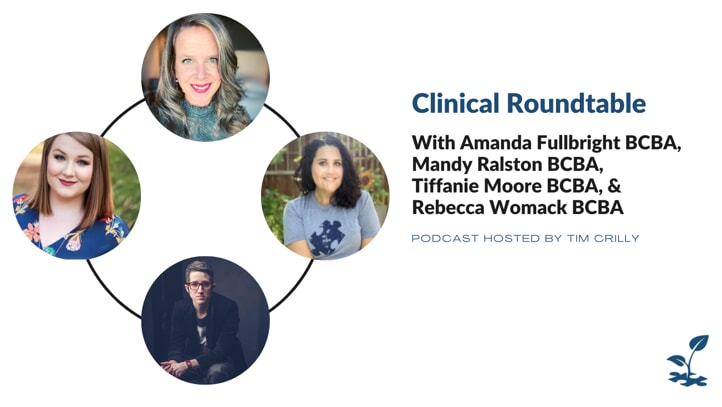
Hosted by Amanda Fullbright, MEd, BCBA, LBA, BCBA, LBA, Mandy Ralston, MEd, Rebecca Womack BCBA, Tiffanie Moore BCBA
March 21, 2024

Listen now:

or listen on your preferred platform:

Episode Description

Tim is joined by a panel of BlueSprig clinical leaders to discuss their upcoming presentations at this year’s CASP conference being held in Portland, Oregon on May 2-3rd. This unique episode offers fantastic insight into the clinical leadership at BlueSprig as well as a glimpse into the many presentations we are set to deliver.

Full transcript

0:13 Tim Crilly: Hello, and welcome back to another episode of ABA Unfiltered. We’re doing a little bit of a special version at the halfway point in the season. This is episode five, I believe. Episode five, take two. But here we are, it’s episode five. And we have a group of some returning champions, as well as uh Tiffanie Moore, who’s new to the new to the program, to come on and talk about um the upcoming CASP conference. I know it’s a little bit away, but you know how those things go. It it comes up at you pretty fast. So we thought it’d be a good idea to share a little bit about what Blue Sprig and the Cedar group will be doing at this year’s um event, just to kind of give our audience a little bit of a taste of what might be available to you when you go up there and hopefully get folks to start registering as the clock ticks away. So we’re gonna do a little bit of a round table discussion about our presentations and sort of talk to each other about the process, who we’re who we’re working with, what we’re presenting on, and those sorts of things. So I’m joined by um Amanda Fullbright, Tiffanie Moore, the aforementioned, Rebecca Womack, who you just had a pleasant conversation with last week, uh, and Mandy Ralston, who I think this might be her third or fourth time on on the on the show. So um some familiar voices and a new friend Tiffanie. So ladies, welcome.
1:44 Amanda Fullbright: Thanks, Tim.
1:46 Tim Crilly: Okay. So Rebecca, for the sake of time, uh you have the most presentation. So let’s let’s just start there. Um and I know you have a little bit more of an inside baseball relationship with CASP. So maybe if you don’t mind, give give folks a little bit of background information about what exactly CASP is, in case they don’t know at this point.
2:12 Rebecca Womack: Sure. So CAS stands for the Council of Autism Service Providers, and it’s a nonprofit organization for organizations who provide services for um ABA services for people with autism or autistics. And so what’s really cool about CAS, they um have a way of getting people across the country together to feel really connected and to create different kinds of opportunities to talk about things that go well within their organization, things that people might be struggling with. And it’s just a great way to learn from other people and also um understand what’s happening within the healthcare industry.
2:54 Tim Crilly: Thank you, Rebecca. You know, and I think the thing about CASP is, you know, over the years we’ve really seen it grow and it’s become a real uh a real focal point in this community. So I know Blue Springs involvement in it has also grown over time. Um and it’s really been interesting to see some of the things that they’ve been putting out uh when it comes to standards and maybe a future accreditation process. So they’ve been up to a lot of great things. So we’re really excited to be a part of it. So um, why don’t you just give us a little rundown of those presentations that you will be involved in?
3:28 Rebecca Womack: Sure. So two of the presentations focus on the topic of documentation from different angles. Uh so one of the presentations will be about just documentation topics in general that uh organizations might struggle with. And the ideas for the attendees to have takeaways of what they can do um differently or better to support effective documentation. In the other um presentations, one will be about just some issues related to TRICARE and some maybe challenges with um implementing the benefits and solutions at the same time because you always want to be solution focused. And then I’m also glad to collaborate on a panel that will discuss how to handle crisis crises from the perspective of a payer and other practitioners, and then as well as a BCBA and what that looks like for an organization who uh maybe needs to improve their processes uh to help their families.
4:30 Tim Crilly: What do you mean by crises? Like the family is in crisis? Yeah.
4:34 Rebecca Womack: Yes. Yep, if the if the child um or the client receiving services has a crisis and that crisis is defined as however the family wants to define it, what do they do when that crisis is happening until they can get some stable care, whether it’s um inpatient or outpatient care? Like how do they navigate those next steps?
4:57 Tim Crilly: Now who is who’s on that panel with you?
5:00 Rebecca Womack: So that will include um Dr. Darren Sush from um Evernorth, I believe it’s called now, and then Dr. Michael Cummings and his partner Janelle Van Cleave, and um and then myself. And so it’ll be good because everybody will be able to talk about from their perspective areas of importance when it comes to addressing a crisis and what that looks like for each of the different people represented.
5:29 Tim Crilly: Yeah, it’s interesting. I think Darren’s a good, good uh candidate for that role. I think he’s you know he’s really um really knows the insurance side of stuff. So that’ll be interesting to hear his perspective on you know that that payer uh role in that process. Um okay. I that sounds a lot more interesting than the documentation one, but I know documentation is very, I know it’s very, very important. So um, you know, I think that’s something that that’s that needs to be talked about and and um and looked at. So I do appreciate you know you you doing some heavy lifting on on that subject as well. Is that by yourself?
6:06 Rebecca Womack: So yeah, one of them will be so I was grateful to be the primary content writer for the documentation chapter in the CASP organizational guidelines. And uh so I’m thankful for CAS giving me the opportunity to highlight some of the really important points in that chapter and um what it means, implications for our field now and going forward.
6:29 Tim Crilly: You know, and when you were on the show last episode, this was sort of like a adjacent topic that we talked about. So, you know, sort of that clinical standards and making sure that everything’s you know right where it should be. Tiffanie’s nodding in agreement um that you can’t see at home, but it’s true. Uh so I think it you’re the you’re the right, right person for that that topic. So I think you know, Casp is lucky to have your your involvement. Obviously, you’re gonna be very busy and hopefully get a lot of like hot water with some some lemon in it by the by the end of those those those two days because you’re gonna be doing a lot of talking.
7:02 Rebecca Womack: Thanks. Appreciate that. I’m like, I’m excited to um to see everybody again and to learn from other panelists and curious to find out what my colleagues at Bluesbury are presenting on as well. Um I know we’ve got some great minds here.
7:18 Tim Crilly: With that, who who wants to who wants to jump in here? Tiffanie, you’re the newbie. Why don’t you go next?
7:24 Tiffanie Moore: Okay. So my first jobs were actually in a school setting, uh both public and private. So I’m going to be presenting about bringing some of the interventions that work really well in the classroom setting into the center. Um I think that a lot of our clinicians don’t have a ton of exposure to those types of interventions that allow our clients to be successful whenever we’re trying to transition them back into a less restrictive setting. So hoping that there will be some value in the topic.
7:59 Tim Crilly: Now, are you doing this solo?
8:02 Tiffanie Moore: I am doing it solo, yeah. Okay.
8:04 Tim Crilly: Now, how nervous does that make you?
8:08 Tiffanie Moore: Uh, probably like a four on a scale. I’m okay with it, yeah.
8:12 Tim Crilly: Okay. Because sometimes by yourself is easier, and sometimes with other people is easier. I, you know, I don’t really know. Um, I like being more, I’m more of a panel, panel guy myself, but uh no one seems to ask me to do those things anymore. It’s been it’s been a few years, so I don’t know if that’s about in nudge nudge. Okay, so school-based services and and how we can bring those into the into the real world or sort of school-based supports and then how they they can translate into the everyday therapy that that we we do.
8:42 Tiffanie Moore: Yeah, yeah. So whenever I started working in the school system, I was like, I’m gonna change the world with all these great ABA interventions, and it was just way too hard. Like the interventions I was bringing to the table, the teachers were like, absolutely not, we’re not able to do that.
8:58 Tim Crilly: Sounds great, but yeah.
9:00 Tiffanie Moore: So I had to learn really quickly how to adapt and how to utilize really simple interventions that a teacher can do in a classroom full of 25 to 30 children, right? So I want ABA providers to be able to utilize similar interventions because that’s what teachers need when it’s time for that transition to occur. They won’t be able to implement some of the things that we’re doing in the center. But if we set the stage and give them a foundation of just easy to follow, materials-ready interventions, then uh our clients will be much more successful.
9:36 Tim Crilly: Yeah, it’s a it’s a great point. Feel free to jump in at any point, folks. Um, but I think you know, just looking at thinking about approaching the parent and working with the parent, you could come in and say, this is the best possible way to tackle this issue. But if that parent says, like, no, I can’t do it, like that’s that’s too much for me, then it’s not the best possible. And you have to move on to that that next ball might be a slower process, it’ll actually be faster because they might have more involvement in putting it into place. So I think that’s a sort of a correlation there that I’m I’m picking up on.
10:10 Amanda Fullbright: Tiffanie, are these uh interventions that you might have uh RBT work on during the during the day at a center or an in-home session?
10:20 Tiffanie Moore: Yeah, definitely. Uh, and I think that that’s a huge benefit of being able to introduce the interventions in the center prior to the school because they still, even though simple, involve a lot of rules for the individual to learn and and kind of get the hang of the intervention before they really start to see the value as well. And the intervention becomes fun, and they’re typically looking forward to like points earned at the end of the day or choosing something out of the treasure chest. And so if we can get the intervention to be super motivating in the center, then it’s going to just be a seamless transition in the classroom. The teacher will have more buy-in. So, yes, that’s definitely the idea, though, is that an RBT would be able to easily implement, teach, and get success with the intervention before we teach it to um uh a classroom provider.
11:15 Amanda Fullbright: That’s awesome. I was at my son’s open house last night and what you know, touring the school and and seeing the different classroom like management things and and reinforcement strategies that they have. Like these guys are so creative, and the kids really seem to like it, you know. So that’s really cool.
11:35 Tim Crilly: It’s true. Teachers do, you know, because they’re they’re the sometimes they’re put in a pressure cooker that forces them to come up with, you know, concepts. And you know, the funny thing is like, okay, if we do this, we’re gonna get the pizza party or whatever. And every kid thinks they actually earned it, even though it was like feta completely, like they were definitely getting that pizza party, but the teachers just been manipulating them and they magically get the beans, you know, whatever they were working towards at the last minute. So, you know, it’s genius, but you don’t know it when you’re eight.
12:03 Amanda Fullbright: Yeah, and Tim, you were a teacher, yeah.
12:06 Tim Crilly: Oh, no, that’s we don’t talk, we don’t talk about that. Those are the dark days, but yeah, I was. Um yeah, I taught I taught um kindergarten for one year, which ended up being my undoing. Um, and uh first grade for two.
12:26 Tiffanie Moore: That isn’t me.
12:27 Tim Crilly: It wasn’t wasn’t wasn’t my calling. I thought it was, it just wasn’t. Um it turns out I had a you know, there was an undiagnosed um guy in my my kindergarten classroom that I want to hear from the kids. Well they’re probably all in jail now. I mean, you know, because of that one weird kindergarten that set them set them on a course for for we’ve got to find these kids, they’ve got some stories.
12:51 Mandy Ralston: Talk about a podcast. That’s a podcast.
12:54 Tim Crilly: Well, they were they were five, so I don’t know how much they’d remember, and it was 18 years ago. I mean, they’re probably in their 20s, so um so yeah, but yeah, it was not it was not for me, but I did I did learn a lot about um the lack of management. Um, I was always a little bit better with the one-on-one or a very small group. You put you put the 20 plus in front of me and it it it all unraveled pretty fast, you know, and they could smell blood in the water, it was pretty bad. Yeah, it’s basically like yeah, it’s like uh um you know, uh just the the inmates running the asylum basically by by April. It was it was I knew it was time to go. And you know, it’s funny because then I I fell into the ABA world, and that June after I left teaching, I I met Dr. Kerr on day one um at a school in Tustin, California, and the rest is history. So, but yes, I I did start as a teacher. So thank you, Amanda, for dredging that up. And now I have to go have some therapy sessions later this afternoon.
13:59 Amanda Fullbright: Blame it on me.
14:00 Tim Crilly: Yeah, so here’s the real conundrum we all face. Um, Amanda and Tiffanie are presenting simultaneously. So I think now we should have Amanda present what what she’s gonna be working on so people can gauge who who they’d like to choose, because you’re gonna have to choose.
14:20 Amanda Fullbright: Oh goodness. All right, well, yeah, thanks for that, Tim. Uh hate to compete with my I didn’t make the schedule.
14:28 Tim Crilly: Maybe Rebecca, maybe Rebecca can make some calls or something.
14:32 Amanda Fullbright: Yeah, let’s make some calls. Um, because I actually really want to see your presentation, Tiffanie. So um, so I am presenting with Dr. April Foreman and Rachel Hochfeld, who are both on the learning and performance development team here at Please Brig with me. And we are presenting on creating a culture of continuous learning through our internship and supervisor training programs. That sounds amazing. And I was waiting for follow-up questions.
15:06 Tim Crilly: Oh, okay. Well, I’ll let I’ll let the the the panelists ask some questions. I have a Becca says it sounds amazing, so go for it, Becca.
15:16 Rebecca Womack: It does. So how I don’t know if you guys you addressed this in your presentation, but how do you know if learning has occurred? Like as an organization, like you put all the effort into the training and the training is done, but how do you know if it’s accomplished its job?
15:36 Amanda Fullbright: Yeah, I mean, just like anything else that you’re you’re trying to do in an organization, you set your goals and what you’re going to measure uh you know, as as you’re creating the program. Um, inevitably with with our team, we always uh something kind of pops up and it’s it’s interesting to us, and we might dig in a little deeper. Um, but you you’ve set those goals um in the beginning. So with our internship, you know, we measure we measure a few things with that. And uh, you know, an easy one to measure is do they pass the BCBA exam? And on what attempt? That’s that’s really easy to measure. But then we also are looking at how if are we hiring them as clinical supervisors? And if we’re hiring them as clinical supervisors, uh, you know, how well are they prepared for that position when they start? And then we also are looking at how long do they stay with us, and then you know, there’s some other measures from their time as being a clinical supervisor that we can look at and kind of correlate back to that internship program because we have a number of clinical supervisors that weren’t in our internship program, and it’s kind of a cool to compare the two groups.
16:50 Rebecca Womack: That makes sense. I mean, it does, and I think that causes me to think of a follow-up question to that then. So those are indicators of when things go well, and so you’re you can be confident in the program that you’ve developed. But how do you know if it’s not going well? So you do the training, and then what do you do to see if you need to make changes in the program?
17:13 Amanda Fullbright: Yeah, so along the way, we don’t want to wait until they are you know taking their tests and using that as the only measure. It’s an outcome measure, but we have different measures along the way. And so our internship program is structured in a way that there are these um stop gaps throughout the program, to where we um we are working with their um center director, their um director of clinical services to evaluate their progress in the program and the learning in their program. And how are they doing? And and for us in that program, it’s not just about the interns’ um skills that they’re building, but also that center director’s skills supervising that intern. So the more we can pour into that center director, um, who is the responsible supervisor, kind of the more bang for our buck we get, we get a higher return on investment if we’re targeting the dyad, if you will, at the same time. Because then the next time that responsible supervisor has an intern, then uh they’re more and better equipped to to be able to support and supervise that that intern. So we’re looking at that um several times throughout that internship program, which is 2,000 hours of uh field work experience. I think that’s a really sorry Rebecca.
18:36 Tim Crilly: For those of you at home uh with your ABA unfiltered bingo card, if you had dyad, you’re you just scored.
18:45 Rebecca Womack: Oh my goodness. I so that made me that’s really a good um way to demonstrate stewardship over work, you know, that you um you work really hard and put your energy into something, but then you also have a plan to ensure its success. So I think that’s a beautiful um example. And speaking of the internship program, what is the pass rate? Do you mind sharing a little bit of information about that for the BCBAs who go through it at Blue Spray?
19:12 Amanda Fullbright: Yeah, so our pass rate in 2020 was 90%. Our pass rate in 2021 was 86%, I believe. Um, and the the national averages haven’t come out for 2021, but for 2022, I believe it was 68% pass rate. So we’re um quite a bit above the average, which is where I always want to be. Um, but what I think is um really cool about the internship program is the number of interns that we have, you know, helped to become BCBAs. And um, I believe let me let me check my number real quick. I should have had this ready.
19:53 Tim Crilly: Yeah, real time, real time data search here. This is this is riveting.
19:58 Amanda Fullbright: Riveting stuff, y’all.
20:01 Tiffanie Moore: While you’re searching, I just want to say I don’t want to sell myself short, but I cast my vote for your presentation because the internship program has just been such an incredible program for our organization. And so everyone would be so lucky to get to hear about it, truly. Absolutely such great work.
20:24 Tim Crilly: Yeah, but all the interns should go to your presentation to learn about and then go look at the documentation stuff that that that Womac’s doing, and then I’m sure whatever you know uh top the two topics Mandy have will also resonate for interns as well. But I don’t think there’ll be too many interns in CASP, unfortunately.
20:42 Amanda Fullbright: Yeah, so in 20, thank you, Tiffanie. Thank you so much for that. Um in 2021, we had 46 people become BCBAs out of our internship program. So pretty amazing stuff.
20:53 Tim Crilly: That’s a lot. That’s a lot.
20:55 Amanda Fullbright: Awesome, so impressive.
20:56 Tim Crilly: Yeah, it’s pretty cool. Um thank you, um, Amanda. I I’ll just go to neither. I’ll just just to to not make anybody feel bad.
21:05 Amanda Fullbright: I’ll just silent protest.
21:06 Tim Crilly: Yeah, I’ll just boycott, I’ll just boycott in the hallway or something.
21:09 Amanda Fullbright: Yeah.
21:10 Tim Crilly: Or do you get CEUs for either one?
21:12 Amanda Fullbright: Yeah, both definitely, probably Divinecia.
21:16 Tim Crilly: Okay, well, I’ll double check on that. I’ll go to that one. Um okay. Um Mandy, Mandy Ralston. Um for those of you who have heard Mandy, she’s uh part of the Bluesprink uh family over at the Cedar Group. And we, you know, we’ve had a couple conversations about the great work you guys are doing. So I’m really excited that you guys get an opportunity to share that a little bit, especially at a place like CASP, where you have a lot of senior clinical leadership gathered in in one place, as opposed to you know, some of the bigger conferences where it’s BCBAs just sort of running around trying to get CUs and you know, and they’re not necessarily uh people in a position that can can make decisions about the the future. direction of their organizations and sort of around the tools that that you guys are working on. So um give us a little um insight into what what you’re you’re you’re presenting on and then who you’re presenting with.
22:14 Mandy Ralston: Well I’ve got a couple of presentations that I’ll be doing. For the Cedar group we’re going to be talking about uh quality of life and outcome measures and how decision models uh that we are making over at the Cedar group could help illuminate that path forward. But we’ve we’ve put a little spin on it we’ve decided to package it in a relational frame as a pop music song. So hopefully it takes uh some of the more boring elements out of talking about uh some of these repeated issues that keep coming back up in the industry. So hopefully it’s gonna be a little more fun.
22:49 Tim Crilly: And who who is this we?
22:51 Mandy Ralston: Michelle Brennan Cook and myself. So uh our executive uh vice president of quality uh so I think Michelle and I both have the gift for Gab so uh I think it’ll probably be fairly entertaining to watch us run our mouths for an hour.
23:05 Tim Crilly: Uh I I had the the great fortune of sitting on a panel with Michelle um a number of years ago must have been 20 2014 it was at an insurance conference out in California and I had just really started my my role at Magellan at that point and she I was you know she was my boss the lady that plucked me out of nowhere and brought me into that world and uh we were the first people set to present in the morning and it was up in Burbank California. She lives in the Bay Area. I came I only lived like an hour and a half away from Burbank but I I came midnight before because you can’t you know trust LA traffic Michelle decided to fly morning of so I’m sitting up on the the dais or whatever you call it and sort of sweating through my socks and suddenly the she’s not up there with me suddenly the back door flies open and she comes running up sits down boom and she’s perfect like says everything perfectly and I just was like you know breathing into a paper bag up there waiting for it. So hopefully you hopefully she’ll she’ll be there well before uh the start time of your presentation and Michelle I say this with love and you know it.
24:12 Amanda Fullbright: Mandy I uh as the learning lady over here uh you know boring trainings are like sticking thumb ticks in in my eyes I’m sure everybody’s but you know so I am really looking forward to you guys uh bring in the fun with this one it look sounds like a super super creative spin on this so yeah is it being advertised in the catalog is that so like people know it’s the place to be okay oh yeah yeah yeah I think so I think the the the the title of the presentation uh probably will pique enough interest that we’ll have a pretty good turnout.
24:44 Mandy Ralston: I actually got uh invited to do this presentation at the Lobos Institute um last year because uh uh Dr. Eric Larson had actually seen me do this before and so he thought this was a very accessible way to talk about these issues and he really enjoyed it for reasons it will become apparent later. So stay tuned. Are we allowed to know the title?
25:05 Tiffanie Moore: What’s the pop song?
25:07 Mandy Ralston: Oh I can’t tell you the song but I can give you the title.
25:10 Tiffanie Moore: Right?
25:10 Mandy Ralston: So it’s a pop music relational frame for influence outcomes in ABA how decision models can illuminate our path forward. So good title right it’s nice and wordy. Can you text me the song though I know you you actually know this you you have seen this in action you were part of the original presentation so I’ll but yes I I’ll give you a picture clue okay thank you I I have a Britney feel to it. I don’t know why I just it feels like it’s maybe Britney but I don’t know I mean it would be appropriate for the last couple of years but no okay oh well oh well okay so that’s that’s presentation one what’s what’s your other um yeah I got invited with the the diversity equity and inclusion uh special interest group at CASP to sit on a panel with uh Dallas Star and Maria uh Sasaki Solas to talk about um dealing with naysayers and organizations about why you you know the naysayers that don’t necessarily want to adopt some of these DEI uh initiatives and and policies and procedures so you know change is hard change management is difficult and I think um for people that maybe haven’t experienced certain um otherness uh as related to some of these DEI uh demographics it it it’s it’s a conversation and it it takes sort of walking people through why their logic or what’s been normal for them may need to change a little bit. So um I think that’ll be a fun interactive question and answer kind of uh panel that we’re gonna be doing. Okay.
26:46 Tim Crilly: So a little bit more interactive. Yes definitely that’s that’s cool. You know I I think it’s it’s a it’s a needed topic at a needed time. So you know good for you to to to be brave and and get up there and do those kinds of things. You know I I do think we’re at an interesting point. We you know we talk about how all our BCBAs are they’re too young, they’re too inexperienced and all those things but I think with that comes you know sort of a change in attitude as the future sort of um hurdles forward. So you know these kinds of topics and then getting in the ear of people is is important at this point.
27:23 Mandy Ralston: So yeah I mean I I had a very wise friend I was talking to about this uh you know just how to navigate these kind of conversations and and she summed it up really well she said you know it’s it’s awkward risky and needed.
27:35 Tim Crilly: So okay so it wasn’t me that that said it’s okay not a very wise friend it’s just my my my face instantly popped into my brain. So exactly okay sorry Amanda’s not liking that joke um okay this was a lot of fun i this was the easiest I didn’t have any notes I didn’t have to do anything in prep um what did we miss uh the dates I guess it’s May first no second and third in Portland um you can’t pick a more interesting city to visit for a few days so if if just for anything Portland one of the great walkable um cities I think in America um it just you know you can’t go wrong any turn you make uh it’s a nice town great food um if you enjoy beer then the whole town just smells like beer uh so it’s that kind of place and you got snowy mountains in the distance and the river it’s just beautiful I’m really excited uh and it’s an opportunity to see some old friends so people that maybe you haven’t had a chance to see in a few years hopefully we’ll we’ll be there. Casp is by far my favorite conference and I’m I’m really excited that um we’re we’re getting back to it and not only that but Blue Spring is really taking a a big role in this process. I think it’s an important it’s an important time for us to to illustrate sort of the leadership that we have and the the talent like you guys in the room um and I’m really glad that we’re we’re out there showcasing it. I’m curious is this um has everyone been to the CASP conference before on the call I haven’t I haven’t I’ve been wow am I the only one no I’ve been many I okay I I hung out with you in the Arizona one and you were wearing those black and black and yellow pants so we have hung out in a lot of places we’ve had a lot of conferences together you know it’s it’s funny it was always in Las Vegas historically because I think the original members just basically said well I kind of feel like going to Vegas let’s have a conference there. So the first time I went was 2018 and it was um in Las Vegas but then it was in back to back years it was in Phoenix and it was a little bit a little bit easier like the hotel made for a a little bit easier of a time than it than it was in Las Vegas. But it’s just grown so much that it it’s had to sort of bounce around um which is a which is a really good a really good thing. So um I’m really excited and obviously you know Lori’s uh Lori Unum’s leadership coming in has has sort of changed the direction of CASP but it’ll be really it’ll be good to get in there and learn not just you know what we’re we’re doing as an organization but what sort of CASP is looking at in 2022 and beyond because I think they’re up to some some pretty interesting things that can really help help us in our mission to do the things that we want to do within this community and uh uh it’s gonna it’s gonna be a fun time any final thoughts looking forward to seeing all of you guys in person hanging out and and learning from you guys except except you Tiffanie we gotta make some calls we gotta make some calls thanks for having us on Tim just give us a chance to hear about what you know each other are presenting on and um to learn a little bit more about cast like that just is really thoughtful of you so appreciate it. Full disclosure was Amanda’s idea so kudos so you know it’s that ever the the eternal learning person you know everything has to be a learning opportunity. So here we are here we are uh but thank you guys um you know hopefully um some of the listeners out there um you know when you hear this then you you recognize their their names when you see them stop them in the hall say hello um and you know make some new friends that’s what going to places like this are all about so uh thanks for listening and ladies thanks for for joining i i really appreciate your insight you’re a bunch of smart thoughtful people so it’s always good to have those kinds of conversations so um like it share it subscribe i don’t know all the things you’re supposed to do um but thank you for listening to another episode of ABA unfiltered thank you bye y’all

Find a center near you.