Back
ABA Careers

Season 3: Episode 9 – What Can Decision Models Do For You?

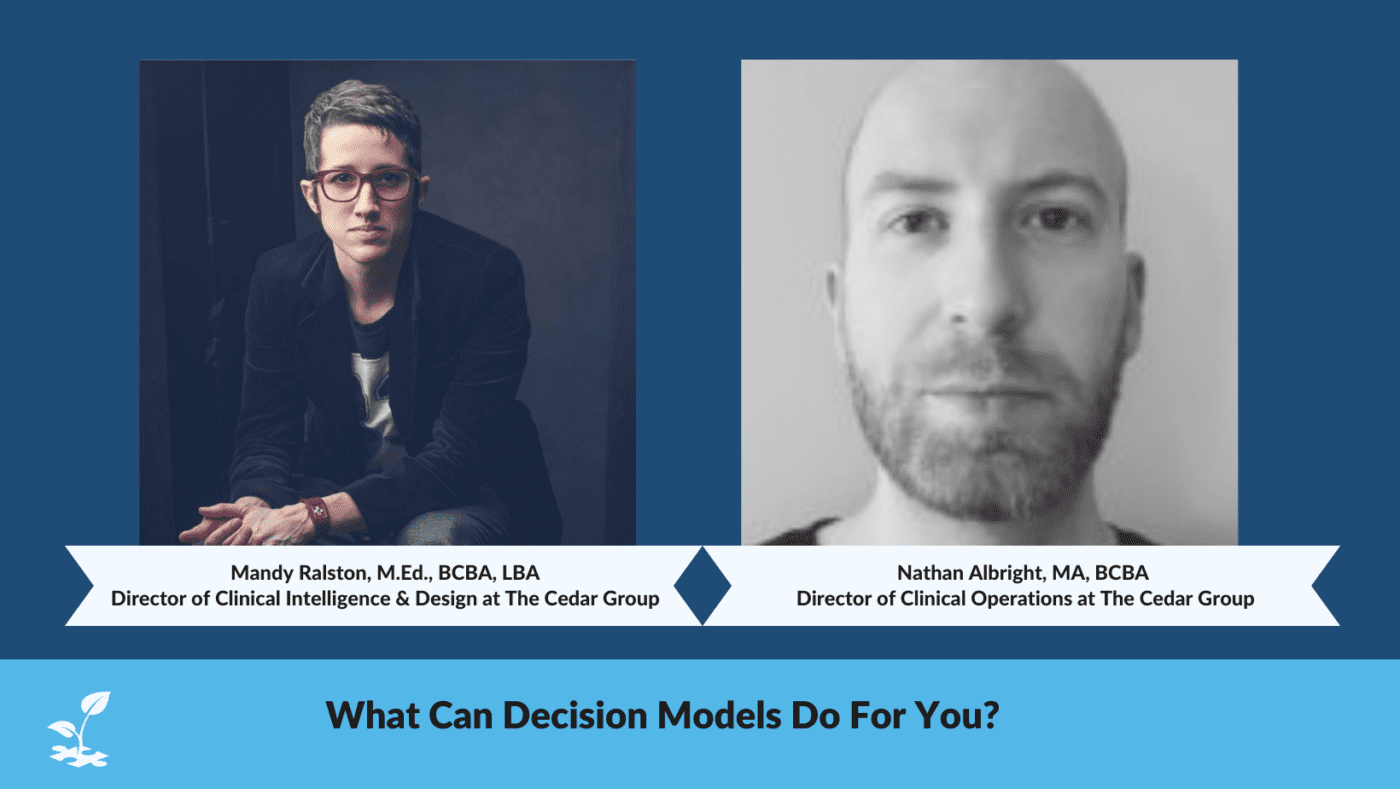
Hosted by Mandy Ralston, Nathan Albright
March 21, 2024

Listen now:

or listen on your preferred platform:

Episode Description

In the Season 3 Finale of ABA Unfiltered Mandy Ralston and Nathan Albright from The Cedar Group rejoin the show to discuss the innovations they have made in their decision model tools. The discussion centers on how these tools can help improve the quality of care for the ABA industry. Tune in to hear the group chat about how proper use of decision models can lead to a comprehensive accreditation process for ABA providers.

Full transcript

0:10 Tim Crilly: Hello and welcome to season three, season finale of ABA Unfiltered. I am joined by some repeat guests as well as one of our returning champions, um, Mandy Ralston and Nathan Albright. Um, we’ll go with Mandy. Sorry about that, Amanda. We talked about it before, and I still went Amanda, but uh you might know her as Mandy, you might know her as Amanda, but uh, you know, Mandy’s been on a few times. Um both of both of these these friends are with the Cedar group, and we’re here to talk a little bit about the work they’ve been doing in the year since since they last joined us, or about a year. I’m not I’m not quite sure on the timeline there, but it’s been a while and they’ve been up to a lot of amazing things. So we just kind of wanted to circle back and and and and talk a little bit about some of the some of the work they’ve been doing and and how they feel it can impact various touch points within the industry and what that means for us moving forward. So um, Mandy, if you don’t mind, maybe give a brief introduction to yourself. If anyone wants to get the full Mandy uh background, there’s two episodes where she goes into into length, but for the sake of time, maybe just you know the cliffs notes version of uh of who you are and how you ended up here.
1:24 Mandy Ralston: All right, yeah, I’ll try to keep it brief this time, uh Tim. So I’m Mandy Ralston and I am the uh director of clinical intelligence and design at the Cedar Group, uh, recovering entrepreneur, 21-year behavior analyst, um, and otherwise curious intellectual decorator crab. So how’s that?
1:43 Tim Crilly: Sure. We’ll we’ll make that your business card. It’s finally short enough. Okay.
1:49 Nathan Albright: Nathan, friend, sir. I’m Nathan Albright. I’m the director of clinical operations for the Cedar Group. Um, it’s been spending about the last, I don’t know, 18 months, you know, learning and growing with our software and trying to get these integrated with our insurance providers that we partner with and also with the uh the intake process of Bluesbury, which I’m sure we’ll talk a little bit more about. So I’m excited to be back, Tim. Thanks. Okay.
2:13 Tim Crilly: BCBA, right? I mean, we’re gonna use credentials, okay.
2:17 Nathan Albright: 10-ish years of experience. Okay. Uh give or take, uh, what you define as actual experience. Okay. Perfect.
2:25 Tim Crilly: Uh that’s a good point because my my experience is a little bit of a tapestry. So it’s interesting to make those determinations. Okay. So uh rather than have one of you describe what the Cedar group is, I’d like for each of you to give your version of what the Cedar group is, just a couple sentences, what what you think it is and the impact. Mandy.
2:49 Mandy Ralston: Um, I like to think about the CEDAR group as sort of the skunkworks of applied behavior analysis, a think tank of technology and how we can fuse together um decision support software along with uh a pretty robust uh group of minds that have uh expertise in the areas of clinical and operational uh design for applied behavior analysis.
3:14 Tim Crilly: I understood some of that. Okay, Nathan. What do you see the Cedar group as?
3:18 Nathan Albright: Uh I’m gonna try and translate it into extra nerd science fiction style here. Okay. Uh uh what we’ve really noticed as we’ve grown with the Cedar group is this large group of brand new BCBAs and these great minds at ICHOM and you know, Bico and CASP that have these great standards of practice that are being created. And I guess I see um the Cedar group as kind of the wormhole of information where it seems such a vast length of space between brand new BCBAs and that standards of content, and hopefully we can be kind of in the middle there and bridge that gap so we can get that information and how to apply that for brand new BCBAs and experienced BCBAs the like in a fast and efficient way.
4:05 Tim Crilly: Okay, thank you. I think, you know, I think that’s very on point with a lot of things that has been a theme this season across our conversations with various folks. So those of you that are more regular listeners, you’ve sort of heard us talk a little bit about, you know, sort of that new BCBA and what it’s like to sort of get dumped into the to the industry currently and what sort of things that we can do as an industry to not only support them post-test into their career, but leading up to that point, you know, from how do we relook at the way in which we train those expectations that are placed upon um newer BCBAs. We’ve we’ve you know touched on specialized BCBAs and some of our conversations. So I’m really excited to have you guys on because I think this plays an important role because the some of the things that you guys have been have been doing obviously didn’t exist before. And that’s sort of what you know Mandy alluded to. It’s it’s like, okay, we took all this, we know what the problems are, and lo and behold, there are solutions. Um, but we got to get them in the people’s hands, and people need to be using them in an appropriate manner. So the the way I kind of wanted to sort of frame the conversation was can we touch a little bit about you know, you know, what these decision models are and and sort of what their role plays in the health plan, um, larger to medium-sized provider groups, but more to Nathan’s point, I really want to go down this this this this conversation path is those new BCBAs. So, you know, they’re all important, they all play a role. Um, so if you could sort of, you know, you can decide who wants to to tackle what or you know, kind of you know, play off each other. But the health plan, what is what can the CEDAR group do for health plans on a national basis? Can you, you know, can you pick on that a little bit and describe that for our listeners, sort of what what that looks like, what that relationship is when you guys say you’re working with a with a health plan.
6:10 Nathan Albright: Yeah, it’s it’s a it’s a unique opportunity to kind of be in the middle between you know insurance providers and and ABA providers. And trying to understand the perspective for both, I think has been really valuable with how we’ve created our content. Um, I think one of the largest barriers for insurance providers that we get information and communication from them is it’s very difficult for them to see standardization across ABA companies or even within ABA companies in large groups, you know, even like Blue Sprague is. So, you know, there’s hundreds of ECBAs sometimes in a single company. And to be able to say, well, all of this comes from the same place isn’t necessarily a very confident stance that an insurance provider can take. But on the flip side, we’ve got ABA providers that say, we’re not always truly understanding what is what why is something approved, why isn’t something approved, what are your medical necessities that you’re looking for? What are the details that are significant from your perspective compared to our perspective? You know, how do we paint you an accurate picture of what you’re looking for so you can get these families the funding that you need? Um it’s an interesting place to kind of be in the middle of the road between those two. And I think that information has been really helpful into you know creating a set of applied standards to say, well, as a collective group, as a collective group of BCBAs, how do we report in the same way with the same information, with the same content, with the same sort of general decisions that are being made, all while individualizing that to the client? Um, Mandy, I’m gonna pause there. I’m gonna let you piggyback off the bat.
7:55 Mandy Ralston: Yeah, I think um one of the things that we’re trying to do with the Cedar group is not only to assist in the standardization of care and help people uh arrive at the similar decisions given similar data and background information about clients, right? Um, to have some kind of guided pathway related to um standards of care, best possible practices. And also to you know, improve transparency between providers and payer groups, uh, because this is really a non-zero sum game, right? The that’s a win-win situation. If the client’s outcomes are better, then that means that the providers are doing a good job, they’re being reinforced for their good work. And at the same time, the payers are motivated to uh help get to that same uh outcome with the clients based on the fact that they have shorter amounts of care, right? Or less intense amounts of care. Um, so it really is a win-win goal if we can both both parties start being more transparent about what it is that we’re doing to make these decisions. And frankly, you know, we’ve gotten feedback within the field that uh the outcomes don’t sort of bear out the story that we hear on a uh qualitative level, right? We have lots of information from families and parents that say, yes, ABA absolutely did what I wanted it to do for my child. But when we look at standardized assessments or some of these other curriculum assessments, they’re not telling the same story, right? And so people are starting to put out reports and analyze data in a way that is not uh flattering. Uh so I think uh it’s incumbent upon us as providers, as BCBAs, if we are actually going to help um uphold our field to really change the conversation about how we’re going to demonstrate our worth.
9:48 Nathan Albright: Yeah, that’s a that’s a good point. Uh, you know, as you were talking to, Mandy, one of the things that crossed my mind was, you know, we’d like to be able to check this box for insurance providers to say, I inherently trust the data and the information that comes from the entire organization rather than just individual VCBAs within an organization. And if you can do that, and if you can create that trusting relationship between your insurance funders and your ABA providers, you it opens up conversations for preferred providers, or let’s talk about funding per code because the data is trusted, or you know, let’s talk about your peer review process. And you know, what we’ve been doing a lot of is focusing on the intake process with Blue Sprig and with our models. And you know, ideally what we’d like to do is we like to say, well, how can we use this trusted data, this trusted relationship to make more efficient processes for your providers and for your insurance companies? You know, do you have to individually review every single piece of paper and every single treatment plan if all of the data is inherently reliable now? Um, you know, can we start to have some of those conversations to make those efficiencies really advantageous to not only a funder, but also to an ABA provider?
11:07 Mandy Ralston: Yeah, so as an example, Tim, like one of the tools that we’ve developed at the Cedar Group is called the Intensity Prescription Determination Model. And the reason we have developed it is because guaranteed to anybody listening to this right now, if we ask all the different BCBAs to take a particular client, look at them, look at their symptom burden, look at their age, uh, look at their skills and their deficits, and then determine how is it uh tell me how you arrived at the number of treatment hours per week that this person gets. A, you would have a very wide um deviation of the number of hours, and B, nobody would have a standardized way of telling you how they arrived at that number.
11:48 Tim Crilly: Yeah, um, I think, you know, I am still here, by the way, everybody. Um I think, you know, something that jumped out at me and what you guys were just talking about. I go back to my days at Magellan and thinking about, okay, you know, just taking the California market, we were managing um a plan here in California, had about 1,200 to 1,500 um members across 400, I think, and nine um network providers. Now, all 409 didn’t always have an active case, but let’s just say it was in the 300. So you’re talking about a lot of different organizations producing um documentation for reauthorization. I think from a care management um perspective, it was easy to sort, I don’t want to say good and bad, but I’m gonna have to. It was easy to identify what was maybe not great. Um, but it was it was really hard to like to identify what was good to to great. And I think that’s an that always sort of jumped out at me. It’s like, okay, I can tell if it’s this is way off, but I can’t ever really tell, is this appropriate? And I think that’s been the that’s been the challenge of this industry as a prior authorization fee for service model, trying to say, and Mandy, you touched on it, I need 25 hours. Why? Um, I don’t know, I just need 25 hours. So I think that’s that’s been a real key um factor in this. And you know, I think the work you guys are doing um plays into that because you know, going back to the the the Magellan days, you know, okay, we we had a good sense of about five to ten providers because they had a large volume. We interacted with them all the time. Then you had people that were onesie twossies and you maybe had two touch points a year with that organization. So you could never really get a true sense of who they were and what they were doing. And they were probably just getting authorized no matter what, because it was just it, there was just so little to go on based on you know what is what we’re supposed to be doing, what we’re not supposed to be doing. So I think that’s where this really is a uh game-changing, and I hate that term, but you know what I mean, sort of um, you know, in information and help and resource that you guys are putting into this field.
14:13 Mandy Ralston: Well, I I think it’s an interesting thing, like you talking about trying to review different providers at Magellan, and you’re like, okay, uh quality is only uh it’s a relative measure, right? Like you have to have a standard to measure good and bad against. And so if you are only seeing 400, 900 different BCBAs within the entire field of 40,000 plus now, your idea idea of a relative good provider is just based on your pool. It’s not based on a standard, right? And so that again is part of the issue that’s driving the dilution of quality for apply behavior analysis. Um, you know, it’s like because we’ve got half of the field or over half the field is less than five years post-certification experience, and I think it’s even worse than that. It might be two or three years at this point with the rate of growth of BCBAs in the world. Um, Tyra Sellers, uh, who is the director of ethics at the BACB, talks about the zombie apocalypse of mentorship and supervision within BCBAs because you’ve got such bad, or not bad, excuse me, we’ve got such young BCBAs who are quickly being turned around to supervisors toward other interns to BCBAs, that they are passing some of their gaps in their experience, their gaps in their skill set on to these other BCBAs. And so one BCBA that doesn’t have all the skill set that they might need to go be effective, then passes that skill set down to somebody else who then is also equally diluted in their skill set and it just gets from bad, you know, it sort of gets bad to worse very quickly.
15:50 Nathan Albright: Yeah. It’s I really do want to emphasize the the disconnect between, you know, we we talk about outcomes a lot, and I I think that’s a more common conversation across the board of, you know, of an understanding of what the outcomes should look like, right? Um, you know, we all know what an outcome measurement could be. And I think there are more BCBAs out there that can understand what an outcome measurement is versus how to actually get to that point. I think that’s that’s the biggest thing that gets missed right now in the field is you know, I’ve got these processes, I’ve got this job, I’ve got this company that I work for, and all these outcome measurements that get reported that I know that are told to me that are important, but I’m not necessarily sure on a daily basis how I utilize that information or what types of things I should be doing to be able to get to those outcome measurements, right? So, you know, yeah, uh, you know, percentage of goals mastered is of a generic outcome measurement, but you know, what does that mean and how did I get to that point? Like if, you know, if I have some goals and 50% of them were masterable, maybe that’s bad to somebody, maybe that’s good to somebody else, but it all predicates on, you know, did I select the right amount of hours? Did I choose the right goals? Did I complete my assessments properly? Did I use my assessments to evaluate where my goals should be pinpointed from? Can I project where my assessments would lie in six months if I did or I didn’t do treatment intervention? You know, there was all these like middle ground metrics that just get sort of lost in the mix. And I think that’s where we find our mantle and our responsibility to the situation is you know, to provide those middle ground metrics and how a BCBA, whether they’re two years into their program or 20 years into their program, can find those metrics accessible to themselves.
17:47 Tim Crilly: Oh, go ahead. Sorry, Mandy.
17:48 Mandy Ralston: No, you go ahead, Tim.
17:50 Tim Crilly: I mean, it is it is my show, but that’s cool. Um no, I I think uh, you know, when I think about what you just guys were talking about here and that large provider and uh sort of the the way things can drift internally and you know, and it plays to the point you were just you know making, you know, if you’re if you’re if you’re hiring, you’re bringing people on, um, the the the pressure is to get people and get them in a position where they’re billing, but you don’t really have a true sense of of who they are, where they came from, um, you know, sort of what standard of of um training that they live under. Uh, but the pressure is you got to get, you know, you have to, and you know, I I understand it’s from a financial standpoint, but it’s also from an access to care standpoint. But it it’s a it’s a it’s a road that we’re going down where it’s it’s not gonna get better until something changes, um, which I don’t know what that change is. Uh there’s a lot of different things we’ve talked about, but I do think if you have an organization that can put the right tools in the right people’s hands, you can get a little bit more of a self-assured feeling around this is our clinical product, this is what we’re producing. We know it’s impacting the families in a positive way, it’s allowing us to make change. You know, Mandy, I’ve seen, I’ve seen the intake um decision model that you’ve made. And, you know, one of the key factors that like I took away from that is it will it might tell you this client isn’t appropriate for you. You don’t have the skill set to work with this family. And I don’t know if a lot of ABA providers ever really do that. And that that’s a dangerous road. And it’s probably a small percentage of the clients that are coming in the door, but it’s still, you know, if ABA isn’t right for them or you don’t have the right clinical skill set to work with that family, it can do a lot of damage. So I think those factors, when you look at large organizations and that the sort of the pressure to grow, where do you guys see your models fitting in?
19:57 Mandy Ralston: Well, I think the model that you’re referencing, uh, Tim, is the the resource evaluation model. And it really what it tries to do, the intent of the model is to best set up the clinic, the clinician, and the client for success. So it does not tell you yes or no to take a client necessarily. What it will do is flag certain areas to say, you may need to do a medical rollout prior to doing an initial initial intake. You may need to collaborate with these other providers prior to or during your initial intake, you may need to set up these safeguards prior to actually starting services with somebody. So I think it’s it’s it’s a model that is designed to optimize um clinical care with the demand of trying to get access to services for people that otherwise might be on a quote unquote wait list. But to your point, um, if the services are not appropriate for any number of reasons, whether that’s because of a particular clinician skill set or an environmental issue related to the clinic itself or certain comorbidities or um high risk factors for the client, if if you’re not addressing those appropriately, it’s just as harmful, if not more, to start services for somebody than to let them be on a quote unquote waiting list during those early intervention periods. Absolutely. Yeah.
21:21 Nathan Albright: Yeah. We’ve we’ve we’ve had about, I mean, the last five months alone, I think we’re closing in about 2,000 individual decision models ran just within the Bluesburg organization. And it gives us a lot of data points. I mean, we’re talking, you know, tens of thousands of data points within these, you know, up almost 2,000 models. And it’s it’s shown some success in a few ways. Um, number one, where Manny’s talking about is prioritizing ABA services across to the individual’s needs and not necessarily just an ABA in isolation. Um, you know, a secondary model. Uh teaches the BCBAs that are running the initial assessments to prepare a little bit more in advance before the clients start their first day of services with us. So every client walks in and it’s not just a blank slate then, but you’ve got all this time between your assessment to their first day of services. If you know more information about what your needs are, and if there’s some high priority challenging behaviors that are coming into your door, train your staff, build your behavior intervention plans, do some things in a proactive measure that aren’t necessarily uh commonplace yet. Um, so we’ve set a center up to prioritize needs and priorities. We’ve set a BCBA up to prioritize their caseload management. Um, what we also do with the treatment intensity model is given an accurate representation of the number of hours that are needed, the number of units should be requested from an insurance funder, which may or may not be the same value. Um, that also gives us an opportunity to say, well, here’s the number of goals we should probably be looking at. And due to the assessment results, this is the level of goals that we should probably be choosing from. You know, the treatment intensity model not only tells us how many hours or units should be requesting, but also can help build some predictive modeling in there to say, you know, this is where your BB map score is today. This is where your BB map score would be in six months from now if you weren’t going to do ABA therapy. So that helps us find some terminal attainable six-month goals that clinicians can now accurately choose from. So we’re building this intake process through Boost Brig. And so far, very successfully to say, here’s how we prioritize services, so here we accurately represent our data. And all of that goes back to the funder, hopefully, to build that really trusting relationship. So that’s not only advantageous for a funder and a provider, but it’s very advantageous for a family to get the outcomes that they need and sometimes the short amount of time that they have to do therapy successfully.
23:59 Tim Crilly: Yeah, that’s that’s all very well said. I I, you know, one large organization, two large organizations, three, you know, so on and so forth, using these things, the impact that it can have to sort of raise the tide or, you know, it’s sort of around the industry because uh clinical excellence becomes a little bit more apparent, and therefore the standards of expectations from the funding sources will obviously increase. Um, so I think those those are all like uh fantastic points. Uh and it’s it’s kind of hard to wrap your head around sometimes, but you know, it we are all in this together, and sometimes it doesn’t always feel like that, which is uh unfortunate. Okay, so let’s let’s get back to that the earlier point around the new BCBA. To me, I think back on on my my journey here, and the idea of going in and just randomly doing an assessment and coming up with a recommendation and like having it just be a thing that was real and it worked, and it’s a little alarming, or you know, like I’m really good at DROs, so like I just recommend a DRO every time, um, even though it might not be what’s actually going to make any any change or so on and so forth. So um I also think back to I I started out as a teacher and my first um I was a first grade, and I remember the door closing on the first day, everyone staring at me, and I’m like, I went into this thinking I knew what I was doing, but then once the door closed and it’s just me, it’s like, how am I in charge of this? Um I I kind of think I kind of think about you know, sort of the the the new BCBA in the same in the same light, and it’s not necessarily their fault. We just sort of say, hey, go do this. So, you know, for for your guys’ perspective, what what what do these tools mean for um, you know, a newer, you know, less seasoned? How about uh BCBA?
25:59 Mandy Ralston: I mean, I’ve been having uh some fun, if you will, because we like data. Um, you’re allowed, you’re allowed doing some doing some informal polling on LinkedIn, right? And so asking questions like, how many of you BCBAs out there felt like you were ready to take on your own caseload after you pass your exam? And I’m telling you that the numbers are all over the map. You’ve got basically divided four ways between absolutely, uh, somewhat, not so much, and not at all. There are people out there and they know it.
26:32 Tim Crilly: They know it’s 50-50 basically, between I’m kind of ready to ready and not ready to no way.
26:38 Mandy Ralston: Yeah. And then you ask the same kind of questions about how do you determine which assessment you’re going to use for a client given their particular chronological age, their diagnosis, their skill sets, etc. Again, just as good as a rule at table. Like there is no rhyme or reason to how people get there other than that’s what I was taught. So they’re like one, two, three trick ponies with the skill sets that they have. And it’s not necessarily that they’re basing it off of evidence-based practices. It’s based on oral history and things being passed down.
27:12 Nathan Albright: I mean, we I we I’d really love to get to a point long term where, you know, the models are advantageous to brand new employees, you know, whether it’s for you know a large company and their risk management component of it, to know that, you know, if there are models out, then there are systems that are created. Even a brand new employee can make um proper next step decisions to support a family without having to worry about long-term ramifications or uh necessary oversight, you know, or an approval from a supervisor, you know, if we’re all coming to the same conclusions, there’s a little bit more of an efficiency there or a uh a confidence that you know you you can hire safely and you can teach while still making good decisions at the same time, rather than relying on a really good supervisor to teach those individual BCBAs. Um, but for a brand new BCBA, you know, to me, I think it would instill a lot of confidence to have some of that technology behind the choices that I make, rather than just being on an island telling a family, you know, I really don’t think this is the best direction for you to go. You know, there’s some weight behind that now to say, you know, this is why I feel this is the direction we should go. This is the here’s the reasoning, here’s the data behind this. Um, you know, if we’re really concerned about it, here’s all the information that I’m coming to. So if somebody says, well, how did you figure that out? Well, I’ve got an answer for that now, finally. And I can continue to have an answer for that. It it really reminds me of um, you know, if I go to a doctor’s office and you know, I say, Hey, this is kind of how I’m feeling, Doc, he just doesn’t whip out a 3,000 page book that he had from his med school and go, I’m pretty sure you have this thing on page 542. He asks some questions and he puts my symptoms in. And, you know, that narrows down a set of follow-up questions that he’s gonna ask. And when I answer those, it narrows down my prognosis of what types of diagnoses he may provide me. And based off of what that’s selected, because ultimately he is the doctor or slash BCBA, and they still have to make that decision ultimately. But when it’s narrowed down and your scope of practice goes from a 3,000 page book to a set of things you can pick from that you can count on with one hand, you know, there’s a lot of confidence behind that choice. And then that builds me into treatment pathways. So not only is that helpful for you know the PCBA, that it still has a lot of confidence, but it also makes sure that, you know, the treatment that I’m offering to my clients is valuable to them too. And I don’t think we can stress enough that early intervention has shown that if we’re unsuccessful or if we’re not utilizing that time properly, we’re missing out on a lot of learning opportunity for these kids. And I just I don’t think we we have we can afford the opportunity to take advantage of that time.
30:08 Tim Crilly: Yeah, uh, you know, and it it I think there’s a an opportunity to take this even a couple steps backwards, and you know, how can these these tools play a role in how we train BCBAs from a university standpoint, as well as from you know, while you’re doing you know, your quote unquote internship or whatever we want to call it, you know, sort of leading up to taking that exam. Have you guys had any sort of um conversations or around those those topics?
30:35 Mandy Ralston: Yeah, definitely. I I think um Nathan brought up a really good point in recognizing that these types of clinical decision support models have been used in the medical industry since the 80s. Like this is this is not new technology, it’s just new to applied behavior analysis. And the faster we can adopt these kind of tools for our young clinicians or even for our seasoned clinicians for that matter, um, the more um efficacy we’ll be able to demonstrate within our field, uh the legitimacy of actually having a medical model for applied behavior analysis. I mean, I think to some extent uh ABA skipped a few steps uh in the process of becoming a bona fide certification and licensure, and then getting insurance coverage for all these treatments when we don’t actually have some of those standards in place for ourselves yet. And so uh I think we’re sort of racing against our own um you know self-imposed uh values that we want to put in place here for how to make some of these treatment decisions. And so, yeah, getting these models in the hands of uh universities that have programs designed to create behavior analysts would be wise, right? Because again, frankly, we’ve we’ve demonstrated that we are producing individuals that can pass an exam. They have not necessarily demonstrated practitioners’ skills at that point. Absolutely. And again, when you ask them frankly and they feel safe to answer, they will tell you they know that they don’t have those skills. So I think there’s something that we’ve got to do to help them because they got into this, you know, industry to help people. They don’t want to lose their certification, they don’t want to lose their jobs, they don’t want to hurt consumers or the field in the process. So they want to do right.
32:26 Tim Crilly: Yeah, uh it’s all that’s absolutely perfectly said. You know, it’s that I don’t want to do it the wrong way, but who’s helping me make sure that that happens?
32:37 Mandy Ralston: Right, right.
32:38 Nathan Albright: Who who benefits from this too is is very generalized as well. I know we talk about a lot of clinicians that manage a caseload, but you know, there are model conversations and topics and things that we’re, you know, we’ve we’ve either built or are building that aren’t necessarily just for a single VCBA with their own caseload. They’re for supervisors to evaluate centers and centers needs and where to prioritize company resources. Um, you know, there’s um there’s models that we’re creating that are you know meta-analysis, you know, how do I how do I know when I’m doing an article search, if this is a good and advantageous article that I that I need to use to benefit this thesis or you know, this this paper. Um, you know, so for universities, you know, having something like that might be beneficial to them. You know, there are individual models to say, my my goal progress is stagnant. You know, how do I how do I know where the barrier is? Um, you know, so who’s benefiting from these models? You know, the population that each model individually serves uh shifts based off of the topic as well. So I don’t necessarily think models are exclusive to just a VCBA with a caseload to be successful or a brand new VCBA. I think the concept of accessibility to standards of care, whoever that applies to, I think there’s a place for an application for decision modeling to be helpful.
34:07 Tim Crilly: Yeah, so last week or last episode, um Jonathan Mueller or Mueller, sorry, uh from Ascend Um Behavior in Colorado was on. And we did a little kind of goofy um ghosts of ABA past, present, future, sort of, you know, playing into the whole um Dickens theme there. And one of the things we talked about was the future, obviously. And he made some predictions and you know, sort of around accreditation and uh um case rates or you know, sort of pervert provider status, you know, whatever you kind of want to classify it as. And, you know, sitting here listening to you guys, I really feel like, okay, well, yeah, that’s probably happening. Uh, it needs to happen, certainly in accreditation. Um, you know, it’s the wild, wild west, it’s becoming more tame, but you know, it’s still a little, you know, sort of differentiated. I think, Amanda, you touched on that a little bit. Um, so from that standpoint, where do you guys see? How does the Cedar group uh you know hypothetically play into sort of folks out there looking to to form an accrediting body?
35:22 Mandy Ralston: Yeah, I mean, it’s interesting. People are are presenting uh outcomes frameworks. You know, again, Nathan, I think mentioned at the beginning, we’ve got uh iCHOM has uh outcomes frameworks that they’ve released. Um, we’ve got the behavioral health center of organ uh behavioral health center of excellence accreditation group. Um now CASP is also going to be announcing their accreditation process upcoming. Um, and presumably that’s going to come with some outcomes framework as well. And we’re sort of in a um an echo chamber or at least some kind of conversational loop because we don’t actually have any data to suggest which of those frameworks or how each of those frameworks might demonstrate efficacy, right? So we have multiple tools that we’ve been uh suggested and have been vetted for us as practitioners as to which uh assessments and curriculums might be best under certain conditions, but we don’t actually have information yet about the conditions under which you would select which ones and in what order, uh at least in my opinion.
36:28 Tim Crilly: Okay.
36:29 Mandy Ralston: Um and so I think I think we have an opportunity to play uh a hand in determining based on data and usership um which of those outcome frameworks may be more effective and under what circumstances. So I think the Cedar group is poised very well to partner with many of these groups, all of them, frankly, um, in order to demonstrate that sort of that efficacy.
36:56 Nathan Albright: I I don’t want to say anything else. That that was perfect.
36:58 Tim Crilly: Okay, perfect. Uh you must be watching the clock too, so you know we’re up against it a little bit. Um uh you know, I I I can’t I can’t thank you guys enough. I think you know, just sort of the way it can, it this this the stuff you’re working on, just it it helps people from all walks of this industry, whether you’ve been at it for 25, 30, 40 years to 25, 35 minutes, uh, you know, it’s there’s no there’s no one that shouldn’t be sort of excited about getting these things in their hand. So that said, what’s the best way to learn more about you guys? I my my suggestion to my to anyone that’s listening out there is to to find Mandy on any and all social media platforms. I think she does an amazing job of putting out a lot of great, uh, interesting questions, content around our industry, um, you know, thinking outside of of the norms at the moment. So, Mandy, what’s the best way to find you in in that that realm?
37:55 Mandy Ralston: Yeah, if you want professional thinking, Mandy, definitely go to LinkedIn. Um the the Facebook is definitely less um ABA centered uh content. So yeah, go to LinkedIn, find me there, Amanda Mandy Ralston. Um, we’re gonna be upgrading our website over the next few months. Um so uh stay tuned.
38:17 Tim Crilly: Yeah, stay tuned for that. Yeah, don’t yeah, just follow find find the Cedar group on on social media at the moment. I that’s my my suggestion. Um any any parting thoughts? Uh what’s next? You know, what we can, you know, when you guys come on next time, what do you think we’ll be talking about? What what do you want to give me here?
38:37 Nathan Albright: I think the next time that we’ll be able to come on, I think one of the exciting things that we’re going to be able to do is not necessarily be as reactive with our models of here’s the information, what do you do with it? Um, you know, we’re we’re building predictive frameworks inside the model to say, here’s the information, here’s how it will be valuable in six months or in a year, or this is how you should prepare and make better decisions to not have to be so reactive in the future with treatment plan writing or goal selections or our predictions. Um so we’re able to start to create some of those algorithms within our decision models to not necessarily be reactive with the information, but also to plan for the future as well. So, you know, hopefully the next time that we’re on here, we’ll be able to pull some of that in and have that conversation with you as well to say, you know, what are BCBAs and new BCBAs doing to, you know, predict the outcomes that they would need for their treatment plan writing or their goal selection or goal outcome measurements. Um I’m kind of excited for that personally.
39:37 Tim Crilly: Yeah, I mean, that’s you know, and I think not only anything to do to get the best possible information, but the idea of maybe shortening the amount of time it takes someone to produce said document is probably a real, a real gem um for folks out there. You know, I think some of these reports and sort of that reauthorization um timeline is is very arduous. So anything we can do to enhance that process as well as shorten it, I think that’s a that’s a gold mine uh waiting to happen.
40:07 Mandy Ralston: I think uh just to add a couple other items there on top. Uh, I I think hopefully by the next time we get back on your show here, Tim.
40:14 Tim Crilly: Um assuming it’s we have a season four. I mean, let’s just be honest. We gotta we’re planning on it, but we’ll see what happens, see if they pull the plug on me or not.
40:22 Mandy Ralston: Well, we should have some data that we’re able to publish uh at that point. I would think we’ve got a couple of different university partners that we’re working with on research. Um, and then also uh hopefully be able to tell you about a couple of speaking engagements that we’ll have on the docket for 2022 as well. So that’s great. That’s great.
40:38 Tim Crilly: Okay, well, let’s plan that. Um, and I I appreciate you guys coming on um season finale. Um, I can’t thank everyone enough uh for all the help uh that that we had making this. Andrew, our new producer this year, did a fantastic job keeping me on task and making sure all of the behind-the-scenes stuff was was perfect. Uh Meredith Taylor, she runs all the social media at Blues Brig, was just an enormous help to help sort of get the word out. I think uh she did an amazing job making people aware that this this is out here and hopefully it attracted new listeners. Um Ashley, our VP of Marketing, who constantly has notes for me to try to improve the way in which I behave on this program. So uh Ashley, thank you. Thank you, Ashley. Yeah. It’s keeping us all employed, probably. Uh uh, but just to to the folks out there listening, I really appreciate um the support. And and you know, anytime you’re you’re able to download or share it with someone else, I appreciate that. So thank you everyone for a great um third season. I’m really looking forward to to season four, which will be kicking off sometime in in mid January. So so be on the lookout for that. But until then, happy new year, and we’ll talk soon.

Find a center near you.