Episode Description
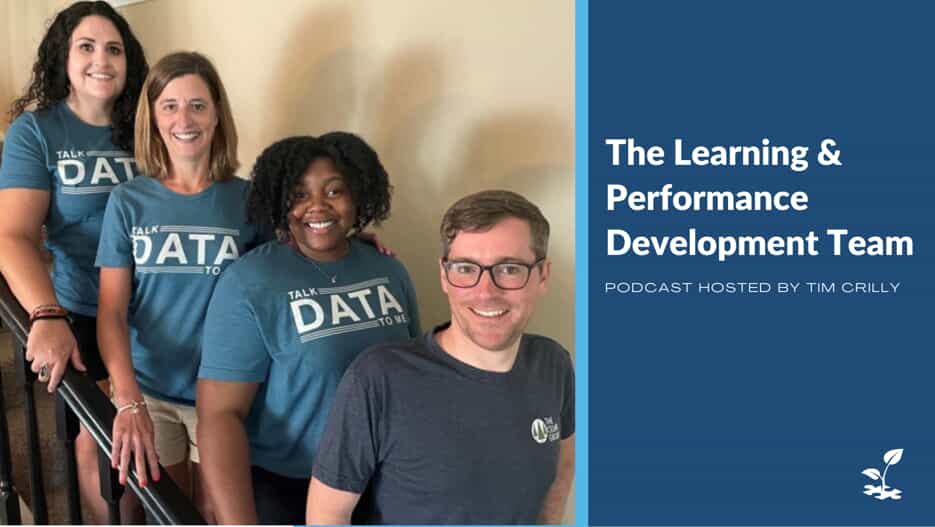
In episode 2 we take a behind-the-scenes look at how BlueSprig’s Learning and Performance Development Team approach training across the entire organization as well as a look into how the team stays up to date on the continuously changing landscape of the ABA world. The team discusses some of the unique features of their team that make BlueSprig’s LPD team the best in the business. Tune in to learn more about how Amanda, Rachel, Apral, and Andrew do to support BlueSprig’s mission to change the world for children with autism.
Full transcript
0:07 Tim Crilly:
Hello and welcome to another episode of ABA Unfiltered. I’m your host, Tim Crilly, and today we have a very special episode. And I know that sounds like a 1980 sitcom about uh you know Willis smoking or something like that. But it’s special because for the first time ever, we’re doing a live sitting together in the same room, even though everyone’s being very quiet as I talk. We are all in the same room. And I am joined today by the BlueSprig learning and performance development team. And rather than name them off and then have them introduce themselves, I think we’ll just go around the room, introduce, um, and then get started and talk a little bit about what their department does and how that impacts sort of the whole organization here at BlueSprig, uh, from clinical to ops to onboarding everything involved with being ready to go out and do your job with within the organization. So, Amanda, why don’t you kick it off, introduce yourself, give us the Cliff Notes versions because we’re limited on time and we have a lot of people here.
1:08 Amanda Fullbright:
I’m Amanda Fullbright.
1:10 Rachel Huckfeldt:
I’m the VP of Learning and Performance Development or LPD. I’m Rachel Huckfeldt, and I am a content manager for the LPD.
1:19 Tim Crilly:
Great.
1:20 Dr. Apral Foreman:
Hi, I’m Apral Foreman. I’m the Clinical Initiatives Manager for LPD.
1:25 Andrew Blomstrom:
And I am Andrew Blomstrom. I am the Learning and Performance Development Manager for LPD.
1:30 Tim Crilly:
Okay, and Andrew, we met last week. Um, he’s also the producer of the podcast, so he’s doing double duty today, producing and um guesting, I guess is the word. I don’t I don’t know if that’s a word, but okay. So thanks, guys. You know, we tried to have this um this session in the first season, and I didn’t have a producer that day, and I messed it up. And Rachel was living through a hurricane and doors were blowing open. So it was it was good that maybe that episode never made it to air, but I I am glad that we’re getting a chance to to do it today. So um I’m gonna let you guys kind of dive in and you know, you can raise your hands, you can however give eye contact to each other, whoever wants to answer questions. But I I think the best place to start is what is the overall function of your guys’ team? So it’s a small team for a very large organization. So could you give us a sense for sort of what you guys what you do, what’s your what’s your overall um goal from a daily to weekly to monthly to yearly basis? So if you all want to take a little piece of that, go ahead. I’ll I’ll be quiet for a minute.
2:38 Amanda Fullbright:
Well, first we’re in charge of all of the new-hire training and onboarding for all of our employees, clinical operations, support services, um, everyone, we are in charge to make sure that they get on and start off on a good foot, um, learning stuff about placework specific compliance things, um, everything they need to know uh for their position. And then we hand it off to you know, their local managers and they do a lot of hands-on training and just get on-the-job experience in whatever position that they’re in. Um, but something that we’re really proud of is that performance is also in our department. And so we’re really focusing on helping people perform to the best of their ability at their jobs because when we’re all performing at our best, our clients benefit. So anything to add to that?
3:35 Tim Crilly:
So let’s talk a little bit more, I guess, about what your individual roles are in that process because you all introduced yourself with a slightly different category. Um, so you know, Rachel, in from that standpoint, from Amanda’s description, where do you fit in? What sort of things do you do to push that mission forward?
3:53 Rachel Huckfeldt:
Sure. So I am the content manager and also a BCBA. And so I develop a lot of the clinical specific training. And the things that I do to kind of make that happen are a lot of continuing education. So I get the opportunity to kind of stay ahead in both our field and the adult learning kind of fields. Um, and then having the opportunity to um actually create the trainings that that go into Learn Upon that are delivered to our clinicians.
4:27 Tim Crilly:
Yeah, I have heard your voice a lot going through the CEU process. So yes, uh oh, you heard that voice I’ve heard. Okay, good. Okay. What about you, Doctor?
4:36 Dr. Apral Foreman:
Um, in my role, I really um enjoy being able to analyze our data and help people be able to do their jobs as effectively and efficiently as possible. So I spent a lot of time in Excel and I love it. I love Excel. Um, I also really like the problem solving piece I get to do of like if you’re having a performance challenge, really getting to take in all the information and analyze it and kind of figure out where your pain points are, and then we can come up with a solution to help you solve those.
5:06 Andrew Blomstrom:
And I am the non-clinician of the group. Um, so my primary focus is more on the technical and operational side of the training world. Um, so currently I’m creating some new trainings for such reads with all the updates, um, you know, any training on any of the technical platforms we use, as well as trying to develop trainings for our operational and support services staff.
5:27 Tim Crilly:
Great. And I failed to mention they’re all wearing ridiculous hats. So uh Andrew has an octopus, purple octopus on his head, and we’ll just leave it at that. Um, okay, so how does the process work? Because you know, we you you talk about, you know, Amanda and I talk a lot, and you know, you guys are sort of like that center spoke on a wagon wheel. And you know, you sort of you kind of go around and you touch all departments. So what is the process for um, you know, we don’t have to go end to end, but you know, the sort of the beginning stages of of why a training needs to occur, how you’re interacting with a department that might might be needing the training to then that completion and then sort of getting it out there. And we’ll get to the the delivery system in a minute, but what’s the process look like for you guys as it relates to something as as you know mundane as you know center maintenance as all the way up through um safety measures when it comes to behavior in the in the clinics as well?
6:25 Amanda Fullbright:
So if a department uh that one of our departmental um partners recognized that there might be a training need, then they reach out to us and we we have a process that we go through. It’s um, you know, for lack of a better term, it’s kind of an assessment of their needs and what they want uh the output to be from uh our employees. And so then we kind of assess how many employees are we talking about here and and what really do they want out of it? And then uh we make recommendations. So that might be a training and it might not be a training. It might be a job aid or it might be um, you know, just a webinar or something like that. It might be just some resources that we don’t even develop, that we just uh put them in touch with. So we really take it through that assessment and then we make some recommendations. And then depending on what the topic is or what recommendation we’ve made, one of the four of us will partner with them uh to create the content if that’s needed. Um so if it’s clinical, a lot of times it’s Rachel, if it’s ops or technical, a lot of times it’s Andrew. And uh and then we we go through a process from there.
7:39 Tim Crilly:
So it’s not just it’s not always all putting your heads together. There are specific people on the team that have specific specialties and they can just kind of go off and and and do it. Yeah. That’s that’s right. That speaks to leadership, I would, I would imagine. Uh okay, so um learning management system, what is it? How does it work? And why does it maybe make us a little bit different as a um as an organization?
8:09 Andrew Blomstrom:
Yeah, so currently our uh learning management system that we use is Learn Upon. Um all of our employees get access to this uh platform upon hire. It allows us to quickly deliver all of our training content to the employees right from day one from the moment they start. They have access to all the content they would need for onboarding, uh, as well as a plethora of resources at their disposal. If they have any general questions, like at Manda had mentioned, some of those job aids or just on-the-spot training they may need to learn more information about any particular topic, those are available to them. Also, their managers can request trainings if they see that a particular individual needs additional assistance in a particular area. They can reach out to the learning and performance development team for suggestions and/or to request access to certain courses to help them develop the skills that they need to be successful. Um, it’s also where we can kind of also make sure from a compliance standpoint, we can track a lot of those requirements that our payers have from the compliance standpoint uh to just to ensure that all of our clinicians are meeting the standards they need to meet uh to keep their certifications and licenses to keep our payers happy.
9:15 Tim Crilly:
So it’s like a library in a way. Okay, so it’s a library that um everyone has access to. So, April, how many trainings do you think are in there?
9:25 Dr. Apral Foreman:
Oh my goodness, a lot.
9:27 Tim Crilly:
Oh, okay. That narrows it down. Um, would you say um does it lean heavy on clinical stuff at this point? Is that the the the probably the more updated? Uh okay. So is there a process for um okay, maybe we have a training that maybe now is seems antiquated. Do you guys sort of go through an audit and edit those?
9:53 Amanda Fullbright:
Rachel, why don’t you tell Tim about what we’re doing this week with the RBT?
9:59 Rachel Huckfeldt:
Oh my goodness. So we had launched the RBT course in September of 2019 when we changed a task list too. And that was going pretty smoothly. And then COVID hit, and we made some down and dirty quick adjustments. And you know, we’re we’re hopefully envisioning the future now where we’re going to be able to get back to more normal functioning. Um, whether or not COVID likes that. We’ll see. Um, but we’re revamping. We took a lot of feedback that we’ve gotten from OMs and clinical directors and um the people in the field and the RBTs themselves. And we’ve made a lot of changes to that course sequence and the way that the users are going to be able to interact with that. So we do have kind of these larger projects that we work on, and I would say look at and make big changes, you know, at longer intervals just because it affects so many people. Sure. But for the individual courses, we have a maintenance library and so they get looked at at minimum annually if we think it’s something that’s content is likely to change, like the BACB has new ethics coming out. Sure. So we know we’re gonna have to look at anything with ethics in the next quarter. Um, so we just kind of make those determinations based on the content.
11:28 Tim Crilly:
Sure. So I think that speaks highly of the quality of training that is available. If you guys are saying, okay, this doesn’t work anymore, this doesn’t make sense, or hey, this didn’t land right and you guys are revamping it, I think that really speaks highly of the quality of the team and the work you guys are doing. Um, because you know, it’s easy to just let things, and we did it, it’s there, it’s fine. But if you really want to push forward with the best possible results, you have to constantly be looking at, you know, looking behind to make sure you’re, you know, kind of looking in into the future.
12:01 Amanda Fullbright:
I think we spend probably at this stage more time looking at the maintenance of our resources and our courses than we do developing new content, just at this stage of our organization and how long we as a department have been doing this. Um, we we probably do spend more time on maintenance. And it also has changed our strategy. When we’re creating content, we now look forward and say, is this likely to change? How can we devise it in a way that it’s going to cause the least disruptions if we have to change this in a little bit?
12:41 Tim Crilly:
Are there any specific stats you’re proud of? I mean, do you guys, what kind of data do you guys track as it relates to learning?
12:51 Dr. Apral Foreman:
Uh so for our RBT and BT training program, we um keep track of how long it takes our staff to complete their 40-hour training and be ready to work independently with learners. We also keep track of how many days it takes them to obtain their RBT certification as well as the pass rate on that. And that is a program that really is in maintenance. I think the content is really solid and our pass rate is consistently in the 90s. Um, so that’s when we’re really proud of. That was kind of our first big program we released. And so maintaining that and seeing that data stay consistent and up there in the 90s is really um inspiring, and we’re really proud of that. Um trying to think of some other ones.
13:34 Amanda Fullbright:
Um we also to uh keep data on our internship program for 2020, we had a 90% pass rate, first-time pass rate for people that participated in our internship program, which we’re very proud of, and uh trying to maintain that high quality through 2021.
13:53 Tim Crilly:
Okay, so the internship was on page three and it was time permitting. So let’s since you brought it up, let’s let’s let’s talk a little bit about that. And then I want to go back uh to something, but I think it’s an important um piece of all of this. So uh, you know, okay, we can bring in a new person, they get trained to be an RBT, and they go out into their job. You can hire a BCBA and they get trained to do things the Blue Spring way. But can you talk more about the internship program, what that is, and how your team is sort of uh in lockstep with that?
14:25 Amanda Fullbright:
So in late 2019, uh the the three of us, April, Rachel, and I, uh sat down and said, you know, what what was the internship program we wish we had? And we, you know, brainstormed and then we took it to uh a work group of people in our organization that were currently uh in process to become a BCBA and people that were BCBAs. And we tried to choose people that have been BCBAs for you know many years and brand new ones and just to try to get a um breadth of experience. And we we sat down and we said, okay, this is this is the ideal internship program. Now, how can we make it um work for Blue Spring? And uh so we designed a program in which our interns go through um they’re completing all of their hours, their unrestricted hours and restricted hours, they’re going through the entire task list. And at the end, they’re prepared to take the BCBA exam, but they’re also prepared to be a clinical supervisor, which is lacking.
15:34 Tim Crilly:
They’re two different things, certainly.
15:36 Amanda Fullbright:
And and so you know, they can do a real life job, not just take a test, yeah, is is the entire goal of that um that program.
15:46 Tim Crilly:
Sure. But you also need to, you know, you really need to prepare them to pass that exam because if they don’t pass that exam, what’s the point?
15:53 Amanda Fullbright:
Yeah, it’s the minimum threshold. Yeah, yeah.
15:55 Tim Crilly:
So but it’s an important one because if if you’re not getting folks ready to do that, then you’ve just been spinning your wheels. Um, yeah. So that’s it’s the the balance must be the hard part of that. Because it’d be easy to just focus on one or the other and call it a day. Okay, so what was that passer rate on that?
16:14 Amanda Fullbright:
It was 90% in 2020.
16:16 Tim Crilly:
Okay, that’s pretty good.
16:17 Amanda Fullbright:
It’s pretty good.
16:18 Tim Crilly:
I don’t know what the national average is, but it’s probably lower than that. It’s like 60 68. Okay. Okay, well, we’ll look it up later. We’ll do an we’ll do a corrections episode at the end of the season.
16:28 Dr. Apral Foreman:
Very good.
16:28 Tim Crilly:
If needed, okay. So thank you. I’m glad we got a chance to talk a little bit about that. But I think one other thing we wanted to touch on that makes you guys and your team a little bit um different than the rest of the field is you have some sort of accreditation that I know you all know exactly what it is right off the top of your head at any given moment. But we’ll look to Andrew to maybe talk a little bit more about what that accreditation is.
16:51 Andrew Blomstrom:
Yes. So our training department is accredited. We are accredited through the accrediting alliance for training and development. Uh, what this means is that we have met international standards in training and development for quality and demonstrate our commitment to pursuing excellence through service that are measurable, accountable, and of the highest quality.
17:10 Tim Crilly:
Wow, is that right off the top of your head?
17:11 Andrew Blomstrom:
Yeah, I have that’s amazing.
17:13 Tim Crilly:
That’s amazing. Um, okay, so what does that mean?
17:17 Andrew Blomstrom:
What that means is that we had to go through an application process and the the AATD looked at our training content to ensure that the way that we as a training department function and the content that we deliver goes through the mess the necessary steps, as Amanda kind of mentioned during our process, to make sure that the content that we’re outputting to our peers meets the standards that make sure that they are receiving the information they need in a way that is uh relevant to what the skills or knowledge that they need to achieve. Um, so just make sure that we are meeting standards in our development process and the way that we are releasing content to our employees to ensure that they’re getting the best experience possible from the training of your delivery.
18:05 Tim Crilly:
That’s great. So, what sort of maintenance is involved in that? Is that like a one-time thing or is it um it’s a three-year-old. So you have to re-re re-go through the process or okay. So when is that up?
18:16 Amanda Fullbright:
Uh 2022.
18:18 Tim Crilly:
Okay, so it’s coming up. Yeah. Okay. Uh I I, you know, I can’t speak enough about you know what you guys just for me and my professional development have meant because I probably wouldn’t have maintained my BCBA if it hadn’t been for Amanda staying after me. So I do appreciate the quality of work that you guys do and just sort of how you do consider each each level of this organization. And it doesn’t ever feel like there’s an importance placed on one group over another group, which I think is is is uh is a really strong statement about who we are as as an organization. So I do appreciate that. And and you know, with that, we can you know give a little round of applause to you guys. Um, what did we miss? Is what’s next? What do you guys, you know, what do you foresee as the next sort of phase in in your team? Uh you know, what is 2021, second half and 22 going to bring to your little department?
19:18 Amanda Fullbright:
Oh man, we we stopped predicting the future. Oh, okay. Uh in uh in 2020. Um we we stopped trying to predict the future, but um we have we have some exciting projects on the table uh in terms of you know the internship program continuing to move the bar and and you know continuing to um work with our operations team. Uh like you said earlier, uh we are a little bit heavier on the clinical side. And um, I mean that’s because the clinical business. Yeah, it’s a clinical business. And then and those are the people that work directly with our clients. But our ops team is vital to our organization and this is the success of our organization. So we’re gonna continue to um invest in our ops team. And uh also we have some exciting things in store in terms of uh training with our BCBAs, um, partnering with the Cedar group on some things uh coming up. Uh we are working on the Sprigs and Sprouts program, which is patent pending. Patent pending, um, which is gonna be um great for our early learners and for our clinicians that are gonna work with our early learners. So those are some exciting projects.
20:40 Tim Crilly:
April? Sound like you were gonna say something? No? Okay, nothing to add.
20:45 Rachel Huckfeldt:
I I would just add that that we are also working in the short term because we did stop predicting the future, on um getting some tools ready to help our clinicians prepare for the changes to the RBT task list in 2022, the supervision standards in 2022, and our new ethical standards in 2022. So it’s we know those are coming.
21:07 Tim Crilly:
Sure, and it’s an ever-evolving, ever-evolving process for you guys. There’s no like we’re done, put a fork in it and move on. You have to constantly be looking at it.
21:15 Amanda Fullbright:
Just as we think we have like arrived, the BACB will put out a notice of something. And we’re like, okay, let’s let’s put that on a project plan. Yeah, yeah.
21:27 Tim Crilly:
You guys ever say no if someone comes to you and says, like, hey, we need this training? Yes. You do, you you you’re allowed to okay.
21:33 Amanda Fullbright:
Well, and I mean, we we we don’t just say no, we say no, but here are some solutions we can offer you that we think will better suit your needs. Um, because if somebody wants us to put together a one hour training, it’s not just our time that we’re we’re looking at to develop that. That is an hour for you know, all of these people, and that’s an hour they can be. Working with our clients or doing something else. And if that’s not what they need, then that’s not what we’re going to do. If I can give you a job aid that you know tells you how to do something in three quick steps, I’m not going to make you take an hour training. So we do say that.
22:14 Tim Crilly:
That’s a good point because you know you can you can get caught up and train, train, train. That’ll fix everything. But then it can create you know obstacles with with other with other areas.
22:24 Amanda Fullbright:
Sometimes training’s not even needed. Sometimes we just need to clarify like expectations or something like that.
22:30 Tim Crilly:
Yeah.
22:30 Amanda Fullbright:
Yeah.
22:32 Tim Crilly:
Okay. Well, you know, I I I really appreciate it. I think this is this is great information. And you know, hopefully uh, you know, more people hear about the internship program and you know, not only internally, but maybe in an external fashion and want to come on and then they can just get a sense of what the onboarding looks like and really understand what you guys are all about throughout the process. But I know internally, everyone here um they you are appreciated, um, you know, and and I think it it really helps a lot of people do their job a lot better. And that’s what we’re trying to do. So it’s cool that we have a team like you, I guess is what I’m trying to say.
23:07 Amanda Fullbright:
Can I plug?
23:08 Tim Crilly:
Amanda, does there anything you need to plug? Any upcoming events that you might want to talk about?
23:13 Amanda Fullbright:
Yes, yes, there is. Um in October, we’re really excited that we are having our second annual clinical conference. And we have um decided that we’re going to continue to do this conference virtually. We started it virtually out of necessity because of COVID, but because everyone can access the uh the event virtually, we don’t have to bring people together and and um physically and then take them away from their centers and their clients. So we’re gonna continue to do that virtually, and that’ll be in October. We have six awesome speakers lined up uh to speak to us. And don’t we tell you who they are?
23:56 Tim Crilly:
I would love to know.
23:57 Amanda Fullbright:
Am I allowed to know? You are allowed to know. So we have uh Jonathan Tarbox. Heard of him? Uh yes, and we have Tim Vollmer, and we have Vivian Ibanez, and we have uh Stefano Bogato, and we have uh a panel from Dr. Michael Cummings, uh Janelle Van Cleave, and Dr. Michael Cameron are gonna do a panel on trauma-informed care. I’m gonna facilitate that discussion. So yeah, and we also have Peter Gerhardt, which we’re so excited that we got uh to come speak to us. And uh yeah, so can we go to it?
24:38 Tim Crilly:
Did Rachel pull that off? Is that no? No, oh okay, nothing to do with it.
24:41 Rachel Huckfeldt:
Oh okay. I I thought it was a cool topic. Okay, oh okay.
24:45 Tim Crilly:
So that’s open to internal or is this an external employees only.
24:50 Amanda Fullbright:
Employee only.
24:50 Tim Crilly:
So it’s exclusive.
24:51 Amanda Fullbright:
It’s exclusive.
24:52 Tim Crilly:
Okay, so it’s a you would you call it a benefit of working at Blue Spring?
24:56 Amanda Fullbright:
I would. So if if you’d like to partake, you know, I will I will be there. I will be there. You can go. And if anyone is not an employee listening, they can check out our careers web page. Okay, I guess.
25:08 Tim Crilly:
And just in time, October, you have plenty of time to get on get onboarded.
25:12 Amanda Fullbright:
Yeah.
25:12 Tim Crilly:
Um, well, that that sounds really great. I know that’s a lot of work. You guys, it’s gonna be a big sigh of relief when it’s over, and then the next day you can get started on next year’s.
25:22 Amanda Fullbright:
Yeah, yeah, exactly.
25:23 Tim Crilly:
It’s like at the elf when they Santa gets back and he’s like, let’s start preparations for next year’s Christmas. Yep. Um, so um, guys, again, I I thank you for for doing this. It was really fun to do it live. Andrew, thank you for producing this. I think it taught us that we can maybe take the show on the road a little bit, which could be a lot of fun. Um, it feels a little bit more nerve-wracking with everyone staring at me, but um, I think we did okay. And you know, I think we’ll see. I will listen to it and see how it turned out. But um, thanks again, everybody out there listening. Um, stay tuned for more episodes of ABA Unfiltered. And thanks again.
25:57 Amanda Fullbright:
Thanks.
25:58 Rachel Huckfeldt:
Thank you.