Back
Autism Resources

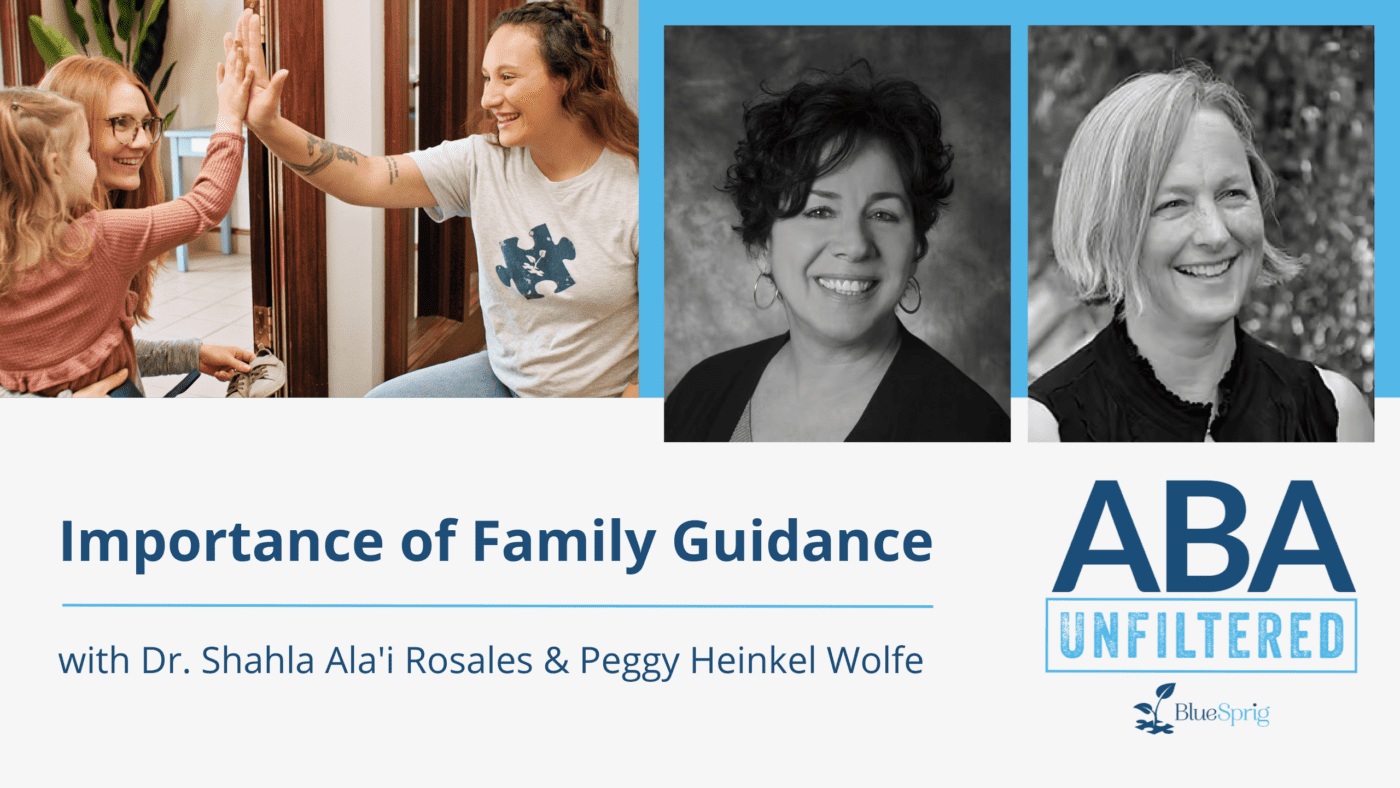
Season 5: Episode 4- Importance of Family Guidance

Hosted by Dr. Shahla Ala'i Rosales, Peggy Heinkel Wolfe
March 21, 2024

Listen now:

or listen on your preferred platform:

Episode Description

We are joined by Dr. Shahla Ala’i Rosales & Peggy Heinkel Wolfe. Shahla and Peggy join the podcast to discuss the importance of family guidance and talk about their book, Responsible and Responsive Parenting in Autism: Between Now and Dreams. Join us on our journey to learn more about the field of ABA. Visit https://bit.ly/ABAUnfiltered_Podcast to listen now!

BlueSprig CEU Website: Use Promo Code “Podcast” to get 5$ off

https://bcbaceu.bluesprigautism.com/

Responsible and Responsive Parenting in Autism: Between Now and Dreams

https://www.amazon.com/Responsible-Responsive-Parenting-Autism-Between/dp/0991040384

https://difflearn.com/products/responsible-and-responsive-parenting-in-autism-between-now-and-dreams

Full transcript

0:09 Andrew Blomstrom: Hello everyone, this is Andrew Blomstrom along with Amanda Fullbright, and you are listening to ABA Unfiltered, where each episode we interview guests from around the world of ABA. Whether you’re a BCBA, RBT, or just interested in ABA, you are sure to pick up some actionable advice you can utilize on your journey. Now, without further ado, we would like to welcome on our guests, the authors of the book Responsible and Responsive Parenting in Autism: Between Now and Dreams, Shahla Ala’i-Rosales and Peggy Heinkel-Wolfe. Why don’t you both start by telling us a little bit about yourself? Shahla, we’ll go ahead and start with you.
0:47 Shahla Ala’i-Rosales: Hi, I’m Shahla Ala’i-Rosales, and I am an associate professor at the University of North Texas in the Department of Behavior Analysis, and I’m just very happy to be here. This book was an act of love, and it’s it’s always nice to have the opportunity to talk about it, especially with my dear beloved Peggy, who I’ll pass it over to.
1:10 Andrew Blomstrom: And Peggy, why don’t you go tell us a little bit about yourself?
1:13 Peggy Heinkel-Wolfe: Hi, I’m um Peggy Heinkel-Wolfe, and I’m uh a resident of Denton. I don’t know why I felt like I had to say that first. Lived here a long time, parent of a 30-something with autism and uh two other wonderful grown-ups. And um uh I’m a journalist, and yes, this book was totally an act of love.
1:38 Unidentified Speaker: Awesome.
1:39 Andrew Blomstrom: Well, happy to uh excited to talk to you guys about this book.
1:41 Peggy Heinkel-Wolfe: Thank you. Thanks for having us.
1:43 Andrew Blomstrom: Of course. Thank you guys for joining.
1:46 Amanda Fullbright: Yes, we are so excited that you’re here, and I just I love this book, and I have so many things to talk about about the book. Um, so you know, let’s just kind of dive in if you want to. Um I know that this is a super valuable resource for autism parents and clinicians that that might work with those with autism. Um, I’m not an autism parent, but I do have two kids. And there were pieces of that book that I was, you know, highlighting and putting stars by because of they hit home with me just as a parent. And I I think that it’s just beautifully written and and thank you guys for writing it very much. Thanks. So you arranged the book into three parts uh the power of learning, the power of connecting, and the power of loving. Can you talk to us a little bit about how you decided that those would be like your three anchors or pillars for the book?
2:47 Shahla Ala’i-Rosales: Well, it was definitely a process. Um, you may or may not know it. It took us over 10 years to write the book. Um, yeah. And and partly because we are both um parents and working and life was happening. Um but also one of the things that happened is um we we would go out into the world and then we would come back together and we would talk and we would try to, I don’t know, to make a message that that would be it would be a guide. And I think that was um always a present idea for us, but how we felt we would most usefully provide guidance um changed over time and the world changed also. You know, the the way services are delivered changed, uh, the pandemic happened, um, we had life happening. And I think all along this notion of the cusp has been important to us. And so we really tried to pick just a few things that we thought would be very cussful. And and really that was the the results, the the learning, connecting, and loving that that we tried to think really deeply about what are three really strong um, maybe even like North stars for people to keep being able to adjust where they are. Um, and those those were the three we landed on. I don’t you want to add anything?
4:26 Peggy Heinkel-Wolfe: Yeah, just a little bit. Um because I’m a writer by trade, um, I I can’t help but talk about how I took notes when we were having all these conversations. These weren’t um all although they there were times I was not taking notes, we’re just talking and thinking. But at one point, um all the notes got printed out and they got they got pasted up on the wall in in um my breakfast room and they started getting sorted. So in some ways, the ideas uh there there was some organizing principles at first, but it was too much and it was very academic, and we were trying to make it relatable um to a wider range of uh readers. So yeah, it was it was fun. It was like uh cut and paste. There were times where big chunks of notes got cut off that piece of paper and pasted over on the other side of the on the other side of the breakfast room because that’s where that idea belonged. So that’s kind of how it came together. It was very organic. I I had forgotten about that part.
5:33 Shahla Ala’i-Rosales: And and and how it was so inductive. I mean, we really we really thought about the stories and then went to that place. I forgot about that that those several mornings, actually.
5:47 Amanda Fullbright: That’s awesome. I love hearing about people’s organizational styles as they’re trying to, you know, organize themselves around a large project and and writing a book is a very large project. Um Shahla, you just talked about the behavioral cusp or or things that are cuspal. Could you maybe elaborate on what you mean by that for some of our listeners that might not be as familiar with that term?
6:11 Shahla Ala’i-Rosales: Yeah. So um there are different ways of looking at development. And one of the sort of theoretical frameworks that’s come out of behavior analysis is the idea of a behavioral cusp. And a lot of times in behavior analysis, we think of it as a skill that allows um entrance into more opportunities in life. Um I’m gonna do a little behavior speak since that’s your audience, but um, that that allows access to new reinforcers, new environments, and and new skills. And I think one thing about that is important about the concept is it is not just skills, like environment changes can also serve as behavioral cusps. So um, and it is a theme throughout the book because it has influenced, at least it’s influenced my conceptual frameworks and how I look, how I look at early intervention. You know, I think about the children I work with and the families, and really trying to think about what are the things that will promote accelerated development? What are the things that will promote more opportunities in life? And what are the things that will promote more agency, that both the child and the family will be able to make choices and their voices will be part of what happens to them along the journey. So, and I think um even early on when Peg and I met, before there was a word that we talked about this, um, it was an approach that we both shared that try to make the right choices about um and think about the decisions in ways that will be transformative. And I think that’s one of the biggest things about the concept of the trut the cusp is that um it is a concept, it’s not linear, the change, it’s a concept about transformation. So from our, I always say this and I don’t know if it’s a if it’s a if it’s a good way or not, but from our grandmotherly positions, um part of what we wanted to do is look back and think about um what would be cuspel? What was Cuspel for us? And um, and so that was a concept that that we used to sort of look at, it was our lens for looking at a lot of what we were saying and the examples we were giving. Does that help? I don’t know if that’s enough for the direction that you were thinking, but um yeah.
8:48 Peggy Heinkel-Wolfe: And just a small thing to add as a parent, especially when my son was younger, um, it was cuspable for me to learn. I’m not using the word correctly, but you guys can indulge me a little bit, to learn that everything had to be broken down in bits and to to teach him, and then it was cuspable again to learn that I didn’t have to do that every single time. That’s really important because if you suddenly think you have to break every single thing down into little bits to teach, you just exhaust yourself thinking about what all the work you have to do, and it’s really not true. If you’d pick the right things, um, you can just sit back and relax and watch them just bloom. It’s really nice.
9:38 Amanda Fullbright: Peggy, would you say that as a parent that you experienced many of those kind of cuspal moments as a parent parenting your child with autism or your adult with autism?
9:52 Peggy Heinkel-Wolfe: Um, I try not to parent anymore. But I will say the most uh recent example of something that felt cusp was uh when my son uh he drives, he drives himself to work. He needed a new vehicle. He did the classic thing for our family, which is to drive a vehicle into the ground, and then when it’s 20, 25 years old, then you buy a new vehicle. And that’s a cuspal. I I don’t want to miss the worry. That that is such a leap of an experience. I mean, imagine a car that has no power windows, no cruise control, no uh computer in the dashboard, none of that material experience. And then this car gets delivered and it happens to be an EV, so you don’t even um power it the same way. So uh um he spent an afternoon with a friend who owned a Tesla. That’s not what he bought, he bought a used Chevy Bolt, but um the conversations in the house now are completely different about how we get around, and um and it makes me think about the world in completely different ways. So it’s been uh very transformative for me. By an EV, you’ll know what I mean.
11:17 Amanda Fullbright: Thank you for that. I think that we myself included often can think about behavioral costs for transformative moments for um the children that we’re working with or or or our own children. But I’ll be honest, I haven’t really thought about I as a parent or I as an adult, you know, go through these transformative moments as well. I kind of rocked my world for a minute this this morning. So thank you for opening my eyes to that. Not really sure why I hadn’t have thought about that before, but but of course, we all do, right? We all experience those moments.
11:54 Shahla Ala’i-Rosales: And I think as parents were so busy doing. Um, and and and there’s a fair, and that’s part of the the title, the responsibility. You know, it’s a lot of responsibility to to help this this new soul journey out into the world and and all the hopes and dreams and anxiety you have about that journey they’re gonna make. So I think sometimes that pausing and looking at the organization of what we do and how we do it is not always there. Um, which is why I think the the being with other people, whether it’s other people through a book or other people through conversations and stepping back, I think that is really an essential part of parenting. And to sort of honor who you are as a parent and the learning you’re going through and the changes, I think is something we don’t often do, but it it is probably um one of the most important jobs in in human societies. Um, we basically have a responsibility for shaping the future and um how we do that and the help we get doing it is um is important and are thinking about it, you know. And I think Peggy brings up in the book about um her love of books, very when she’s giving her message in the very beginning and how that helped her as a parent. And I think I think we really wanted to be part of that canon for parents, um, in addition to the playground conversations, because I think some of that awareness of who I have been as a parent also has happened on the playground with other parents, you know, while our kids were running around or doing whatever they were doing and thinking about what are really important parenting steps we can take that that will affect our children in beautiful ways. But thank you for saying that, Amanda.
14:00 Amanda Fullbright: Well said, Shahla, as as usual. Uh so in your in the book, you you talk about that our society does not place much emphasis on building new behaviors until there’s a problem. We often wait and respond to a problem rather than working to a dream. That’s powerful. You said you started this book, it took 10 years to write the book. And and I’m not sure when that that kind of statement came in. It was it earlier or later in the 10-year period, but have you guys seen a shift in this? Or are we still right where we started?
14:43 Shahla Ala’i-Rosales: I think a little bit of that will always be there because of aversive stimulation. I mean, you know, one of the things that happens is when there’s aversive stimulus, we we go into action mode, we try to move it away, we try to change it, whatever. So some of that will always be there. But I think one of the things that has increased, you know, in terms of our human knowledge base is that um as we learn things about those aversive situations, we can also move into prevention. We can move into thinking about, like if you look at the FA literature, it’s it’s really clear there are some conditions that people just have problems in. You know, when we can’t get access to attention or things that are important to us, when we can’t um engage ourselves in ways that don’t hurt ourselves or other people, you know, and also when we haven’t developed grit to get through um and master things that are hard, you know. So with all of those situations, we’ve learned about those things as humans. And I think, you know, I’m I’m very uh honored to be part of a discipline that has really looked at those situations, looked at function, looked at how we work with those situations. Um and because we know all of that, I think we can go more into prevention and move more into the areas of how we like it to be, not just how we don’t want it to be. Um, but but that does take some intentionality. And it also takes looking at our systems and designing systems that set us up to dream and construct rather than um stop and destruct. Um and that is, I think not only in our field, but probably for humankind, that is a shift we’re learning how to make. Um but but it was from the very beginning, I think also something Peggy and I shared about our approach is that we didn’t neither of us, and we didn’t do it perfectly, but for for our families and for the people that we worked with in practice or that I worked with in practice, I I think that it was always about how to teach, how to become, how to make it more, how to expand, rather than how to stop, how to stop, how to stop. Um that that was a philosophical agreement I think we had from the very beginning. I don’t know if you want to add on to that. I I feel like I keep jumping in.
17:36 Peggy Heinkel-Wolfe: No, well, I I want you to go first because I know the audience of this, and um, and also I sometimes it takes me a minute to process the question. Okay. And then I hear you processing the question. It’s like, okay, I know what I’m gonna say, but that’s like like two minutes after the question, I know what I’m gonna say. I just um, especially as a young parent, I there was a lot to do. That whole busy thing is a real thing, and I didn’t want to spend time on things that weren’t building something, you know. I there was times that we were advised, you know, you need to extinguish that. And being a writer, I knew what the word extinguish meant, and I didn’t like using that word for my child. That doesn’t feel very loving. Um, but I also knew that if we got busy doing things we needed to do, um uh that would crowd out some of the other stuff. And and I’m I just wasn’t gonna worry about it. And and that was true. I it did crowd out things that were frankly harmless. I was lucky that way. My my kid wasn’t um you know, playing with knives or something like that. So yeah.
19:01 Amanda Fullbright: You you bring up um an interesting point, Peggy, of he was doing things that were relatively harmless. And in in your you know, point of view as as his parent, you know, they didn’t bother you. And you were you were willing to be patient and let the the rest of the things you were building crowd those out. And I believe it uh Glenn Latham calls them junk behaviors, if I’m right, Shahla. Yeah. And and I use that term a lot with with when I’m talking to parents or or frankly, other clinicians, and I’m like, oh, that’s just you know, this junk, let’s just don’t worry about that. We’ll move on. It’ll it’ll grow out of it. And if or or they’ll, you know, their repertoire will get bigger that that they’re not worried about that anymore. And and I’m just worried about from your wondering about from your perspective, you know, how how was that for you? Did you do a lot of that kind of ignoring the the harmless or junk behavior? And how might that have differed from other parents that were in your community or that supported you? Oh gosh, this question is for me.
20:07 Peggy Heinkel-Wolfe: Um, yes, it in informed a lot of my behavior, but uh um my behavior, wow, as a parent. Wow, I just blew my own mind there. Um, but uh I think it’s important to remember too, I was parenting in the late 80s and early 90s, um, and loads of folks were lost load if they knew anything, and then um loads of folks were also really excited about let me hear your voice, and they were trying to make sense of that. So um it was hard sometimes to find um decent support um uh uh when we were coming up. Uh we felt pretty alone, but every once in a while an angel would come by. Um, a speech, this his first speech therapist was um really good at what she did. And we also had a I guess you’d call it a play therapist, but not in the sense of traditional psychology where a child is recovering from trauma, but just someone who came over with toys I never thought of buying, um, and introducing them to Sam and seeing how he responded to them, and then having a whole world open up from that. So that was um those kinds of things were really, really helpful. Did I answer your question? I just started rambling in the house.
21:41 Amanda Fullbright: It was a rambling question as well.
21:44 Shahla Ala’i-Rosales: So I’d like to add a footnote um because you said Glenn Latham and we both brightened up. Um we actually um I as a parent and as a professional. In fact, I used to teach a parenting class, and that was. One of the textbooks we use, but we have found great inspiration from his work. He was very good at minimizing what you said, the junk behaviors, and really um, and we talk about this in the book, and really focusing on his metaphor is focusing on the sunshine, focusing on where you should put the sunshine, where you should put the sunshine of your attention, your time, your physical proximity, and really moving it towards the things that would be healthy to grow in the child. And so things like focusing on play, focusing on sampling new things, focusing on the language that goes with that and how you arrange the contingencies so that the child progresses in those ways, and you have to, and you not have to, you are less likely to spend all your time focusing on what you see maybe as troublesome or what other people see as troublesome. Because I think that was also important about what you said, Amanda, is that part of it is what we want to do, but part of it, because we are a collective kind of species, um, you know, what other people think affects how we do things. And especially as a young parent, you know, the approval or disapprovals of people, we take that into consideration. And sometimes you really have to have a community that helps you look towards what you want to grow and away from what is a problem and move away from that. Um, and it is easier the younger a child is. People are very forgiving about the things toddl. Um, and it hurts less than it is when you’re 16. So that that’s also why the focus in our field and and the focus in our book is also talking about, you know, thinking early on and as you go along about how to think about those preventative steps before there is a problem and how that naturally helps you fall into the dream about where where you and hopefully the child as they get older choose to go.
24:23 Amanda Fullbright: Thank you for that, Shahla.
24:26 Andrew Blomstrom: So another part of the book that kind of stuck out was um you wrote a section that says behavioral interventions are constructional, not pathological. Can you elaborate on the statement and how you think this kind of affects the roles of parents, clinicians, and the child receiving services?
24:48 Shahla Ala’i-Rosales: Um, well, let me say first, that is a very complicated question and a really good question. Um, and it’s something that I think as a field we’re pondering on, and both from a conceptual framework as well as a pragmatic and technical framework. Um so I think part of the reason we said those words in the book, and part of the reason that is that is my perspective and our perspective is that um if you think about the process of behavior change, behavior change is just that. You’re changing the behavior under different environmental contingencies. So even when we are moving away from something we would consider a problem, we’re building something up. Um, and that is actually part of our ethics code, also. So, in addition to the theoretical and the technical, there’s also the ethical, is that um when we are addressing a behavior that is problematic, we have to, by virtue of our ethics and the way behavior works, think about what goes in its place. Because if you just stop, that means not living. And so, so in that sense, you know, when we talk about pathology, and and maybe that was a very extreme way for us to put it, because when we talk about pathology, we’re trying to understand the disease and the underlying causes for it. When we’re talking about behavior change, we’re going in and we’re asking the question, what’s going on? What are the conditions? What are the skills or behaviors or responses that we’re thinking about? And in the applied sense, we’re looking at how it could be and how it could be that would be better for that human being and the people around them. So by virtue of that, it is constructional because we’re building behaviors, we’re not cutting them out and removing them because you can only do so much cutting with the human and then they’re done. So, so the idea is that when we look from an applied perspective, that that it’s it leans away from pathological and a disease model towards a how could this be model? And and how can we arrange the environment? How can Peggy said it beautifully, how can we break things down into teachable steps? And I think I think this is true of any kind of education or teaching. It’s it’s building because it is teaching, it’s it’s establishing some new repertoire, some new way of being in the world. Um, but I I also think apart from the technical and theoretical, I think as a heuristic or something that helps us um move forward in in useful ways. I think that it’s just a good way to think about things. Um if you’re approaching it as a team, you know, whether the team is the parents or the professionals or some combination. I don’t know if that answers the question, but um but that’s kind of what we were thinking.
28:07 Andrew Blomstrom: No, that’s great. Thank you.
28:12 Amanda Fullbright: So an another question for you, maybe Shahla can can start this one. Um, you’re right, in ABA therapy is a love and science-based interaction where two or more people are engaged in an interaction. And this is the very first time I’ve ever heard ABA uh described in this way. And and for the record, I like it. Um, but how might you respond to some more harderline BCBAs, behavior analysts that might get itchy about the word love, love describing uh ABA.
28:48 Shahla Ala’i-Rosales: You know you know them. So, yeah, so I have to say there’s several things to unpack with that. Um, one is that I should full transparency, that was part of how I was raised as a behavior analyst, um, even before I knew it was behavior analysis. You know, my first um exposure was actually when I was a teenager. I was working in a Head Start program and I didn’t know what the foundations of that program were. But the woman who ran it, Miss Juliet Whitaker, was one of my early mentors. And she from the beginning um taught me about the importance of science and and and care and love in working with young children. And that program actually part of what they were implementing was what was called the behavior analysis model. There was a big study going on at that time, and they were part of what was happening and the evaluation of different approaches to early childhood education. So I was seeing some programmed instruction, and I was seeing um some work with behavior analysis without even knowing that what it was. But from her perspective, there was a very strong belief in the importance of science in educating young children. And then as I moved forward, um, my early training with uh Dr. John Lutzker and Sandra Lutzger at SIU, there was such a deep focus on compassion and care and science that that, and and I kind of think there’s a metaphor that’s helpful to think about that, and that’s a bird that a bird can’t fly without two wings. And if we think about those two wings of applied behavior analysis as love and science, um, that’s what powers it. That’s what moves us forward as a science. It’s a metaphor. But then I went to Kansas, and one of the first articles that I read, it was published in 1978. I got to Kansas in the early 80s. So it wasn’t a new article, but it was fundamental, was an article by Montwolf about the heart of behavior analysis and the importance of social validity and and how, as an applied science, that um that the things that are important to human beings, and he in he says, like love, joy, um, all of those things, that they’re not scientifically inappropriate or impossible. They’re just scientifically difficult. And I think that’s what our field has struggled with. You know, what are the measures of joy? And actually, there’s a young researcher, Jennifer Posey, who’s doing some nice research in that area. And the Cagles for a long time have been looking at measures of affect and how happy children are in the therapeutic context. Um, Denny Reed and Carolyn Green have been doing that work. So it’s a long stream that has attended to the comfort and the happiness of people during intervention, children and adults. So it’s it’s not a new concept. Um, I think to use the word love maybe a bit stronger than um in some scientific journals, but I think, and I credit some beautiful professional in New Mexico who said this when I was talking once. She said it’s honorable love. And so, and there are different types of love. You know, there’s romantic love. We’re clearly not talking about that for many reasons, but but there’s an honorable love and deep affection we feel for each other as human beings, and we should surely feel for the children we’re working with. And we know parents feel that for their children. It is the propelling force, the animating force of everything they do for their children. So I think it’s good to speak those words of love, to say that is that is a core value we have in doing our applied work. I think, you know, there’s all kinds of applied fields. There’s applied engineering, applied physics, applied behavior analysis. And I think for applied behavior analysis, our MOs, our enforcers, I think we keep flying if our if our if our motivation is about the well-being and the happiness and the progress of the people that we’re working with. And I think sometimes there’s a lot of criticism, and then I’ll stop because I know I’m going on and on, but I think sometimes we criticize each other in the field a lot. You know, for example, if someone’s using Procedure X, we say, oh, well, they don’t care about the clients. I really feel like the majority of people that I’ve met across 42 years of or more being in the field, a majority of the people in our field really care about, they get into the field because they care about the people they’re working with. I think sometimes, occasionally, that’s not the case. Or like all humans, we get sidelined and care a little bit more about something that interferes with that. But I think we can be pretty confident that that is an underlying motivation for most of us in the field. We work in systems and societies that are hard. Um, and the best of us do things that we would do differently if we had the time and the community to help us step back and realign. So, you know, I feel as frustrated with anybody about the divisions and the criticisms and the concerns about what’s happening in the field. But when I step back, I I think most of us are on a path towards love. I don’t, I don’t, I don’t think there’s as much division as we think that there is. Um, at least I hope that there’s not. Um, but I do think the L word is is is a hard one. And you know, this is the last thing I’ll say. I I have learned so much from feminist and womanist theories, where there’s a a really a high level of comfort talking about emotions and talking about big emotions and ones that link us together as as a group, as humanity. And I think that um I hope, and there’s an early behavior analyst just passed away, but Maria Ruiz, who has talked about um what those theories can help inform the areas of emphasis for us and how we look at how we progress as an as an applied science. Um yeah, that was a lot of talking. I don’t know, Peg, do you want to add to that?
35:54 Peggy Heinkel-Wolfe: Or I I do, and it’s gonna be terribly strong. Um, so everybody, I guess that was a trigger warning. Yeah, that’s good. As a parent, um, it would be very alarming to me to have someone working with my child who has some kind of aversive feeling about love. So we we do spend some time in the book um talking about those the different relationships and the value of you know parents as a full partner in the decision making and the steering. Um, so and after I I need to say too, after saying that really strong thing that I just said, um, I I’m not sure I ran into anyone in my son’s life that didn’t uh get attached to him in one way or another, and not in a way, well, one person, but anyway, some that get because when you’re a parent, you’re thinking about boundaries too. And you’re thinking about um, you don’t want someone so attached to your child that they’re messing in that boundary. So I appreciate the concern about boundaries. I think that’s what people are concerned about, and parents are concerned about that too. But I don’t think there is one of the most powerful things I learned was how to be attached and detached at the same time, and it’s the same for a professional. You can be attached and detached at the same time. Um, so um uh just you know, there is nothing wrong with loving a fellow human being. Good Lord. But I don’t know what the difficult conversations are. I mean, I know I, you know, people like to talk about what they’re doing, and that’s that’s cool. So, um, and they want respect for what they’re doing, and I think most of us do respect what everyone’s trying to do, and most of us understand it’s a human endeavor. But I think we know how to do boundaries. I think most of us who are healthy know how to do boundaries, and most of us who are healthy really do want to be loving human beings, so let’s just wrap our round arms around that and pull that in nice and tight, because that’s the best way to go. I love that.
38:25 Andrew Blomstrom: Thank you both for that. That was great. And uh, I’m not a clinician by trade, but I am a parent, and I agree with both of you. As a parent, if I were to place my child in the care of a clinician, uh, I would love them to be in that type of an environment where not only are they getting the scientific side, but they’re also getting that love and respect uh, you know, from the clinician as well. I think, like you said, the two wings of the bird uh, you know, would allow my child to succeed more so than just one on its own.
38:53 Amanda Fullbright: And I certainly don’t disagree with anyone that most people I’ve encountered as well do, you know, love the kids or the people that they’re working, adults that they’re working with. I just don’t know that we’re talking about it. And I don’t think that we’re comfortable as a field talking about it. And I’d I think that we should change that.
39:19 Shahla Ala’i-Rosales: Yeah, I agree. There’s a study I’ve always wanted to do. It’s it’s kind of a retrospective thing, but I want to go through Jab and Jabba and count emotion words that are used and and look at what the trends are over time. Actually, jayb, jabba, and behavior analysis and practice, because I think we would see a lot of fear and aggression. Um we’re comfortable with fear and aggression, but we’re not so comfortable with affection and love, um, you know, or or feelings of safety or whatever, whatever all those other emotions are. And I think that though what we’ll see is I think we’ll see a trend over time with all those what we consider, you know, favorable emotions, ones that we want more of, we’ll see a little trend of those trickling up and more comfort talking about that. I think, I think interestingly, the pandemic um opened up a lot of dialogue in our field about some of those issues. And and it also opened up a space for for more people to be part of the discussion, people of color, people with autism. Um, and those discussions have been hard and they’re really important. Um where we go with them and how we learn to have the discussions, because that’s a learning, um, I think is is gonna take some some practice and some feedback and some revision so that it is productive. But it’s I think that’s been a really important thing that’s happened. Um yeah.
40:59 Amanda Fullbright: I I agree. I think most things that are difficult or hard are probably important.
41:05 Shahla Ala’i-Rosales: Yeah.
41:06 Unidentified Speaker: Yeah.
41:08 Amanda Fullbright: Um, and we’re we’re coming up on time, but I I cannot uh leave this conversation without commenting on um one last thing. Uh as a f field, I do think, as you said, through the pandemic and and other you know periods of time, we’ve made some modest strides in our field around cultural humility and understanding the importance of it. And in in the book you write, uh the science behind any treatment plan will not be compromised when professionals respect our families’ values and culture. Behavior analysts can continue to make their own practices stronger and be more resilient by learning to listen and respond to people who have different backgrounds and life experiences. And this includes families’ perspectives and value systems and their child’s emerging perspectives and opinions about the course of their life. That was a powerful statement, an important statement. Can you talk to us a little bit about the importance of considering a family and the child’s culture and values when working with them? And and for those of us that are still maybe kind of grappling with how do I, where do I start? How do I start this? You know, maybe a couple of action items for them you could share.
42:32 Shahla Ala’i-Rosales: You want me to go first? Oh, please. Um well that knowledge, those words were born of both experience and scholarship and interaction. Um, I think there is uh, I’ll start with the easiest one, the scholarship. Um, there’s a growing body of um thinking and researching and experimentation about how to be more responsive to one another, especially the more different we are from one another. And because the world is changing, because there is more information about injustice, there’s more information about who’s not been able to have a voice, to have, to have participation in decisions and what happens. As all of that scholarship grows, I think it’s behavior analysts, it’s important that we contact it. And some of it’s within the field, much of it is outside of the field. Um, you know, for example, there is a an amazing scholar, Ruha Benjamin at Princeton, who talks about AI systems and how we design systems to be um exclusionary or inclusive. And what that looks like and how it can shift. That’s important for us to look at because we do design and we need to think about the design of interventions, the design of our intervention systems, and how they either move us away from systemic oppression or how they move us towards justice and equity for all. So there’s at the systemic level that scholarship helps us, but also at the individual level, you know, understanding our biases, understanding that conversations with families listening takes time. And to also understand, you know, most of the families are young families. So it’s also the time to be on that journey with them and to accompany and listen to that process and to help share information because the things that we might understand from new studies coming out or the way things have been done, part of our job is it is a collaboration. It’s not unidirectional. So we we participate in that process of developing shared purpose and value making, but also understanding, and there’s some really beautiful scholarship in early childhood education about this, understanding families have really different values. You know, what one family cherishes will be different in another family. You know, that that’s all there. So that that’s part of the scholarly part. I think at a personal level, um, I think having come from two really different cultures, that created a tension throughout my whole life of seeing, oh, there’s really different lenses. And then living in a third culture, they’re very different ways of looking at life and and to be comfortable in those in-between spaces and be comfortable in the provisionality and the changiness of it that that it changes for everyone. It’s changing for us again as humanity. Um and in an interaction level, I want to say that part of our being able to say that was the result of Peggy and I being friends over the course of 25 years and both of us having communities and understanding that that listening and responsivity, again, cultural responsiveness, child responsiveness, affects responsiveness. Contingency responsiveness is a theme throughout the book. Um, and it is a it is a skill. And it is a skill that you learn to observe, it’s a skill that you learn to listen, and it’s a skill that you adjust, that you change, you shift. So that is an ongoing theme in the book and beyond, I think, for us. Awesome. Also, too, I just want to say Peggy has this whole other life and has done incredible work in journalism about social justice, especially in areas of climate and racial injustices. And um that kind of brings tears to my eyes that I would be able to watch her over the course of time be a crusader for changing things. So that work that she’s done has influenced also how we look at um at what’s happening in in treatment settings.
47:59 Peggy Heinkel-Wolfe: I just wanted to add one small thing that I got. Thank you for that, Shell. That was sweet. But anyways, one small thing that I learned from Shella, she gave it words. I I knew how to do it, but she gave it words when you don’t know how to start something. You don’t you don’t know how to enter. And it’s like, um, yes, you do know how to enter because you learned in kindergarten how to listen. So listen, just start with listening. Everyone knows you really do know how to do that. Sometimes you’re listening for the next thing, the next gap for when you’re gonna say your thing. But if you’re really listening, like I was listening to Shahla that whole time, and I’m thinking, I have no idea what to say. I hope they just stop the podcast when she gets to the end, and we do that random question thing that I’m I’m really scared of doing. But, anyways, um then towards the end, she was saying that thing, and I was like, Oh yeah, Shahla told me about how when we don’t know what to do, we it’s because we don’t know how to enter the situation. And it’s like most of the time you too, because it’s just a basic, the the basic tool you bring to everything. I don’t want to say you bring a hammer no matter what kinds of nails are in front of you. But as a journalist, I know how to listen and observe and take notes. So when I’m and I went places uh often that were like, I have no idea what’s gonna happen here. I have no idea what I’m gonna do. I have no idea what story I’m gonna write, but I know how to listen and and observe and take notes. And then that’s it. You just start there.
49:37 Shahla Ala’i-Rosales: From a behavioral perspective, for all those behavior analysts out there, it’s it’s just start the chain. And the chain starts with the entry, and the entry is listening. You know, that that is being in a space where you can do that. From a so from a behavioral point of view, if you want to do that, the beginning of the chain is that it’s it’s being welcoming and listening. I I also want to say on a cultural note, um, one thing that Peg and I share is we grew up in the Midwest, and Midwestern uh humility is a beautiful thing. And and Peg keeps demonstrating that over and over again. Um, and I I appreciate it. It’s a it’s a beautiful, it’s it’s something I value culturally.
50:24 Peggy Heinkel-Wolfe: Well, thank you.
50:28 Amanda Fullbright: All right, Andrew, I’m gonna turn it over to you for our questions of the week.
50:35 Andrew Blomstrom: All right. Thank you very much. At the end of every episode, we like to end all of our guests with three, as we like to call them, wild card questions. Two of the questions we ask to all of our guests. And then the third is truly a wild card question, where we will let kind of the wheel determine uh which question we will ask. However, we’ll start with those two questions we like to ask all of our guests. Um, as you probably know, Amanda and I are heavily involved in learning and performance development. So we are always curious on what you are learning. So, if possible, if you wouldn’t mind uh briefly sharing something that you’ve learned lately.
51:18 Peggy Heinkel-Wolfe: Good Lord. Or are learning currently I’m learning to be a better cook. I thought I was a pretty good cook. I am a pretty good cook, honestly. I am, but um, I’ve been um uh following Chris the new the new pathways Christopher Kimball is uh traveling with Milk Street and that style of cooking. Um, and I’m I’m learning some new stuff. I can’t believe it all these years. I’m 62, I’ve been cooking since I was eight, and uh I’m still learning. Yeah. Awesome. I love that.
51:59 Shahla Ala’i-Rosales: I need to give a different answer because I’m sorry. No, no, well, no, I am not learning to cook better. I wish that I was, and you are a fabulous cook, but no, because I was on the podcast a few days ago for for the other book that that I was working on. Um, I gave one answer. So um I’m thinking about another answer, and I’m thinking of two really different things. One is I’m learning to play with LOL dolls um in imaginative ways, and um, that’s been interesting. We you’ll appreciate this, Peggy. We made a Harry Potter hat. Um so the LOL dolls are playing Harry Potter, which is an interesting fusion. This is all with my granddaughter. So that’s what I’m learning. Um, I’m I’m also learning kind of in a more serious realm. Um, you know, students are changing over time and they are confronted with so much. And I’m learning some strategies with them about how to have hard but safe conversations. And I want to give out a shout out to my legal and ethical class for helping with that. Um they’re they’re just beautiful. But we even have come up with like a signal system of when things you know are triggering us a little bit, when this is a hard conversation, and that’s been kind of cool to explore that with the students.
53:22 Andrew Blomstrom: Thank you guys. Always next question I have for you guys. Uh let’s say tonight, instead of 24 hours in a day, you have 25 hours. What are you going to do with your extra hour?
53:39 Peggy Heinkel-Wolfe: Sleep. That’s my answer to it. That’s today.
53:46 Shahla Ala’i-Rosales: That’s the first thing that came to mind. Sleep is so important. Um, yeah, so that would be the thing.
53:56 Andrew Blomstrom: Beautiful. All right, and now for the last question. Uh, we will go ahead and do our wheel spin here. Let me go ahead and share my screen. All right. And Peggy, if you don’t mind, I will leave the honors to you. Here in a second, I’m going to go ahead and hit play on the spinner. Um, whenever you are ready, if you don’t mind, just tell me when to stop it. Um, we’ve got numbers one through twelve on the spinner, and uh in front of me I have a list of questions titled one through twelve. And then whatever number it lands on will be the last question I ask to you, the group. Um so I’ll go ahead and start it. And whenever you’re ready, Peggy, just tell me to stop, and then we’ll figure out which question we’re gonna ask.
54:51 Peggy Heinkel-Wolfe: What a funny little thing. Stop. They’re upside down now.
55:01 Andrew Blomstrom: All right. So this one might make you guys think a little bit. But what is the best advice you have ever received?
55:13 Peggy Heinkel-Wolfe: Oh, I don’t have to think about that one at all. There’s no mistake you can’t fix.
55:19 Andrew Blomstrom: That is very good advice.
55:22 Peggy Heinkel-Wolfe: I love that. It was from a boss.
55:28 Shahla Ala’i-Rosales: That’s really good.
55:29 Peggy Heinkel-Wolfe: But he was also the son of a preacher. So maybe that’s where it came from. I’m not sure, but I loved it. I never forgot it. It was such a gift to hear that.
55:43 Shahla Ala’i-Rosales: This is advice I’m still working on. I think I’ll work on all my life. Um, but it actually comes from something. I’m a Baha’i, and there was um uh passage that we were studying, and there was one line in it that I’ve been thinking on a lot. I think it’s good advice, and it was elevate all, malign none. Um, and I’ve been I’ve been thinking about that, and that is harder than you think. Um, but I think that the idea was if we all do that, that society will raise up and that will it kind of goes with the theme, I guess, of you know, move towards the things you want to grow. And I think, yeah, yeah. So that that’s it.
56:30 Amanda Fullbright: I love both of those. And that was the first time we’ve had that question. Well that was cool. Oh, didn’t get the cartoon questions.
56:42 Shahla Ala’i-Rosales: Honestly, I was racking my brains if it was the cartoon question. All I could think of was Dory, which is interesting. Beautiful. Oh my gosh. Well, thank you so much.
56:53 Peggy Heinkel-Wolfe: Like we really this was I get so nervous about these, but I’m getting I’m okay. I can do this. You did great.
57:02 Amanda Fullbright: I can answer questions. Yes, you did great. And thanks for sharing your time with us um and and people who will listen. Um, I think it’s an important conversation to continue to have.
57:15 Unidentified Speaker: Yeah.
57:16 Amanda Fullbright: All right, I gotta go. All right.
57:18 Shahla Ala’i-Rosales: Okay. Well, thank you guys. Thanks, everybody. Amanda, see you next week. Okay, awesome. Bye. Bye.
57:27 Andrew Blomstrom: If you or someone you know is looking for some CEUs, head over to https://bcbaceu.bluesprigautism.com/ and use the promo code podcast to get five dollars off any CEU in the catalog. A link to the site can be found below in the description. Thanks again for tuning in, and we’ll see you next time.

Find a center near you.