Episode Description
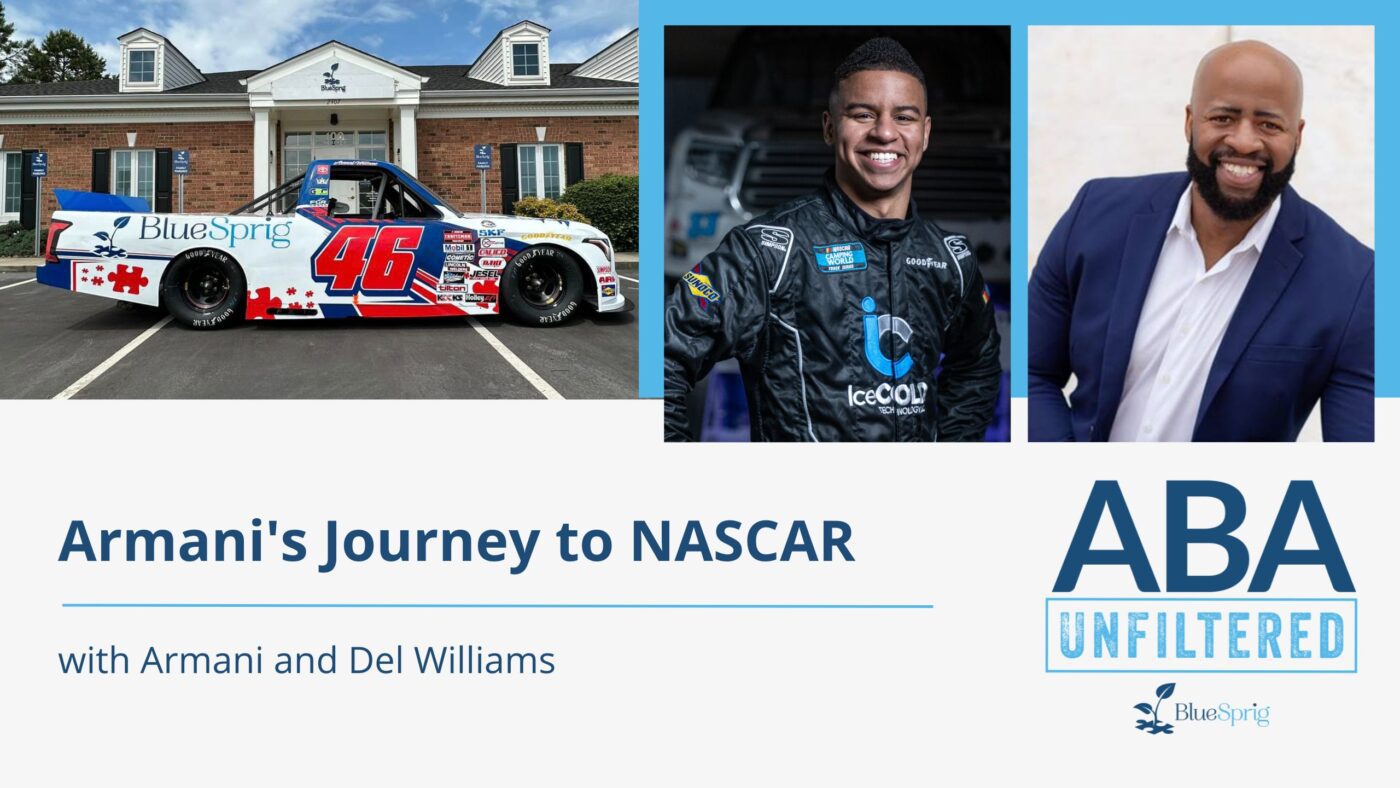
Join NASCAR driver Armani Williams and the Head of Team Armani Racing, Del Williams, as they discuss Armani’s inspiring journey in becoming a professional driver and the role his autism diagnosis played.
BlueSprig CEU Website Promo: Use Code “Podcast” to get $5 off!
Full transcript
0:15 Andrew Blomstrom:
Hello everyone, this is Andrew Blomstrom along with Amanda Fullbright, and you are listening to ABA Unfiltered, where each episode we interview guests from around the world of ABA. Whether you’re a BCBA, RBT, or just interested in ABA, you are sure to pick up some actionable advice you can utilize on your journey. Without further ado, I would like to welcome on our guests, Armani and Del Williams. Armani, why don’t you go ahead and tell our listeners a little bit about yourself?
0:44 Armani Williams:
I will. And uh first of all, I appreciate you having me and my dad on here today. But uh for me, my name is uh Armani Williams. I’m 23 years old. I am a driver in the NASCAR Craftsman Truck Series, driving the number 46 Blue Sprick Toyota Tunda for Glory to God Racing or AKA G2C Racing. Been racing ever since I was uh eight years old. You know, it was always my dream and passion to want to be a race car driver. And even today, you know, I’m a college student as well, studying mechanical engineering at Oakland University in uh Rochester Hills, Michigan. You know, so you know, but for me, I I always uh loved cars all throughout my life. And, you know, so as I right now, I’m just I’m living my dream. Awesome.
1:31 Andrew Blomstrom:
Awesome, great to hear, and thank you for joining us. Yeah, thank you. And Del, uh, tell us a little bit about yourself.
1:38 Del Williams:
Uh well, thank you for having me. Um, I have the pleasure um of being Armani’s father. Uh, my name is Del. People sometimes see me hanging around, but I don’t do anything cool in the race car, I’m really just his dad. Uh, but I do have um um an extensive uh background in sales and marketing, and I’m currently uh team principal uh for Team Armani Racing, and so I help Armani a lot with uh the business and uh sales and marketing aspect uh of his chosen profession. That’s awesome.
2:08 Andrew Blomstrom:
Thank you. So happy you guys are able to join us today. Thank you for having us. Yeah, thank you very much. So, Armani, if you don’t mind, um can you tell us a little bit how you got started in racing?
2:21 Armani Williams:
Yeah, yeah, I you know, I get there a lot, but like I’d be happy to share it. I mean, you know, for me, uh it all started when I was a very, very young kid. I I always loved racing from the get-go, you know, like I would get every Hot Wheels and Matchbock cars that I could get at the store, anywhere I could find it so I can come home and play with them, whether I was at my dad’s, whether it was at my mom’s or my grandparents, you know. It’s just I always fell in love with cars from the get-go. And I had this one gif uh of a Kirkbush number 97 NASCAR card that like I kind of hold dear in my heart. And every time I look at it, uh it always just seemed like it was a beginning for what was to come for me. And then I heard about NASCAR, you know, that like I think from there that’s when I started hearing about NASCAR. And I’m like, you know what? Yeah, I want to watch this, just see what it’s all about. And you know, first time I watched it, I was blown away. And it amazed me of just how fast those cars were going, like 180, 190 miles per hour. I like, I thought that was the coolest thing I’ve ever seen. And so it just made me wanted to watch racing more and more every time it came on on the weekends, you know. And the more I watched it, that the more I felt to myself that this is something that I wanted to do. You know, I wanted to be a professional race car driver. And I told my dad about that. And, you know, really, I didn’t come from a uh racing background. My family didn’t do a whole lot of racing, but um, my great-grandfather used to own an out-of-body shop in Detroit, you know, so it seemed like that there was some connection there. And so we hit it right from the get-go with me starting uh racing go-karts at eight years old, um, and then moved my way up to uh racing late models, uh having 18 wins and a couple of championships to go along with it, had some great success, and then moved my way up to much more bigger and uh and faster cars in the Architruck Pro Series in the Midwest. And that same year, I was fortunate enough to be invited to one of NASCAR’s programs called the NASCAR Dive for Diversity program. And, you know, it was uh the type of recognition that I needed because NASCAR gave me the opportunity to move up at their level. But they had a NASCAR series up in Canada called the NASCAR Pinty series. So as you can imagine, you know, me living in the US all my life, yet I get to race outside the country just to get a whole new culture and a whole new experience. It was just so cool. And, you know, it was the first time in a long time that I actually learned how to really be a pro at a high level, you know, with things that you do on the track, uh going to different racetracks and how to be fast, how to, you know, take tips here and there from other drivers in the series, what things you have to do off the track to help better prepare yourself for when you start to go and race. So I took a lot of that experience in Canada and came back to the US, still racing in NASCAR and racing several races in the ARCA West and the ARCA East series, to moving up to the ARCA Menark series, uh, racing a couple of times at Phoenix and then here in Michigan as well. And um then uh right now I’m a NASCAR Craftsman Truck Series driver, and uh, I’ve been racing in the series since 2021. So, you know, it really is just for me, this whole journey has just been trying to you know live up my dream because it’s something I’ve always envisioned. Like I want to, you know, be at the very top of NASCAR and you know, being in the NASCAR Craftsman Truck Series is a first step towards achieving that. So I just want to continue moving up the ladder in my career and show people what I can do.
6:06 Andrew Blomstrom:
Awesome. I can’t wait to come watch it at the Daytona 500.
6:10 Armani Williams:
Yeah, absolutely.
6:12 Amanda Fullbright:
Del, so was there any apprehension early on when Armani wanted to be uh a race car driver and he’s eight years old? Like, where you’re like, oh, not my baby, you know.
6:23 Del Williams:
Um, you know, Armani, um, not really. I mean, I think um at an early age, Armani uh, you know, demonstrated that he was a very uh courageous kid, you know, uh he really didn’t shy away from much of anything. Um, and I think, you know, my first uh the only hesitation I had is uh when he first went to Go-Kart Racing School, uh it was a four-week uh racing class. And he was on this, you know, he’s on the spectrum, and you know, they were moving really fast, and they really didn’t have at the school any um experience uh working with or communicating with someone that was on the spectrum. And so I wanted to make sure that Armani was retaining all the information that was being provided, and so basically I just had him take the course twice, and so instead of four weeks, he did it eight weeks. So he got everything twice to make sure he retained all of it. But that was the only thing I could think back in terms of um apprehension. Um, I think from the day he stepped into his first go-kart, it was very clear uh that this was something that came very natural to him. Um, and I compare that to um my 15-year-old son, uh Armani’s younger brother, who’s in driver’s head, and he’s not very good at all. You know, and so and Armani kind of had this down, probably um, you know, at an early age, eight or nine years old. Uh, I I even remember Armani was probably 11 years old and um completely illegal. But you know, we would drive uh through the subdivision and down the street to the store and my Ford Explorer SUV, but it was Armani driving, not me, you know, and so he he was behind the wheel at a very early age. He could just do it. He could just do it.
8:18 Amanda Fullbright:
So that that opens up a whole new question for me. I have a 17-year-old that, you know, is driving, and I’m terrified if she drives more than like a five-mile radius of our home, right? Um was driver Zed for you because you still had to take driver’s ed and like learn to get you know a driver’s license legally, right? Like, what is that like when you’ve been driving since you’re eight years old?
8:41 Armani Williams:
Well, obviously with uh race car driving, there are no limits. You go as fast as possible, you drive as hard as you can. So you can imagine making that transition to trying to learn how to drive on the road and highways, and you got your traffic lights, you got your speed limits. So, like I had to really try and control myself and make sure I was careful of myself as well as everybody else on the road. So, you know, for me, I you know, I there was a a lot to learn, you know, just like everybody else, you know, like I wasn’t perfect right from the get-go, you know, it was just something where, you know, I needed a lot of practice, and you know, it was gonna take me a little bit of time until I got comfortable with it. And then uh eventually it just became natural, you know. So, you know, I think being that like I was already racing cars, you know, it kind of made that transition a little bit easier. So um, you know, yeah, I mean, didn’t really take that long for me to, you know, get comfortable with everything.
9:40 Del Williams:
If I can add to that, um, Armani, uh, it should be noted that Armani had his license to drive a full-size race car NASCAR before his actual driver’s license. He was uh 15 going on 16 when he received his NASCAR license. And so uh it was really interesting for him to have that before his actual driver’s license.
10:01 Amanda Fullbright:
So okay. What is a NASCAR license? I mean, I can make some assumptions here, but I didn’t know this was a thing. Tell me, tell me about this.
10:10 Del Williams:
Yeah, and so basically, you know, um as you move up, and and Armadi gained his license through the uh NASCAR Driver Diversity program, which he just mentioned. And basically, it’s a lot of testing in terms of your car control, your ability to maintain minimum speeds on a track, what have you, because you know, NASCAR um to a certain extent, it’s like a video game. There’s a lot of different types of race tracks, uh, although sometimes it looks like they’re just going in a circle. Each track has its own individual characteristics and personalities. Um, and so as you qualify and show that you’re you know capable on one, it unlocks two or three more that might be somewhat similar, but yet a little bit more advanced. And so Armani qualified in Canada on a couple different tracks early to receive his license to drive in NASCAR. And you build on that license, as I kind of mentioned. You get your initial license if you can show certain minimums uh through their combine programs like the Drive for Diversity program or through his racing in Canada uh to get that minimum license. And then as he continues to move through the series, that license expands in terms of other areas where he’s able to compete.
11:28 Amanda Fullbright:
Very cool. Very cool. I’ve never thought about it like that. It’s like a video game, and you unlock levels. That’s cool. Yeah, that’s really cool. So, Armani, there’s like ovals and there’s road courses. Am I missing any other types of tracks?
11:44 Armani Williams:
Um, no, you you pretty much nail uh the top of the head, you know, there’s road courses and uh ovals. Now, generally those ovals don’t have like different amounts of miles, like you’ll have your half-mile ovals, or you’ll have your one mile ovals, or your 1.5 mile ovals, or something like a 2.5, which your you know, Talladega and then you know, Daytona International Speedway, which hosts the Daytona 500 every year in February, you know. So, you know, you got those type of tracks. And then, you know, of course, the road courses you you can find them all over America, you know. So we’ll race those as well.
12:21 Amanda Fullbright:
Do you have a favorite?
12:24 Armani Williams:
Oh, yeah, you know, I will say I’ve raced that several NASCAR sanctioned tracks already, although I do like to race all of them sometime soon. But I will say my favorite track so far has it’s gotta be my home track here in Michigan. You know, it’s uh it’s a two-mile track, it’s wide, it’s fast. We go like almost 200 miles per hour. And for me, I just feel the need for speed. I want to go as fast as possible. So I like racing at a track like that. I also like the fact with a track like that, you can just move around. So, like as a driver, you love to have options to just move around, run low, run middle, and run high, you know. So I I enjoy that track very much, even though I raced it one time. I certainly too love to uh race it some more and you know eventually win there too.
13:14 Amanda Fullbright:
What’s the fastest you’ve ever gone?
13:17 Armani Williams:
Yeah, I will say right around that 200 mark. But I mean, I will say I don’t think it was at Michigan. We could we were close, but not in Michigan. It was at a track in Pocono Raceway in Pennsylvania, and it’s a triangle oval, and like they got a really, really long uh front straightaway. And so, you know, by the time you get to turn one, you’ll definitely hit 200 miles per hour getting through there. So, right now, and that track in particular, that’s the fastest I’ve gone so far. And uh, you know, hey, give me some more of that. Let’s try to hit 210 if we could, you know.
13:54 Amanda Fullbright:
That’s awesome. So is it scary or is it fun or like this lovely mix of both scary and fun? Um or somewhere in between, you know, something else totally different.
14:06 Armani Williams:
Yeah, your your adrenaline can uh kick up a little bit when you’re going at speeds like that. But uh for me, you know, I I’ve I’ve just never been uh afraid of speed, you know. I just feel like it was always in my blood to just want to be want to be in something that’s fast, you know. And so, you know, for me, like going at those speeds of uh 200 miles an hour don’t scare me. I I actually love the the feeling of it, you know, like you’re just on that ragged edge of out of control, yeah. You know, you’re on rails, you know, because you’re just pushing the race car as much as you possibly can, you know. So I I I love going at those types of speeds.
14:44 Andrew Blomstrom:
Awesome. Do you ever find it hard to turn off, like when you’re just driving around the neighborhood to turn off the NASCAR side? Uh and you know, not want to take off maybe maybe a little bit.
14:58 Armani Williams:
I mean, uh at least like when when I started to learn how to drive on the roads or highway, you know, I had to really try hard to just pretend that I’m not on the racetrack. And it’s like, you know, I had to be careful out there. But uh, you know, over time, like the more I’ve dived, uh, you know, I’ve kind of been able to switch it off and just you know, be like what normal people do out here, you know. So like uh, you know, I will say it was uh a little bit hard at first, but uh it’s all good.
15:26 Andrew Blomstrom:
Yeah, I know just and I’ve never raced NASCAR. I know, like you were kind of saying, coming up a highway just to a normal road, I’ve got to kind of switch back up.
15:33 Armani Williams:
Okay, I gotta slow like you want to see if you can try and hit uh 100 miles per hour more if you don’t have any traffic going up, but you you know you’ll get pulled over by a cop anytime soon. So it’s like I gotta try not to do that, you know.
15:48 Andrew Blomstrom:
So I know earlier you kind of mentioned you know your overall career goals are reaching the top of NASCAR. But what are some of the milestones you’re kind of hoping to accomplish uh to get to that that pinnacle?
16:05 Armani Williams:
Um yeah, you know, like for me, like I think it’s what every race car driver wants to do, you know, like I want to win races, you know, like not just win one, but I want to be able to win many more and you know, be able to win a championship as well. You know, like I think, you know, doing a couple of those things, you know, which to me, I I feel like I have the ability to do on the track. I’ve been able to show it time and time again. So like when I when I can reach the point when I can start doing that and doing that more consistently, you know, I’ll definitely be able to move my way up the top and garner opportunities to, you know, racing the NASCAR Cup series, you know, and show the world that uh what I can do, you know. So I mean, really, you know, that’s that’s what every driver chased for, including me.
16:56 Andrew Blomstrom:
Is there any particular race like you know, Taladeggy or uh the Daytona, any particular race that you’re like, that’s mine? I’m gonna win that.
17:06 Armani Williams:
Yeah, you know, uh for me, I I know I mentioned Michigan being my home track, and I even mentioned uh about like the Daytona 500, but to me, like the Daytona 500, you know, it’s like it’s like the Super Bowl of racing. It’s what every driver dreams of winning. Heck, it’s like the Indianapolis 500, you know, it’s the biggest race in the world. So, you know, for me, it just feels like something that, hey, uh, you know, every driver has a shot at winning. So like I know if I can be in that race, I feel like I can have a shot at winning, like one of the biggest races, if not the biggest race in NASCAR, you know. So I feel like that’s a race that, you know, I would want to win more than anything. Awesome.
17:53 Amanda Fullbright:
So, Armani, we’ve talked about, you know, mentioned earlier, like you are on the autism spectrum. How do you think, or do you think, that being autistic helps your abilities in racing as a race car driver?
18:07 Armani Williams:
Oh, yeah, absolutely. Like I think with for people who are on the autism spectrum, you know, we have a unique ability to be laser-like focused on things that catch our interests or things that catch our attention. You know, that really we just have that driven focus uh to want to be the best in our ability at it. So with me in racing, you know, it’s no different. You know, like every time I get in a race car and put that helmet on, strap those belts on tight and start those engines, you know, I know it’s go time, it’s ready to go. And I’m just focused and driven to go out there and do what I need to do to help accomplish our goals uh throughout the entire race. You know, whatever we need to accomplish during the race, I do everything in my power to go out there and be able to accomplish it. So, you know, it’s it’s that like laser-like focus that I have in a race car. So really, you know, like being on the spectrum, it really helps me a lot with that.
19:14 Amanda Fullbright:
Yeah, I I got the opportunity to meet you guys in Texas at Texas Motor Speedway, and um the really cool opportunity to listen to the radio while you guys were were racing. And I sat there and I thought and I was listening to the radio and I was hearing all the different people on your team talk to you, and you’re hearing all of this. And I didn’t hear you talk much, but you must have been listening to that. And I was thinking to myself, how in the world does this man listen to all of this stuff going on? And driving a car at, you know, almost 200 miles an hour. I mean, how do you do that? Do you train for that off the track or does this just come natural?
20:01 Armani Williams:
I think like, you know, a lot of that can come from like at least like before you go out there and race, you know, when you’re driving for a team, you want to get to know everybody that’s on your team, you know, to understand like, you know, where their focus is at, what their philosophy philosophy is, and just do all you can to be on the same page so that during a race, you you’re able to work together on certain things that go well for you or things that don’t go well for you. And you’re having to battle that adversity. So, yeah, I mean, what happened at Texas, you know, like, you know, it was a bad deal, and you think we want to panic and you know, thinking the race is over. But, you know, for me, like I do my best just to try and stay calm and you know, always find a solution for the problem and to not give up, to know that there is a way to where we can battle back and, you know, uh battle through this adversity and overcome it, you know. And so, you know, for me, I I think it’s just something that I’ve always had throughout my life, even before, you know, I got into a race car, you know, it’s just being that steady, calm demeanor and just always trying to find solutions and never trying to give up easy.
unknown 21:16
Yeah.
21:16 Del Williams:
And I think if I can add to that a little bit, I think, you know, um you generally speaking, there’s a there’s uh a team meeting uh with the driver, uh, crew chief, uh spotter, uh pit guys uh ahead of a race. Uh and this strategy meeting can start days before uh and lead into the day of. You know, when you’re watching a race and you see one person in the front and one person in the back, that’s not always because the person’s in the back. Sometimes that’s part of the strategy is to be in the back and make a lay charge. Some other people say, hey, listen, we feel like it’s better at this particular track to be out front the entire way. It has to do with the type of equipment that you have or Or the experience of the driver at that track. And so there’s a lot of things that go into where cars are positioning for the vast majority of the race. What you see is somewhat intentional. Um, but to the fan, you see, okay, this guy is going really fast, and this guy may not be. Just always remember that there’s a strategy behind it. And sometimes those are intentional moves, and you hear some of that being played out on the radio as well.
22:26 Amanda Fullbright:
So yeah. Yeah. And I and I was watching, and and Del, you were pacing around. You, you, you seem a little, you know, worked up. And the the owner and the and and part of the crew was all worked up. And I’m looking at Armani. I’m like, oh, he just looks like calm, like he’s just on the beach somewhere. And I was so impressed, like so impressed by by your, you know, just demeanor, your calmness that day. Um, and listening to the spotter and and you talk was like, it seemed like y’all had been together for a long time, like y’all had a really nice communication uh uh worked out. Is he always your spotter?
23:10 Armani Williams:
No, so like, you know, he’s someone that like, you know, when I joined this uh glory to God racing team, you know, like uh I I’ve just uh been starting to work with this spotter. His name’s Tony. Um been working with him for a couple races now. And, you know, he he just does a good job of like, you know, pumping me up uh and just so I can keep pushing, always lets me know what lap times I’m running, you know, always encourage me. So he’s always helping me in every way, shape, or form, you know, and so you know, I got to meet with him at least before Texas, you know, and you know, we’re just trying to establish a relationship of, you know, what he does with a spotler and what exactly that I need him to do as far as you know, help helping me put in the best position to where, you know, I know exactly what to do when he calls for certain cars around me, inside or outside, you know, things of that nature. So, you know, it’s all about establishing that communication, that relationship so that we know exactly uh what we have to do during the race, you know. So, you know, uh having all that is important.
24:14 Amanda Fullbright:
Yeah, definitely. I was thinking as I was listening to you guys, it sounded like y’all had been, you know, together, working together for a long time, but I was thinking about that relationship and the communication and how how important that is to performance, you know, to your performance and doing well. So that was such a cool opportunity.
24:34 Del Williams:
Yeah, you know, I think um if I can jump in, you know, one of the things that sometimes gets missed in racing, I mean, this is professional sports, and you know, a lot of what goes on in the radio is very similar if, you know, if you’re watching the NBA finals last night and they take a camera and microphone into the huddle and the coach is talking to the team, or if an NFL team takes a timeout and they’re discussing things. I mean, professional sport, um, you know, it’s intense, you know, it’s very, very intense. Um, and so you feel that and you had an opportunity to kind of see what that uh that passion looks like, uh, what that intensity feels like, what it sounds like. And uh, and I was so glad you guys were able to do that because often when you’re you know you’re at at home watching a race on TV, regardless of what form of racing it is, there’s so much that you don’t know that’s going on. But that’s that’s what it’s like to be um uh in pref in professional sports and get like a up-close, mic’d up view, so to speak.
25:36 Amanda Fullbright:
So yeah, it was so cool. It was just like one of the coolest um experiences and to see um to see the behind the scenes look at everything that goes into it. It was it was amazing and and such an honor to to see you uh do your thing, Armani. That was just it was really cool.
25:56 Armani Williams:
Yeah, and I’m I’m glad you guys had a great time at the track, you know, and it’s just I I tell people all the time, you know, it’s just you get a whole different vibe when you’re at the track watching a race versus watching on TV. Like, you know, it TV can’t do it justice. But when you’re at the track, you know, you get all the sensation, you get all the feels, you know. Like I just tell everybody, just try and come to a race one time. And I promise you you’ll want to go to another one after your first one, you know. So I’m just glad you guys had a great time for sure.
26:28 Amanda Fullbright:
Yeah, I was tempted to try to come out to North Carolina and watch you race too, but it’s kind of far from Texas. So uh Armani, what advice would you have for for young people that that are interested in racing um and want to kind of you know get started in in this career? And you know, from your experience, what advice would you have?
26:53 Armani Williams:
Um that’s a great one. Uh I would say, you know, to start in a career like this, you know, you you you gotta start early, at least from the race car side, you know. Like I think from the beginning, you know, you’ll want to have a support system around you that’ll help you continue to move up through the ladder in your racing career to help you get to where you want to be. Um, as far as uh race car driving goes, you know, like you might want to just start off with racing smaller cars from the beginning and sort of gradually move yourself up to now where you’re racing much uh heavier and faster cars. You know, it’ll give you like a steady progression as far as helping to sharpen your driving skills. So like once you are able to show your ability on the track, you know, you’ll continue to move up through the ladder and then you you understand, you know, what exactly you need to do. And so like I think the main thing is just to start as early as possible and just have a great support system around you. Just have people that, you know, believe in what you’re trying to accomplish, and they’ll do everything that they possibly can to help you to achieve your dream. So when you can have do both of those things, uh, you’ll you’ll have a lot of opportunities and the possibilities will be endless for sure.
28:13 Amanda Fullbright:
Awesome. And Del support system, you know, probably number one right here. What advice might you have for parents? Um, maybe with kids on the spectrum, that, you know, thinking about their their life, you know, like eight years old, they’re young right now, like like supporting them to meet their goals and you know, maybe goals that you didn’t even imagine for them.
28:37 Del Williams:
Yeah. Yeah, I think um the important thing is to follow your child’s lead. Um, you know, whatever it may be that they’re interested in, whether it’s racing, whether it’s art, whether it’s um, you know, dance, you know, whether it’s farming, you know, whatever they show a genuine interest in, um, you kind of have to go down that road with them. And the reason I say that is because, you know, one of the things we saw with Armani when we started supporting, you know, what he wanted to do is we saw a whole different confidence, a whole different level of self-esteem and and um and and and just confidence in what he was doing, you know, he seemed to brighten up and become far more happier because he saw someone supporting his dreams. Um, one of the things that I’ve learned from parents uh of kids on the spectrum is that you know that uh you know, that outlook in terms of things they want to do in life is generally fairly narrow. And if we try and shade that to what we would like them to do, or something that we grew up doing, or something that we were interested in, um you tend to kind of lose them a little bit. And so I think we’re just blessed and fortunate to just really pay close attention to Armani and where he was gravitating uh towards. And we jumped two feet in and said, hey, let’s see how it goes. And so my my advice would really be just to kind of you know be observant, you know, find those things where they really show an interest and jump into it with them, you know, be very supportive, do it with them. Uh, and I think it makes all the difference in the world.
30:20 Amanda Fullbright:
That’s beautiful. Thank you. Thank you for that.
30:26 Andrew Blomstrom:
So, Armani, you’ve openly talked about your diagnosis. Can you kind of tell us a little bit about your decision to be public about having autism versus not publicly disclosing that?
30:39 Armani Williams:
Yeah, I can. Um, you know, like growing up as a kid, you know, I I was I felt more like a shy guy from like Mario games, you know, just always quiet. Never really felt comfortable in open opening myself up because of what I had with with autism. You know, I just felt so uncomfortable with it. And I felt that if I were were to share it uh openly, that like, you know, people would make fun of me for it, you know, because the whole understanding of what autism is, like not a whole lot of people understand what it is and what people with autism go through on an everyday basis, you know. But to me, like I felt that like the more I grew up into it and at least going through my racing career, you know, I felt that, you know, I could do much more than just being a race car driver. You know, what I’ve been able to accomplish with with such a difficult situation, living my life through autism and all the challenges that presented. I just seeing where I am today, that we can help bring some inspiration and hope uh to millions of other people who have been impacted by autism, you know, realizing that I’m not the only one who’s dealing with this. So, you know, at that point, that’s when I kind of felt more open to wanting to share my story and share all the experiences I had in life living with autism and helping people to understand how I was able to overcome so many obstacles and so many challenges through adversity that millions of individuals, families, and children with autism can kind of do the same thing and be able to find what they want to accomplish in life. You know, what is something, what is their dream? What is something that they’re passionate about? And so, you know, really throughout these last several years, you know, like we’ve been able to make a greater impact on that. And we’re gonna, and I wanna continue doing that because there’s just like at some point, there’s there’s certain people that just need some positivity for life, you know, that need someone that can help bring them up. And, you know, I just felt that, you know, I needed to step up and be able to share about myself and throughout my life, you know, in a way to try and connect with millions of people who are like me. So that’s why I felt uh more open to sharing my story.
33:13 Amanda Fullbright:
How does it feel that you’re potentially very likely a role model to lots of people with autism?
33:22 Armani Williams:
You know, quite honest, uh like I never thought of it from the beginning, but you know, uh to be honest, I’m I’m glad that, you know, I’m able to do something bigger than just racing. You know, I do enjoy being that role model. I do enjoy helping people who are like me and just finding ways to give them some positivity, finding uh ways to help inspire them so that they can continue their way forward and living through autism, you know, to never let autism hold them back. That there are strengths to living with autism and and not weaknesses, you know. So I do enjoy, you know, just being able to like help uh millions of people with autism that you know needed the most. So, you know, it’s it’s not something I I envision myself doing, but I I’m very glad that you know I’ve been able to do it and continue to do it.
34:20 Amanda Fullbright:
Well, it’s it’s great. And I think that you guys are an inspiration not only to uh people affected by autism, but also, you know, everyone else that’s getting to to know you and getting to to watch you live your dreams. It’s it’s it’s awesome and it’s it’s cool to to get to watch you and to be a part of that.
34:39 Armani Williams:
Yeah, thank you. You know, it’s just um I just never knew if it was possible or not, you know, like I mentioned before with all the challenges I had to live through with autism. But this is why, you know, you gotta have a great support system around you. And I think, you know, without my uh parents, my family, especially, you know, my dad who’s with us right now, who’s been through with with me thick, thick and thin for 23 years, you know, I don’t think I would have been able to be where I am today. So, you know, it’s just um I’m very grateful for it. And it’s something that I think everyone should have. It’s just a great support system behind it.
35:20 Amanda Fullbright:
Awesome. That’s awesome. Makes you proud, Del.
35:24 Del Williams:
I mean, it really does. Um, you know, just watching um Armani and and you know, the man he is and the man he’s becoming, um, you know, just being a young person and looking outside of just himself and just thinking about others and just having that desire to be that role model. Uh, you know, it’s it’s amazing. I I used to tell Armani, like, you know how many autographs and people, kids I picked up and hugged, you know, by the time I was 18 years old, he said, How many? I go, none. You know what I mean? And so it’s like, it’s just amazing to see the impact um that he has on people. And I think um, you know, to tell a quick story, when I really understood where Armani was going um with this, uh, it was a few years ago, and a mother had reached out uh to Armani and she had you know described her child who was on the spectrum to Armani, and she talked about how, you know, the last three years they’ve had a birthday party um for um their kid, um, invited a few kids at school just trying to kind of help with the social aspect of it, and no one had shown up to any of the birthday parties for three years. And so as a parent, that makes you very sad. And all she asked for maybe Armani to do was to maybe just kind of write a uh, you know, just a happy birthday note or what have you to the kid. Um and Armani decided to take it further. He sent back a message to the lady and said, you know, would it be okay if I FaceTimed the kid and talked to him on his birthday? And so I just sat back and watched Armani uh jump online with the kid on his birthday, have probably like a 20-minute conversation, just trying to uplift the kid and let him do that, you know, he had a friend in Armani. And just like, I, you know, just thinking back to that. And Armani was probably, I’d say, 18 or 19 at that time, and just to see his heart, just recognize, you know, um, you know, you know, a moment where he could do more than just be a race car driver, but really, you know, be a friend to someone who was struggling from a social standpoint. I I just knew at that point he got it. He really understood, you know, not just who he was as a race car driver, but who he is as a person um uh going forward. And so I thought I just thought that was just amazing.
37:46 Amanda Fullbright:
That is such a beautiful story. Thank you so much for sharing that. It’s beautiful. Um, I know we’re getting at time and we need and and I’m really excited to play Question of the Week, but but I think we have one more question that I’ve been very interested to know. Um what kind of car do you drive off the track, Armani?
38:09 Armani Williams:
Oh, yeah. So for me, I drive a cheap Wrangler.
38:13 Amanda Fullbright:
Oh, okay. A hard top, soft top?
38:16 Armani Williams:
Yeah, a hard top. You know, like I’ve taken the top off, you know, several times, but you know, the next step for me is to cruise around without the doors, you know. So I’m still trying to figure that out, but uh eventually I will. But uh it’s a very popular car. You see them on the road all the time, and you know, I I just enjoy enjoy driving it every chance I get.
38:38 Amanda Fullbright:
Anytime I go um somewhere and rent a car and that’s an available option, a Jeep, I will get the Jeep because it’s such a fun thing to do.
38:47 Armani Williams:
Everybody wants the Jeep for sure.
38:49 Amanda Fullbright:
Yeah, I don’t own one, it’s a little impractical for my lifestyle, uh, but I I think they’re quite fun.
38:56 Armani Williams:
So you know, I I will I will say good story too. Like, so um I had a race in uh St. Louis where I was gonna make my NASCAR Craftsman truck series debut. And so we decided to drive my cheap uh to go to the race. But interesting enough, like my dad has always told me like growing up how he always wanted to get a cheap. And he and he never had a chance to drive it yet. So like like what we’re on this road trip, and I just knew like eventually, because I’m I’m driving it at first, like I knew uh eventually, you know, he’s gonna want to like pull me over and get into the seat so he can cruise around and see how every day works. So it was almost like I almost helped make his stream come true a little bit. So it’s just it was a cool story.
39:40 Amanda Fullbright:
So that’s fun, that’s super fun. It’s cool. Yeah all right. Well, I’m excited to play question of the week every week. So um Andrew will lead us through this fun time.
39:54 Andrew Blomstrom:
All right, are you guys ready for question of the week? Ready.
39:59 SPEAKER_03
Awesome.
39:59 Andrew Blomstrom:
So we’ll be asking you three questions, two of which are um questions we ask to all of our guests. And then the third question will be our wild card question where we’ll bring up our spinning wheel and have kind of the wheel decide our third question. But to kick things off, um, as Amanda mentioned earlier, we are part of the learning performance development team here at Blue Sprig. So we are really big in learning and development. So if you guys could, um, we’d love to know something that you’ve learned lately or are in the process of learning.
40:31 Armani Williams:
Oh, you want to go first, Tad?
40:36 Del Williams:
Um, so I learned just this morning that today is I think it’s called Happy Environment Day. That’s today. Oh so get your recycling done and yeah.
40:55 Armani Williams:
Yeah, you got a good one because I I could go like a million ways. Um man. Yeah, sorry this is taking a while to think like what what’s it? Um I will say I would say uh I learned and and and I will uh this was just yesterday. So I was at the um Detroit Grand Prix yesterday for any car. I learned that it was the first time uh they had raced uh on the street to Detroit since 1982. So I was born in 2000, so I was nowhere near around the last time they uh raced there. So it made its return after 42 years. So I’m just kind of like, wow, that lost, you know. That is cool.
41:57 Andrew Blomstrom:
Awesome, thank you guys.
41:59 Amanda Fullbright:
My husband watched that race. Yeah, yes, I’m watching that too.
42:05 Andrew Blomstrom:
Yeah, it was an awesome race. The next question Imagine today, instead of twenty-four hours in the day, you have twenty-five hours, just one day, one extra hour, how would you spend your extra hour?
42:28 Armani Williams:
I had one hour. I would say I would say I would try to find a uh find a uh open racetrack where no one’s in around and just you know, if I had a four Mustang or whatever, just take a little good ride and just race around the track, you know, just get the feeling of uh speed and on that edge a little bit. So like I would I would try to find that extra hour just to find that particular track and just race on it, you know. It’s awesome.
43:13 Del Williams:
For me, I would say sleep. I would I would love to have an extra hour of even if I’m not asleep, just like doing nothing, just vegging out for an extra hour. That would be great.
43:25 Andrew Blomstrom:
Awesome. Thank you guys. All right, are you guys ready for the wheel spin? All right, let’s do it.
43:35 Armani Williams:
Oh, we’re gonna spin the wheel now. It’s like a wheel of fortune. Okay, it wakes up.
43:40 Andrew Blomstrom:
Let me share my screen real quick.
43:46 Armani Williams:
I don’t know. I get a little nervous about the wild card, but give me your best shot.
43:52 Amanda Fullbright:
It’s up to fate. It’s up to fate in the wheel here.
43:55 Andrew Blomstrom:
Yep. All right. Can you guys see my screen? Uh yes. Awesome. So in a second here, I’m going to go ahead and hit that play button in the middle. Armani, if you would do the honors, whenever you are ready, just tell me to stop and I will hit the stop button and it will land on one of those one through 12 numbers. In front of me, I have a list of questions, one through 12, and then whatever number it lands on will be the third and final question that we ask you guys today. Are you guys ready?
44:24 Armani Williams:
Yeah, yep. Let’s do it.
44:26 Andrew Blomstrom:
All right, I’m gonna hit play and then just let me know, or money, whenever you’d like me to stop.
44:30 Armani Williams:
All right.
44:46 Andrew Blomstrom:
Question twelve. All right. If you could be an animal, what would you be?
44:54 Armani Williams:
Oh, that’s a oh, that’s a really good one. And I do like yet. Um I would say I would like to be more of a wolf, you know, because uh I I do think uh I got some smarts. I do think I’m you know well behaved, you know, or always, you know, like wolves are are pretty, you know, courageous and determined for anything, you know, and uh I I feel like I have a little bit of that attribute. So I would I would say I’d be more of a wolf than than anything, you know. Awesome.
45:31 Amanda Fullbright:
I thought you were gonna say cheetah because they’re so fast.
45:35 Armani Williams:
Yeah, but I like I like the wolf. I like the wolf. That’s good.
45:39 Del Williams:
Yeah, I would say a black panther. Oh, awesome. Oh, yeah. I have no really good reasons other than they look really cool in the wild. Um, they’re a little mysterious. Um yeah, Black Panthers, first thing I could think of. Awesome, beautifully.
46:03 Amanda Fullbright:
Very cool. That’s the first time we’ve had this question, too. That’s the first time it’s come up on the wheel. So I’m glad you guys got a brand new question for us. Awesome. Yeah, yeah. Well, guys, thank you so much for spending your your day with us or your some time with us today. Um, what’s your next what’s the next race that you guys have planned? Anything on the docket?
46:28 Armani Williams:
Uh yeah, so like I know my next race will be like RIP, uh aka Indianapolis Raceway Park, which is like a half an hour away from the Indianapolis Raceway. I know I’ll be racing there. Um, but right now we’re we’re we’re still working to try and get like at least I’ve raced twice. So we’re trying to get about five or six more races uh before the end of this year. So, you know, we’re still working on that.
46:57 Amanda Fullbright:
Good, good.
46:59 Del Williams:
And so I think too, uh a poke and oh is a very good uh possibility uh for us as well, and that’s gonna be uh ahead of ahead of um of IRP. So we’ll we’ll have to see. So we’ll probably be in the uh race car again uh in the month of July, is very likely.
47:18 Amanda Fullbright:
Awesome. Well, very cool. We’re wishing you luck. We’ll keep an eye on you following the career. We we hope to see you guys again soon in person and get to watch you race in person. But we really appreciate your time coming on and to the podcast today. And um, yeah, just thank you guys so much and and best of luck with with the next races.
47:41 Armani Williams:
Yeah, thank you very much. You know, we’ll definitely be at going at it for sure.
47:46 Amanda Fullbright:
I have no doubt. I have no doubt. Thank you guys so much. Thank you. Bye. Thank you. Bye.
47:52 Andrew Blomstrom:
Thank you. If you or someone you know is looking for some CEUs, head over to https://bcbaceu.bluesprigautism.com/ and use the promo code podcast to get five dollars off any CEU in the catalog. A link to the site can be found below in the description. Thanks again for tuning in, and we’ll see you next time!