Back
ABA Careers

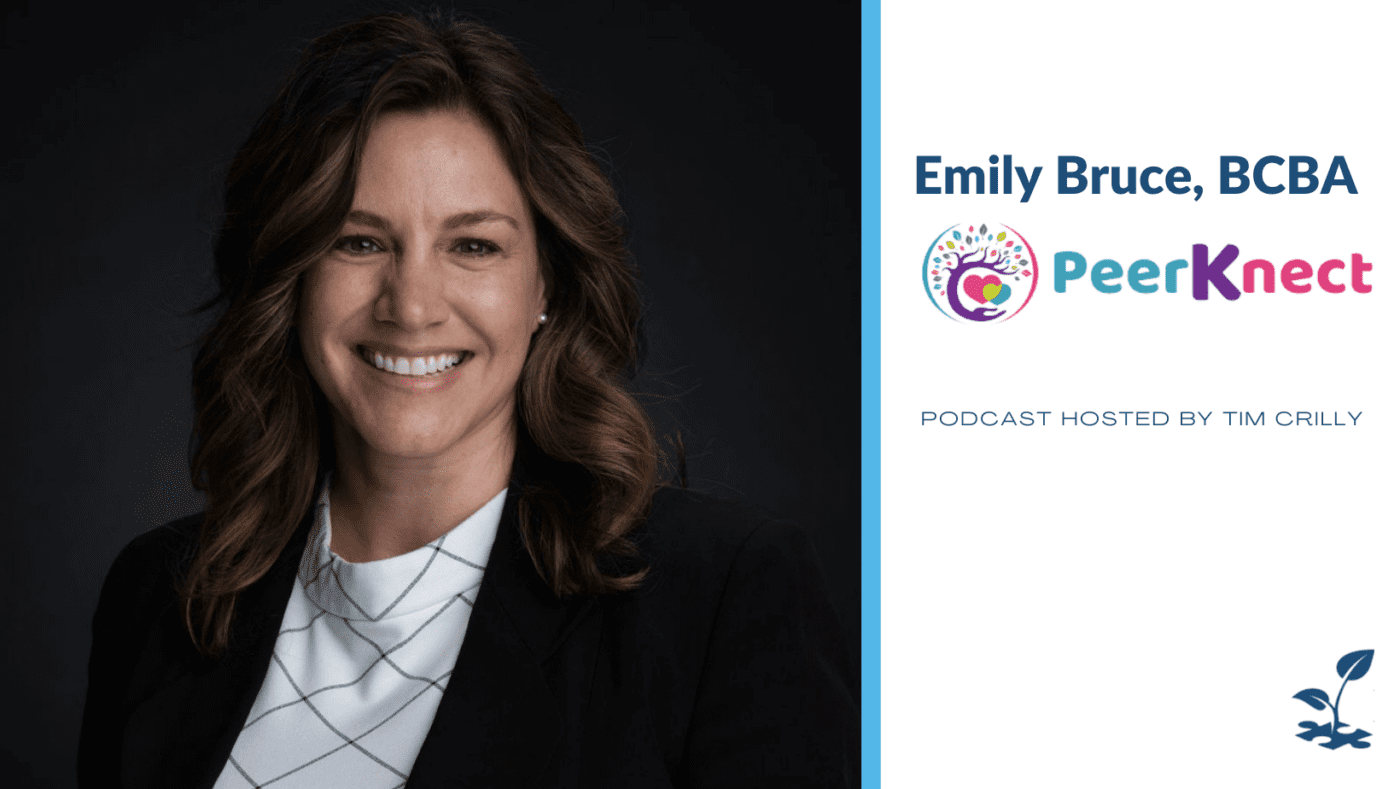
Season 4: Episode 1 – Emily Bruce BCBA Founder and CEO of PeerKnect

Hosted by Emily Bruce, Tim Crilly
March 21, 2024

Listen now:

or listen on your preferred platform:

Episode Description

To kick off season four of ABA Unfiltered, the team is joined by the Founder and CEO of PeerKnect, Emily Bruce, BCBA. Emily and her team are on a mission to help families build appropriate social networks for their children on the spectrum.  Tim and Emily have a fantastic conversation about the importance of social opportunities, the challenges families and clinical teams face, and how PeerKnect is offering a fantastic solution. Tune in to hear this great conversation and learn more about PeerKnect and how it can impact both families and clinicians.

Full transcript

0:10 Tim Crilly: Hello and welcome back to ABA Unfiltered. If you can believe it, this is episode one of season four. If you took the over on how many seasons we would have been allowed to do, hopefully you’re you’re getting that payout on that gamble. Somehow we we made it to four seasons, and I’m really excited about the upcoming season. And our first guest is Emily Bruce. She’s a BCBA. She is the founder and CEO at PeerKnect. We were introduced by a mutual friend back in the fall to sort of talk about some of the work that she’s doing in our community. And it’s just a real fascinating concept and idea. And I just was really excited that Emily agreed to come on and talk about it and her work and her passion and what she’s trying to accomplish for the population and the communities that we’re working with currently. Whether you’re with Blues Brig or another ABA agency or a parent out there listening, I think it’s it’s going to be a fascinating conversation for you to learn about and hear some interesting things that Emily and her team are up to. So Emily, before we jump into what uh PeerKnect is and what you guys are trying to do, would do you mind giving a little bit of background information on who you are and sort of your journey through through all of all of this, getting to where you are today?
1:36 Emily Bruce: Yeah, just uh, you know, a brief introduction. As you mentioned, I’m a behavior analyst. I live in Nashville. Um, I have a master’s in psychology. I’m the mother of two children, both teenagers, both typically developing. One’s in college, one’s in high school. Um, I had a small ABA therapy practice here in Nashville for a few years. Uh, and I transitioned all of my clients out this past July to focus 100% on growing PeerKnect and just, you know, trying to help families get connected.
2:09 Tim Crilly: Okay. So that was the short version. I’m sure there’s a lot of a lot of things that happened to get you to that point of running your own your own agency. So um, you know, it’s an interesting time to be an ABA owner. You know, I think uh last July was probably uh a trying time for a lot of people. So, you know, it’s it it we saw a lot of fluctuation in in the community. So uh I think you know, sort of the things that you’re trying to do and expand on the work that you you had been doing is is going to be a great conversation um for today. So I we talked about how this isn’t a scripted show and everything, but you did tell me a story uh when we when we first met about how this idea came to you and how it relates to your old life and and what you were doing before. So if you don’t mind, maybe kind of tell that story and then give us a little bit of information about what exactly PeerKnect is and what you guys are trying to accomplish.
3:11 Emily Bruce: Yeah, so um so I I came into the field of ABA later in life. You know, I was already a mom, um, had my children, went back to school, got my master’s in psychology, and then just kept on going to become a behavior analyst. I worked as an RBT first for a few years and then um, you know, passed the big exam, right? Became a BCBA. And I think because I was older and just, you know, had different types of experience, I was like, I want to do my own thing. But one of the things that I noticed when I was, you know, started out as an RBT working with families, is that I basically was always my client’s best friend. Um, and every parent would say, hey, do you know how to get me connected with another parent or with one of your colleagues for a play date or a social connection? Let’s work on play skills, let’s work on um, you know, building friendships. And I would try, but it was impossible. And um, you know, if if I could get connected, if I did have a colleague uh who had a client who was eight years old, they worked with them on Tuesday, I worked with my eight-year-old on Thursday. So it was just like this impossible thing. And once you start texting people, trying to make those connections, you know, as we would say in the field of ABA, my uh behavior was put on extinction because it wasn’t reinforced. So it was like we can’t uh just keep trying to connect and text everybody that we know every single week.
4:34 Tim Crilly: And you start hitting all those dead ends and it becomes more work than you can, you know, absolutely. Yeah.
4:40 Emily Bruce: And we’re already doing so much work anyway, as um, you know, ABA practitioners. So I it was just kind of a common theme with every family that I worked with. And um, I had one kiddo that I was working with just for the summer, and uh he was around the same age as my son, he was a young teenager. And um, it just so happened on one of the days that we were going out into the community working on some social skills, I had to pick my son up from band camp. And I didn’t logistically, I didn’t have time to take him back home. So um I was like, listen, buddy, you got to go with me, but you can just sit in the car, you can play your switch, you can sit by the pool at this this uh place that we’re going to and just hang out and wait for me. And so we get to the the the the place where we were having the uh the session, the community outing, and my client’s mom knew that my son was with me, and she knew that they were the same age, and she said, Hey, listen, since we’re working on social skills, would you mind if your son joined us? I was like, Yes, absolutely. You know, that that’s a wonderful idea. Now I I was thinking the same thing, but of course, you know, I can’t.
5:46 Tim Crilly: Yeah, you can’t initially.
5:48 Emily Bruce: So we go into this little room. Um, we’re at a center, we set them up on uh Super Mario Brothers. They’re playing video games. And um, you know, my my son is prompting, my client, I’m prompting. We’re we’re we’re trying to get them to engage and you know, not dye the characters, you know, all that fun stuff. And my um my client’s mom, I was so happy. I was like, this is wonderful, what a wonderful moment. And my client’s mom leaned over to me and she said, This is the first time he’s ever done this, you know, her son. She said, I’ve tried through Facebook, I’ve tried through meetup, I’ve tried through church, I’ve tried through school. You know, we’re in we’re in Nashville, so everything, you know, everybody’s connected to a church. And I was just like, this is not right. You know, this is how can you not get connected when you have all of these connections as an adult? Um, and from the time that I started working in ABA, I kind of had the idea for um an app or a platform just ruminating in my mind. I was like, you know, something should exist that connects families, that connects parents, that connects uh BCBAs or SLPs and OTs for social outings. And um so I um I left that session just kind of thinking, you know what, I’m gonna see if something exists. And I did some research, nothing existed. And I was like, you know what? I’m gonna do something about this. That was the moment I was like, I have to get these kiddos connected. Um, when my son was in the third grade, uh, he had a lot of anxiety. He he had a really hard time making friends and getting connected. He had just started a new school, we had moved. Um, and I remember just as a mom thinking, man, I just really want him to have a friend. I just want really, I feel like that would make all the difference in the world for him. And so I just kind of extended that to all of the parents that I worked with. When I’m their child’s best friend and we’re working on play skills, but then when I leave that session, they are alone. And so um I reached out to one of my good friends who happens to be my business partner now, Aram. Uh, he just finished his PhD in software engineering. So convenient for you.
7:59 Tim Crilly: Yeah.
7:59 Emily Bruce: Yeah, yeah. I was like, uh, he had his at the time he had his master’s in computer science. He was, he was beginning um his PhD program. And I said, uh, hey, I have an idea for an app, and I’m wondering if you could maybe create it. Like, can I tell you about it? So um he was like, Yeah, let’s meet for a cup of coffee. We sat down, we told him, I was like, I just want to connect parents with each other, a parent to a parent, a parent to a caretaker, or nanny or grandparent or somebody, or therapist, or even a therapist to a therapist for the purpose of finding a suitable play date for these kids. And he was like, Yeah, let’s do it. So we started coding back in 2018, and it evolved over time. Of course, COVID hit. So in the beginning, it was just in-person play dates. Uh, and then we added virtual play dates. Uh, we added filters so parents can search for play dates using filters uh according to their radius or their geolocation, so they can search for like within five miles or 20 miles or 50 miles, uh, gender diagnosis, age. Um, we added non-business hosted events, which would be like a birthday party or a karaoke party. I love karaoke, so I always say karaoke, but um, or like a holiday party, like a Halloween party.
9:17 Tim Crilly: Yeah.
9:18 Emily Bruce: Yeah, what’s that?
9:19 Tim Crilly: You put your own agenda when it comes to events. Like I got it.
9:22 Emily Bruce: Exactly. What I mean, I used to Nashville, so I mean well, and and listen, I would bring my karaoke machine to sessions with clients, um, and we would have the best time just singing. I was like, you know what, this is awesome, but I want them to have a friend to sing you know, uh all of their songs too. So duets absolutely so karaoke parties are fun, but anyway, so uh so then it evolved into being able to say, yeah, I want to have a birthday party for my child. I want five people to attend or 10 people to attend or eight people, whatever. And for for parties like that, it’s not just about having a birthday party, it’s really about um creating an event and an environment for kiddos to have an experience so that they can learn behavior for future experiences like that. So we’re enhancing the skills that they already have, we’re building upon the foundational skills. But I know parents want their children to be independent. They want them to thrive, they want to improve the quality of their lives. And so if they never get an opportunity to go to a birthday party, or if they host a birthday party and nobody comes, like they’re they’re missing out on some of those skill-building opportunities for them, just like going to a movie. You know, I love that so many movie theaters are hosting sensory-friendly movies because it does provide that opportunity for learning. Um, so then they can go to a movie that isn’t sensory-friendly at some point. Uh, but anyway, so as we as we um were developing, we added all these different features. We added um a place for businesses that host sensory-friendly events or caretaker training events or any type of event that’s promoting inclusion to post those events on the application. So parents basically can connect with another parent or caretaker or a therapist. Um, and therapists can connect with each other as well for that peer-to-peer interaction to work on those uh goals for their clients. And um, we also embedded ID verification because we want to protect our families. So, anyway, that’s what PeerKnect is. It’s we say that we build friendships and social connections for children with special needs by bridging the gap between parents, caretakers, and therapists. Um, and we do that using mobile technology. And um, you know, we tried to think of everything that we could, every feature, every safety feature. Uh, we’re still uh growing and developing, but that’s basically what we are. And that was that was the catalyst. That one story with my client was really what was like, I have to do something about this. I really do. I can’t just go through life knowing that these kids are not going to get connected.
12:00 Tim Crilly: Yeah, it’s, you know, and I I remember getting off the you know, the the call we had back in the fall and just kind of really thinking back on, you know, I’ve been out of practice for for a while as you know, as you kind of move through your career, sometimes you get far away. But I started thinking back on some of the the adolescents that I had interacted with, whether they were relatively high functioning or you know, wherever the sort of um you know social ability um fell, and I just started thinking about them. And and maybe back then didn’t it didn’t, I was younger and didn’t really register, or I didn’t have kids or kids of that age. And you know, now I have a 16-year-old and a 12-year-old, you know, and just thinking about how how hard that must be for those those families if you do have this adolescent who you’re watching grow up turn into a man or a young woman or whatever it is, and not not having that ability to have some of those social opportunities. And it’s not for a lack of of trying, but it’s for a lack of how do I go about making this happen? And I and I started to think back also the the point you made about how you sort of feel like maybe they’re their their best friend um, you know, that day, that time, that week. And I I I did sort of think like, yeah, I remember this one guy, and yeah, I probably was, you know, because I wasn’t that much older than him now that I think about it, looking back. I mean, I felt way older than him, but you know, I was young and he was a teenager, so we weren’t that far apart. Um, and it’s just, well, I I might have been a bigger part of his life, which is great and important, but it wasn’t the thing that is the most appropriate. And I that’s why I think this this work is really impactful and really amazing. Um, you know, I you know, if it only helps one person, you know, obviously, great. But you obviously we want to try to help as many people as possible. So from there, you know, sort of can you really just describe how does it work? So like who is it designed for? You know, if if you’re this type of user, you know, how does it work for you? If you’re a therapist, that sort of thing. So how do you guys, you know, sort of direct people to interact with with the app?
14:23 Emily Bruce: So that’s a wonderful question. Um so for parents, they would download PeerKnect from either the Apple store or the Google store. And we have two different account types for parents. So we have a free version, and all they have to do to sign up for the free version is just um, you know, submit their their email and create a password, and then the free version allows them access to all of the business hosted events in their area. Um if they want the premiere account where they actually uh post play dates or search for play dates or birthday parties and those other things, um, then they would go through, they would select the premiere account, which right now we are offering a two-month free introductory offer for our uh premiere account. Um, just because we we just launched, we did our soft launch last year, we’re trying to grow networks in different communities. We want our parents to use the app. Um, and in some places they might download the app and they might be the only one, but we’re trying to grow that network for them so that they can get connected. But um, so for the premiere version, they do have to go through ID verification. So, as I mentioned, we embedded um ID verification. We use a platform called AccuentGo, and they will uh verify a user’s identity in real time using eDNA technology. Um, and I did that because I’m a mom and as a BCBA, you know, I was like, I don’t want any of my clients to get connected with somebody that might be a nefarious character. And I always use that word if people laugh at me, but really that’s what they they would be. So eDNA technology checks your IP address. You know, if you’re in Nashville and it says um you’re supposed to be your IP address is in Washington, then obviously that’s a red flag. Do you have multiple aliases? Are you on a watch list? Um, and so you know, we do have to charge for the Premiere account because we do have ID verification. We also have uh Google Assist embedded uh within the application as well. And what that does is if you post a play date, there’s a button in the play date where you’re where you’re creating the play date. And uh Google Assist, you you push on the button, it pulls up a whole list of places in your area, so like libraries or parks or jump centers or play centers. Um, and then it automatically populates the one that you choose within the app. Um and that just adds that extra layer of safety to the parent because they know that this has been verified by Google, obviously. It’s a it’s a safe location, it allows them to meet in the community and not at their homes. So they know the person that they’re meeting with has been verified, and then they can also use Google Assist to find a suitable location for the play date. Um, once two people are joined uh within a play date. So if you request to join my play date and I accept it, then you will find out where the location is. Um, and then we can also chat within the app.
17:22 Tim Crilly: So, you know, those are some those are some features, but um so it allows parents to obviously connect and maybe get to know that other parent to to sort of learn a little bit more about what they’re looking for and what might be a good good fit. You don’t necessarily want a 15-year-old and an eight-year-old or whatever it would be. Okay.
17:40 Emily Bruce: So but you can look at the child profile. So if say you see Emily B has, you know, Emily B is a parent and she posted a play date, you would see eight-year-old um male with an ASD diagnosis. Um, so you will be able to see that information before you request to join. And then if you request to join and I look at your information, I can see the child profile and I can see, well, he’s, you know, I’ve got an eight-year-old and he’s got a 17-year-old. I don’t think that’s really suitable. So I’m not going to accept that play date. Um, but the other details, like where the play date is, that is not um provided until I have accepted um you and your request to join my play date. Okay. And so people can’t stalk, right?
18:24 Tim Crilly: Okay. And in theory, four or five people could could join an event, you know, especially if you’re talking about some teenagers or, you know, sort of those older kids, you can’t have uh a few that I’m assuming.
18:36 Emily Bruce: So well, yeah, so that would be um, so the play dates are are basically peer-to-peer, one peer to another peer. But the non-business hosted events, which we call parties and events, uh, that’s the that’s the tab that you would click on. You could uh have an event where you want four or five other teens to join. So you could have like um, you know, like uh game night or Dungeons and Dragons or social skills group, whatever you want to call it. And you can say, you know, I want five kids to join. And then it works the same way as the uh play date. So somebody would request to join. So if this is for teenagers, so anybody between 14 and 17, um, this is what we’re gonna do. Somebody requests to join and they have a five-year-old, you could say, well, I don’t think, you know, we’re looking for teens to join this group. So you could say not accept. But if it’s another like 16-year-old and it fits in that group that you want to accept, then you go ahead and accept them and then they find out all the details where it is, all of that. And then you can communicate in within the app.
19:39 Tim Crilly: So then from a so that’s a parent parent on a Saturday, whatever, you know, Tuesday afternoon, they’re trying to just find some social downtime for their for their kids. But there’s also a sort of a, I don’t want to call it a therapeutic, but there’s a an option for uh therapy teams to to be involved as as well. So how does how does that work? What’s your vision around that that application?
20:01 Emily Bruce: So we have two different types of business accounts. So we have business accounts for um like disability organizations uh who host events um or movie theaters or jump centers, whatever. You know, a lot of these uh businesses will host inclusive events because they want to promote community engagement. So um they would go to our website. We have a web platform, uh, we have professional accounts, so they would go to the professional account and then they would sign up through there. And again, they have to go through ID verification because we want to make sure that anybody who’s promoting an event is an actual verified business. Um, and then for the therapy practice, they would do the same thing. They would go to our website and sign up through our web platform. And they also have the option to promote any events that they might be hosting. So they would sign up. So therapy practices would sign up for the therapy practice model. Um, and that allows them to promote business uh events, I’m sorry, events, uh, caretaker training events, whatever it is that they’re hosting within their clinic. Um, but then they also have the option of adding what we call designated users. So those would be like BCBAs or RBTs or SLPs, OTs that work for the therapy practice. Um, and they can add as many as they want. If they have five people uh therapists working for the organization or 500 therapists working for the organization, they can add designated users and there’s a fee associated with adding, you know, however many you add. There’s uh bulk discounts. But then what they do is they add that designated user and it allows the designated user to download the app from the app store, and then they have their own account where they can post play dates or search for play dates for their clients as well.
21:48 Tim Crilly: Okay. So in theory, I’m, you know, obviously you’re working with the parent. This isn’t something that a therapist is just going rogue and setting up. No, no, no. Hopefully not. Yeah. So working with the parent and if it’s something that’s built into their their program it’s something that can be sort of used to further their their goals and and work on certain things that are that are following it to either their IEP or if it’s an insurance funded uh uh plan you know so those those are options as well to to take to take that sort of therapeutic environment and then bring it into the community with with new faces and and work on some of those things that were sort of outlined in that that that child’s uh program so I think that’s that’s a real interesting um opportunity for for you know clinical folks out there well you you know we always have goals right that we’re working on whether they’re verbal behavior whether they’re behavior social skills play skills my wife gives me some all the time so yeah so you have goals too totally get it um and we know as therapists that we cannot always replicate uh what happens in like the playground environment or a play date environment or in the community we cannot um replicate that in the clinical environment so we have to have those opportunities for that peer-to-peer engagement and sometimes it can happen within the clinic but sometimes it doesn’t and it’s also a really wonderful way to um teach parents so we always have that parent training piece so if we actually go with our client um on a play date we can model for parents what that looks like we can be prompting we can model for the client on those in interactions right we’re always trying to help um increase the the physical activity so you do that during a play date right you’re playing uh you want to help them pick up on social cues you want to help problem solving skills you want to help promote creativity and all of that does happen in a play date and it it happens through those peer-to-peer interactions and that’s why they’re so important so I can have a client and we’re working on play skills but a client’s going to view me so so we’ll use a technical language right we’ll we’ll use a technical word instructional control right so I always am going to have that instructional control and so what what that means is I’m that stimulus for Emily’s the therapist she’s going to reinforce me in a certain way we have a learning history together and we know what’s going to happen.
24:19 Emily Bruce: But in a peer-to-peer interaction it should be natural it should be organic these kids should be playing they should be learning how to communicate and a and a peer is going to not have that same instructional control as the therapist. So so we cannot um always generalize those skills that are learned with the therapist to that other play environment unless we have that other peer to help them generalize those skills. And that’s the piece that’s missing most of the time with ABA therapy. Yeah we can go we can have a DTT session right we can we can have them come to the clinic and we can go through their schedule blah blah blah but children you know we want them to play we want to promote play we want them to not you know you and I before we started this conversation we’re talking about rote responding right so we have something scripted then that’s not natural you just want to you we want these kiddos to be natural yeah so sometimes ABA can be a little bit rigid and sometimes ABA is criticized for the rigidity and you know I really want ABA to move in that direction of play and helping a child really truly thrive as a child um it’s not just about that rote responding it’s like how can we help them be their best self? And I think through play and these social connections making friendships, reducing isolation it’s really going to help uh kiddos thrive in a different way.
25:45 Tim Crilly: Yeah I mean if you’re working on a turn taking goal or you know something along those lines and it’s a 25 year old RBT working with a five year old or a six year old client is that really and they’re playing a game or whatever is that really turn taking or is that just compliance with an adult you know exactly following instructions by an adult. So I I totally get what you’re saying. And you know there’s there’s opportunities obviously with with center based um uh programming because there are other clients there and things like that but there’s not always the right fit or the right match. So I think that’s what this this added benefit is that it can help people find a better fit. Just because your neighbor happens to be the same age as you growing up doesn’t mean you’re automatically going to be friends with them because they’re the most convenient person. You know you might not really have the same interest and things like that. So you know sometimes you have to go outside a little bit to to find that that that better that better fit. So um that that you know it I think it’s really it’s really great. I think it’s really needed because you know we live in a world that’s obviously very technology driven. We have you know as I get older the the the parents we work with are are getting younger and the kids are getting younger. So this is a world that they’re a little bit more accustomed to and it’s sort of you know how do you meet people and you know through whatever various uh you know online platforms is it’s a little different than than when I was um coming of age I guess is a good way to put it so I think it’s great that you guys are are are putting something together that can can help because it’s a it’s a huge need. I think everyone would agree that the the the more social opportunities you have I think we’ve all learned that lesson over the last two years. Yes so yes how just important it it is. You know so I I I I commend you and I think it’s great. So before we start to wrap up where can people go directly to to learn a little bit more read up a little bit more about you guys?
27:49 Emily Bruce: So PeerKnect is uh we have a unique spelling it’s P-E-E-R-K-N-E-C-T so connect is K-N-E-C-T so if they just go to peerknect.com um they can find out more on our website but also just go to the the um Apple store or the Google store and type in PeerKnect all one word that’s P-E-E-R-K-N-E-C-T and and I want to add something to what you just said about social connections um it’s also a great way for parents to get connected because we know with our families a lot of times the whole family um experiences that um social isolation and which increases anxiety it decreases um depression it and and just makes you know the quality of life decrease and so PeerKnect is not just for uh the special needs community uh we say that we build friendships and social connections for children with and without special needs so you don’t have to have a child with a diagnosis to use PeerKnect and a parent who might have um you know one kiddo on the spectrum and one or two kiddos that are typically developing they can use PeerKnect to get the siblings connected as well because we know that a lot of times the siblings because mom is mom and dad are spending so much time going to all these different therapies for the kid with special needs a lot of times the siblings get left out so this might be a way for mom to find a play date for a sibling get connected with another parent and just really help the the sibling improve their quality of life and reduce that isolation for them as well. So you know we I did I was inspired by the special needs community and the autism community because of the families that I worked with. And then as a mom, you know I mentioned you know with my son when he had anxiety um just knowing what that felt like as a parent I would have used PeerKnect when he was in the third and fourth grade. I would have because I really knew how important it was for him to make friends and get connected. And as you mentioned COVID has shown us for the past two years how much it stinks to be isolated. Yeah we know families who’ve been doing this for 20 plus years, right? That social isolation because of um what’s happened with their family. But anyway it really is a way to get connected and and we did create it for this community but but then we’re like you know what there’s so many other families out there. Like you said the younger generation um they do use technology a lot more and they do get connected through um applications and social media and so you know it’s it’s for everybody it’s for every parent. And I I I did include the therapy model because with you know BCBAs we are the gold standard they always say right for ABA therapy. But we also have the opportunity to go in the community and go in the schools and go in the home and provide support in different um in different locations whereas other therapists don’t always you know they they’re not approved for that. So you know if we can help kiddos generalize those skills get connected enhance those the the skills that they already have I think you know we we’re doing wonderful things. That’s that’s what I’m hoping for anyway.
31:06 Tim Crilly: Yeah I’m really glad you brought up the the the family that’s something we didn’t get to touch on when I first met you and I I think it’s so important and it’s something we try to preach around here. I think it my my first sort of realization around uh the impact of the family or or how a behavior you know uh an ABA team coming in can could can be an influence on that was when I was at Magellan um I I work for Magellan so we we manage the ABA uh authorization process you know nationally for Magellan and I started to realize like oh my gosh there’s families in crisis all I have to do is walk over to this row over here and there’s gonna be mental health professionals that can reach out to this family to make sure that they’re getting everything they need and just sort of communicating with those ABA teams around okay it’s not just about little Timmy what else are you guys you know seeing is there anything that you know we should be aware of what should we be looking at and sort of that sort of opened my eyes to the idea of you know if you’re a parent and maybe you’re not in the best mental health situation at the time of of of treatment then you need to to really work on that as well because you know if if you can’t if you’re not if you’re not ready for it then it’s not going to be as effective um intervention. So it’s really important that that not you’re not isolated you’re not alone and you can like to your point go out and meet other parents that are going through the same thing that that have that ability to say yeah it’s hard I get it you know and and really come from from that that point of view. And I love the idea of it’s not just for uh you know kids on the spectrum or special needs it’s for everybody anybody who’s out there that might be struggling from a social standpoint or parents that have kids that excel at bringing people together like get them on there as well to be some of those those models and and and bring those kids together and and and help um help kids make friends because I think kids helping kids is a lot better than grown ups telling kids what to do.
33:16 Emily Bruce: Absolutely and we love our we love our peer models right and we love those kiddos like that. You know I’m I I’m sure that you’ve heard stories of parents you know who had a wonderful group of friends and then they had children and then one of their ch children had a diagnosis and they were engaging in what we call interfering behavior or problem behaviors. And their friend group kind of dropped off. Right. And so which is so unfortunate and so unfair but this is a way for maybe parents to gain a new friend group because they can meet with parents who understand and maybe are going through some similar situations. And so it really is a way just not not for the child to get connected but also for the parent and like I said their siblings it’s really um not just an application you know we don’t want PeerKnect to just be technology or an app. We really want it to be a movement to promote inclusion. That’s why we added the business model on there. So businesses can promote their events we really want those businesses to promote community engagement but we really want families to get connected as well.
34:24 Tim Crilly: Yeah and I don’t mean to put anything else on your plate but there’s probably a lot of opportunity for some research within this as well. You know so I don’t know if you’ve started to pull the string on that but it would be really interesting to see what sort of these relationships, these mini communities that you’re building what that does for a sort of quality life index for for um for for families and and clients so you know just something to consider in 2022 if you want to get a research uh paper going and and and put a you know maybe write a book why not?
34:54 Emily Bruce: Well I am this I don’t know if we mentioned if I mentioned this when I met with you last time but I am working on my PhD I’m in the dissertation phase PhD right and that was a suggestion that one of my chair people had for me was like why not do something with PeerKnect and do like a pre and post um you know survey and see if if quality of life improves but I I have developed a behavior skills training application for my dissertation. So that’s even more technology to help the field and help parents out.
35:28 Tim Crilly: But anyway so we’ll we’ll have a conversation about do it on your side do it on the side later.
35:32 Emily Bruce: Right right right that’s fine but yeah absolutely I think research would be uh I would love to see PeerKnect used in research.
35:39 Tim Crilly: Yeah I I think there’s a lot of um a lot of opportunity there’s got to be uh maybe some of the university folks that that I know listen maybe they can reach out to you get something going on yeah that’d be wonderful. So um Emily it was so nice to to see you again and and get a chance to really dig in and chat. I I I’m really excited to see where this goes and you know I just want to remind anybody out there listening go take a look just read a little bit more about um Emily and her team and what they’re doing um and pass it along to to any family or or you know clinical friends that you might have that you think would benefit from from this opportunity. So um you know thanks again for for being here and for all of you guys out there listening. I’m really excited about um season three and and this was a great way to kick it off. So so thank you everybody and um tune in next time for another episode of ABA upfilters

Find a center near you.