Episode Description
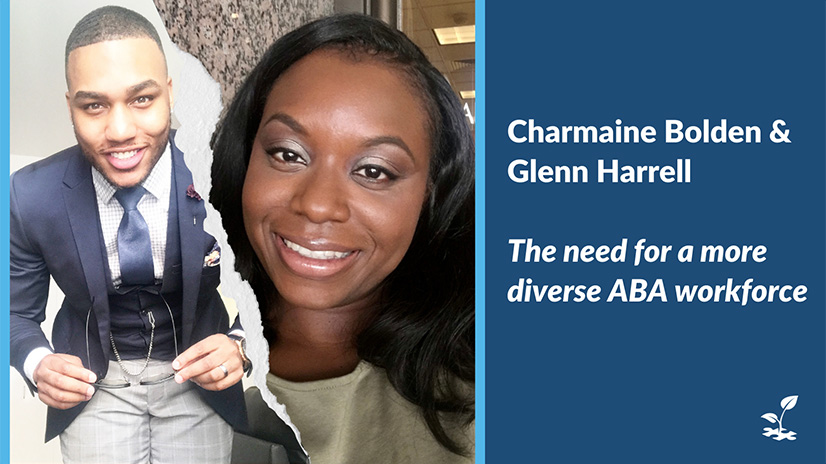
In this week’s episode of ABA Unfiltered Tim is joined by BlueSprig BCBAs Charmaine Bolden and Glenn Harrell to talk about the lack of diversity in the ABA community. Tune in to hear poignant commentary on the state of diversity in the ABA landscape, their thoughts on how to improve the issue, as well interesting stories about how Glenn and Charmaine found ABA and careers as BCBAs. Their passion for the families and communities they work with is palpable in this insightful conversation.
Full transcript
0:11 Tim Crilly:
Hello and welcome back to ABA Unfiltered. I’m your host, Tim Crilly, and today I have the great fortune of being joined by two fantastic BlueSprig BCBAs, Charmaine Bolden and Glenn Harrell Jr. But apparently, depending on which side of his family you ask, there could be a different pronunciation, but I’m going with Harrell today. So they’re here to talk about uh the ABA industry as a whole and really what can be identified as a lack of diversity in this community of clinicians and the academic part of the whole process. So I’m really excited to get their perspective, learn a little bit about them because to be honest, uh I’ve chatted with Charmaine a couple times on clinical things, and I just talked to Glenn for the first time last week. So I’m gonna learn a lot about them today, along with you, and I’m really excited about that. So, you know, hopefully they’re interesting. I don’t really know, but uh I get the feeling that they are. So before we get started, uh Charmaine, can you just take a minute? I’m gonna make you go first because you seem the most nervous. Uh can you just go first and introduce yourself, um, you know, your role at BlueSprig, uh, you know, and and sort of how long you’ve been with the with the uh organization.
1:28 Charmaine Bolden:
Absolutely. Um, so I am a market director in the DFW area on the Fort Worth side.
1:35 Tim Crilly:
That’s Dallas. That’s Dallas for anybody outside of uh out of outside of Texas.
1:40 Charmaine Bolden:
True, true. I forget there is another statement. Um so I’ve been with BlueSprig since November of 2018. So pretty early on with the company. Yes, uh, one of the first BCBAs actually in the Dallas Fort Worth area in Texas.
1:59 Tim Crilly:
Okay, what is a market director? What is that? What’s your role? So, what does that give you responsibility over?
2:05 Charmaine Bolden:
Yes, so market director is a new term for us at BlueSprig. So previously we were called area clinical directors. So primarily I help oversee centers. So the operations managers and the clinical directors, I work with them directly very, very closely day in and day out. And we look at the operational key pieces such as um incoming clients, getting those new staff ready and those therapists trained to work with the clients and then the clinical directors, just the ongoing quality of care for the client. Okay.
2:40 Tim Crilly:
So you have an operational and a clinical sort of role to your to your daily life. Absolutely. Fantastic. Okay. Glenn, I know it’s hard to follow. Uh she she knocked it out of the park. So uh give us, give us, give us a taste.
2:56 Glenn Harrell Jr.:
Yeah. Okay, so uh I am over. I am a BCBA. I was licensed actually um uh eight months ago, I believe. Congratulations. Uh yeah, thank you, thank you, thank you. It was super exciting. Um and I actually just made my one year at BlueSprig, which is awesome, and January 15th. Um, so my role at the Bel Air Clinic is the clinical supervisor, and I literally spend most of my time interacting with the clients, the therapists, uh, and pretty much anybody at the clinic, the parents. Um, my normal day-to-day uh looks like uh updating treatment plans, uh writing treatment plans because for some reason six-month authorizations go by so fast. It’s like I feel like I’m doing one or two um a month. And it it it’s it’s fun. It’s fun, but it it can be uh tasking for sure. Um, and then other than that, trying to find different and innovative ways to um teach the clients. So that’s kind of uh what my role looks like uh from a normal day-to-day, but I love it.
4:00 Tim Crilly:
Cool. You know, well, congratulations. You know, that that’s a great achievement passing that that process and and getting into this this club of people. Uh, you know, um, I think it’s a lot harder than than when I had to do it. So I’ll I’ll tip my hat to you. Uh the rules have changed over time. I’ll I’ll I’ll I’ll give you guys credit on credit on that one. So along those lines, and you know, I think we we talked a little bit about it before we we started this this recording, but I I’m always fascinated to hear a little bit about how you know people end up in this world. Because if you don’t, if you’ve never heard of it, I don’t know how you’d ever think, well, that’s something I want to do. I want to be a BCBA and do this. So I know I know for me and a lot of people that you know, sort of in in my demographic age group, uh, we sort of fell into it because it was a less established um process at the time. So can you um, Charmaine, can you just give us a little story about how did you end up a BCBA? How did you end up in the ABA world?
5:02 Charmaine Bolden:
Um, similar to you, I really fell into it. Um, so after um school, I actually went and I was working in an immunology lab. And it was great for the science and the pieces of that, but I didn’t have any or a lot of direct contact with people, and I was really missing that. And so I started volunteering for various groups in the area, and I ended up volunteering for a program with a young girl who was autistic, and I loved it. Um, I got to interact with her and her siblings and her family, and they were talking about just various therapies and things like that, and I was really curious, and so I started researching and I found a program um for ABA. And so I did the University of Cincinnati program um online, and I decided to just kind of dive right in, and so I went and found a job that was doing ABA and I went to school at the same time, and so I had just that combination experience. So you never look back.
6:10 Tim Crilly:
That’s cool. So you had a you had an affinity for science research, uh, but you need a human, the the human side of it. I I think that’s a great combination that that this field offers. You can you can dig into the to the nerd data stuff and and really try to examine things, but you also get to you know put your hands on people’s shoulders and and and really get to be involved in in seeing the improvement. You know, I last week’s episode we we had um some folks from the Cedar group on, and you know, they’re they’re they’re a sister company of ours, and they’re working on sort of outcome measures and some tools that they’re gonna be able to put in your guys’ hands on a clinical basis. But one of the key factors, uh well, yeah, wait to I wait to see. Uh but one of the one of the factors we talked about was sort of that um an outcome measure about you know that that family satisfaction. How are you improving the lives of those families? So I think that’s a key element to sort of what you were just describing. You got to go out into the community and be, you know, adjacent to these families to see them make those those leaps and leaps about. So that that’s that’s really cool. Glenn, young guy, um interested to to hear how you how you fell into this.
7:28 Glenn Harrell Jr.:
Yeah, I and I and it’s exactly that. I think I kind of stumbled into it uh accidentally, uh, like most people that I hear of. Um I think for me, um my path was similar in the sciences, uh, and in that my goal since I could remember was to be a doctor. Um I come from lower socioeconomic status. So for me, there’s a very few, a handful, I would say, of careers that we all kind of look towards as ways to escape uh the status that we currently lived in. Um and for me, I chose doctor. Uh sports seemed a little bit too cliche, although I did play pretty much every sport. But um I ended up going to um Florida Institute of Technology, FIT, uh, on a pre-med scholarship. So I went there pre-med biology um after graduating from Valley Forge Military Academy with an associate’s degree in biology life science. Uh I went there with the goal of just learning people because I grew up as the older sibling and I was just always interested in why people did what they did. So I’m like, huh. I mean, I’m interested in being a doctor. Maybe this is where I’ll learn that at. So I did internships in high school, uh, internships in college, and I’m doing labs, and I’m like, oh, I’m doing a lot of math and a lot of science, but there’s not a lot of people stuff. Where is that? What part is that? So maybe when I pursue my bachelor’s bachelor’s degree in biology, maybe I’ll start to see some of that human interaction that I’m kind of looking uh forward to. Um, and then I got up to like the end of my junior, senior year, and I’m like, you know what? I completed all the courses in my mind, I’ve fulfilled my obligation to getting past of the hard stuff that I kind of set on myself as a milestone. Um and I got to a point where it was time for an internship, and the school was like, you need an internship or you can’t graduate. And I’m like, there’s no way I can do more of this science-y stuff because I’m bored out of my mind. 300 people lecture halls is just not cutting it for me. We’re the people. Um, so luckily, we had an uh autism treatment center on our campus at FIT. And I went in there for an internship um like review session, and I just loved it. They were talking about SDs and they were talking about motivating operations, and it was just like cause and effect. And I’m like, wow, everything I’ve pretty much dedicated like my early years to in terms of science, I found right here in one day just sitting at a roundtable meeting, not even an intern yet. And I’m like, you know what? This this is it, this is it. Um, no longer want to pursue uh the the medical school side of it. Everything I want is in this field, it’s right here. And then when I talked to the people, they were literally telling me it’s like a step-by-step process. You start here, and if you want, you can get here. And they were they were right. I started as a BT uh with the RBT route and I like step stairs up until my way to BCBA. I actually um started with an MBA um and then found out that the BCBA rolled out new requirements. So I went back for uh a second degree, and that’s kind of how I got to my BCBA.
10:44 Tim Crilly:
Okay, so to describe I fell into it, I I don’t think that’s quite accurate. I think both of you, both of you actively seeked something that filled filled a passion for you. And and I I can only imagine what sort of clinician that that makes you. Because I became a BCBA because Dr. Sharyn Kerr, you know, who who you know works with us, I I worked with her um a long, long time ago when I was first starting my career. She said, uh Tim, if you want to keep doing this job, you have to go back to school. So that’s that’s literally how I how I fell with it, how I fell into it.
11:19 Charmaine Bolden:
Okay.
11:20 Tim Crilly:
So yeah. When I say fell into it, more pushed, I guess. So um, but that that was great. You know, and I think those are the kinds of stories that shed a lot of light onto why this is such a peculiar um work field. There’s not a lot of people like you wanted to be a doctor and you tripped over ABA and was like, wow, this is really cool. You know, um that it’s probably a a core reason as to why we don’t have the the size of a workforce, A, that we need, um, and and B, probably why we have a less diverse workforce than we probably we should have but at this point in in time. So I do want to touch on that a little bit um as we we dive in. But thank you. Those were those were great stories. I think producer Lucas is probably rethinking what he wants to do uh now as he’s getting ready to graduate pretty soon from from school. So um he’s probably feeling a little inspired. Um so you know, when we look at when we look at this this community, um the the academic part, the you know, of of the whole process is is primarily older white men that are developing and training the future generation of clinicians, BCBAs, who are primarily white, white women. Um you know, obviously the the the field has begun to diversify over time, but I look at a a world of autism that runs the spectrum. Um, you know, in a country like America, you can have hundreds of different languages being being spoken in in the home, and you have families with uh with um children with with autism that you know English isn’t their primary language, and yet we have prime you know a primary workforce of 23 to 35-year-old, you know, women. Uh so what do you guys see as a way that we can maybe start to um make make changes on that? You know, is there a way to get more more diverse um people interested in this process? So I’ll I’ll sort of open it up there if you have any any thoughts on on what it what we could be doing as not just individuals, but you know, us as a community of people like BlueSprig or the board or the various sort of um you know sort of professional associations that are out there. And any thoughts on that? I’ll put you on the spot.
13:57 Glenn Harrell Jr.:
Yeah, um, I think um where I would start off is I would say the board being like the entity that that we all kind of all fall under, I think we would need the board and all the participants in the board too, or I would say probably better, uh the leaders of the board to be intentional about increasing or diversifying the field. I mean, all the applications come through them, all the regulations come through them. Um, and I think if they created maybe a task force of people um who went out and tried to um connect with uh minorities where they are, uh at maybe uh uh uh HBCUs that are predominantly uh people of color, black people, um, and or non-PWIs, um maybe reaching out to or speaking to non-psychology majors, uh, maybe where uh athletes or or people might hang out. I think that’s where we need to start. Um, because I think right now where we are, we’re just kind of speaking about it and kind of raising awareness through social media and um like email correspondence and things of that nature. But I don’t think there’s a lot of intentionality behind it. Uh like put it in people’s faces just like we do psychology, um, because that’s the only way people are gonna find out about it. Right now, people are kind of finding out through like word of mouth and like the grapevine effect. Um, and we see change happening, but I think it’s happening at a much slower rate than it could if they created programs that were focused intentionally on that and not going from um, okay, this is what we plan to do, but now we’re gonna make it a little bit broad so that everybody’s comfortable. Like, no, if we need to increase the black demographic, then create something that’s specifically targeting the black demographic as opposed to everybody, um, because there are other areas that need to be targeted because of the low numbers, but just just being intentional. I think that’s kind of where I would say uh it needs to start.
16:05 Tim Crilly:
Yeah, I I I like that. I think you know, if if you have those professional organizations that really put a commitment towards um community awareness, I guess is maybe a way to put it, you can you can start that because then hopefully if they’re putting out ideas, measures, uh sort of ways that groups like like BlueSprig or other larger or even small, oh I never thought of that. Hey, maybe this is uh this is how I can uh you know sort of get folks involved. So, Charmaine, I don’t know if you have anything to add on that. Uh it looks like you do.
16:42 Charmaine Bolden:
I do. Um, very similar to what Glenn was saying, I think just to kind of add a little bit to that, you know, within the organization, there are several, you know, um black people or just or people of color just in general that work for the organization in different capacities. So they may already have their BCBA, they may be seeking their BCBA, they may be joining us as just a BT, or even during the application process. And so, you know, I’ve worked for various, a lot of different organizations and companies within this. And sometimes it starts there. Just who do you have internally working for you? Are you intentionally putting that and pouring into them to help them grow? Are you intentionally talking to those who are hiring about what they’re looking for? You know, are they having the right standards when they’re hiring? Are they indirectly um maybe teasing people out in the application process? You know, and so they never kind of get started in the field.
17:44 Tim Crilly:
So you brought up the BT or the RBT, you know, is do you feel like that is a good place to start sort of targeting a younger group of people and starting to educate? So I are you guys in your, you know, I know Charmaine, you probably have a larger um control over hiring process and you know, sort of what you’re doing in your in your role with with BlueSprig, is that something that that you’re doing, we’re doing? Um, have you seen any sort of uh effect on that? Sort of getting them while they’re young and and sort of showing them what a you know a career path could look like. Because I do think if you if you like the work and you’re willing to do the hard, the hard job of being an RBT and getting down there and your knees hurting every day and you know, all that sort of even as a young person, I mean mine hurt any mine hurt anyway, but uh you know, it you can outline a career path for someone if they’re committed to it, because it’s not easy because you got to go back to school and all those things. Is that something that we we’ve had any sort of um success in doing, or is that something that we’re looking to try to do? I I don’t really know. And if if you have any insights, that’d be great.
18:55 Charmaine Bolden:
Yeah, I think both. Um, I think BlueSprig as an organization has had a lot of success I’ve seen when I compare to other organizations I’ve been a part of. And I credit a lot of that to Keith, honestly, just because when you hear him speak about diversity and different things going on, it’s such an inclusive message, right? And so it really empowers and motivates those who are in hiring positions to go out there and seek that as well and try to create that same type of diverse background in their centers and within their area. Absolutely.
19:30 Tim Crilly:
Okay. Uh so you talked about you talked about Keith, and I know um, you know, last geez, June, July, I don’t know. I you know, I know sort of uh a light bulb went off, and I, you know, and it was obviously the the country was staring at a lot of a lot of factors, a lot of change happening um in everyone’s community. I it’s hard to picture uh um even small towns that didn’t have um you know sort of protests and and things going on. So, you know, from from your perspective, the way that that BlueSprig has sort of said, hey, how are we approaching this? What are we doing right? What are we doing wrong? What what have you guys seen that that that feels feels like the right thing? And are there any things that you think that we could be doing better?
20:21 Charmaine Bolden:
Um I I’ve had a lot of experiences. Um, and I would just say some things that are right, you know, we have started things such as the Kintsugi group, um that’s on a high level, looking at organizational changes. I think we can also start to implement maybe smaller pods or pieces of that um within the clinicians to kind of help them focus and maybe have some um mentorship at a lower level as well. You know, I look at different client situations that I’ve been a part of where, you know, at previous organizations it may not have been handled the same way. And so what I mean is I’ve been a part of a situation where a client has made comments. They did not directly say anything racial or anything like that that we may be able to take to a court of law and say, you know, they were discriminating, but it was the tone and some of the language used, and BlueSprig or recognized that and said, absolutely not. We are an inclusive company. We want everyone, you know, no matter the color of your skin or where you come from, to feel comfortable comfortable working with any of the clients that we have. And so those are definitely some personal experiences that I’ve been through here that I would say, yes, they are taking the steps into getting it right. Um, like everything, we still have room to keep going.
21:45 Tim Crilly:
But for now, I think we’re definitely taking Yeah, I that’s that’s you know, I don’t think anyone feels like it’s possible to flip a switch. No, it takes a while. It takes a while. Um, you know, it’s it it it’s it’s amazing that it took this long. But you know, I’m I’m proud, you know, I’m I’m proud to be a part of at least an organization that is raising their hand saying, hey, let us know how can we how can we make any any changes to to improve to improve the the perception or the actual quality of your daily life here as an employee and a member of a community. So um, you know, that that that makes me feel good and and I I hope it it resonates down to to the people that it matters the most to. Anything to sort of top on that, Glenn?
22:33 Glenn Harrell Jr.:
No, I literally think uh Charmaine hit it right on the nail on the head. Um, but I guess if I was going to add anything, it would just be uh that that constant trickle-down effect. I think the company does an incredible job on like the grander, more corporate side of uh bringing up those issues and making sure those conversations are had because it it’s necessary. It’s so necessary, but I think when you get down to the level that might be lower, uh maybe like the the BCBAs and lower, I think that information isn’t conveyed um at this at the same rate or with like the same intensity and magnitude, so that our BTs and RBTs fill it as well. So I would say that probably would be uh the difference for where where the company’s excelling versus where I think there’s some areas for improvement.
23:20 Tim Crilly:
Okay. You know, and I think that’s that that’s a reasonable expectation of a of a group that’s growing at the rate we are. So I think all those things are are under uh under uh consideration. And I know it’s we’re just at the beginning uh of this. It it you know it’s it’s it’s gonna take a little bit longer, um, you know, uh moving moving forward. So you know, you know, Charmaine, you did touch on some some obstacles, obviously, that you faced with I guess more of a perception or attitudes from from families. How about you, Glenn? Is there been any sort of things in your professional career that that stand out to you as you know as a similar situation?
24:01 Glenn Harrell Jr.:
Absolutely. I uh I don’t I don’t think that would be would would be avoidable. I think when I started ABA, I started in Florida. Um and you see you see it everywhere. Um, even if the families don’t say it, or even if the clients don’t make the the direct remark, it’s all in the energy, and like the energy, like you can you can literally feel it to the point where like you you might feel nauseous. So I’ve had encounters with parents, um, other practitioners um in the form of microaggressions that I still see daily here at our company, and it doesn’t um mean like explicitly like that these people are racist, or you can say make those type of blanket statements, but those those microaggressions again matter because they’re rooted in systemic racism. So I think uh it’s an experience that we all go through and that we all talk about um I mean, off the clock um to kind of console each other because it just happens. Uh, I’m nervous every time I get a new client and I gotta turn the camera on because I’m not too sure whether or not the Pamela’s the family is gonna be receptive to how I look, which I believe is non-threatening and not with your smile.
25:11 Tim Crilly:
I know this is uh a podcast, but uh I don’t know how anyone could could see that that thousand one smile and and be worried.
25:19 Glenn Harrell Jr.:
I appreciate that.
25:20 Tim Crilly:
I mean, other than you’re an Eagles fan, I’d say that would probably be the only uh misgiving I would have about Eagles, we struggle for such a long time.
25:30 Glenn Harrell Jr.:
We struggle for such a long time.
25:32 Glenn Harrell Jr.:
Okay, but uh yeah, but um it does happen. I it’s it’s just something um I think if if we’re gonna approach it, it’s gonna come in the form of like uh cultural sensitivity training to the employees as well as the families, just letting them know what they’re coming into, yeah, and how prepared and how qualified that all the practitioners are, and letting them know that like we stand behind our people so that families who don’t have our best interest in mind or might have their own agendas, they just know that this might not be the company for them. And having a company say, hey, if you don’t like like the type of people that we employ or have any issues with that, then we’re just not the police for you. And I think that’ll that’ll that that’s the stamp that that we all want to see, and I think it’ll be helpful.
26:20 Tim Crilly:
You know, I think something that maybe uh you know you, a couple others, a group of us, maybe you know, we should think about how do we get out on the um once we start having conferences again, let’s get out on the conference circuit and let’s start presenting on various things and you know, maybe see what the Kintsugi group puts together and and and get out there because you know, the the more you get up and you have a microphone in in front of you and you can open some some minds, you know, the the better. And you know, you get into certain certain groups and you have you have ownership groups, and you know, the more you can make things apparent to them, you know, maybe we can see more of a global change. So I think I’d have a lot of fun hitting the road with with you guys. I’ll just I’ll I’ll share it and just you know sort of ask softball questions and then you know get get out of the way. But I think that would be that’d be a great thing for I think BlueSprig to to get out in in in front of as well, assuming we ever have a conference uh ever again, live and in person. So um, but it’s which I’m I’m sure we will. So uh, you know, I before we wrap up, is there any sort of just anything you guys want to throw on top? I’ve really enjoyed listening to you and your the your passion for your work is is um is evident. So hopefully, you know, I know people can’t see your faces when they’re they’re listening in their cars or whatever, but trust me when I say this, you can you can see it in in their eyes that they really care about the work they’re they’re doing. And you know, that that makes me proud to be a um you know uh one of your co-workers. So I I I applaud you and um and I I thank you for your your time.
27:56 Glenn Harrell Jr.:
So any last minute things for me, I would say uh I would just ask people to to always remain conscious. Um, I would I think because of the field that we work in, we all know um that autism is a spectrum, which is why we made the big shift in the DSM. And I think if you can accept that uh the disorder is uh diverse in nature, then you can only expect that in order to reach out to the diverse field that we serve, the diverse population, that you would also need a diversity in practitioners. It’s so important. Um, if we really want to change the world with people in autism, like we we have to target all the differences. Um that’s that’s probably what I think.
28:43 Tim Crilly:
Fantastic. Charmaine, any last nuggets of wisdom?
28:48 Charmaine Bolden:
Yeah, I think Glenn just mentioned a lot of it. Um, just wrapping up, thinking about, you know, again, I think the more we can push this as an organization, you know, because we are growing and getting so big, you know, getting the word out there, looking internally at the employees that we do have and how we can help them grow and help them move forward with the mindset that we have, and maybe we can help change the field, putting more of those action steps in place, like we’ve done for so many other things.
29:19 Tim Crilly:
Okay. And Glenn, real quick, I know you’re wearing a Hillman t-shirt. Um, you know, so are do any do any? I I saw when you were when we first got on.
29:29 Charmaine Bolden:
Alabama state. I didn’t think anybody was gonna know this. Okay.
29:33 Tim Crilly:
Um are there any are there any ABA programs within that that group of colleges? Are is there is there an opportunity to maybe be out in front of that and and work with group of universities to create it, you know, an ABA masters with with the the programming?
29:50 Charmaine Bolden:
I there definitely is. So I attended a HBCU Alabama State, okay, um, in Montgomery, Alabama, and there wasn’t anything, right? Or, you know, recently we do a lot of research, we have interns constantly asking us where we should go to school, and I haven’t come across any of that, but I definitely think you know, we get out there, we do some groundwork, plant some seeds. I think we can help.
30:16 Tim Crilly:
Yeah, I mean, because you know, you can you can build an online model, it it takes a while, um, but it’s it’s it’s I think it’d be a fantastic conversation to start. And why shouldn’t we be the ones to so we have to we have to get it started before this airs in two weeks and no one steals our idea? Yeah, okay. So hang up, get on the phone right now. Get on the phone right now. I don’t like people to take take our ideas.
30:41 Glenn Harrell Jr.:
No, that just just before we leave, I know we we weren’t going to talk about spend a lot of time talking about Kintsugi, but that’s one of the things that we have been working on. Um uh one of the the subgroups that we have a part of the Kintsugi um is uh HBCU relations. And one of the things that we’re trying to do is develop these relationships with the HBCUs across the country, starting with the HBCUs that exist in the same areas that BlueSprig currently operates, and seeing if we can develop a relationship where maybe we can come in and we can introduce the field to them at a very basic level. And from there, if they don’t have master’s programs for ABA, maybe seeing if we can kind of institute some programs or just kind of spark the minds being in the area where people of color are and getting them interested and letting them know that there are career opportunities uh here at BlueSprig in the form of internships that could lead to full-time positions um and outside of the organization.
31:37 Tim Crilly:
Yeah, I mean, it is a it’s a not a bad job for a college student to to work as an RBT because you have, you know, you can create the flexibility in your schedule, put a couple bucks in your pocket, make a difference, that sort of thing. You know, and like we we talked about earlier, it can spark something that says, wow, uh, this is the worst job ever. I’m out of here, but at least that person knows. Or wow, look at this impact I’m making and and and pursue that. So uh okay, I kid. Anyone who heard me say that, I kid. It’s a fantastic career opportunity. I really, I really appreciate it. And I would love um in the future to have you guys back on just to talk about anything, um, you know, just where you’re at, what’s going on, sort of updates um as it relates to this this topic because it was really interesting. I was shooting for 20 minutes and we’re you know close to 36 minutes here. So um and it flew by for me. So hopefully um it flew by for everyone at home. So again, thank you, thank you for joining. Um, you know, Glenn and Charmaine. Hope to have you back soon. And I hope to meet you in person at some point in in 2021 when we can all start to be together again. So um thank you and and thanks to everybody out there for listening to ABA Unfiltered. Uh, hopefully tune in next time for some more uh powerful, powerful guests.