Episode Description
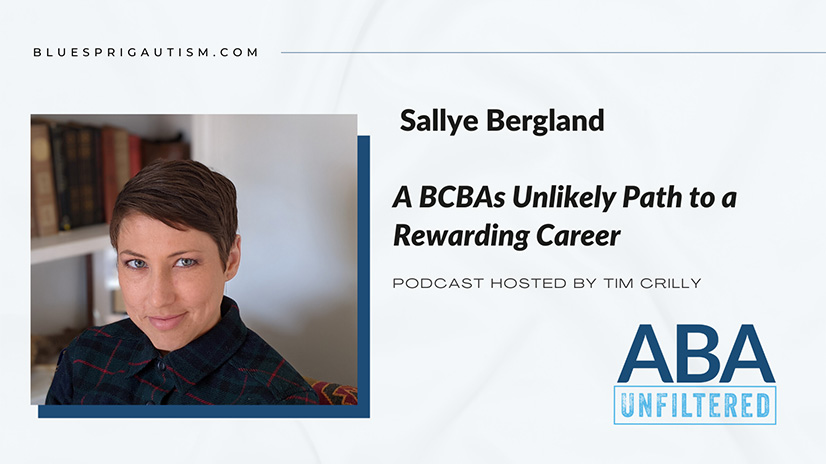
BlueSprig Market Director Sallye Bergland BCBA joins ABA Unfiltered to discuss her family connection to autism and how it led to her unplanned decision to become a BCBA. Saylle shares how growing up with a sibling with autism impacts her approach to care and the families she works with as well as how it continues to impact her and her family. Saylle shares some great stories and talks about her thoughts on helping adults with autism. We hope you enjoy her powerful story and share it with the families you work with!
Full transcript
0:07 Tim Crilly:
Hello and welcome back to another episode of ABA Unfiltered. Today I am joined by Sallye Bergland. She is a market director with BlueSprig. She’ll kind of give us a sense of what that means in her role here at BlueSprig. But, you know, apart from being a fantastic clinician leader in our organization, Sallye is also the sibling of someone with autism. So we thought it’d be a really interesting conversation to have with Sallye today, to sort of walk a little bit through her life, what it was like growing up, how it led her to where she is now, and how it impacts her clinical life, as well as, you know, now that she and her brother are both adults, you know, sort of what is that interaction? What’s that role in her life? Just to sort of give families out there a little bit of insight in into maybe looking towards the future and then you know, get it from Sallye’s firsthand experience. So Sallye, thank you so much for joining. I’m really, I’m really happy to be able to chat with you today.
1:09 Sallye Bergland:
Well, thank you for having me.
1:12 Tim Crilly:
So Sallye, give us a little bit of your background, um, you know, sort of your your your career-wise, what you’re doing here at BlueSprig, and then we can sort of jump into the other stuff. So, what does it mean to be a market director and sort of what your your your your daily life look like?
1:28 Sallye Bergland:
Sure. So um I am a BCBA based out of Portland, Oregon, and I oversee uh more of the clinical quality um in our Oregon centers, which we have four of them now, um, and Washington as well as Colorado. So I’m there as clinical support for all of the clinical directors, um making sure that um that the centers are getting um training support in a variety of um strategies. Um, if there’s uh a case that needs additional support, needs some extra um troubleshooting, then I’m jumping in to support those cases. Um so yeah, I’m excited to be able to get out into other states. It’s kind of a newer role for me. I was just in Oregon when I started with BlueSprig. And so branching out um and hopefully with COVID restrictions lifting, we’ll get to travel a little bit more.
2:32 Tim Crilly:
Yeah, that’s great. And I know, you know, sort of up in the Pacific Northwest, it is a little bit of a challenge because there’s a lot of different rules as you sort of intermix with the state lines. So I’m sure that’s something that you know keeps you on your toes uh when it comes to trying to managing, you know, three different uh locations. So that’s great. And you know, we’ve known each other for a little bit now, and I’ve had a chance to to work with you. And I’ve been up, you know, Portland’s probably the place I’ve visited the most. So I’ll just say Portland, the Portland locations are my favorite. So, you know, with no bias whatsoever. So okay, so thank you. So with that said, can you give us, you know, give us um some, you know, some some background on, you know, sort of your family growing up and and you know, sort of what it meant to be a sibling uh to someone with autism.
3:15 Sallye Bergland:
Sure. So I grew up in Southern California, um and you know, child of the late 80s. Um my brother is just 13 months younger than me. So we’re very close in age, and I have an older sister as well who’s only a year and a half older than me. So I am like triplets based, basically.
3:35 Tim Crilly:
You’re the middle triplet.
3:37 Sallye Bergland:
Basically, yeah, exactly. Um, my sister and brother actually have the same birthday three years apart, and I’m in the middle. Yeah, so we were all very close in age. Um, and you know, he uh he always was a bit delayed, um, but it wasn’t obvious right off the bat, um uh because he wasn’t as impacted. And back in the 90s, like they weren’t diagnosing um like they do now. So um it was kind of difficult to figure out what his needs were, but um, I remember you know being so close in age with him growing up that um social uh challenges were the biggest barrier for him. Um and we always went to kind of the same schools. So um I was there as the big sister, and it it seemed like there was a bigger age gap than there actually was. Um but it was I was able to kind of be that support as we grew up together. So that was pretty neat.
4:47 Tim Crilly:
So at about what age do you remember? Do you remember when he was diagnosed?
4:53 Sallye Bergland:
Was it through the school districts or yeah, going through the school districts? Um and they tested him for everything under the sun until they came to that, but um there weren’t the the supports there that there are now. Um they didn’t have access to ABA services. Um and so he he got speech and adapted PE. Um and um that was basically it. So um my family was kind of just figuring it out as we went along.
5:29 Tim Crilly:
Sure, because there wasn’t that availability. You know, I know Southern California, you know, sort of late 90s, early 2000s is when the regional center really kind of kicked off. But you know, depending on, you know, sort of what county you lived in at the time, you really didn’t know what kind of services you were getting. So it was probably pretty common that you know, families like you were probably more reliant on the school district than than anything, or obviously to sort of go out of pocket and find some sort of private private programming. But back then, I mean, I know it’s not a a ton of time ago, but it just sort of shows you how sort of still in the infancy we are in this this um this industry. Uh there wasn’t a there wasn’t a ton of options out there, you know. So that’s you know, that that’s you know, it’s good that at least there was something at the the the school to to give him and you guys sort of that that relief or sort of some level of help.
6:21 Sallye Bergland:
Yeah, yeah. It it was hard. I mean, going through the the IEP, I remember knowing what an IEP was when I was, you know, like eight, nine years old. Um, but a lot of uh the pressure was put back on my parents for their parenting style. It’s like, you know, the behavior issues were because you need to be harder on him at home, or um, you know, they would send him home, um, he’d get suspended for I think he he bit a teacher once.
6:52 Tim Crilly:
Okay.
6:52 Sallye Bergland:
But yeah, it’s you know, those things came up.
6:57 Tim Crilly:
Not an easy time.
6:58 Sallye Bergland:
Yeah.
6:59 Tim Crilly:
So for you, uh, you know, obviously you ended up diving into this this industry. Did you know sort of early on that like, hey, I want to be someone that that helps, or did it sort of just sort of happen by accident or it kind of just happened.
7:18 Sallye Bergland:
Um it wasn’t my intent at all. I I was actually kind of trying to run away from it because I was like, this is my life, this has been my life. Um, working with him um and through high school. I was always involved in his Boy Scouts and all of that. Um and so going into college, I was like, I’m gonna be a dancer. I want to be a dancer. So I went to school to be a dancer. Um and so I got my bachelor’s in dance and uh minored in teaching. Um and the economy was what it was in 2009, and I decided to go to grad school to be a teacher and um ended up nannying um for a family who had a a child who um was highly impacted on the spectrum. And so um that kind of like led me back to it. Drew you back in. Yeah, and I was like, oh yeah, I do really love this. Um, and meanwhile, I was working with my my brother as he was transitioning out of like teenage life into adulthood. So that was kind of happening about the same time where I was like, okay, this is the world of autism again. Yeah.
8:35 Tim Crilly:
And it at that point, it probably felt like a very different landscape. So, you know, when you kind of cycle back into it later, you know, maybe there was resources now that you probably weren’t aware of 10, 15 years prior to that. And maybe that did make it a little easier for you to dip your toe in into this this pool of uh you know the the service the service portion. So it’s interesting how that sort of came full full circle for you. Yeah. Um is it something that you now currently in your in your professional life, is it something that you um bring up when it uh when you’re working with with families, or is it something that you sort of let evolve more naturally?
9:20 Sallye Bergland:
Um I think it depends on the family and um the circumstances that they’re dealing with um in that part of their child’s life. Um I think it is definitely relevant with some families as they’re making decisions about um about uh services and about how independent they’re expecting their child to be. Um and also just uh when families are like, I don’t know what to expect with from my child when he is 18 plus years old. Like I don’t know, I’ve been told that he’ll get to this point, but not further. And they kind of like tamper their expectations. Sure. And um kind of make uh assumptions that um once they hit adulthood that that’s the end of the learning opportunities, which is not the case. So I do kind of bring it in when it’s like, hey, um adult, you know, adulthood is not the end of learning. Um, but there does need to be some planning involved.
10:26 Tim Crilly:
Yeah, I mean, that’s what we had a conversation that was last week’s episode that you know sort of focused on uh at 14, you know, the um Jennifer who was on last week, you know, for what did she think uh her son’s 20s were going to look like when he was 14? It became very different at 18 and 19 in a positive way. She thought he was possibly headed down, you know, more of a restrictive environment, sort of that sort of future, when in reality, you know, things clicked for him and changed a little bit, and he went down a more of an independence route. Um, and she really, really stressed the idea of changing expectations. So I’m really glad you you you touched on that because I think it is a very crucial, crucial point, you know, and and I think going back to my my time when I, you know, I was interacting with families, I know just from a personal standpoint, I feel like I got a little bit more um street cred, I don’t know if that’s the right word, once I had my own children. Now, neurotropically developing children, but it’s easier to have a conversation with a family about sort of caregiver guidance and and all those things when at least you’re a parent. So I know from from your standpoint, it probably is a little bit easier to have those those conversations, and it probably does create a little bit more, um, you know, brings more weight to to your advice for for those families, I would imagine.
11:51 Sallye Bergland:
Absolutely, yeah, because I mean I don’t have my own kids yet. And so um going through uh the years that I’ve been as a supervisor level, as a BCBA, um, you know, as a 20-something year old, parents are looking at you going, who who are you? Who are you to tell me what to do with my teenager? Um so it does definitely help um for parents to know that like it you get it’s a different perspective, uh, definitely, especially when it’s um family.
12:26 Tim Crilly:
So yeah, yeah, you know, and I think obviously there are a lot of people involved in the the ABA world or the autism sort of advocacy world who are parents, you know, or or siblings, because it just it becomes something that you you wanna I went through this. What can I do with my life experience to then go help these folks? And I’m sure that’s a common, common thing across, you know, the different different aspects of of society as well. But I think it does feel like it’s a it’s it’s a common thing that most people that fall into this world didn’t really fall into it. They had some level of exposure that opened their eyes to the to the need. Um, so you know, I think that’s an important thing. You know, I I I’m just someone that fell into it myself and really enjoyed the the the people and I kind of stuck with it. So I I am one of those ones um that sort of just didn’t know what ABA was until someone told me, oh no, you’ve been doing that for you know a couple couple months now, that sort of thing. So, you know, you you’re probably a little bit little bit different than than me. Um so now as an adult, you know, I I I know you know I don’t think you guys live in the same zip code or or anything like that, but sort of like as a as a sibling, you know, what are you and your your sister sort of what is your role currently? Um, you know, as maybe your parents get a little bit older or or that sort of thing. What do you guys see um as the the sort of the next phase for for you guys?
14:07 Sallye Bergland:
Yeah, that’s a good question. Um he uh my brother currently lives with my sister in Michigan, actually, um because my family’s out there. And so um it’s been like right now, there’s a bit of a long distance support going on. It’s like um I’ve over the past several years since he’s lived with her, um, because initially we were all in California and she was living with my parents. And so when they moved, they were like, we need to create some space between mom and dad and him um to give him that opportunity for independence, but he wasn’t quite ready to be living like on his own. Um, so it worked out just situation, you know, my sister ended up moving, she had an extra room. So he rents a bedroom um with my sister and her husband. And um, I’m there as like support from a distance. Um, my sister called me up. I don’t know what’s going on. Like, tell me what to do here. Um you’re doing telehealth. So basically, yeah, yeah. Um, and and we’re at that point now where it’s like, okay, um, he’s been in the same job um for about four years now, which is pretty dang good because it took him some losing a few jobs to figure it out. Um, and so now it’s that point where my sister um is maybe she’s like, do we want to stay in the same place long term? If not, do we want to give him the opportunity now that like I’m in Portland kind of newly and now have a house where like if he wanted to come out and live with us, we want to give him the opportunity to make those choices for himself. So um we’re kind of at that stage right now where giving him the opportunity to decide if he wants to stay in Michigan long term or come out to Portland.
16:07 Tim Crilly:
Are there decent support systems for him in Michigan, like from a sort of services standpoint, as you know, obviously family support?
16:15 Sallye Bergland:
No, um, not really. Um, he kind of we we all lucked out with his current job situation. Um he works at Walgreens and they’ve been wonderful. Um, and they have their own um internal training system um for employees working with under other individuals on the spectrum. And so they’ve been super supportive, even though he’s not in a specific program per se. Um, but he doesn’t really have any other supports right now. Um, although we are working on getting him um mental health support because um depression and anxiety are definitely yeah.
16:54 Tim Crilly:
So touching on the Walgreens, uh, I think that’s an interesting you know point you brought up. It’s something that Jennifer actually mentioned last week as well. You guys would be you guys should be friends. You have a lot, you have a lot to chat about. Uh so is that something where he would be able to you know do a job transfer and and and stay within the organization to Portland?
17:15 Sallye Bergland:
Yeah, he could. And and actually he has done a job transfer once before in Michigan because my sister was um further upstate initially when they moved, and then they moved further downstate. And so he was able to stay with Walgreens, um, which we were super happy about because he likes it. Yeah, that’s really cool.
17:34 Tim Crilly:
And obviously, you know, it looks a little different, the people are different, but sort of probably the process and the sort of the you know, the overall job is very similar. So it’s it’s for uh and not that moving and all that would be an easy transition, but obviously that creates, you know, he doesn’t have to go in and interview and learn a whole new thing. It’s right, more or less this the same, the same job. That’s really cool, you know. And I think that’s something, you know, if um if we had a magic wand, you know, sort of that what what what could we do? And I I think one of my magic wand things would be how do we create more employment opportunities for you know this this this group of adults? Because I I think it is it is limited, it’s growing. Um, I think with better awareness and and more corporate support, you could have some real programs. The problem becomes some of the vocational training is is lacking. So, did he have access to sort of vocational services, whether it was through the school district or that sort of thing? So no, he didn’t.
18:34 Sallye Bergland:
No, it was all yeah, family. Um and some lessons learned the hard way along the way. Um, but he he he actually started out his first job out of high school as working at the local grocery store. Um and my sister actually also worked at that grocery store. And so she was kind of a support for him there and helped we as a family helped to guide the managers to better understand him, um, but also to hold him accountable because like there were definitely some things that like they had to call him in and talk to him. And so um they had to learn how to how to talk to him where they wouldn’t trigger an emotional response. Um, but at the same time, it’s like there, I was like, really be clear with him because he needs to know. He really needs to know so that he won’t do it again. But um, there were definitely it was a learning opportunity.
19:34 Tim Crilly:
What about from like a a social life standpoint? Um is that something he’s been able to carve out for himself?
19:43 Sallye Bergland:
Um, so he did better in California because he was able to um build some really, really great friendships in high school um and a lot of other um those kids also on the spectrum. Um and so it was a really, really great, great group. They stuck together right out of high school and they still are in contact, somewhat um remote, you know, um they still play online games together and things like that. But it’s been hard in Michigan um for him to build a network there. Um, and so that actually is one of my biggest concerns for him right now is being able to build a network. And so that’s where um giving him the option to potentially come to Oregon, um, where there might be more opportunity close by. Um that’s kind of triggered the conversation a little bit.
20:39 Tim Crilly:
Yeah, okay, I’ll put that on the magic wand list as well. You know, I think it’s it’s it’s really hard because then you you bring up, you know, sort of the comorbid issues and depression, and obviously, you know, those sorts of things are gonna feed upon each, you know, feed upon each other as well. So that becomes that kind of becomes a real issue. Obviously, you can medicate and do those sort of things, but the ability to sort of build out a friend network and and have stuff to do on a Friday night or you know, whatever it might be, is is an important thing for someone, you know, as assuming he’s late 20s, you know, kind of kind of guy, you know, that’s that’s sort of what you what you’d want um you know to have access to. So, you know, I I we we have so much energy and resource and focus on the young the young kids. And obviously that’s very important because you want to be able to get to a point where there’s there’s more access to you know in the classroom and you know, sort of all those things. But there is a real drop off, you know, and I think that is a problem in our in our industry. And I don’t think it’s for a lack of people wanting to help, it’s just really a lack of how do you how do you actually make it something that can be you know funded and and you know put out there. And obviously there’s a lot of donations. donations and volunteer and and all those sorts of things, but that’s not always a sustainable way of really creating that that lasting change as it relates to sort of these these issues that you’ve you’ve brought up in terms of employment and socialization and dating and you know all those things that you’d love for everyone who wants access to them to have them. So um if you could just fix that I think we’d be all set.
22:25 Sallye Bergland:
Yeah yeah just wave that magic wand magic wand you know yeah I’m gonna I’m gonna have to go and get one of those.
22:31 Tim Crilly:
I don’t know where they are but I gotta go I gotta go find one. My list is growing you know my list is growing but I think it’s great you know and and you know for people like you to take your personal experience and then turn that into professional um just you know that that the professional toolbox that you now have to go out and and help people because the future is is I have a 15 year old and an 11 year old it’s it’s a scary unknown for for me you know but I can put sort of some my finger on a few sort of things that I’m pretty sure they’ll be able to do if you know if if the the if the things were reversed, you know, you don’t know if that’s that’s really the case. And I think for families that’s sort of hitting adolescence can probably be a very scary scary time for for them and their families.
23:21 Sallye Bergland:
Oh yeah it’s um adolescence is it’s like you not only are you dealing with puberty like any normal teenager um adding on just so so much uncertainty about what after high school is going to look like what um what rate they’re gonna be picking up skills how much support they’re still going to need um in a lot of ways my brother surprised me I mean like the things that he picked up as an adult I’m like the day that he did his taxes by himself I was like hallelujah and he remembered to do it and it was like after years of like you know let’s talk this through let’s and and those types of things where it’s like you know when the first day that he he called me because he remembered it was my birthday and I think he was maybe 17 18 and I was like um and so like those are the things where they’re big moments um but you just don’t know when they’re 13 14 years old all the time like how much um whether they’re going to develop those skills at 17 at 25 at 30 um because they still might come it just might take more time.
24:35 Tim Crilly:
Yeah yeah well Sallye that went really fast um I I I uh I always look down and it’s like whoa the the clock because it it goes it goes so quick and you know I I appreciate you um you know obviously it’s been great to work with you and I I’m so glad to see how much it’s expanded up in in your your neck of the woods because when you came on there was it was a very very small market. There’s a lot of a lot of work to be done a lot of work to be done up there. So um I’m I’m glad you decided to to come work with us and I know and thank you for for joining us today and sharing a little bit about you know your personal life and I I know that’s something that uh is is important and it’s really great for people to be able to to share those stories. So so thanks again. Come back anytime we love to love to have you and just kind of chat maybe about some something cool we’re doing up in Portland or you know if if your brother does end up moving and you you you create that new social pod you can tell us tell us all about it. So I will okay so thanks again and and thank you out there for for listening to another episode of ABA Unfiltered uh we’ll be back next week or the week after that whatever it ends up being and uh we’ll talk to you then thanks everybody