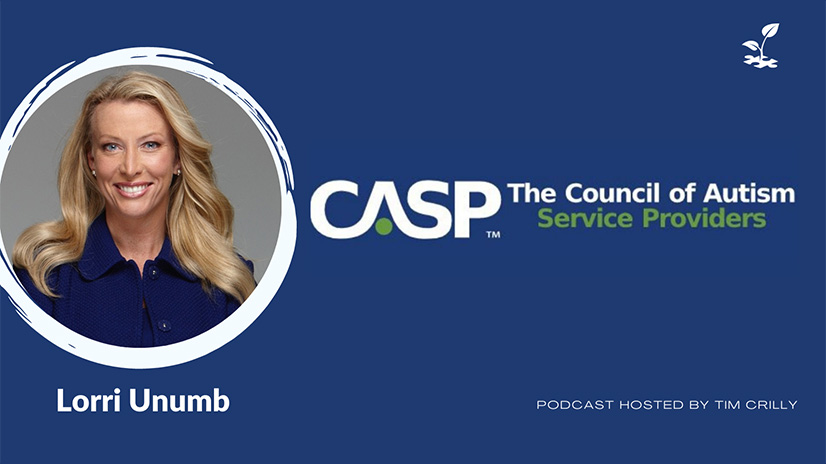
Episode Description
We’re excited to kick off Season 2 of ABA Unfiltered with Lorri Unumb, CEO of the Council of Autism Service Providers (CASP). Lorri and Tim talk about her path through the world of autism and how it led her to be an instrumental advocate in changing the autism space and creating access to services for countless families. Lorri also shares what drew her to CASP, the work they have been doing, and their plans moving forward. Lorri touches on how CASP has dealt with COVID-19 and like others, has pivoted to host their 2021 annual conference “unCONVENTIONal” virtually. And only on ABA unfiltered will you also find out what Lorri’s favorite cereal is!
Full transcript
0:12 Tim Crilly:
Hello and welcome to ABA Unfiltered. I’m your host, Tim Crilly, and today, somehow, we are joined by Lorri Unumb, who is the CEO at CASP. And Lorri, I’m really excited to talk to you. It’s been about a year, uh, coming up on a year since the last time I saw you. And when I saw you last, you had a lot of big plans. You guys were getting ready to roll out, and I do want to talk about those, but you know, obviously something got it got in the way of that. And I do want to touch a little bit about what 2020 has meant to you guys over at CASP. But before we get to any of that, and I I don’t feel like you need an introduction, but if you wouldn’t mind indulging me for a second and just sort of giving our listeners a little bit of some background about who you are and uh you know where your passions are and how you got into the world of autism.
1:02 Lorri Unumb:
Oh boy. Well, thanks, Tim, for the um invitation to be here. And I could talk for a long time about kind of how I got where I am. I guess I got into this field generally after my firstborn child was diagnosed with autism shortly before his second birthday. And at that time, I was teaching law school. I’m a lawyer and I had been practicing law with the United States Department of Justice for a number of years. Left that to teach full-time at George Washington University Law School. And while I was there, my son Ryan was diagnosed with autism. And um that just led me down a completely different career path because he um it was recommended that he have ABA therapy. And um, we didn’t know what that was at the time, but you know, we we educated ourselves and said, okay, if that’s what the doctors are recommending, that’s what we’re going to do. But of course, at that time, insurance would not pay one penny for ABA.
2:10 Tim Crilly:
So um that so that sparked something in you, I’m guessing.
2:15 Lorri Unumb:
You could say that. You could say that. Um honestly, for a couple of years, we just paid privately for his treatment, and we were very, very fortunate that we were able to do so. My husband and I are both lawyers and we both worked full-time. And so um we lived on my husband’s salary, and we used my entire salary to pay for Ryan’s ABA. But, you know, after doing that for a few years, and and even we, as a two-lawyer income family, we sold our house and we moved to a less expensive house so that we could continue to fund that therapy. But after a few years of doing that, I just I just couldn’t take the thought of this is so unfair because Ryan is getting treatment because he happened to be born into a family that could financially make it happen. What happens to the rest of the kids that that aren’t so lucky as to be born into those families? And so, you know, I just kind of motivated by that experience and and just the thought of the inequity for those children, that’s when I thought, you know, they told me insurance doesn’t pay for this, but nobody explained why insurance doesn’t pay for it, right? Why doesn’t it? So that took me down um a whole advocacy path that led me here.
3:44 Tim Crilly:
And you know, and obviously your work at um Autism Speaks speaks for itself. Now you don’t have to name them in order, but can you name the states in which in in in the order in which they enacted uh law?
3:57 Lorri Unumb:
Um I don’t know if I could anymore. For a long time, I definitely could. And and I pretty much had every law memorized, like every line of every law.
4:07 Tim Crilly:
Yeah, I can imagine.
4:09 Lorri Unumb:
You know, but I I I definitely tracked them one by one and and worked in many of the states. Yeah. We actually I started working on the autism insurance reform before I ever went to Autism Speaks. We we my husband and I moved back to my home state of South Carolina. We had been living in Washington, D.C. We moved back to my home state of South Carolina just to be closer to family for the support, you know. And um, it was while I was there that I wrote the the initial bill that got filed in the South Carolina legislature. That was 2005. And I just worked as a volunteer on that bill and and worked with a lot of other families in South Carolina, just volunteers. We weren’t affiliated with any organization. We just were doing this as a bunch of moms and dads, right? So um worked on that for two years, and that bill that required health insurance to cover autism treatment and ABA in particular passed in South Carolina in 2007. And then shortly after that is when Autism Speaks contacted me and said, Hey, that seems like a good idea.
5:20 Tim Crilly:
You seem good at this.
5:21 Lorri Unumb:
Well, you know, I I think they just thought, well, yeah, insurance should cover autism. It should cover ABA. And they realized, as did I, that to accomplish that it had to be done on a state-by-state basis. And so they reached out and said, Do you want to take the experience, everything you just did in South Carolina, take it, take it on the road, take it on the road?
5:45 Tim Crilly:
Take it the road show, the Lorri Unumb Roadshow. That’s amazing.
5:49 Lorri Unumb:
You know, Tim, it took me a few months to even decide whether to take the job because I was back again working with the United States Department of Justice in what I considered kind of a dream job. I loved it. I loved my career. And um, I really wasn’t sure whether to just leave my legal career and do this Autism Speaks work. But ultimately, obviously, I decided, yes, I do want to do this.
6:15 Tim Crilly:
Well I I think I speak for millions of people when I say thank goodness you did, because I think you really did change this landscape. And I know you probably don’t want to say that out loud, but it’s really true. Your work just basically speaks for itself. And and you know, we we really everybody out here that’s able to now go into a home or a clinic and work with a family, bring those services to a family that you were just alluding to that would never be able to afford the level of care that they get now. They might not know it, but you know, you you’re you’re a shining example for how that all came came to be. So we can move forward on that. I yeah, I know you know probably don’t want to sit sit back and take too much of that, but you really did have a huge impact on this on this industry. So thank you.
6:58 Lorri Unumb:
Well, I I thank you for those kind comments, and I do want to interject that there were hundreds, if not thousands, of families who who did this, right? Yeah, so it it was a beautiful example of kind of democracy in action and the way you learn about government in sixth grade. Hey, it really does work.
7:17 Tim Crilly:
It does work if you stand on those steps and shake your fist, things can happen. That’s that’s good to know. That’s good to know. Um, so what drew you to CASP? Because I I’m a fan of CASP. So, what what was it about CASP that that that got you over there?
7:32 Lorri Unumb:
Yeah, well, thanks for asking that. Um, I actually was kind of I I was very happy in my career at Autism Speaks when CASP reached out to me um early last year, early 2019. And um CASP was looking for new leadership. And um I I thought originally I wasn’t so sure because I thought, well, there’s still more work to be done at Autism Speaks, but then I really was kind of wrapping up that 50 state road trip, right? Um 2019 is when we finally hit the 50th state, Tennessee, to uh pass autism insurance reform. And I thought, you know, maybe this is a good logical next step for me professionally, because I’ve spent the last dozen years creating these funding streams through autism insurance reform. And so as a result of consistent funding availability, the field of ABA has just exploded, as you know. And I thought maybe it would be a logical next step for someone like me, a parent who cares very much about the quality of services, to run this professional trade association and ensure that people aren’t coming into the field just because they see dollar signs, right? You know, I mean, if there’s if you can bill private health insurance and you can bill Medicaid, people are going to come into the field and say, hey, this is a viable business opportunity now. And great. I I mean I want it to I want it to be a sustainable business opportunity.
9:18 Tim Crilly:
Yeah, it needs to be in order for the help to get there.
9:21 Lorri Unumb:
Exactly, right? You have to have the money to perform the mission, but I also feel a little bit of um an obligation to be like a protector. I I’m still speaking on behalf of families when I um work with providers to ensure that they’re motivated and in this for the right reasons.
9:41 Tim Crilly:
Absolutely. And you know, and I think the first time I ever talked to you, it was a while ago. You probably don’t remember, but it was back when I was with Magellan and we were talking about I don’t I don’t know what it was, but uh my time there at Magellan managing the the network, or not really the network, but managing the clinical aspect of the ABA network. The one takeaway I had from that was wow, this is a consumer protection business. It’s about making sure that the right things are happening at the right time, and more importantly, they’re happening by the right people. And I think that’s what I like the most about what you guys are doing at CASP. So could you just for anyone who doesn’t know, could you explain what CASP is?
10:28 Lorri Unumb:
Sure. So CASP is a nonprofit 501c6 association of autism service providers. Individuals don’t join CASP, organizations join CASP. So BlueSprig, for instance, is a member of CASP, and um, you can be a nonprofit uh provider organization or a for-profit for profit provider organization, that doesn’t matter. Uh, we have both. And um our mission is to cultivate, share, and advocate for best practices in autism services. It’s very simple, but it drives all of the work that we do, focus on best practices, cultivate them, share them amongst the field, amongst amongst all stakeholders, and advocate for the use of best practices throughout the field.
11:25 Tim Crilly:
Okay, so as I alluded to at the top of the conversation, you know, you we were in in Phoenix in January of 2020, and you guys had a lot of big, big plans, and it was really exciting. You know, it was like a little bit of a buzz in the room. You were handing out packets of so some things that you guys were planning on doing, all your initiatives, and you know, it’s all it was a lot to read. There was a lot of information in there. You guys have done a lot of hard work leading up to that, and then obviously everything changed. And and I don’t I don’t want to make this all about 2020, uh, but you guys really put everything on hold and jumped in with two feet to get in there and really help folks like us. You know, we’re a bigger organization, we have a lot of resources, but we still turned to you. And I know a lot of people did. So, could you talk a little bit about what your guys, you know, how were you able to assemble so quickly and get so much concrete positive information out into the in into the public as everything was changing on a daily basis? What state’s doing this, what’s closing down, what’s allowed, all those sorts of things. Can you just give us a little bit of information on how that worked out for you guys?
12:32 Lorri Unumb:
Sure. So, yes, we were coming off of our annual conference in January. We had lots of new initiatives that we announced. There were so many exciting things um going on in CASP. And then, you know, that middle weekend in March is pretty much when it hit for everybody. Um, and we kind of all were on the phone together. A lot of CASP members were on the phone together, literally just an old-fashioned phone call, or I guess it was probably a Zoom call, um, and talking about oh my gosh, how are we going to face this? And it was really useful for me to listen to the providers and listen to what the concerns were. And then literally over that weekend, we just made a decision to pivot. We just made a decision. All of the projects that we have been working on and we’re rolling out are just going to be on the side burner for a little while. And we are going to 100% pivot and work 24-7 to address COVID-related needs for our members. And I think that, and I mean, there were literally all nighters as we worked to overhaul our website literally in a matter of a couple of days, so that we created a whole section of just COVID resources and we divided them up on a state-by-state basis, or you could search on an insurer by insurer basis. You could search for telehealth resources. I think it’s all still up there, but um, and with good reason since the pandemic is not over. But um, you know, we just thought it these um people who are running autism service agencies are really busy just on a day-to-day basis trying to keep their head above water, trying to comfort their families. If we can just pull together resources and be that one-stop shop for them to find everything they need to find, that will be extremely useful. And the other thing that we did that I think really was valuable for our members was just pull them together frequently. You know, I’m a big fan of putting a lot of smart people in the room together and you’ll have I have t-shirts that say that.
14:52 Tim Crilly:
That’s my my motto in life.
14:54 Lorri Unumb:
Well, I I look good, Tim. I love that.
14:57 Tim Crilly:
I’m never one of the people in the room, but I like to know the people and make sure they get into the room.
15:02 Lorri Unumb:
Well, you know, it sometimes I’m just the organizer, right? If I’m just the one who facilitates the conversation and that’s fine. But I knew if we put these people on the phone together on a regular basis, they’re going to figure out the problems. They’re going to solve the pandemic-related issues together. And they did. And and the one thing I I think I’m also just a huge believer in collaboration in in this field, you know, there is no reason to be competitive.
15:34 Tim Crilly:
Yeah, I uh Keith, our Keith Jones, our CEO, talks a lot about that. You know, there’s, you know, we want to be the best. And if you know one organization is able to make change, then that affects all organizations. It’s not about one organization getting all the kids doing all the treatment. It’s about making sure you you you you fix the the problems and everyone benefits from that. So I think that’s that’s the perfect sort of attitude. And obviously a group like CASP, they’re they’re living, breathing proof of it.
16:03 Lorri Unumb:
I mean, it’s just it is such a central um theme through everything we do, is that we foster collaboration. I would say we expect collaboration, but that sounds almost too dictatorial. We don’t have to, you know, we don’t have to force it because everybody who’s a part of CASP appreciates that this is the better way to operate. And so it is naturally collaborative. Um, you know, it’s it’s the sad thing about autism is that there are more than enough cases to go around, yeah. Right.
16:35 Tim Crilly:
And not enough people to to serve.
16:37 Lorri Unumb:
Not enough people. I mean, there’s a there’s a supply and demand issue that we’re not even close to solving, and so it permits us to function in a collaborative way that really is valuable when you’re collectively facing an issue like the pandemic.
16:54 Tim Crilly:
Yeah, I I couldn’t agree more. So, what is the plan for 2021? Now that you know, obviously things there’s there’s some level of normalcy to a degree returning. So, you know, some places kids are back in school, some they’re not. You know, services for the most part weren’t really interrupted. Um, I’m guessing there’s no uh I haven’t had an email sent out about a conference in in January. I’m I’m guessing that’s not happening at this point. Not in person, not in person is what I mean. Yes.
17:22 Lorri Unumb:
Yeah, yeah. So there will be we will have our annual conference. It this year it’s called unconventional.
17:29 Tim Crilly:
Okay.
17:30 Lorri Unumb:
Get it? Very nice, yeah. Conventional. Um, so it’s January 11th through 13th, and it will be virtual, which has been interesting because um it gives us the opportunity to bring in just a huge swath of fantastic speakers that we wouldn’t necessarily be able to afford to fly in, um, you know, but we can tap into them. So we’ve got three fabulous keynote speakers, we’ve got some plenaries, and we’ve got 60 to 70 keynote uh breakout speakers um offering concurrent sessions throughout. So it’s gonna be a year unlike any other, uh, and I’m really looking forward to it. The information’s going out soon um on that conference. But cool.
18:15 Tim Crilly:
That’s that’s that’s great. I mean, it’s nice to see that there’s some level of we got to keep the the momentum and and keep the conversation going, even if it if it’s gonna feel a little different. And you know, obviously at some point we’ll we’ll all be able to get back in in the room together and and do those things. Because, you know, I think that the the real beauty of a conference like CASP is the ability to really connect with senior leaders um around the country and really learn more about oh, this is how it’s done in Iowa, and oh wow, it’s so different in Minnesota or or whatever you know that the case may be. So I, you know, looking forward to getting back to to those sorts of things will be good, but keeping the information flowing is is always a good thing as well.
18:57 Lorri Unumb:
Well, like one example, Tim, is and and you guys will appreciate this. Um at in my role at CASP, I hear from a variety of members about the things they’re working on, their special projects or whatever. And I’ve had a number of people reach out to me and say, my agency is really focused on outcomes and outcome measurement, and we’re spending a significant amount of energy putting a package together around this. And, you know, after the second or third agency said that to me, I said, all right, we’re going to talk about this at the conference. We’re going to put together a panel where a couple of different agencies can share. We’re focused on outcomes. Here’s what we’re doing, here’s what we’re finding. Because again, that’s that’s something it’s great to have a variety of agencies working on it, but every single agency doesn’t need to reinvent the wheel. So let’s share what we’re doing. And and that’s an area where we still have work to do as absolutely as a field, right?
20:00 Tim Crilly:
Yeah, it’s that uh, you know, it’s the it’s the myth of outcomes. It’s something I mean everyone talks about, but we haven’t really been able to put our finger on yet. Yeah, so we’ll we’ll get there. I mean, I think people forget how new ABA is and how just re how recently it has even started being regulated. You know, it we’re we’re really still in our our maybe in diapers by now, but certainly we’re we’re very new to to to this process. So there’s so much work to be done and so many, you know, great people um in this field that really care. And like you said, that the competition. I you know, when I first started in the field, I I felt that a lot. We know what’s best, we’re gonna, you know, keep it to ourselves. It’s our our secret way of doing things, and not there wasn’t a lot of collaboration. I don’t see that anymore. I do see a lot, especially with as you know um some of the bigger agencies have have really stretched out over a national presence. You know, I think there is a lot of coordination at the top with with those groups to make sure that we are all sort of working on a on a common goal. And uh it’s been it’s been nice to be able to make some of those introductions from people I know around around the country to make sure that we are we are all talking together. And I and you know, I I’d love for you to give just a brief commercial about you know why anyone listening who’s not a CAT member, why why they should consider it um you know this year.
21:29 Lorri Unumb:
Oh, well, thank you for the opportunity. Sure.
21:32 Tim Crilly:
Hey.
21:33 Lorri Unumb:
What our members tell us is that their businesses operate so much more smoothly because of their membership in CASP. They learn innovative ideas, they, as I said, collaborate with each other on solutions to common problems. And particularly during the pandemic, we have just gotten unsolicited email after email saying, thank you so much. We do Think we would have made it through without your help. We cannot tell you what a lifeline CASP was for us. And you know, at CASP, we we feel like we’re just on the cusp of building the association that we’re ultimately going to become. We have literally more than doubled our membership in the last year. We have people joining like almost daily or organizations joining almost daily. Now I will say that we do not admit every agency that applies. The threshold for becoming a member of CASP is that you must demonstrate a commitment to evidence-based services. And if you as an organization do not demonstrate that commitment to evidence-based care, either you’re you um maybe you don’t embrace ABA or you do embrace ABA, but you also embrace a handful of other things that don’t have the literature to support them, then um you’re not a good fit for CASP. And we have had to reject some organizations on that basis.
23:12 Tim Crilly:
Um that’s that that’s that’s really great. You know, I think part of going back to my Magellan days, you know, there was people we had a network of 405 groups, like not individual BCBAs, but you know, agencies, and probably about 250 of them at any given time servicing children. I’m just talking about California at the moment. And there were some that you just couldn’t believe some of the things that they were doing. Now, obviously, this is seven years ago, it’s a little bit different now, but you know, it’s good to know that you know those standards are you know, that bar is constantly being being raised, that you have to be able to meet these. And I think some of those health plans out there are getting a little bit more wise to that. And you know, I think that you’re seeing a narrowing of networks with certain groups because they do want the best, the most high-quality people that are you’re able to show what they’re doing. And you know, and I think groups like you are really helping drive that and really give them a solid place to look to say, what should we be looking for as it relates to what is a solid provider? Going back to my you know original point of it is about consumer protection, making sure that these families are getting the best possible information at the time when they need it. So, you know, again, I’ll I I began by applauding you and I’ll continue to do so. And it’s really fun to watch um you you get involved with this and really take it in a direction that I think is gonna really make a more global impact than you’ve already made. So if that’s possible, you’re you’re you’re still at it. So I what are you gonna even do after this? Like ABA on Mars or something?
24:47 Lorri Unumb:
What’s not think that far ahead? I will like, you know, we’ve had a lot of interest in CASP membership from international organizations.
24:55 Tim Crilly:
Okay, here we go.
24:56 Lorri Unumb:
You know, I mean, um, there’s autism everywhere. Everywhere, yeah. If we think we have a supply and demand issue, go to India, go to um, you know, even European countries have huge um supply and demand issues for ABA. So um I I see as agencies are just forming, they really want to learn from those in the United States who have been in business for 20, 30, 40 years. And that’s one thing I think that separates our association from from others out there in autism and in ABA. If you look at our board of directors, these are oh, I was gonna say these are no spring chickens, but I mean that in the in the most positive, favorable way.
25:42 Tim Crilly:
Well, hopefully none of them listen to this, so that’s fine.
25:47 Lorri Unumb:
I love you. And what I mean is we admire your um depth and breadth in the field and wealth of knowledge, I think is the word you’re looking for. Wealth of knowledge, thank you. There you go.
25:58 Tim Crilly:
Yeah.
25:59 Tim Crilly:
Over a very brief career.
26:01 Lorri Unumb:
Yes, that’s right. Over three years, you have developed wealth of knowledge.
26:06 Tim Crilly:
Exactly. Well, you know, Lorri, obviously, thank you so much for joining. And I hate to do this to you, but we do ask um our our guests this this one question, and it’s a yes or no question. And so I need you to decide yes or no, and then the reason why you’re just deciding yes or no. Fair?
26:27 Lorri Unumb:
I don’t know yet. Ask the question. Okay, fair enough.
26:33 Tim Crilly:
Is cereal soup?
26:36 Lorri Unumb:
No. What kind of question is that?
26:41 Tim Crilly:
I I’ve heard people make an argument for yes, so it’s it’s up to the individual um person to to decide.
26:49 Lorri Unumb:
Yeah, that that’s a definite no. I I had cereal for breakfast this morning, Cinnamon Toast Crunch. And um, yeah, you you you you don’t pour, well, wait a minute. I was gonna say you don’t pour soup into your bowl in two stages, the cereal and then the milk. There may be some soups that you do that. So I’m not sure that’s the right differentiating factor, but but the answer is no.
27:20 Tim Crilly:
Okay, well, since you’re a lawyer and you’re the first lawyer I think we’ve had on, could you could you uh like sit at each table in a courtroom and make a case for it? Could you defend soup as cereal and could you prosecute it?
27:34 Lorri Unumb:
I guess if if soup were paying me enough, oh I could make an argument. Yeah, absolutely. Would I make an argument? I don’t know.
27:44 Tim Crilly:
Okay. Um, well, that might be the best answer we ever get. Um so uh Lorri, thank you so much. And and everybody out there listening, I I hope you got as much out of this as I did. I actually learned a lot about you. I didn’t know that much about your your your previous life. So that was really that was really great to hear. And I can’t wait to see you in person at some point in 2021. It would really feel like wow, we’ve really come a long way. So hoping for that, and for everybody out there listening, I I hope you enjoyed today’s guest, Lorri Unumb, and you know, all the wealth of information that she she just brought to us. So thank you again.
28:19 Lorri Unumb:
Tim, thank you so much. It was fun spending a little time with you.
28:23 Tim Crilly:
Perfect.