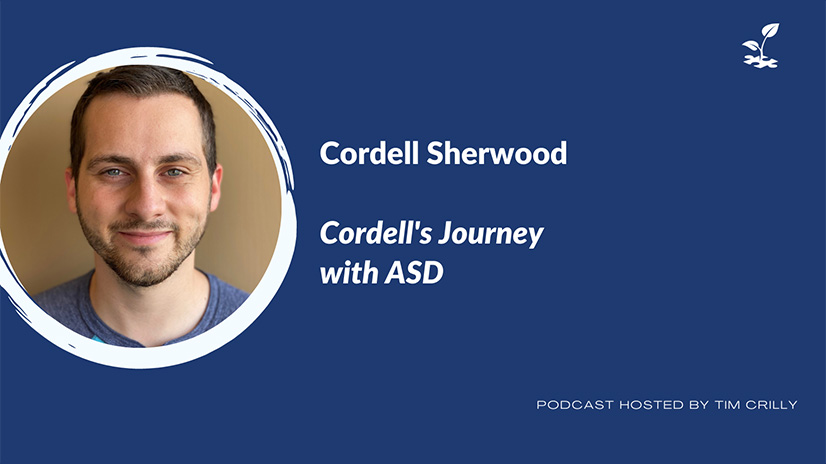
Episode Description
Cordell Sherwood, diagnosed with Autism Spectrum Disorder (ASD) at the late age of 10, shares his story that ranges from being bullied as a child in school to becoming a guest speaker in graduate study classes at USC. In this episode, we explore systemic issues that exist within many school districts and the benefits of addressing an ASD diagnosis at an early age. We also get to meet a really interesting young man with an important story to share.
Full transcript
0:07 Tim Crilly:
Hello and thank you for joining us on ABA Unfiltered. I’m your host, Tim Crilly. Today we are joined by Cordell Sherwood to talk about his experiences in school and growing up with ASD. Cordell, very nice to have you. I appreciate you taking out a couple minutes to chat with us. We’re really excited to have this conversation.
0:25 Cordell Sherwood:
Thank you very much. As he said, my name is Cordell Sherwood. I was diagnosed under um autism spectrum disorder when I was around 10 years old, I want to say. I’m 23 now for reference. Uh back then it was Asperger syndrome was the diagnosis, but uh nowadays it all falls under autism spectrum disorder. So yeah, it’s uh very good to be here. Thank you for having me on. Great. Where did you grow up? I grew up in the uh Phoenix area of Arizona. So I am originally from Washington State, but I moved down here to the valley when I was about five years old.
0:53 Tim Crilly:
So I’m really I’m really more Phoenician or whatever we call it. That’s that’s yeah, yeah, yeah.
0:59 Cordell Sherwood:
I’m I’m not too sure what I’m not too sure what it’s called either, honestly.
1:03 Tim Crilly:
Um at age 10, you had your diagnosis. So you you probably remember that process relatively well, I’m guessing as a 10-year-old. Do you have memories of that time?
1:13 Cordell Sherwood:
I actually do remember getting the diagnosis. Uh kind of the story behind that, why it happened so late, because a lot of a lot of kids that grow up under the spectrum usually get diagnosed at a really young age. Um, two years old seemed to be the average, but there’s actually a lot of programs and organizations that are trying to go even earlier than that. But for me, I remember my parents didn’t exactly like they knew that I was on the spectrum at a very young age, but there was never really like a way to get me a diagnosis. And when I moved down to Arizona, I had a weird situation happen at school where my uh my first grade teacher basically came up to my parents and were like, you should not get an autism diagnosis for your son because it will put a label on him and he’ll be limited throughout the the rest of his life by getting that.
2:03 Tim Crilly:
So I have heard many, many stories similar to that. So it’s not an uncommon thing. And and that’s um that’s too bad, uh, you know, because getting a diagnosis didn’t change who you were. You know, you were still the same person the next day. So that’s really a shame. Uh from there, you know, what type of services did you get involved in? Was it all school services, or did you have other types of maybe well, I guess not really insurance-based services back in those days, but was there any other sort of extra outside of school services that were available to you?
2:35 Cordell Sherwood:
Outside of school services, unfortunately not. Um, and the only reason for that is kind of just because growing up, my family didn’t really have, we didn’t really have a lot of money growing up. So we couldn’t really afford to get any extra services. But on top of that as well, it’s like my parents didn’t even really know that a lot of these services even existed. Like ABA therapy was one where my parents nowadays are just like, man, we wish I wish we knew that this existed, or occupational therapy. No one had told them, like, hey, these programs exist for people on the spectrum, but no one let them know that. And honestly, who knows if we could even afford them in the first place back in back in that time.
3:14 Tim Crilly:
When we have you know the all the conversations around you know, state mandates and states requiring insurance-based services, you know, it sounds great, but there still is is a cost share uh associated with that. So even though services have gotten more accessible to families, there are still you know barriers to everyone getting the exact care that they should be getting. So you’re you’re you’re not alone in that. What do you remember about school district and sort of that getting a diagnosis and what changed for you? So I’m guessing that was around third grade.
3:45 Cordell Sherwood:
Yeah, um, it was uh fifth grade, I would say, is when I got my diagnosis. Yeah, and the reason for that was because I didn’t have a diagnosis when I moved to Arizona in the Arizona School District, I wasn’t receiving any help from the school district because there was no reason to, because I didn’t have the diagnosis. So nobody knew that there was a problem. But of course, what happened out of that was just that I was going to these meltdowns is kind of the best way to describe it. Just like uncontrollable fits of just crying fits, just a lot of emotion built up through that, and it was uncontrollable. And oftentimes there wasn’t really a reason for it as well. It would just happen occasionally, but I couldn’t really get the help I needed because I didn’t have the autism diagnosis. So eventually, fifth grade, I was at the different school at this point, and they were just like, he needs to get a diagnosis because we can’t do anything about this until he finally gets one. So thankfully, that school was just like, you need to get on top of this. So my parents got the diagnosis for me finally. The main service that I received, well, actually at that time was speech therapy because I couldn’t pronounce my R’s or L’s. My name is Cordell, by the way.
4:54 Tim Crilly:
That’s not that’s not great. I get it. Nope, nope, not great at all.
4:58 Cordell Sherwood:
But of course, then of course, I was able to get a uh an IEP, an individualized education program. And that way there would be like specific things that it would list specific things that I would need help in and like different accommodations that I would need, like extra time on tests, or just like space that I can go to where I could be by myself in my own headspace and not pressured from the outside. Uh just just stuff like that um that I was finally able to receive as a result of that. So yeah, that’s that’s basically the gist of it.
5:31 Tim Crilly:
Was school a challenge for you? Did you enjoy being at school from an academic standpoint, from the structure? Were were there things that that you enjoyed about school uh or was it was it a challenge for you?
5:43 Cordell Sherwood:
School was definitely a challenge for me, I would say. I kind of excelled in in math, and I liked doing math, you know, very very logic-based, sure, linear, very logic-based stuff. But like I struggle with English, which was like tabbing more into the creative side of my brain. And then, of course, group projects are just a nightmare trying to work with uh well, I mean it’s a nightmare for everybody, to be fair, but um having a social disability also just does not help in that kind of situation. So, yeah, no, school was definitely tough. And um, I mentioned the meltdowns earlier that I would have, and I I would probably say like the kind of like the biggest struggle was just like there wasn’t really a way that the schools did to help me with the meltdowns. So my teachers had no idea what to do. And so when I would experience meltdowns, they would just tell me to go outside the classroom. That was all they could think of doing.
6:36 Tim Crilly:
Because just so you weren’t a distraction to other kids, they weren’t really maybe even trying to help you, unfortunately.
6:42 Cordell Sherwood:
Yeah, exactly exactly, exactly. I think there was there was one time I remember this specifically. There was one time I had a meltdown in class, the teacher asked me to go outside, and then the special education teacher was in the hallway at that moment and was like, Hey, can you just go into our classroom? Like, you know, just uh calm down. And it’s like, you know, it’s like, oh, um, okay. Yeah, why didn’t why didn’t anyone think of that? I know. And that was the only time that happened, too.
7:09 Tim Crilly:
Okay. Oh, okay. Oh well. Do you feel like there was a a a turning point for you um as you got older? Did did school become more manageable, or was it always sort of a a struggle even through high school?
7:24 Cordell Sherwood:
I love telling this story because my turning point was definitely around like the transition period between eighth grade and high school. So what had happened during that, there was like an end-of-the-year fundraiser going on for my school at the end of eighth grade. A lot of the students were preparing and helping out for the fundraiser. And one of the um, I didn’t actually mention this before, the bullying that went on during uh elementary and middle school. We can come back to that later. But one of the one of the girls that was involved in the bullying came up to me like at during that fundraiser and was like, hey, so I just want to know, like, so people have been saying like that you have autism and you’re on the autism spectrum, but what is that exactly? So she had asked me what autism was, and I was like, Well, I mean, um, it’s a social disability, just have a hard time communicating with people, understanding people, just very emotional, not really in control of that very much. And she was like, Okay, how do you think your autism affects you? And so I thought about that like then, and I was just like, Well, it’s hard for me to control my emotions, that’s why I go into meltdowns during class and such like that. And she was just like, Oh, oh, that makes a lot of sense, actually. So then after that whole situation, like throughout that transition period between eighth grade and high school, I was just thinking to myself was just like, huh, how does my autism affect me? Because my entire life, no one had ever asked me before. It’s like everyone had been telling me, uh, has been telling me, like, this is how your autism affects you. This is the stuff that you need to work on. But never has someone asked me at that point, what do you think of your autism? How does your autism affect you? And what is your perspective in all of this? I’ve never been asked that question before until that girl that used to bully me just came up and asked that question. And from then on, I just started thinking about how it affected myself, what limitations that I have, and what limitations I’ve been putting on myself. And basically, just throughout high school, just I’ve been trying to work on that and building into the person that I am today. Like at this point, a lot of people can’t even tell that I’m on the spectrum because I talk very clearly, I look people in the eye, and it’s surprising to a lot of people to know that I’m on the spectrum, which is completely opposite of how I used to be. Used to be. Wow. Yeah, and a big part of that is just she asked me.
9:59 Tim Crilly:
Sure, and you finally started thinking about it. Yeah. So it came from a very unlikely source. I take it. Absolutely. I don’t want to, you know, dredge up anything too painful, but I, you know, I think bullying obviously is a huge problem. So if there’s anything you’d like to share on that, I’m I’m sure, you know, as uh as hard as it might be to hear, you know, we’d love to hear anything, your thoughts on that, or or what sort of things should we be thinking about as it relates to you know kids in your situation in those tough years as it is.
10:31 Cordell Sherwood:
Oh, yeah, of course. And honestly, it’s not actually painful for me to bring up the bullying that I used to experience. I’ve moved on from that a long time ago. I’ve made amends with everyone that I needed to, of course. I would just say a lot of the bullying definitely came about because I was different from everybody else. Being that quiet, shy kid in the back of the classroom is a big thing. Being like the teacher’s pet because the teacher would always would have to give me special attention because of my IEP. So, of course, that became more like a it’s not really a teacher’s pet, but that’s kind of like the same mentality almost. And then, of course, the meltdowns absolutely didn’t help because then the main thing people called me in high school was crybaby, because that’s kind of how it well, not of course that’s not how it was. There was a lot more going on than that. But I mean, that was um that was of course the main thing people would pick on, and they wouldn’t and kids would know, like Cordell has a hard time understanding like sarcasm and such like that. Sarcasm was a huge struggle for me, so of course, everybody used it on me growing up. There was also some physical abuse as well, I absolutely, along with the verbal abuse, and it was definitely tough for me. It absolutely was tough for me, and it was hard for me to bring it up to anybody because again, I was so shy, and it was just hard for me to talk with people or look people directly in the eye. It was a difficult situation altogether, and I never at times I didn’t feel like I had that support that I would have liked to have uh growing up.
12:01 Tim Crilly:
So the school, the school wasn’t able to offer sort of any sort of solutions for any of those things for you.
12:07 Cordell Sherwood:
Yeah, we would bring it up to the school, but honestly, there wasn’t not that there wasn’t much that they could well, maybe I’m not sure. We definitely have brought it up before with the school, but you mean changed. Say that again. I’m so sorry. You and your family, you approached the school. My family and I, we talked to the school about everything that was going on, but there was only so much that the school could do. And at one point I had a unfortunate situation. One girl stole my backpack and I started following her trying to get my backpack back, and then another girl came up behind me, like poked right at the pressure points that I had, and I collapsed on the ground because I just couldn’t breathe at that point. And then the aide, the teacher’s aide that was out there to watch the kids and all, she thought that I had initiated the conversation because I was the one going after her, but that that wasn’t the case, of course. So at that point, the principal was like, Okay, the solution to this that we’re gonna come up with, you’re just going to eat lunch in front of my office, and that way you stay away from the other students. I wasn’t in trouble, but just like eat in front of my office so that you can avoid the bullying, so that you can avoid the students because there’s only so much we can do in this situation.
13:19 Tim Crilly:
So that’s really sad because that’s not really a solution. That’s just that’s avoiding a problem until you graduate, and then they don’t have to worry about it anymore. That’s that’s terrible. How did that doesn’t help the next Cordell coming in into onto campus? Yeah. Well, I you know, thank you for for for sharing that. So, you know, obviously you had some trouble in school with bullying, and and you know, that’s that’s that’s really hard to for anyone to have to go through. But from a socialization point of view, from making friends, how did you find the the best way for you to make friends growing up? And what sort of lasting relationships can you speak to?
13:56 Cordell Sherwood:
I would definitely say it was absolutely difficult for me to make friends growing up. Again, being that quiet kid that had a hard time communicating with people, the friends that I did make really were not friends at all. I had mentioned the verbal and physical abuse that would happen to me uh during school. Those were my so-called friends, of course, where they would kind of just have me in the group to be like that outlet for them. Sure. Um, you know, get that out of their system, of course. It wasn’t actually until I had just mentioned how the principal would have me sit in front of her office to eat lunch. Well, there was another girl that was going through a similar situation. She also was sitting in front of the principal’s office to eat lunch to try and avoid people. And we ended up talking and becoming really good friends at that point. She was honestly one of my first real best friends.
14:44 Tim Crilly:
And so maybe the principal did know what she was doing. I don’t know.
14:47 Cordell Sherwood:
Maybe. I don’t know. I don’t I don’t think she anticipated us meeting and talking, but but we we did, and yeah, she became one of my best friends for a long time, even throughout high school. She was one of my best friends. So yeah, it um definitely was a a good thing to come out of a bad situation.
15:04 Tim Crilly:
Good. I I love your attitude, can’t argue with that. So we mentioned Dr. Cameron, that’s how you and I were introduced. How do you know him and how did you guys get connected?
15:14 Cordell Sherwood:
Oh, yes, of course. After I graduated, of course, I started working at this deli here in uh Gilbert, Arizona, called Not Your Typical Deli. It’s a deli that hires young adults on the autism spectrum. And I was one of the founding employees there. I worked at Front of the House Manager for about three years at the deli before leaving. So Dr. Cameron had come into the deli back in uh 2018 just to see what I was all about because it was the deli that hired young adults on the spectrum. And that’s where he met me. And when he met me, he really liked my story about my experiences growing up, and he wanted me to speak to um his graduate class at USC. That’s how we met.
15:50 Tim Crilly:
That’s how I’ve just lectured at USC.
15:54 Cordell Sherwood:
Oh, yes, I gave a lecture at USC back in 2018.
15:57 Tim Crilly:
Not too shabby. He’s never he’s never invited me to do that. Oh no, you are that’s that’s that’s fine. Uh I don’t think I uh would would rise to that level. Are you guys still uh in involved in anything? Do you do you get to do anything or just kind of maintain a friendship?
16:15 Cordell Sherwood:
Yeah, last month he did ask me to do a couple of meetings with him with a group of clinicians that um he meets with. So we had about uh three different meetings with three different groups of clinicians last month. Just talking about advocacy was the uh main topic there. Um at people on the spectrum advocating for themselves specifically.
16:33 Tim Crilly:
Okay. So he’s he’s kind of picking your brain a little bit to uh to to figure out some stuff that that they want to do next. I think that’s great. You know, that’s part of what you know makes BlueSprig pretty interesting, is people get the ability to find a passion and pursue it. And I think advocacy is something that we are very, very strongly pushing. We have a team, so I think the more you can do to interact with Dr. Summer Adami on that team and help out, I think you’d find a lot of satisfaction in that process. So hopefully that’s something you get to do a little bit more of. So, Cordell, I appreciate your story. Um, we’d love to have you on every once in a while just to kind of check in and see what you’re doing. But before I let you go, there’s one question I always ask all my guests. Okay, and it’s a yes or a no.
17:21 Cordell Sherwood:
All right.
17:22 Tim Crilly:
So you need to decide yes or no, and then you need to tell me why you picked yes or no. Okay, okay, I’m ready. So here’s the here’s the question Is a hot dog a sandwich? Ooh.
17:34 Cordell Sherwood:
Ooh, is a hot dog a sandwich? I am going to say yes. A hot dog is a sandwich. Okay. And the only reason I say yes is because it is basically it is it is the basic fundamentals of a sandwich. Uh, meat in between two slices of bread. Oh, but it’s not slices. See, that’s where it gets tricky. Uh, but you know what? You know what? Okay, and a an Italian beef sandwich or a uh French dip. Um you did work at a deli, so you are sort of an expert on that. Exactly. That one, the bread is not cut all the way through as well. The bread’s not sometimes the bread is not cut all the way through, like the like the way that we served it, it was just open face. The roll was not cut all the way through, which is exactly what a hot dog bun is like. It’s not cut all the way through, it’s still got the meat in the middle. It’s a sandwich.
18:32 Tim Crilly:
So the Lucas, our our producer, he’s pointed that out to to people that he said then is Subway not a sandwich, because they don’t cut it all the way through either. So, Cordell, I really appreciate you you jumping on with us, and I appreciate everyone tuning in to listen to us chat for a little bit. And please stay tuned for more episodes of ABA Unfiltered.