Episode Description
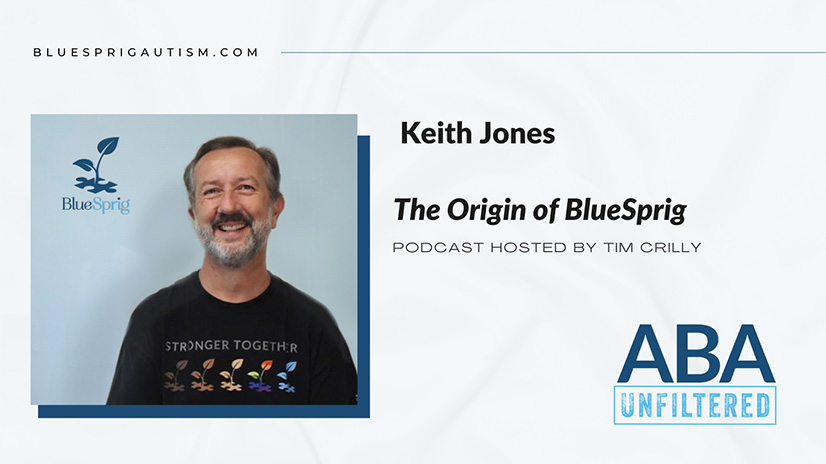
Keith Jones, CEO at BlueSprig, who you heard from in our intro, sits down with Tim to discuss some BlueSprig history, the current ABA landscape, and current initiatives within BlueSprig. Keith just came back from his Road Back Road Trip with a lot of stories to tell and details some of the challenges the BlueSprig team overcame during pandemic shutdowns, and how proud he is of his organization and our accomplishments.
Full transcript
0:06 Tim Crilly:
Hello and welcome back to ABA Unfiltered. I’m your host, Tim Crilly, and today we will be joined by Keith Jones, President and CEO of BlueSprig, to discuss the ABA landscape, some BlueSprig history, and current initiatives. As President and Chief Executive Officer of BlueSprig, Keith is responsible for BlueSprig’s strategy, vision, and values, as well as the company’s operations and employee well-being. Keith brings more than 20 years of experience leading multi-site and multi-state operations, as well as building a world-class team. Keith, thank you so much for taking time to chat with us today.
0:39 Keith Jones:
Thanks, Tim. It’s a pleasure to be here. Can I just point out you paused after you said strategy because there’s a typo? You don’t think I’ve done a very good job on our website.
0:54 Tim Crilly:
All right.
0:55 Keith Jones:
Okay.
0:55 Tim Crilly:
For those of you listening at home, I’ve known Keith a few years now. He was responsible for obviously starting BlueSprig, finding me on the street and bringing me in to uh be a part of this team. And I can’t thank him enough because my time here in the ABA world has been an interesting one. And the vision that Keith brought to the table when we first started talking was very much in line with what I thought needed to happen, but didn’t know if it was possible. And he described and laid out a process for me over a beer and a hamburger and said, This is what we’re going to do. And I said, Great, I think it’s fantastic. I’ll believe it when I see it. And wouldn’t you know it slowly but surely I saw it come to life and it’s been an amazing thing to watch. So, Keith, I guess the first thing I want to ask you is prior to starting BlueSprig, you worked in the pediatric world, but weren’t necessarily involved in the autism and ABA community. What attracted you to that business, that culture, these people? What was it that made you start BlueSprig?
1:54 Keith Jones:
Happy to talk about that a little bit. But I you just said that when we got together and I first started talking to you, you said just then that your thought was what did you say? If you believe in it, you can I maybe you can say something. What did you say?
2:07 Tim Crilly:
I love what you’re thinking, but I’ll believe it when I see it.
2:10 Keith Jones:
I’ll believe it when I see it. I thought you said I believe in you. And so perfect.
2:14 Tim Crilly:
So it’s my fault. It’s my fault. Let me let me I’ll let my wife know that you guys are on the same page that most things are are my fault.
2:24 Keith Jones:
So my alternative was I was gonna open a lemonade stand on the corner outside my house. That would have been the other thing. But I because of you, I thought we could do this. I just judging aside from I the you know spending that time with you and when I reached out to you and on LinkedIn and having some of these sort of wild theories about the landscape and spending some time with you in California talking through that. That really actually judging aside was affirming because I had these sort of theories, but I really didn’t know at all how to really think about the industry and what some of the challenges and barriers would be to this industry. I knew when I started the company what I saw from the outside, but that conversation with you was the catalyst for so much of what we’ve done in the last two and a half years. And what drew me to this landscape and to this industry, to working with children with autism in the first place was when I came out of PSA Healthcare, I knew that I wanted to stay in a very mission-driven organization. I wanted to continue to work on behalf of children, to make a difference in the lives of children. You know, we were a pediatric private duty nursing company. And I think when I was with the organization, at least, we put our clients and our clinicians first. So I wanted to carry on doing that. I wanted to do something that was focused on kids. And as I looked at the autism world at the time, I saw hyper fragmentation, extreme variability in the quality of services, and frankly, a lot of ignorance about how medical model works from a payer perspective. And I thought this was an industry that was ripe for frankly some really significant backlash from payers, and that there was an opportunity to help with that.
4:08 Tim Crilly:
I totally agree. So, with that, I think you’re absolutely correct. You know, when you look at agency to agency, you get inside one BCBA to the next, I think it’s safe to say that there isn’t a lot of necessarily agreement on what we all should be doing, when we should be doing it, and how we should be doing it. And that can be a frustrating thing to not only the payers, but you know, unfortunately, probably some of the families, as you know, sometimes services change and you have a new provider come in and it’s a totally different message that they’re sending to that family. So that’s probably very different than the world you came from with sort of that in-home nursing, pediatric nursing world. So, what has surprised you the most in your time, your almost three years now, really looking and studying and working within the ABA world?
4:54 Keith Jones:
Yeah, I think there’s surprises to the negative, and there are surprises to the positive, right? I think surprises to the negative. I I’ve I’ve never come across another industry where people largely validate themselves through the academic affiliation that they have. I sometimes kind of joke, it’s a bit tongue-in-cheek, but I’ve never met a BCBA that didn’t validate themselves by telling me where they went to college in the first 30 minutes of the conversation, right? Because in the absence of having consistent, agreed-upon clinical protocols that we can debate, discuss, but coalesce around as an industry, in the absence of that’s those sets of standards, what you have is your academic bona fides, right? You bring that with you, and so many people wear that either as a chip on their shoulder or as a badge, right? Of honor. And there’s debate and frankly, derision between the different academic uh schools. And so that when I first got into this, that was a very significant surprise to me. Another surprise to the negative has been, as you pointed out, the range of different approaches and frankly, variation on outcomes. So I talked with, I think you know, I’ve been traveling around the country during this pandemic, talking to employees and saying thank you to them and talking to a lot of our families as well, and talked to a family in Dallas that had recently joined BlueSprig, recently come over to us, and I think they had interviewed something like a dozen different uh ABA providers in the DFW area. We were the only ones that asked about their child. Every single other one apparently said, here’s our program. It’s 35 hours a week or 40 hours a week. This is how we operate. And I think it’s problematic if you come at it from a predetermined perspective. How can you say that you are actually assessing that child and working on behalf of that child to help them progress? I will say, surprises to the positive, I’ve never seen the level of passion exists in this industry. Even these clinicians that I’m kind of tongue in cheek, poking a little bit of fun at, every single one of them, they’re more passionate about what they do than anything else I’ve ever seen in my life. And so can we harness that passion?
7:16 Tim Crilly:
The passion comment speaks very loudly right now. You know, prior to all you know the lockdowns and everything changing, you know, you hosted a very powerful leadership conference. And, you know, I was there and I sort of sat in the corner and minded my own business as I’m told to do, and it was perfect for me. I was blown away by the team that you brought into that room. And it was a big room with a lot of people and the passion that I mean it was overflowing in that room, you know. So that was an amazing experience. And I don’t know, did that surprise you? You know, I know you you you you’re in and out of clinics and you’re meeting a lot of these people. I’m just curious if seeing them in that environment that we all had that common experience, was that something that surprised you or was it something you were expecting because you do know your employees pretty well?
8:02 Keith Jones:
Look, I I hoped for something out that vector. I don’t think I could have hoped for the reaction that we got. I will tell you that was I’ve done a lot of leadership conferences over the years. That’s by far and away the best one I’ve been to because of that passion. And one of the sessions, you’ll recall this, we did a storytelling session where we sort of divided the room. Um, there were 160 clinicians and operations managers that are in that room from all over the country. And we said we want to tell stories because we believe no story, no mission. That’s how you transmit what matters to other people around here, right? It’s how you cascade the the culture and the and the values. And so, hey, anybody want to share their story? I don’t know if you remember, but 80% of the We almost had an extend a whole extra day and boy, those stories were so powerful. I mean, you think about some of them now. I’m still I I still reflect on some of the stories.
8:56 Tim Crilly:
Uh you know, and tears around the room. Yeah, yeah.
8:59 Keith Jones:
Every not a dry eye in the house. I actually had an ex-employee that I was trying to recruit to come work with us, and and I invited her to come and spend a couple of days at that leadership conference. And she worked with me at PSA Healthcare. And she said, Look, that brought out so many emotions for me. It feels kind of like you’re running a cult here, and she meant it in a positive way.
9:17 Tim Crilly:
But are my when do my night? When do my nighties come in the middle?
9:21 Keith Jones:
Nobody will come a work for us now that we’ve described it that way. But everybody is so committed, right? So committed to our mission and to our values and to the cause. She said, I’m not, I gotta go work on me. I’m not ready to join here because yeah, oh my god, we’ve seen anything.
9:37 Tim Crilly:
I was shocked because I’ve been around since the beginning, but it grew so much and didn’t really get an opportunity to see all those things because doing other things and and working on other projects, but just to see the team that you guys have put together really blew me away.
9:51 Keith Jones:
Speaking about the beginning, I remember when we didn’t have video conference in the beginning. There were like five or six of us in one room. You were in California, and we would talk to you on the phone.
9:59 Tim Crilly:
I drew a little picture.
10:01 Tim Crilly:
I drew that the day before I left my first time ever being there. Just so I was like, I hope they send me a paycheck next week.
10:08 Keith Jones:
We have we had Tim, we have a little post of Tim on the wall, and that’s who we talk to instead of video conferences.
10:16 Tim Crilly:
You know, and obviously I I appreciate all that and and the community you have built. But you mentioned mission in your last response there. I’ve been a part of a few organizations, some big, some small. This started out small, it’s gotten pretty big. Mission has always been in the forefront of every conversation I’ve ever had with you, any meeting I’ve ever been, no matter the size of the meeting, the scope of the meeting, mission, mission, mission. Can you expand on that? On you know how important mission is to you and and how it really truly drives decision making from a top of the food chain all the way down to you know your individual clinical decision making processes throughout the day.
10:57 Keith Jones:
Yeah, it’s really important to me, as you know. And I think it’s because there’s probably some deep-seated thing bad about me, but whatever I’m doing, it has to have meaning for me personally. Otherwise, I’m gonna get bored, I’m gonna switch off, I’m gonna go try and find the next thing that has meaning. I’ve always had problems with reporting to other people that I thought were shallow or trite or banal in their decision making and in their thinking, if they didn’t have substance to them, if they didn’t have a story, if they didn’t have a way to conveying, convey to me something deeper than just a surface level, hey, I want to make money or I want to take a paycheck. To me, if you’re gonna get out of bed early in the morning and you’re gonna go to bed late at night, you’re gonna work seven days a week to build something, it has got to have meaning. And that’s what mission to me reflects. We don’t have a mission in order to say we have a mission. Our mission is everything we do, it’s the only reason we really exist is to strive every day to fulfill the obligation of the phrase, we’re changing the world for children with autism.
12:13 Tim Crilly:
Yeah, that’s great. And you know, I think anyone who doesn’t know a lot about BlueSprig, but starts to meet some folks or interact with them, I think it’s right there in front of them every time you walk into a clinic, boom, the mission’s there. And it’s not, it’s not like as you always say, just words on a wall. It is truly the way we look at our daily comings and goings in the community.
12:34 Keith Jones:
It creates an expectation of us all. Like I go to bed pretty much most nights. And if I feel like I or we haven’t advanced in some way towards closer to change the world of children of autism, then that’s a sucky day. And tomorrow I’m gonna have to get up extra early and work extra hard. And and it does, it creates this level of operating tempo and expectation that’s way above what most people will experience elsewhere. I recently had a regional director tell me, hey, when I interview people, I really go deep on mission and values to kind of set the expectation. I said, Oh, that’s really cool. Yeah, mission patch. Because, no, no, no, I don’t think you understand. I’m telling them this place is a nightmare because you’re gonna have to work so hard just to keep up, because we all now have bought in and we’re all hell-bent on changing the world, children of autism. And so you don’t get to come here and mail it in.
13:30 Tim Crilly:
Yes, you know, you’re you’re creating a great commercial and probably a huge uh red flag for a lot of people out there right now, so which is what we want.
13:36 Keith Jones:
Right, should be right that our values, we haven’t really talked about our values, but our values and our mission together, you should understand.
13:43 Tim Crilly:
I wrote the values where I wrote them because I wanted people, one, to know how to make decisions when they were here, but also to know whether this was a place that you know, and that was sort of the next phase of that, but it’s not just a mission, but it’s it’s a core set of values that just are simple, very thoughtful, but they really tell the tale of who we are. So, you know, and I think it there’s not a probably a BlueSprig employee out there that doesn’t know them, or at least most of them, but they’re fantastic guidelines.
14:10 Keith Jones:
Yeah, thank you for saying that. I as I’ve been traveling around the country, having RBTs come up to me and tell me their favorite value, pretty much.
14:17 Tim Crilly:
I mean, mine’s about you know not being judgmental, but being judicious, and I’m the worst at living up to it. So it’s something I try to remind myself of so I can try to do that a little bit better, but I keep it to myself, but don’t say anything out loud. Nothing comes out of my mind.
14:31 Keith Jones:
Wow, you and I are quite similar. That I wrote that up to myself.
14:34 Tim Crilly:
That’s like a little uh post-it note on your desk every day. Yeah, I appreciate that. And I think it it really sets the tone for any family employee that wants to understand who we are. It’s a really powerful message. Along those lines, you know, I I think you know, you started this as a concept with some smart people, and you you started to bring on some other smart people to try to bring the talent and and really start to build out what you wanted to do. So, in that time, coming up on almost you know, three years of of official BlueSprig life, but well over three years of you concentrating on this concept, what are you most proud of? What would you look back and say if you had to put a pin in something? What are you most proud of about this organization?
15:15 Keith Jones:
Gosh, there’s a there’s a few things, but the quality of the team, the quality of the people that have chosen to be part of this mission, it’s just mind-blowing to me. It’s not lost on me at all that any one of our team could choose to go work pretty much anywhere else, and they choose to stay here, they choose to be all in on our mission. I’m incredibly proud of it. I’m very humbled by it.
15:42 Tim Crilly:
You know, I that’s what I would have gone with. I think you’re right. I I think the amount of people that saw what this could be and walked away from something to come to an unknown, it blows me away. Most I don’t think about it every day anymore because we’ve grown so much. But in those early days, it almost used to stress me out a little bit, you know, like, oh my God, we really gotta do this now because this person and that person just joined.
16:04 Keith Jones:
Keith, you and I’ve talked about this, and I know you’ll you’ll be too humble. You you’ll dismiss this, what I’m about to say, but a lot of people have joined here because of you. And it it it’s sort of the Tim Crilly rule, if not but for Tim, many of the key people in this organization wouldn’t be here. But that carries a weight. I think you dismiss it because one, you’re a humble guy, but two, not at all, that pressure, right?
16:27 Tim Crilly:
I mean you know, I I’m trying to do it. Sure, I mean when Sharyn joined, that changed a lot. My wife every day. Is Sharyn happy? Is Sharyn okay? I’m like, I think so. I don’t know, I don’t know what to tell you, but let’s hope.
16:42 Keith Jones:
I think six months in, I said to you, yeah, don’t I know, I know.
16:46 Tim Crilly:
I was worried. I’m a people pleaser, I get it.
16:50 Keith Jones:
It was that was it’s amazing, but that that’s you’re right. People have left things, great things, to come here. And so that again puts the weight of obligation on us, right? We are here to change the world for children with autism, and we can’t lose sight of that, we can’t sh fall short of it. That will, and there’ll never ever be an end to it, of course. I mean, that’s yeah, that’s the thing of it all, but that will keep a lot of us going for a very long time. I was talking to somebody about this earlier today that the rates of bullying in high school for for kids with autism, we don’t provide services in the school setting today, but you we gotta figure it out. We’ve got to figure out how to help kids in high school, kids with autism in school, in high school, and middle school.
17:32 Tim Crilly:
Yeah.
17:32 Keith Jones:
We’ve got to help bullet. It’s not just about providing high quality care in our clinics. Clearly, it’s a big part of it, or in the home, wherever we’re providing those services. It’s about being really active in the communities that we’re in to create awareness and inclusion and to advocate for all children with autism and to make their families feel confident and comfortable that they can go to a ballpark and not have to worry about what’s going to happen. You know, there’s a sensory room available to them. Or if I’m in a school setting, I know that one of the high school athletes has got my back if I have autism. And facilitating that at a community and grassroots level is something that we put a lot of pressure on ourselves. I’ve said this quite a bit. Companies that derive income from children receiving their services should advocate for all children.
18:23 Tim Crilly:
Yeah, not just the easy cases and the you know the the quick fixes and those sorts of things. I I totally agree.
18:30 Keith Jones:
Think about it. You make money off of children, what are you doing for all children? And that’s that keeps me up at night.
18:37 Tim Crilly:
So 2020’s been an interesting year. What did it teach you about your organization?
18:42 Keith Jones:
If you ever question that people at BlueSprig are all in, you don’t ask that question anymore, right? But it’s just amazing the response we’ve had when we’ve said, We need you to do this, our families need you to do this without exception, with very few exceptions. The response has been, put me in, coach, where do you need me? It’s incredible. You mean you you learn, they say in adversity you you find out your true self, right? I’m damn proud of our true self. You look at the employees, our RBTs, our supervisors, our clerk, our area supervisors, our regional directors, all the way up to Sharyn and Jill, Franny and HR and Laurie and Marketing and Christy and East Division, and the the amount of work that they have put in to provide the supports and the tools. When we ask the question of our employees, and I’ve talked to CEOs at other companies and they’ve not had this experience by and large. When we asked the question of our employees, they almost without exception said, I’m in, what do you need?
19:51 Tim Crilly:
It’s been amazing to watch. You know, obviously, you know, we used to be able to get together a lot, not just me and you, but you know, the team and and you know, everyone. It’s taken some hits. You have some new friends, I get it, I can live with it. Uh, but you know, it has been a weird year because you know, we were all together in February, like you just said, 160 of us ready to just tear the world apart, and everything stopped. But to see the gears move and the meetings and the ideas, you know, I wasn’t really I was on the periphery and you know, sort of in involved and let’s take a look at this, let’s take a look at that. But just the work that these folks just jumped in and started doing, I can’t even imagine because I probably only know a fraction of it. So it has been amazing to watch and and be a part of. That speaks highly of you and the leadership team that that you assembled. People want to jump over walls, they want to help, they want to do the things that they signed up to do, and and you’ve been able to provide that opportunity to keep doing it, and that’s been really fun and and inspiring to watch.
20:52 Keith Jones:
I agree. I mean, I mean it’s inspiring for me to watch everybody else. If you could genuinely say that I would never ask you to do something that I wouldn’t do myself, and that’s big part of the reason that I’ve been visiting clinics and visiting families and and sitting down in the front yard, talking to families directly and going from house to house to house over the last six weeks. And I think I’m through something like 40 clinics now and throughout 10 states. But what I’m trying to show people is look, I’m not hiding in my house in Houston or hiding in support services.
21:21 Tim Crilly:
Sure.
21:21 Keith Jones:
I’m here with you. I’m one of you, I’m here with you. What do you need? And thank you.
21:26 Tim Crilly:
Keith, I really appreciate you taking a couple minutes to just talk about the journey and the team and the passion, vision, mission, all those things. It’s been a wonderful two and a half years, and I know there’s so much more to come, so much work to do. We would like to have you on again, maybe with some of your friends, to talk about some other topics. I think that’d be fantastic. But I’d be remiss if I let you go before I ask you a question that I’ve been asking all of my guests. It’s a yes or no. And with your answer, I do need a rationale behind why you’re choosing it. So basically, yes, no, what’s your answer? And then I’ll let you get on with your evening. Is a hot dog a sandwich?
22:08 Keith Jones:
I think it has to be no, because the bun is very rarely sliced all the way through. And I think the Earl of Sandwich would be disappointed if people were to misrepresent his initial invention. And so I think two separate, two separate pieces of bread is important in the sandwich discussion.
22:32 Tim Crilly:
Okay, we’ve had a few folks on. That might be the most historical answer we’ve had so far. You know, but you are English, so credit where credit’s due, you’re the Earl of Sandwich.
22:40 Keith Jones:
You didn’t give me a heads up, so I I couldn’t quote okay. Fair enough.
22:43 Tim Crilly:
We can we’ll put that in uh post edit, it’s no problem. Lucas, can you get on that for me, buddy? You know, once again, to thank everyone for for tuning in and listening to ABA Unfiltered. Keith Jones, it’s been a pleasure. Can’t wait to talk to you again soon about whatever might be most pressing at that point.
22:59 Keith Jones:
Uh it’s been a pleasure, and I thank you to everybody for listening. And even if that’s only my mom and mom, I bet you they get along pretty well. And Tim, never forget, you were my first.
23:09 Tim Crilly:
I’ll take that to my grave.
23:13 Tim Crilly:
Please do, keep that. Okay, thanks. Thanks, Keith. Thank you.