Back
About ABA Therapy

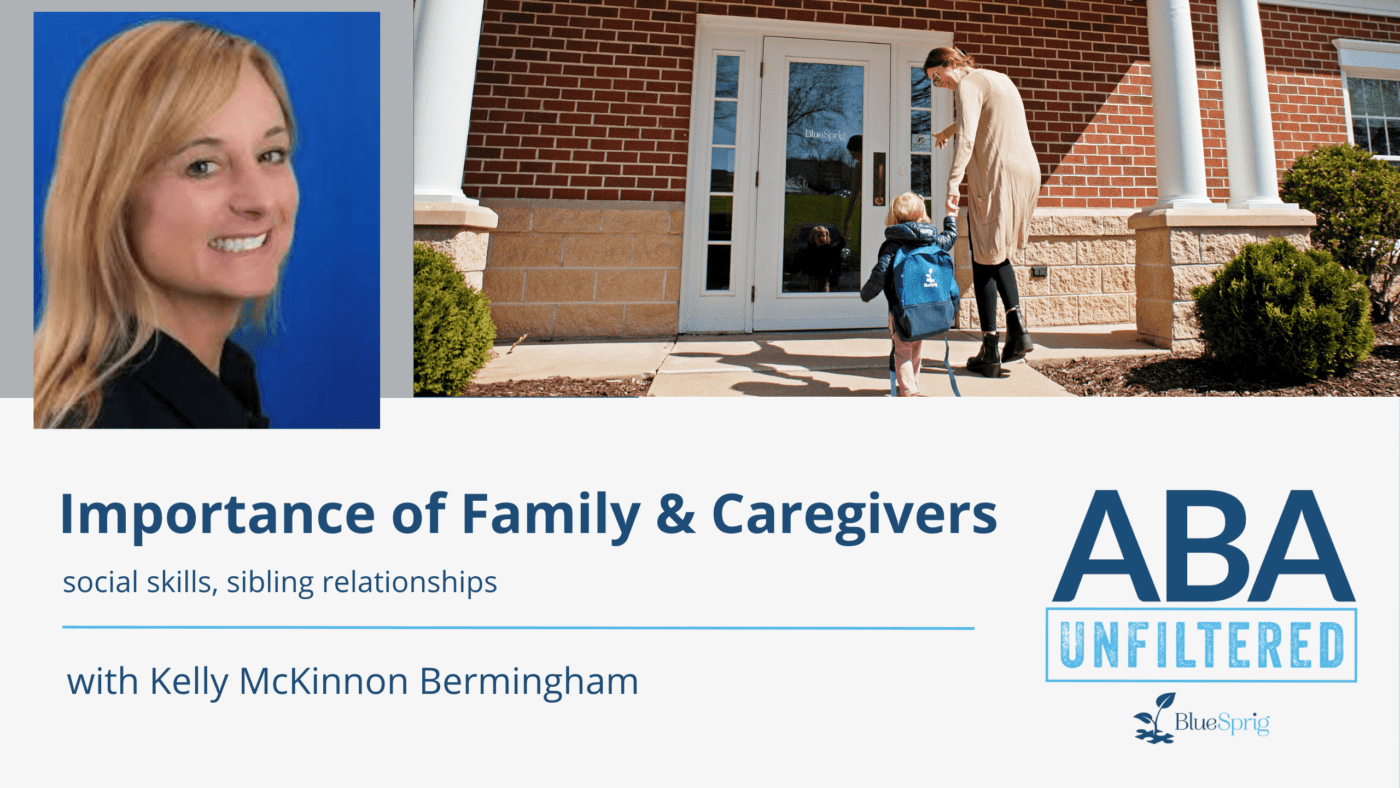
Season 5: Episode 5 – Importance of Family/Caregivers

Hosted by Kelly McKinnon Bermingham
March 21, 2024

Listen now:

or listen on your preferred platform:

Episode Description

Hosts Amanda & Andrew are joined by Kelly McKinnon Bermingham. Kelly joins the podcast to discuss the importance of family/caregivers and the role they play in seeing meaningful outcomes. Kelly talks about social skills, sibling relationships, finding what’s important to you, and more in this weeks episode of ABA Unfiltered.

Kelly’s Podcast: Podcast link: https://podcasts.apple.com/us/podcast/a-25-year-look-across-the-spectrum-with-kelly/id1535918398

BlueSprig CEU Website: Use Promo Code “Podcast” to get 5$ off

https://bcbaceu.bluesprigautism.com/

Full transcript

0:14 Andrew Blomstrom: Hello everyone, this is Andrew Blomstrom, along with Amanda Fullbright, and you are listening to ABA Unfiltered, where each episode we interview guests from around the world of ABA. Whether you’re a BCBA, RBT, or just interested in ABA, you are sure to pick up some actionable advice you can utilize on your journey. Now, without further ado, we would like to welcome our guest, Kelly Birmingham. Kelly, why don’t you start by telling our listeners a little bit about yourself?
0:41 Kelly Birmingham: Thanks, Andrew. Some people might know me as Kelly McKinnon in a former life, former marriage. So I’m Kelly McKinnon now, Birmingham. This is fun for me because 2023 marks my 20th year being certified as a BCBA. I was certified in 2000, end of 2003. And I joke with people because I went to a testing studing place and did my test with paper and pencil. It was not online. I studied, uh I got my certificate in applied behavior analysis postmasters at Penn State, and they would mail me VHS tapes. I would get my VH test tapes in the mail. Jose Martinez Diaz was on them, and I’d watch him, and then I’d fill them out, and then I’d send my paper test back with my VH test, my VH tapes back. So it’s a long time ago. A lot has changed since then. Um and I feel a little bit, I call myself like an old dog or an old dinosaur trying to keep up with the technology. Um, so yeah, I’ve been in the field for actually I’ve been in the field for 27 years, um, since 1995. And my first job uh involved working in group homes in Massachusetts and working to help the state institutions were alive and well still, unfortunately, and helping individuals move out of those institutions they’ve spent their entire life in. Many dropped off and didn’t know their families at all, state appointed guardians, and moving them out into their own homes and getting jobs and um managing the community. And so that was my very first job.
2:17 Andrew Blomstrom: Very nice.
2:18 Kelly Birmingham: Yeah. You know, I I kept going. I in I’m I hail from Maine and Massachusetts. And so I started working with younger children at uh in high school and then younger children. At this point, you know, we’re still talking like 1999, and private insurance did not cover ABA at all. It was state-funded, regional center funded. Massachusetts had some wraparound funds at that time. And when I started doing the work in home, and I um was lucky enough to be supervised by Dr. Michael Cameron, Dr. Robert Ross, and get some really great experience. But I started to notice over those years that we still very were heavily based in discrete trial models. And I was working with some um younger children that were a little bit more skilled, some more severely impacted, some a little bit more skilled. And I was searching for social skill um curriculum, and it just wasn’t there. I mean, back then all we had was like Catherine Maurice’s book, Let Me Hear Your Voice. And um, so that’s what we followed. And so in 2002, I did start writing a book around social skills, and it was published that year. And so I have this schizophrenic career where I very much like doing social skill work with um children and adults, and I also very much like working with the severe and profoundly impacted folks. So I I dabble between the two sides. I like doing both of it.
3:45 Andrew Blomstrom: Very nice. And you kind of mentioned the book that you uh you’d wrote back in 2002. I understand you are currently writing a book and was wondering if you could tell us a little bit about that.
3:56 Kelly Birmingham: Yeah, so thanks for asking. So um, hopefully, I keep saying I’m writing a book. I’ve written it. It’s with the publishers right now, being edited. And I thought about it 20 years after. So in 2002, it was the first year the book came out. I still use a lot of the materials in that book because I started looking at teaching using ABA strategies in a group format. And a lot of folks, I remember thinking people thought I was crazy. So in 2004, I was in California, I opened up my center, if you will. And it was my private practice, it was private pay because again, insurance would not pay for ABA back then, and regional centers did not understand the concept of group ABA. They would not fund me. I had the head of regional center at my place looking at it, going, look at what we’re doing. And they wouldn’t, they wouldn’t fund it. And to this day, they still don’t in my regional center. And the concept of bringing kids together to learn how to learn. And I felt pretty strongly about um the sooner we can get kids to learn how to learn, the more effective we’re going to be in teaching them that we’re fading out that one-on-one support and we’re teaching them to learn in a three-to-one ratio. Because that’s what school is, right? And I kept finding this disconnect between kids that learned really well on a one-on-one setting in their home and then went to school and really struggled. And so I to this day feel very strongly. So I did, I went and actually became ESDM certified, that’s early start Denver model certification, and which takes a long time actually. But I really liked it because it infused a lot of neurology and how understanding how the brain works. And by no means am I an expert at that at all, but I got to learn from that. My longtime mentor out here in California, Dr. Joseph Donnelly, was a pediatric neurologist. And so I always really enjoyed trying to understand how the brain works. And again, I’m no expert, but when I got certified in that, I really started to realize the impact of early intervention, and particularly teaching kids how to learn how to learn. So this new book focuses a lot on those early development skills. Um, it has an updated social skills checklist, which is what we called it in our first book, um, for um ages two up to six, and then an updated social skill checklist from ages six up to twelve.
6:23 Andrew Blomstrom: Very nice. I can’t wait to read it.
6:27 Amanda Fullbright: Any uh estimations of when that will be available to to the public, Ellie?
6:32 Kelly Birmingham: Well, it’s with Hedgehog Publishing, and Josh keeps telling me it’s supposed to be late spring, early summer launch. So I hope so. We were trying to hit it in time for ABAI in Denver, but we’re not gonna make it. So um we’re hoping, hoping late spring, early summer.
6:49 Amanda Fullbright: All right, best of luck to you. Thanks. So uh focusing in a question around social skills and you know, supporting families, because this is our supporting families series right now. How do we help support our families in building social skills outside of those sessions? You know, whether we’re working on social skills inside those sessions or not, what really matters is that they’re they’re doing it in the home as well. So any advice for our listeners who might be struggling in that area?
7:23 Kelly Birmingham: Yeah, that comes up a lot. It’s a it’s a tricky one, no question. It’s, you know, one of the fun things about when I started this book was I had the luxury of going back to ask former families and students I had known over the years. And I was able to talk to about 25 families and some old students of mine, about six old students of mine, and asked them, um, you know, what was good about your experience in social skills at ABA and what wasn’t good. And I was really pleasantly surprised at how positive I heard from the families and the kids. You know, there’s a lot of press right now against ABA. I didn’t get any of that from the families that I that I talked to. And a lot of the things I heard families say, the ones that stuck out with me, one are they just wanted their children to be happy and and moving the bar and measuring what happy meant for that child, right? For some children, happy means a friend, right? Or a few act, you know, maybe they’re in a bowling league or maybe they play sports. Um, for some kids, it was, you know, I only meet meet other children or other friends and certain online, right? Um, I talk a lot about my stepdaughter who’s on the spectrum, she’s 33, and we would say she doesn’t have any friends. She will tell you she has hundreds of friends and she has them all on her gaming platforms, right? And social media, and she’s, you know, FaceTiming them. And we’ve never met them. She hasn’t met most of them, but they call each other and they talk to each other, and that’s her version of friends, and she’s super happy. So some of it is like measuring what happiness means for that child and what friendships and socialization means. Another one is I can’t say enough about sports, and sports are hard for our kids, right? Uh, but um, you know, in California, my husband and I helped found a sports league for children on the spectrum. It’s called Spirit League. It runs on its own now. We’re so thrilled we don’t have to do it anymore. But for every for years, we slept every Saturday um to the field and we did soccer, basketball, and um baseball. And that was in 2006. Those kids now were all still playing together in an adult league. You know, they were young and now they still get together and they do volleyball and they go bowling, right? So, like having a group of people to do things with and those kinds of sports, and again, it was never about the techno like, are you good technically at playing soccer? It was always about like, are you a part of a team? And that was the part we always emphasize. And you know who gets that really well is Special Olympics, right? Special Olympics gets that really well. And so we encourage a lot of our kids when they get into adulthood to move into the Special Olympics arena because they do it really, really well. And then the last thing I will say is a number of families told me one of the best things that their children learned was how to reference their environment. So that was like the third thing, reference their environment so that they they didn’t know what was going on. They maybe they missed the instruction, they weren’t sure like socially how to act. Like, look at the environment and try to change your behavior based on that. That one came up a number of times.
10:37 Amanda Fullbright: And so that that leads me to point out, you know, the importance of imitation skills. Yeah. Yeah.
10:43 Unidentified Speaker: Yeah. Yeah.
10:44 Amanda Fullbright: It’s a great foundational skill. Thanks for that, Kelly.
10:49 Andrew Blomstrom: So, along the lines of that, the social skills, I was wondering if you could talk to us a little bit about sibling relationships and kind of how important those relationships are to children on the spectrum.
11:01 Kelly Birmingham: Yeah, so I’ll do a shameless plug right now. Um, I have a podcast. It’s this really long name. It’s not as cute as and snazzy’s ABA unfiltered. It’s it’s a 25-year look across the spectrum, is what it’s called. Because I was going, I started it when I was hit my 25-year mark. And we do actually a four-part series where we interview siblings. And it was fascinating to me that all four of those siblings do some kind of work in autism or special needs arena. And so a lot of times, like my own step, my stepdaughter, right? We interviewed her, and she was worked as an RBT for years. Now she does case management for a company. And so a lot of these kids are the champions, right? They’re they’re the champions for um the students we’re working with. And I find that all of them said that I interviewed, of course, I picked the ones on purpose that I knew well and had relationships with, but they all said that very early on they wanted to be told about autism and they wanted to um be a part of the therapy at an early age. And I there’s one young man on my podcast, I’ve interviewed him twice now because his name is Ethan. He’s 20, he’s just turned 21. And he’s so articulate about this because he said, I knew something was different about my brother, and no one would tell me, and it used to make me angry because I wanted to understand it. And so he at like three and four years old started saying to his mom, like, tell me everything. I want to know what’s going on. And so I find that including these kids in therapy, and what happens, and I’m no expert, this is just my personal experience. What happens is I find there’s like two sets, right? There’s a group of families that are trying to shield the child from autism, and there’s a group that very much includes them. And the groups, the families that include them, I’ve always found those siblings to do very well. And some of the families where they shielded the child, I found those siblings to be really angry. And there’s no question the child on the spectrum gets more attention, right? They get more attention most of the time than the sibling. And then parents feel guilty, they feel torn, they’re trying to split between, you know, everyone. And this goes back to the social skills. I used to always say if the family can find one thing that they can all do together, that everyone can do together, and it is often the activity that the child on the spectrum prefers, right? And it may be an activity that other people don’t like to do, but if you can start by including that child on the spectrum with their preferred activity and make it fun as much as you can, and then and then try to expand on and grow on it, then the family has this one thing that you can do together.
13:47 Andrew Blomstrom: Yeah. That’s great. Yeah, I can imagine. I mean, I know with like my siblings or even watching my kids, those relationships, they probably closer together than you know, my relationship with them. And so I could understand how important those would be to successfully implementing those social skills in a home environment.
14:05 Kelly Birmingham: Yeah. One of my favorite stories, my husband did this, is my stepdaughter early on flapped, right? And no one ever told her not to flap. He just made it a family thing. And it was like, if she went like, you know, flapped her hands, we’d all flap her hands and go, like, wow, that must be an exciting thing. And it just became a family thing where we all started flapping together. And now she’s 33. She doesn’t really flap anymore. It’s turned into like a one-hand kind of little handout flap funny when we’re trying to be funny with each other. But he normalized that instead of like telling her to not do it. And it just made it all fun. And it was just like something we all did.
14:44 Andrew Blomstrom: That’s awesome.
14:45 Amanda Fullbright: That’s great. Kelly, there are staying on the line of siblings in in some areas. I know in the North Texas area where I live, there have been um sibling support groups and and other types of supports for uh kids or adults who have young adults who have siblings on the spectrum or siblings with special needs. Do you have any of your past clients uh attended those? And do you think that they they can be beneficial?
15:16 Kelly Birmingham: You know, I used to, when I I had a private practice from 2004 to 2014, 10 years. And we it was almost singularly based on social skill groups, and we did summer camps all day, and we did do some sibling workshops. And I can only speak on my own experience. I found that when I included the siblings in the actual therapy, it was much more fun and effective than a separate workshop. Um, I did have to spend some time with the siblings talking through autism. Like, what is it? Why might their sibling act this way or that way? Or what are some things they can do? So we did do, if you will, some like sibling training, sibling support. But as soon as they sort of felt like, yo, I understand, I’ve got it, we moved them into the groups. And so it was a win-win. I had neurotypical peer models in my social skill groups and my camps. And then I also had siblings that could have opportunities to interact with their own sibling.
16:16 Amanda Fullbright: That’s great. And and another thing that they can do together, you know, speaking of things, people doing families doing things together, you know, if they if they’re all participating in therapy, then that’s yet another way to, you know, build that up.
16:29 Kelly Birmingham: It’s so true because then we could say, okay, hey, you know how we play this game of Uno, let’s say, or maybe you did this craft project together. Now you can take that home, and that might be your family activity that you can all do. And I again, I always tell families, I used to always say, make Friday night your family night. I had one mom who took this on steroids. And I’ll never forget her as long as I live. I’m still in touch with her. Her son is now going into law school, something none of us thought was going to happen at age three and a half. I would have not thought that. But she took Friday night. Now we live in California, so we can be outside a lot. Friday night was night at her house, and she had the garage up. She projected a movie. Every night was movie night. Everyone would show up. She devised a craft based on the movie. She’d have a move, the movie going on, she’d have snacks, she’d have an and the parents could all come and they’d hang out so play those. And she would work those kids. And she used to say, just like, I’m gonna immerse my son in this neighborhood if it kills me. And that changed as they got older, right? When he got started being 12 and 13, the theme would change. But she, like her house became the magnet. She was exhausted all the time, I’m not gonna lie, and stressed out. But by high school, I’ll never forget her saying, if I hadn’t done this, I don’t think I’d be where we were. Because the neighborhood kids at first tolerated him, if I’m being honest. He was unusual. He did had some behaviors that were unusual. They tolerated him. Then they started helping him. Then they started to like admire some skills he had that they didn’t have, because he had some really strong visual perception skills, and that played well in gaming. And um, so then they sought him out for help, and then it was like this level of acceptance happened. It was fascinating.
18:16 Andrew Blomstrom: That’s a great thing.
18:17 Amanda Fullbright: How long do you think that that happened or that took to happen? Like all the way to high school.
18:21 Unidentified Speaker: Okay.
18:22 Kelly Birmingham: Oh, the long game. Toler it was a long game. The toleration was probably into like second or third grade, right? And then it was uh now there were helpers and they were helping him with everything. And then like late elementary, because I I stayed with them and knew them all those years. That’s when his skills started to show. And then, you know, by high school, they were equal peers for sure. That’s fantastic.
18:45 Amanda Fullbright: Yeah, I think it’s important to remind all of us to have patience because these things take a long time often to build, and then also have patience for the evolution because kids change over childhood, of course. Their peers change over childhood, of course.
19:05 Kelly Birmingham: That’s the tricky part about social skills, is the skills change but with age, but there are foundational skills that, in my opinion, don’t change. And it is like you referenced Amanda, the imitation, like referencing your environment and imitating and learning from trial and error is like one of those like core skills that does not change.
19:26 Amanda Fullbright: What are some of the other ones you think?
19:30 Kelly Birmingham: So let me tell you. Um, you know, they’re often called like behavioral cusp kinds of skills. And in my opinion, it’s orienting to social stimuli that will then enhance, which used to be called eye contact. Like if we can get past that eye contact terminology and think about as orienting to what’s happening, and then imitation and then the joint attention of shared experience. Like we’re looking back and forth and like we’re in this together. That’s really hard to get to. But if you get to that, that’s a lot of base of like early learning development. That all happens by like one year old in neurotypically developing children.
20:11 Amanda Fullbright: I think that’s so important, uh, such an important skill. Just last night at dinner, um, my daughter asked me something. And I I didn’t answer right away. I was sitting there, you know, reflecting and pondering how am I gonna respond to this? And she said, What? You’re looking at me with the big eyes. So I mean, she knows that that maybe she knows what that means, right? And I and I and I thought about that for a while. Of are a lot of our clients that are on the spectrum, are would they have been able to do that? And you know, a lot of them probably not. And I think that that’s an important skill to pick up on that, you know, body language and other type of of social referencing.
20:53 Kelly Birmingham: And if you’re not referencing, if your gaze isn’t there in the first place, that’s never gonna happen. So I I have moved away from eye contact, you know, the old look at me, look at me stuff. I laugh so hard at myself because I did it. I would tell a client to look at me, and then I would say good looking at me, and then I divert my gaze to collect my data.
21:13 Kelly Birmingham: Oh, yeah.
21:13 Kelly Birmingham: And right, and so eye gaze was reinforced by what? Nothing. Me just giving some praise or often an edible. Here’s a Skittle for looking at me. I was so like non-contingent at all, it was so bad. That’s how that’s how we all did it back then.
21:29 Amanda Fullbright: Yeah, yeah, no, no, definitely. And you know, I personally don’t I’m not terribly comfortable making eye contact all the time. And I was sitting there thinking, I don’t like to do this. I’m making this person do this. Um, you know, so it’s it’s it’s quite odd. Um, when when you were um presenting for Blue Spurge at our clinical conference last year, you know, you talked about eye contact for some time and and you talked about, you know, who is it meaningful for? Who who is getting the reinforcer? Um could Could you just maybe expand on on the I your point of view on eye contact for a minute? Yeah.
22:05 Kelly Birmingham: So um there’s social norms related. So it’s you have to look at it from the listener and the speaker view, like going back to like verbal behavior kind of concepts, right? Listener versus speaker. So if I’m the person speaking, um the social norm, like now let’s picture a classroom. The teacher’s at the front of the room teaching the students. The social norm or the social expectation is that the listeners look at the teacher as a sign one of respect, right? I’m giving you respect. I’m showing you you’re the most important thing that I’m attending to right now. You don’t have to look at someone to hear what they’re saying, right? And so I’ve we’ve heard a lot of kids on the spectrum say, it is too hard for me, like they’ve said this, it is too hard for me to look at you and process your words at the same time, right? And so when you think about it, the listeners are not being reinforced by looking. The speaker is being reinforced, right? So it’s a social norm. And so what we have to think about is beyond the social norm, and I do think it’s important to teach our kids the social normity of it, right? And I’m gonna do a little sidebar. One time I was in a private uh kindergarten and preschool, and we did a fun little project where we watched circle times, both in preschool and kindergarten. And we in a 15-minute circle time looked at the frequency and duration of eye contact. And we presented this at a Calab, I think it was in like 2007, it was a long time ago. And what we found is in preschool, every we did it on a 30-second interval for, I think it was 30-second interval for 10 minutes. And one, the girls looked more often than the boys, and two, this was preschool, and then in two, the girls referenced at least one point every 30 seconds, 70% of the time, and the boys did it 60% of the time, right? And that was a glance. We counted a glance as two seconds. No one sat and stared at the teacher, right? And when we looked at that, when they got into kindergarten, that changed, the boys started to catch up to the girls in their eye contact, but it still was a gaze, right? Not a stare. And so that was something that we always kind of built in when we were writing our goals was that the child would glance toward, right? You could glance towards the speaker as a sign of respect and attention, and then you may avert your eye gaze. There’s also research that talks about if you give a child, um, if you’re giving the directions to a child, if they’re gazing at you, you’re gonna have a higher likelihood they’re gonna follow through on that task, right? So again, eye gaze, eye contact and eye gaze becomes this like very convoluted thing. And you have to know what is the goal of the eye gaze and what is the reinforcement for the person making the eye gaze. And so if I look towards you and then I gain information or I gain social attention, that is sort of like a naturally contingent reinforcement. But we, sorry, I’m getting I go on forever, but our kids are not typically so meet like social reinforcement is not often reinforcing for them. So then we have to think about alternate ways they’d be reinforced. And a lot of ways that is is through information, items, access to things, right? Escaperable, like all of those things. But we have to consider what is what is what would be the most naturally reinforcing thing for that child to gaze towards you and what will they get out of it? That was a long answer. Sorry, I could go on forever.
25:38 Amanda Fullbright: No, I think it’s important because as you said um before, you know, you were describing how you would maybe run eye contact trials and and I share the same experience, you know, on on another part of the country, right? So we all have probably, those of us that have been in the field a little bit longer at least, all probably started from that and we might still be perpetuating that because that’s what we learned. So I think it’s important to have those conversations. And I really appreciated your long answer.
26:04 Kelly Birmingham: And and for families, right? If we bring it back to caregivers, um, teaching caregivers, like so many parents panic when their child’s not looking at them and they spend a lot of time saying, look at me, look at me, and they point to their eyes. And that is where I draw a lot from the early start Denver model um work, is they talk a lot about make yourself, and I’m gonna put it now in behavioral language. I’m using our language for their topic, is that make yourself reinforcing so the child would want to look at you. So it’s about evoking eye contact, not complying with the demand for eye contact. That is so beautiful. I wanted you to say that again. It’s about evoking, yeah, evoking eye contact, not complying with the demand for eye contact. Beautiful, Kelly. Write that down.
26:52 Andrew Blomstrom: It’s going on the teaser.
26:54 Kelly Birmingham: Yeah, beautiful. Beautiful.
26:56 Unidentified Speaker: Thanks.
26:59 Kelly Birmingham: So I was just gonna say, so it’s harder for parents, right? You have to be fun, you have to be engaging. And it’s as simple sometimes as holding an item and waiting for a child to look towards you to handing it to them. Like it’s that precursor before asking a child to ask for the item. Even if they just look for you for the item and you deliver it, a lot of parents think they have to have words for that. And I’m always saying, like, no, the gaze towards you comes pre-language. Like that in neurotypical development happens. And so if you start there, but then you’re fun, then you’re silly, and maybe you’re tickling, and then you pause and you wait for a glance, and then you reinforce that glance with more tickle input, then those kinds of patterns are the things that families can do to create that evoking of eye contact.
27:41 Andrew Blomstrom: Speaking of families and like caregivers, you know, family guidance, I think, is starting to pop up a lot more in the field of ABA and how important it is to for our clinicians to work effectively with our families and caregivers. What advice do you have for clinicians, you know, who are just starting to kind of collaborate and work with those families on their child’s care?
28:05 Kelly Birmingham: Um, that’s a really good question. A shameless plug in my podcast. We cover this a lot because my podcast is myself as a BCBA and a parent. And we talk tackle topics from a parent care or caregiver perspective and a BCBA perspective. And I sort of bring like what my training would say, and then she’d basically tell me why everything I said was wrong. And so um, you know, a lot of things that come up from the caregivers, and I continuously refer back to the Bridget Taylor, Linda LeBlanc, Melissa Nocick, 2018 Compassionate Care article, which when that came out, I was like, oh, thank you, thank you, thank you. Somebody’s much smarter than me said what I always felt. And it was like, we’re not doing enough to put ourselves in their shoes. And it as a BCBA, and I’ve talked about this with parents, it’s hard because I want to move my programs along, right? And then the care, a lot of times caregivers are saying, like, no one slept and we’re having a bad day, and I have a lot of work to do, and I just can’t do it today. And so it’s a balance between understanding that as a BCBA or behavior RBT behavior therapist and understanding and meeting that parent where they’re at, but also helping move that caregiver or parent past that point. That’s to me the balance and the tricky part is meeting them where they’re at, but not being stuck where everyone’s at and being able to move that forward. And I do feel like the compassionate care article brought a lot of things to light that we can do and things to say, such as like, I know no one slept today. What are some things I can do to make this feel better right now so that next time we know what to do and you know, when this happens again, or like that kind of language to use to move forward.
29:52 Andrew Blomstrom: Helping navigate the families through some of those uncomfortable zones into where they get the skills to be successful. That’s that’s awesome.
30:00 Kelly Birmingham: And you know, unfortunately or fortunately, and I I always end up throwing my husband under the bus with this book because um he raised his daughter for the most part, and I was only in on the second half of her life. But it’s easy, and I found myself doing it. You get you don’t have to be a parent of a child with autism to be an excellent BCBA. But what I did find being a stepmom was that I didn’t fully understand the uh guilt, um, the grieving, the sadness, and the happiness, right? And and the how what you have to celebrate like the littlest joys. I didn’t understand that fully. And and we clashed a lot in the beginning because I was a beat, you know, moving our programs forward, moving our programs forward much faster than was the rate that the rest of the family wanted to do. And I had to learn to slow that down a little bit. And um, you just don’t realize that as a BC babe because you’re looking at your data, you’re looking at your program. Um, and you know, I’m working with the family right now, I’m not gonna lie, I’m getting frustrated because the progress is so slow. And I keep having to tell myself, this is where they’re at. Like they can only be here at this time right now, and slowing that down.
31:14 Andrew Blomstrom: Baby steps.
31:15 Kelly Birmingham: Yeah. The long game.
31:17 Amanda Fullbright: The long game. Um, I I love that article so much. I think I’ve read it a dozen times or more. And and I don’t know how old an article has to be to be considered like a seminal article. Um, but if it’s not already considered that, it needs to be like ASAP. Um, it needs to be taught in every class, always.
31:37 Kelly Birmingham: Agreed. I I’m such a geek about it. I tracked down um Melissa Nosek and made her get on a Zoom with me to talk to me about it. She was gracious enough to do it.
31:47 Amanda Fullbright: That’s amazing. Yeah, so great. Earlier, Kelly, you were talking about um, in regards to um eye gaze, typical child development. How much do you think typical child development plays into what goals we should be working on? And and how does that then affect how we’re working with families effectively, you know, gearing, uh, you know, maybe steering them away from this goal because it’s not, you know, developmentally appropriately appropriate or or moving, you know, for pushing to move a little bit further. Can you comment on that?
32:22 Kelly Birmingham: I can. So um this is what sort of happened with the book and this new version was the I mean, I look back at this book, it’s so old and funny looking, and you can see typos in it, and I’m like, oh my God, that is embarrassing. Um, but the checklist came about initially. So it’s a social skills checklist of skills, and it’s across developed across different areas. And what we did, I went to Developmental Psychology World and speech pathologists who get this right every time. And I went to them and we sort of broke down social development into the categories that they should be. And this was in 2002, and we broke them down into like the skills that happen first all include social referencing, imitation, and joint attention. That’s what happens first in development. So in the checklist and the new version that’s coming out, I broke it down more is we I went to the development of psychology and I presented it in a little bit of a slide in the workshop that I do, and I do do this workshop for other companies, is we look at social development up to age four. And a lot of times we’re getting kids at like three and four, right? Because that’s when they’re getting diagnosed. And we look, and I what I did was I look at what skills neurotypical children have that are like these big vital skills. And that’s all a lot of it’s pre-language. It’s I call it like module one in development. And then I looked at the diagnostic criteria for autism and matched what wasn’t happening, right? Like, okay, so referencing eye gaze, joint tension, imitation is crucial to all these other skills. Rate in the diagnostic criteria, it says, you know, deficits in eye contact, eye gaze. So, and the words are different, so you have to match them. Like the diagnostic criteria talks about social reciprocity, um, peer in development in relationships. And what does that mean? And so I tease that apart out to match it. And so the reason I think it’s important is because at three or four, kids are supposed to be talking, right? And so parents want language to come out first. And I understand that because a lot of problem behavior is a result of not being able to communicate. But all those early skills that got missed, I often say, let’s go back to those, right? Because those are their pre-skills. And there is some research, and I can’t quote it because I couldn’t find the article the other day, that talked about the difference in trajectory of learning. Like a child on the spectrum is going to be more successful if they are able to. One was be less withdrawn. And then the other one, and I’m trying, if you can find this article for me, I read it and can’t find it. The other one is more engaged in their environment and learning from their environment. And so I do, I’m sorry, I kind of got off the track of the answer, but looking at the neurotypical development, what’s not happening related to autism, taking those skills and bringing it back to parents because they want the, they want the skills that should be happening at four. And we often have to go back and say, no, wait, let’s look at these pre-skills prior to that.
35:24 Amanda Fullbright: So do you do you think um, well, let me back up. I know that I had a child development course, was not a part of my, you know, ABA coursework, my master’s degree, right? It was it was a part of my you know undergrad. Do you think that um given that a lot of behavioral analysts might not have formal training in child development, that it’s important for us to uh seek ongoing uh education around this area or consult with someone who does? 100%.
35:53 Kelly Birmingham: No, yep, I do. I think both some, you know, not all behavioral analysts are working with children on the spectrum, so that’s fair, right? Um, so maybe it’s an elective course or something, but I the two areas that I always talk about is child understanding neurotypical development um and uh parent systems and family dynamics, like understanding like how families work and the dynamics that and and what can happen when you have a child on the spectrum and how that impacts the whole family.
36:24 Amanda Fullbright: Yeah. I think and and I understand it. The reason why everyone’s in a hurry to finish their coursework and do it in a short amount of time and um, you know, time and money, and money is time and time is money, all that good stuff. Um, but I do think that those of us who are working in the autism services field or or special needs field would benefit greatly from some additional specialized coursework. Yeah. Yep. Yeah. So, Kelly, you talked about your podcast earlier. Um, remind us again uh the name of the podcast and where listeners could check it out because it sounds like it’s a wealth of information for our listeners.
37:06 Kelly Birmingham: It’s on Spotify, Apple Podcasts, Anchor. It’s a long name. It’s called A 25-year look across the spectrum with Kelly Birmingham. Um, it started at the beginning of the pandemic, like everyone else. And I was trying to connect actually with um Jen, my good friend, whose son Dylan is on the spectrum. I’ve known and been that part of their life since he was uh three and a half. And um we were zooming with each other and we were talking about things and we were often we’re talking about Dylan, her son, who’s um severely impacted on the spectrum. And it was a way for me to see him and talk to him because we’re very good friends, her and I. And so we just started topics kept coming up, and I said, We we need let’s make this a podcast because we’re in a pandemic, right? Um, and people can listen to it for free CEUs through Site Pro right now. And um most of them I are uh yeah, there’s a whole bunch of them on there in various topics, but mostly it’s a BCBA talking to a caregiver and sometimes other guests and talking about their perspective.
38:10 Amanda Fullbright: That’s awesome. And I don’t think that we caught the name of your new book that’s slated for late spring, early summer. Tell us the title of that. We’re still debating on that.
38:20 Kelly Birmingham: Okay. Okay. Um, the temporary title right now is called The Group Experience, because I did create in there um a little bit of a checklist on trying to navigate when a child might be ready to move into a group learning experience. And if they’re not ready, how to sort of like shape that experience.
38:36 Amanda Fullbright: Awesome. So check it out on uh probably Amazon and and all the other places that you can buy books. It’ll be through Hedgehog Publishing. Hedgehog publishing. Okay, great, great. Well, Kelly, are you ready to play Question of the Week with us?
38:56 Kelly Birmingham: I think so.
38:57 Amanda Fullbright: Okay, awesome. Andrew, let’s do this.
38:59 Andrew Blomstrom: Awesome. So we have two standing questions that we ask all of our guests, and then we’ll have one follow-up wild card question. So, first question we like to ask uh, you know, Amanda and I are heavily involved in the learning and performance development uh world. So we’d like to ask all of our guests, if you could tell me something interesting that you’ve been learning lately.
39:20 Kelly Birmingham: This is embarrassing, but it’s true. I am working um at Easter Seals right now in Southern California in the severe autism department. I reached out to them in the fall and said, hey, will you take me on? Because I do not have great skills in running an actual functional analysis, right? And writing and collecting data at an APA style that is paper and research worthy. And so I am painfully working with them. They are kind to have included me because I’m an old dog learning new tricks, but I really felt like that was something that was missing in my repertoire. And so it’s stressful. My poor supervisor, I’m like a new young learner, like, help, I don’t know what I’m doing. And he’s having to manage my panic and anxiety because I don’t like not knowing what to do and being good at something, but I have forced myself to do it.
40:15 Amanda Fullbright: I do not think that should be embarrassing. I think we should normalize and celebrate the fact that you said that you’ve been in the field for 27 years, you’ve been certified for 25 years, and you identified something that you don’t feel strong in, and you went out, you’re learning about it, you sought the mention. I think that’s brave and the best thing I’ve heard all week.
40:35 Kelly Birmingham: I’m there’s anxiety and tears regularly right now. I had it was a rough week for me, feeling so uncomfortable in my space. But I I’m trying, I’m doing it.
40:46 Andrew Blomstrom: Getting always useful to learn.
40:48 Amanda Fullbright: Yeah, getting back into that learning zone is freaking uncomfortable.
40:52 Kelly Birmingham: And it’s a lot of people much younger than me teaching me, and I’m having to work really hard to be in that space. And I’m I think I’m doing okay, but it’s been it’s been hard. That’s so beautiful.
41:02 Andrew Blomstrom: Yep. So to kind of follow up with that, let’s say you have uh you find yourself with an extra hour in the day. So now instead of 24, you got 25 hours today. How would you spend your extra hour?
41:17 Kelly Birmingham: Well, the real answer is TikTok. But if I can override my TikTok desire, I I do, I’m not gonna lie, I do like to create content about my thoughts. Um, I have a new venture launching in February called the Social Skill Collaborative, which is workshop and materials around social skills. And the first module is all of this social referencing, um, eye gaze and joint attention. And so when I’m not on TikTok, I’m writing content for that.
41:52 Andrew Blomstrom: Very nice.
41:53 Amanda Fullbright: That’s awesome. So you got your your aspirational answer and your maybe how it’s gonna end up on a Friday.
42:03 Andrew Blomstrom: All right. Are you ready for your wild card question?
42:07 Kelly Birmingham: I think so.
42:08 Andrew Blomstrom: All right, so I’m gonna share my screen really quick. And on my screw, you should now see on my screen a spinning wheel. I’m gonna go ahead and start this momentarily. Uh, whenever you’re ready, go ahead and let me know when to stop. And then I have a list of 12 questions in front of me. And depending on what number it lands on, will be the question that we ask. So I’m gonna go ahead and hit play, and then just let me know when you’d like me to stop.
42:35 Kelly Birmingham: Is there a million dollars tied to this? Or is this like Wheel of Fortune? No, okay.
42:39 Andrew Blomstrom: Yeah, I wait. All right, here we go. And just let me know. Not in the budget.
42:45 Kelly Birmingham: Yeah. Maybe next season. Okay. Stop.
42:56 Andrew Blomstrom: Question five. Okay. If you had to delete all but three apps on your smartphone, which three would you keep?
43:11 Kelly Birmingham: Does that include the ones that come with a phone? Like like uh texting? No, just the extra stuff. Just the extras. Okay. I would keep, oh, I’m so embarrassed. TikTok. So embarrassing. Um I’d keep a news app and I would I probably keep LinkedIn because it’s my shameless social media plug for my content I create instead of being on TikTok.
43:37 Andrew Blomstrom: Well, very nice. Hey, I go down the TikTok rabbit hole as well. You know, it’ll it’ll get you.
43:43 Kelly Birmingham: Do you produce content for TikTok? I don’t. I don’t. I put that’s so funny. I mean, I know I’m getting all red and bit embarrassed. I put two on that were so bad that I was so embarrassed at the quality that I stopped doing it. I just stopped.
44:01 Amanda Fullbright: Well, uh do you guys no? No, I don’t think so. I don’t think so. Um, my daughter, who is 17, uh, thinks that we should have a TikTok, but maybe we do, Andrew. We’re old. I don’t know. Same. Can we have it? Yeah, Myriad is gonna kill me for not knowing this because I’m not on there.
44:23 Andrew Blomstrom: It’s not posted as much as our other sites, but we do have a TikTok.
44:26 Kelly Birmingham: Interesting.
44:27 Andrew Blomstrom: We may have to start clipping up these and putting them on there.
44:30 Kelly Birmingham: Okay, right, right.
44:32 Amanda Fullbright: So check us out on TikTok. Excellent. I didn’t even know we had one. All right. Well, Kelly, this has been a delight. I could probably talk to you all day, but I know you have uh lots of things to do. So we uh thank you again for being on the podcast. And for our listeners, go check out some of Kelly’s stuff. Um, she does great work and is just a wealth of information, and we appreciate being friends with her. Thank you so much. Thanks for having me.
45:00 Andrew Blomstrom: Thank you, Kelly.
45:02 Kelly Birmingham: Bye. Bye, bye.
45:04 Andrew Blomstrom: If you or someone you know is looking for some CEUs, head over to https://bcbaceu.bluesprigautism.com/ and use the promo code podcast to get five dollars off any CEU in the catalog. A link to the site can be found below in the description. Thanks again for tuning in, and we’ll see you next time.

Find a center near you.