Episode Description
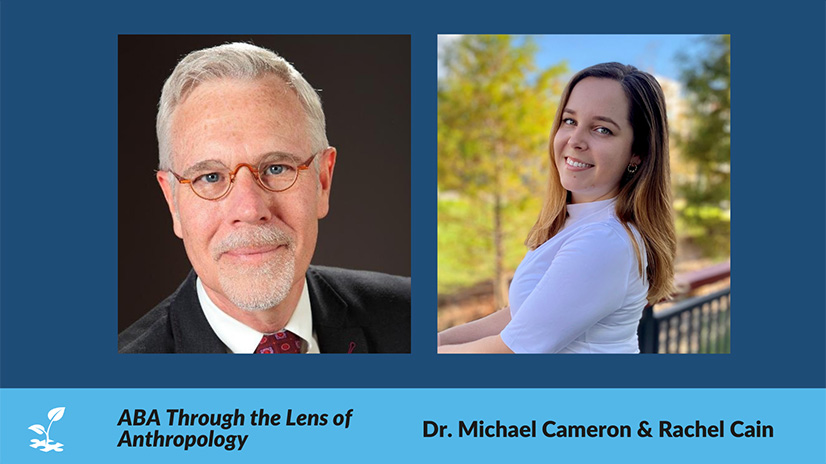
In a must-listen episode, Tim is joined by Dr. Michael Cameron, Ph.D, BCBA-D, LBA and Rachel Cain, M.S., BCBA to discuss her background in anthropology and how it impacts her as a BCBA. It is a fascinating conversation about how our cultural backgrounds influence us as clinicians as well as how we should be interacting with the families we work with. Michael and Rachael provide plenty of food for thought about how important it is for our industry to provide a workforce with a diverse background both culturally as well as academically. Hope you enjoy this thought-provoking conversation!
Please note that due to some technical issues during recording there are some slight audio issues during this episode. We apologize to our listeners.
Full transcript
0:16 Tim Crilly:
Hello and welcome to another episode of ABA Unfiltered. I’m your host, Tim Crilly, and today we are joined by Dr. Michael Cameron, who, if you are a longtime listener, know is one of our returning champions. Actually, he was the first guest we ever had on the show. And now here he is on, I don’t know, episode 25 or something like that. So, Michael, thank you for being here. And also Rachel Cain, who is someone is new to the show. And Michael made me aware of Rachel and her involvement in the BlueSprig family and her unique path to the ABA world. Rachel has a background in anthropology, somehow ended up being a BCBA, which she’ll give us a little bit of background on how that happened for her. But Michael thought it’d be an interesting conversation to talk a little bit about how Rachel’s unique perspective, sort of the schooling that she went through and how it relates to her life now as a BCBA as it impacts obviously the children she works with, the family she works with, as well as sort of her interaction with staff and the way she looks to develop a team. And I’m really excited to have this conversation. So uh before we get started, uh Michael, would you like to give um a quick background about yourself? I know you could probably pontificate for a few minutes on your journey here, but you know, maybe just hit the highlights for us.
1:42 Dr. Michael Cameron:
I’m the chief clinical officer for uh for BlueSprig, and uh I’m also a faculty member in uh the program in applied behavior analysis at University of Southern California in uh in Los Angeles. Thank you, Tim.
1:58 Tim Crilly:
Okay, well that was way too short, but uh we’ll we’ll take it. Uh Michael’s many, many other things, and I’m sure as we talk you’ll you’ll start to realize that. Um, Rachel, uh, if you don’t mind, maybe give us a little bit more about you know your your journey here and and what your role is with within BlueSprig.
2:15 Rachel Cain:
Yeah, well, I definitely don’t have as interesting of a background as Michael does, but uh I am currently a BCBA. Uh originally when I started my undergraduate degree, I got into anthropology and had this grand uh adventure in my mind of how I was going to end up working with the Smithsonian and all this other stuff, but I tripped and fell into ADA instead. I started doing it as kind of just a college job that paid well and was interesting. That fell in love with the field and with the clients and the families that I was working with, and uh jumped into getting my BCaBA at the very end of my undergraduate degree. I was a BCaBA for three years, uh, and now as a BCBA, I’ve held multiple positions doing uh different types of leadership in the centers, uh being a center director and now a clinical market director for BlueSprig in the Mid-Atlantic.
3:15 Tim Crilly:
Great, I I I appreciate that. So you say you tripped into it. I think that’s a common, a common theme with with folks we’ve we’ve had on this show. So um weren’t intending to be there, but something something attracted you to the industry. Could you just give us a little bit about what what you what that was? Was it was it the kids, the work, both?
3:39 Rachel Cain:
Uh well for me, I actually had the benefit of almost all of my friends in my friend group in college were all going for ABA, uh, which is kind of random for a thing to be.
3:51 Tim Crilly:
Real real real wild wild crowd, I bet.
3:53 Rachel Cain:
Yeah, yeah. A lot of uh really interesting arguments over drinks, but uh they convinced me that it was something that I would be really good at just because of the way that I was uh interpreting the world, and that uh I had a class in anthropology where they let me know that as far as anthropology goes, there wasn’t a lot of opportunities that really paid unless you were a doctorate level and had multiple years of experience. So coming out of an undergraduate degree that was a little bit scary. So having that second option was really was really nice, and then working with the kids honestly, that’s what won me over. Okay, the best. It’s the best part of the job.
4:36 Tim Crilly:
Cool. Okay, so maybe you know, for those of those of you at home listening at home, could you maybe, you know, sort of the the anthropology 101. Like what is it that when you’re in an undergrad program, what are the sorts of things that are you really diving into as an anthropology student?
4:56 Rachel Cain:
So one of the biggest things that you learn right off the gate from anthropology is how your own cultural perception is potentially kind of skewing your perception of others. So how you grew up, where you grew up, who you grew up with, all of those different aspects kind of play into how you see the world, uh, which is seen as like rose-colored glasses, and teaching us to sit back and observe rather than judge when you first come in, which is hard when you have your own cultural perception coming into it. But I guess to answer your other question, really what is anthropology and is the study of what it is to be a human being in the simplest form?
5:45 Tim Crilly:
So I’m I’m guessing, you know, without really realizing it, there’s probably a lot of correlation between that and sort of behavior, because obviously behavior motivates decisions people make. And if you look at an anthropology sort of historical point of view, a lot of things were forced into existence due to due to behavior. So there’s probably a lot of correlation. So, Michael, I’m gonna jump over to you real quick. This was this was your sort of uh concept. And I and you know, obviously uh I I’ve listened to you talk, you know, you have a lot of a lot of podcasts and you know, webinars and and things out there. And I I know you do talk a lot about you know, ABA shouldn’t just be this this one thing. And I I love that about you, you know, you talk about the aesthetics of programming and this sort of thing. So when you said, hey, you know, Rachel is there and has this this background, you know, what a cool concept. So can you can you give me an idea of you know sort of your thought process on you know working with Rachel and getting to know her and how her unique perspective sort of impacts those those things for us?
6:52 Dr. Michael Cameron:
Yeah, when you think about it, you know, in in the field of of applied behavior analysis, we develop expertise in the area of learning theory and we understand motivation as uh as well. But we are not content matter experts. Um we understand learning really well, we understand what motivates individuals. So I’ve always held the position that that behavior analysis needs to be informed by other disciplines. So, by way of example, we spend our time programming for children at BlueSprig with autism spectrum disorder. But you have to ask the question: what do we know as BCBAs about child development? What do we really know about normal child development and language development and social skill development and cognitive development? It’s not our area of expertise. You know, we we take the responsibility of programming for individuals, um, but that is not our path of education at all. So for a behavior analyst to be informed by the field of education and the field of special education, uh, for example, is uh is critically important. I also think about computer science and how in the area of computer science we have the capability of accessing machine learning and deep learning, and how computer systems can rapidly assemble information for us and even make um recommendations in terms of future direction that uh that we may go in any any number of areas. So for me, it’s really important that behavior analysts understand other discipline, other disciplines, what is available in other disciplines, and how it can improve our practice of uh of behavior analysis. When I met Rachel and she told me about her background in uh in anthropology, I became extremely intrigued, and uh, and I remain intrigued to this day. And let me let me give you one example of of why. From an anthropological standpoint, when you when you think about human behavior and everything that we know about human behavior, studies in vivo, direct observation of individuals, and a lot of it’s based on animal studies as well, animal analogs. You know, a lot of what we know comes from from Skinner’s labs and in terms of how organisms respond to various contingencies. But think about this from an anthropological standpoint. Today, especially with the pandemic over the last 12 plus months, the majority of our time is spent communicating with other individuals in the context of digital communication. We are on Zoom, just like we’re on Zoom right now, we are on social media. Who is it right now that is actually studying human behavior within the context of digital communication? It’s a completely different area, and and we are completely devoid of knowledge and information about human behavior within this context. However, an anthropologist would not miss that. They would deliberately understand context and where behavior is occurring and how people are relating to each other and interacting with each other, contextualize that information, and take that information in a very important direction. And I see a lot of benefit as a result of behavior analysts understanding anthropological processes, especially as it comes, especially as it relates to participant observation, uh, for example. So, my summary point, Tim, would be it’s really important for behavior analysts to look at other fields and and have an openness in terms of what other fields have to offer, and then to take the best of these other disciplines and integrate it into behavior analytic practice.
11:12 Tim Crilly:
Okay, let’s let’s take a break there. Um, I need to go towel off a little bit, and I hope everyone uh took good notes because that will all be on the final exam. So uh thank you, Michael. That was that was very well said. And um, I saw, you know, Rach Rachel, you were definitely nodding your head a lot. So if you want to comment on on anything that that Michael just brought up and sort of you know what you see in your normal life, uh your everyday life, I guess, and and sort of those correlations.
11:42 Rachel Cain:
Yeah, I mean, it’s not hard to agree with uh Dr. Michael Cameron, but uh I would say that uh a big portion of what he was talking about with the participant observation is something that I try to apply as much as possible. I would say that the majority of it is coming from looking at interactions not only with the clients themselves, but interactions with the families, which I think that that’s something that uh is that missing piece that we often have. Insurance companies require it. Uh, it’s a huge portion of the services that we provide, but it’s often very difficult to make those connections with the family members because uh we’re not necessarily looking at it from that perspective of the cultural standpoint. How do I make this connection with you, other than to understand who you are culturally, who where you come from culturally, and how I can be able to apply that not only to your son or daughter’s programming, but also to what that means to you and your buy-in and the services that we’re providing.
12:48 Tim Crilly:
Uh, you know, um, Rachel, you said something kind of early on when you’re talking about anthropology and how your worldview sort of shapes the, you know, your your the way you grew up and the community and the environment that you grow up in, obviously those things have have an impact on you. You know, when you look at ABA or the ABA world, it’s it’s not as culturally culturally diverse as maybe some other disciplines or or what it could be, but the population that we serve is. Uh, do you have any thoughts on that? Or are, you know, is that is that something that should be um you know more on the forefront of sort of the next wave of sort of change we we might want to make as an industry? Can can we have an impact in that way? And in your opinion, would we be better serving those families if we were able to do that?
13:37 Rachel Cain:
Uh yeah, for sure. I’m a I’m a huge proponent of having as culturally diverse of a setting as possible for all of the reasons that you just mentioned. The the families that we provide services to, the clients that we provide services to, if we’re all from the therapy standpoint coming from the exact same perspective, we’re going to limit ourselves on what we can actually do in the long term as far as how impactful we can be uh to change and assist with that. A lot of it comes into the hiring process itself and whom we’re giving opportunities to at the ground level, at those entry-level RBT type positions. Um I think as a whole, the the ABA world is often very hard to break into. Like you were saying earlier, most people just trip and fall into it. Uh, it’s not very well known. But those that do have the passion and the interest in coming into the field, I don’t think that we should hold them back because of things like they don’t have a degree in psychology or they don’t have this extensive background. Uh, as BCBAs, we are taught to teach others. So there really should be no limitation to whom we’re bringing in and what that really means. Uh, I actually have uh a story about that. Uh, one of the BCBAs that I used to work with at a different clinic, she’s one of those people that could talk to literally anybody at any time. And she was getting her car fixed at a mechanic and just got to talking to the mechanic. Turns out that he is from Peru and has a degree in psychology and really wanted to get into the psychology field. But when he came over here to the US, he was told that his degree, because it was a Peruvian degree, was not able to be utilized here at all. So he got into being a mechanic and working at sushi restaurants and things like that, and always wanted to get back into psychology at some point, but nobody ever gave him the chance. Uh, she convinced me to let him come in for an interview. Uh, zero background, no experience whatsoever. Came in with uh oil underneath his fingernails, like the quintessential mechanic. Uh, when he started speaking, though, I realized that he actually really wants to do this. He has a we gave him a chance, we offered him an RBT position, and he was one of the best and one of the best RBTs I ever worked with. And he’s a BCBA now.
16:12 Tim Crilly:
Oh, that’s great.
16:13 Rachel Cain:
Yeah.
16:14 Tim Crilly:
It’s not Michael, right? It’s someone different. It’s not Dr. Cameron.
16:18 Rachel Cain:
Yes.
16:18 Tim Crilly:
Okay. Just making sure, that would have been a great, great conclusion to that story. Uh okay, so you know, I I wrote down a list of things. We didn’t talk about any of them, and that always happens. This has been a fantastic conversation. Um you know, I think as a as a group, we can be a little bit rigid. Uh, you know, this is the way you should do it, mom. And if you don’t do it this way, then you know, blah, blah, blah. Uh do you do you think that there’s there’s there’s room for, you know, how do we, I guess the question is, how do we train people to think this way, to say, just because you think it’s going to be the right and easy way or perfect way to do something? But if the family can’t do it, whether it’s a cultural reason or just sort of a skill set reason, how do we start to train BCBAs to be a little bit more open to the idea of, you know, it needs to work for the family first, and then I’m the one that needs to adjust my approach. Is that something we’re seeing more of, or is it still an issue out in the field?
17:25 Dr. Michael Cameron:
I I think, Tim, that you know, you just take cultural practices, um, for example, mealtime. You know, there there are some cultures where it is perfectly acceptable to be eating with your fingers at uh at the table, you know, to be taking food with your fingers and eating with your hands and uh and your fingers. And when you think about what we’re ultimately trying to achieve as uh as behavior analysts, is that we are trying to get an individual to be as independent as possible within the context of the family and uh and life with their family. You know, the registered behavior technicians are gonna come and go, the board-certified behavior analyst is gonna come and go, the speech and language pathologists, occupational therapists, physical therapists, they spend uh a limited amount of time in a child’s life. So essentially the it’s the it’s the family that uh that is the lifelong shepherd, and it’s our responsibility as a behavior analyst to to ensure that that we adopt and adapt to uh to the family circumstances and prepare that child to flourish in uh in that context. Rachel, I’ll turn it back over to you.
18:41 Rachel Cain:
Yeah, I definitely I couldn’t agree more. I think it also comes from the the perspective of a company being willing to create a space for people to start to branch into that acceptance because I think uh as BCBAs, we do kind of have that mentality that we know everything. And we’re taught that in school. And when you go and interact with families, uh teachers, schools, whatever it may be, uh we kind of come in there with our noses upturned.
19:13 Tim Crilly:
Sure.
19:20 Rachel Cain:
And I have learned a significant amount from these other providers.
19:24 Tim Crilly:
Yeah. You know, and I think it’s kind of what Michael was saying. It’s like you almost need to walk in with every family, it’s a blank slate. And, you know, you might have a really good plan in place, but you still have to make sure that you are taking in, you know, not just the environmental factors of can we do it in this environment? Um, but is this the right sort of emotional support system? Is this, you know, from a cultural standpoint, are all those the things in place that you need to be successful? And don’t be afraid to raise your hand and say, I need help, let me ask some questions. And then to your point, Rachel, I think not enough people, especially early on, maybe are sometimes afraid to do that. You know, and I know as a clinician, when I had kids, I suddenly felt like I got better at my job just for the sheer fact that I had one thing in common now with this family, even though we didn’t we weren’t living the same existence. I understood the stress of changing diapers in the middle of the night, not sleeping, what that means for you the next day, um, sitting on top of your two-year-old, you know, holding their mouth open, trying to brush their teeth, all those sorts of things became a part of my existence. It it really does help with with you know, sort of that ability to interact and sort of provide, you know, quote unquote, sort of direction and knowledge to that family. Um, but it’s still we we live in a little bit of a guess and check uh industry. And you know, hopefully you guess it right more often than not. But you know, you’re not gonna do everything perfect. And the idea that you would walk in thinking that you you could, you’re probably already a little bit behind the eight ball. You know, you have to you have to give give yourself the ability to to fail a little bit and and learn so you can then adapt and then help those families. So yeah, go ahead. I was gonna say before we before we drop off, please, just any closing thoughts you guys might have.
21:22 Dr. Michael Cameron:
Yeah, I I’d like to pose a question to Rachel because I’m really intrigued by this. Uh Rachel, in in the field of behavior analysis, we have processes uh called eco-behavioral assessment, you know, where we’ll go into we’ll do an observation, we’ll look at a child, for example, in the context of their ecology, we’ll look at influences of the ecology on that individual and their and their behavior. Can can you outline for the audience what the distinction would be when you’re truly engaged in participant observation as rooted In anthropological training versus eco-behavioral observation. Because I see differences between the two. And if we could leave the audience with any understanding of the value of anthropological processes, I think it falls squarely in the camp of the way observation is done. So if you can put on your hat for a moment as an anthropologist and talk a little bit about I think it’s a pith helmet, right?
22:30 Tim Crilly:
Is that the hat you wear?
22:32 Dr. Michael Cameron:
Yeah, I guess exactly. Totally. Absolutely. Sorry, sorry. No, I love that. I love that. Hopefully you’re maybe a pith helmet. If you could just talk a little bit about the difference between the two, you know, how you’d go about the process from a participant observation standpoint versus how you’d go about the process from an ego-behavioral observation standpoint.
23:01 Rachel Cain:
Um, I think that’s a really interesting question to pose because I honestly feel like it’s not something that I necessarily deliberately thought about as I was doing it. But now that you mentioned it, it’s like, oh, I do do it just a little bit different because of that participant observation training. That’s honestly like where the core of everything is. So I learned all of my ABA stuff with that foundation versus the opposite way around. Uh so looking at it from that kind of perspective, uh, there is something called the culture wheel within anthropology, which breaks down all of the different aspects of a culture. And I try to look at all of those different aspects within that participant observation sort of a perspective versus the eco-behavioral uh portion where it’s more so looking at what exactly is happening right in front of you at that time period versus what is the connection between these things that I’m observing and how that person interacts with the rest of the world. So why do they say hello instead of what’s up? Things like that uh are actually rooted in that person’s cultural dynamic or uh responding to a nickname instead of their uh given name, whatever that might look like, uh, but specifically looking at how do they interact with their community? Are they able to interact with their community if they’re talking about a client themselves? Uh, what are the knowledge and stories of their culture that are important to them? Uh, how does their language affect the different aspects of their day-to-day life? Are there certain words, certain meanings that come from that language that matter the most to them? Uh, traditions and rituals that come from their culture as well, techniques and skills, tools and objects, uh, the arts, and of course, my favorite food and drink. Uh, all of those different aspects come from that cultural perspective, that participant observation of why is this person doing what they’re doing? So it’s not just the functions of behavior where you can say, Oh, they’re attention-seeking. You can say that they’re attention-seeking because they don’t understand how to be able to interact and use their language within the greater communities. And how do I kind of pair those two things together? How do I bring those cultural values as well as the ABA assessment tools together to be able to create kind of this program that has these naturalistic outcomes, like how uh Dr. Michael Cameron was talking about the prayer mand for that one family, that meant everything to them within their culture, and that helped that client be able to be better accepted into their culture. So, kind of taking those two dynamics and pairing them together has a really amazing result if you’re willing to kind of take that leap and look at it past what you’re just seeing in front of you and kind of what it can be otherwise.
26:15 Dr. Michael Cameron:
Rachel, I think that is fantastic because I I think we we all bring our own relational frame to this world, right? And and it’s influenced by our own personal culture, our religion, our creed, our our our linguistics, um, all of it. And when we superimpose that on somebody else, you know, essentially we’re doing we’re doing a disservice to uh to the family and uh and also the child. Um so your approach in in terms of looking more broadly, I think you called it the the the culture wheel. Um, I think looking more broadly at uh at all these interconnecting parts, um, I think results in um better informed services on the on our end. Back to you.
27:05 Tim Crilly:
Yeah, Michael, I’m gonna suggest, I know you guys are probably planning another clinical conference for sometime this year. I think we need to get Rachel a uh time slot. I think this is a a topic that would be of of very, very uh much interest for a lot of folks out there. Uh I I certainly, like I said, I had a list of questions that were sort of like boring and generic, and we had uh sort of a robust conversation uh and we didn’t even touch on some of the things that I was hoping to talk about. So, you know, and and we’re better off for it because your your guys’ list was way better than mine. Uh but I think, you know, Rachel, I think there’s a lot of lot of insight you can offer. And we didn’t even mention the fact that, you know, sort of a degree like yours isn’t one that’s you know, sort of a common, but be even, I don’t think, recognized by the BACB as something that would lead you down this path. So I think that’s another another topic as well is sort of like, you know, what sort of expansion in sort of people’s backgrounds should we be looking at as it relates to future BCBAs? Because, you know, we shouldn’t be pigeonholed. Um, you know, obviously you don’t want just just any old thing, but it’s certainly a lot of a lot of opportunity for advancement of the the profession when you look at sort of what people can bring to the table from an academic standpoint as they go into the the real world and and the field. So uh we’re we’re way over. Um, and I’m I’m grateful for it. Uh it was a fascinating conversation. Uh I really appreciate you guys coming on. This is a very interesting topic, and I didn’t realize how interesting it would be. So I gotta give you credit, Michael, where credit’s due. Uh Rachel didn’t mean to underestimate you, but uh very, very, very wise um insight. So I really appreciate you guys. Um, and and thank you to everyone out there um listening as always. I hope you appreciated this this conversation as much as I did. So thanks again, and and hopefully you guys can come on and we can hear from you again.