Back
About ABA Therapy

Season 1: Episode 3 – Distance learning for children with an IEP

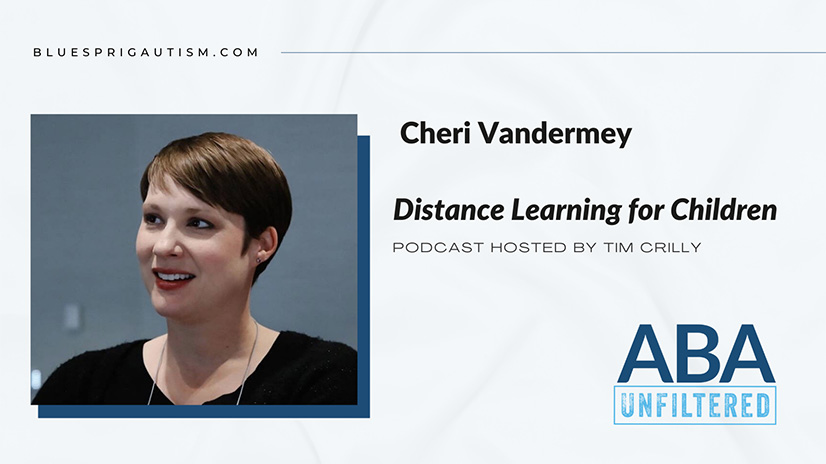
Hosted by Cheri Vandermey, Dr. Summer Adami, Tim Crilly
March 20, 2024

Listen now:

or listen on your preferred platform:

Episode Description

Cheri Vandermey, BCBA, is currently working with a Los Angeles area school district and possesses a plethora of experience with public schools as well as a vast knowledge of the IEP process. This episode focuses on the challenges families and teachers will face in a distance learning environment for those students with an IEP. Cheri proves to be an incredibly intriguing guest to have on with our host Tim Crilly, and first-time co-host Dr. Summer Adami to discuss this situation and how school districts might move forward to improve the learning environment for these students. With so many questions up in the air, our discussion focuses on potential outcomes as well as the lingering questions that exist within the school system during a pandemic.

Full transcript

0:06 Tim Crilly: Hello and welcome to ABA Unfiltered. I’m your host, Tim Crilly, and today I am joined by my wonderful co-host, Dr. Summer Adami. That’s kind of like when the Brady Bunch brought on Oliver late in the show because clearly the original cast wasn’t getting it done. So I have Summer with me today to help get through this conversation and uh help guide that. So I’m really excited. So thank you, Summer, for agreeing to co-host. Today we’re welcoming Sherry Vandermey. She’s here to discuss school districts and the challenges that a virtual learning environment will create for students with IEPs. So we’re really excited to bring her expertise to the conversation. So, Sherry, thank you for joining us.
0:47 Sherry Vandermey: Thank you so much. I am thrilled to be here. Just a little bit by way of introduction, I actually started out as a special education teacher. So I know schools kind of from the inside out, I think. And I think that’s been really beneficial to me as a behavior analyst going into school districts. Tim mentioned that today we’re going to talk about maybe some challenges facing us. And I feel like today will be a big discussion about the challenges and maybe some suggestions, but I’m not sure we have great answers. I think we’re going to start with a lot of questions just to start getting kind of our juices moving, our minds thinking. And one thing I always say about being a BCBA in a school district is you have to be flexible and you have to think outside the box. And so if you’re used to doing school-based behavioral consultation, then I think you are primed and ready for this big challenge. And if not, then this is a great opportunity for us as behavior analysts to grow and challenge ourselves to think outside the box, to really look at behavior analysis in a new way, kind of reinvent what, how we can support teachers, students, and parents. Thank you for having me.
1:48 Tim Crilly: Great, we’re really excited. Summer, welcome.
1:51 Dr. Summer Adami: Thank you. Thank you so much. Thanks for having me back. And I’m really excited to talk about this topic today.
1:57 Tim Crilly: So we had a chance to talk the three of us earlier in the week, and it really sparked a lot of great thoughts, things that I hadn’t really thought about. So Summer, get us started. Where’s the point of origin we should begin this conversation with?
2:09 Dr. Summer Adami: I think that this is so timely because I think this will offer the opportunity for a fresh perspective from the school district on what potential plans are being made when you can’t make plans, but then also really that desire to get our kids back into the classroom to get those IEPs going again, and then to potentially answer some questions that I know a ton of parents have asked me specifically about school and when is my child going back to school. So I think just in general, a conversation around management of that IEP, potential ideas that are going around, and then the idea of distance learning and how that applies to and maybe a challenge for some kids that are receiving services. I think well, if we wrap those topics up today, we’re good. We can we can all retire then. That’s right, that’s right. All right, so just to kind of get started, COVID has absolutely thrown a wrench into providing services for kids with disabilities, most specifically all children, but definitely those kids that aren’t necessarily going to be able to attend to distance learning through a computer. And a lot of parents have questions about that management of the IEP. What are some of the questions, Sherry, that you get most often? And what are some of the questions that your teachers are asking, or what are some ideas that your team is uh working on?
3:26 Sherry Vandermey: I think I’ll start with teachers. Um I think I will say, especially from a behavioral standpoint, I think classroom management has been something that is constantly coming up. Teachers have no idea how to manage all of these students in a Zoom platform when they can’t actually control the environment. And I think that’s been really challenging for them. I’ve seen some of our absolute best, strongest teachers kind of fall apart because they can’t use the same things in the same way. The passion, the walking around the room, the monitoring, the teach like the floor is on fire kind of approach. It’s it’s a very different way to do things. And so I think that’s one of the challenges. And that’s definitely a place where we as behavior analysts can step in, think outside the box, and try and look at what makes up good classroom management and how can we generalize that and help them generalize that to a distance learning. So that’s been a that I think that’s been a really huge piece. Certainly the idea of just managing and implementing behavior plans. If we have these behavior plans in place for students, especially students with one-on-ones, now what? That’s students in the home, either with a parent sitting next to them or with the parent working with another student and they’re kind of left to their own devices. And so, how can we then provide services? And I think that goes along the lines of where parents are coming from too. How am I gonna get my services? How is my student going to be supported? I mean, you said before we left school that they needed a one-on-one aide, which means they needed consistent support, and now that’s not being provided to them or it’s not being provided to them in the same way. So, how are you gonna fix it? How is the school district gonna support these children? And I think we have the same questions as a district and how to best use the services that we have available.
5:10 Dr. Summer Adami: Yeah, absolutely. You bring up some excellent points, and along those lines, you have exactly as you say, you have parents not only acting as teachers, but they’re also working from home too. So they have children there, and some may be more independent than others. They have multiple children, so they’re acting as teacher for multiple students and learners in their house, and they are also working, or they didn’t sign up to be a teacher, right? They signed up to be a parent. Yeah, absolutely.
5:36 Tim Crilly: So, do you guys think, you know, when you put your brain back to March when everything started to close down originally, and there was sort of this like glimmer of hope that it’s okay, well, we have spring break, we’re only gonna be out this time, we’ll definitely all be back before the school year ends. It could be next week, it could be next week. Do you feel like that made it a little bit easier back then for families and teachers, as opposed to now, where it’s like, well, we’re probably definitely starting this way, and we really don’t know if and when we’re going back. Do you think that creates an even bigger sort of psychological challenge to start the year?
6:12 Sherry Vandermey: I definitely think it does. And I think one thing also for behavior analysts to understand is that for the most part, last year there was a lot of flexibility in what education could look like. We were kind of providing educational supports, we were providing educational opportunities. The game has entirely changed now. Now, most districts, you’re required to actually teach. There are educational minutes that are being needed to like there now, this is real teaching now. And so I think it’s a totally different playing field. So, yeah, I do think last year there was this, okay, we’re just gonna do the short term, we’re gonna do this to make it through. We’ll just keep the kids engaged a little bit. I know that there are districts out where I am in California that said, no matter what, we will not fail your child, your child cannot decrease grades. And so that was the perspective. That’s not the perspective anymore. So I think if we’re going to be supporting teachers, we have to realize that this amount of stress that they’re gonna be under, the demands that they are going to be placed under are so much higher than they were before. If you’re a behavior analyst and you’re gonna work with a teacher, you want to really find out what that memorandum of understanding is. They might call it an MOU or an MOA, a memorandum of agreement. What is it that the teacher is being required to do now? Maybe that they weren’t being required to do. One thing I talk a lot about in school consultation is you have to know the culture. You have to know the MOs that are working with these teachers. And if you don’t know what’s being expected of them, you won’t be able to support them. And so some things to be asking and knowing are like what are the work hours, how many face-to-face hours are they supposed to be doing? What is the attendance policy? Are they supposed to be like tracking these students down and who’s doing that? What format, what platforms? I mean, this whole there’s there’s so much. And unfortunately, this is slowly unfolding, and schools are about to start. And so teachers are already under an incredible amount of stress. So, Tim, I I I love that idea of yes, we have to look at school consultation now as very different than it even was a couple months ago.
8:14 Tim Crilly: Do you guys think there’s workarounds as it relates to this specific population, given the smaller nature per school? Like, has there been any discussion about, well, okay, maybe it’s appropriate to get this group of students on campus and put in various safety measures to make it work because that might be really the only solution to help them? Or are people ruling that out on the face of it?
8:40 Sherry Vandermey: I know out where I am. Um, the original idea was we would do for typically developing children for general education, we were gonna do kind of a hybrid thing. But then for special education students, we were gonna go full-time because we said, yeah, it’s a smaller group, um, there are more adults in there, we can kind of keep things separated, but now we we don’t even have a choice to do that. We can’t let one student even walk on campus. So I think as we move back, um, hopefully, I think there’s a constant discussion that students with special needs need special accommodations, and we have to look at them as a different population, even with the idea of wearing face masks, right? We realize maybe they can’t wear the face mask. Right. So I think there’s a good perspective on that, and there’s constant discussion. But right now with what the government’s saying, we can’t do any of it. But moving back, hopefully, we’ll be looking at them as a different group, realizing, especially with the regression potential and the need for really intensive support, that they need more hours maybe than some other students.
9:35 Dr. Summer Adami: Absolutely. So some of the things, um, and I work primarily in an organization that provides in-service or in-clinic services. We did switch our model to in-home services, and now we have a bit of a hybrid model for both in-home and in-clinic. And actually, the children have had a really remarkable response to intervention because of the ability to be in the home and be where they are and to work closely with the families. That said, we do have an increasing population of clients that are receiving telehealth-only services. And as it relates to the delivery of that, where we would call it telehealth, school would call it distance learning. I can see, you know, a really nice opportunity here for behavior analysts to work alongside teachers to work on shaping those, what we would call as you know, the distal prompting, right? Where you start to shape up some of the behaviors that would increase the likelihood of success for kids that are able to somewhat participate during a telehealth session or a distance learning session. So it seems like, uh Tim, to your point a little earlier, there are opportunities here to kind of get creative, to work with small groups and to even create where this is um part of what we’re doing as well is thinking of um, we would call the parent a proxy. If they were in school, they would probably be a paraeducator. But working from that model too, where we would have an expectation for a proxy to help facilitate the session, but this is that fade out criteria. This is where you would, you know, be able to hopefully quickly work the proxy out of being a necessary participant throughout the entire session and only that necessary participant for potentially things that need a bit more prompting or need a bit more finesse, and then naturally with help with some behavior reduction. So it just seems like a primed opportunity to work closely, you know, with clinicians that have had to figure this out as well. Um, and ordinarily, we may see a ramp up in services during the summer so that children don’t regress between school years. And some of our clinicians have been working really hard on that wearing face masks, on distal prompting, on preparing kids for a different type of learning environment. And I really could see this hoping to bridge some of the gaps that are there between school consultations and BCBAs because of, you know, perhaps past experiences. But have there been talks about increasing consulting relationships? Or Sherry, what are your thoughts on really utilizing some of the BCBAs? And absolutely, I love that you brought up a memorandum of understanding because I think you have to understand where you know both parties are coming from and the expectations to be managed during that relationship.
12:07 Sherry Vandermey: I think even just increasing maybe the we may see some of our districts an increased need for outside BCBA consultation, even coming back. I know that I have a list of FBAs that need to be completed. They are currently on hold. Every month I get another one and another one, students coming from other districts, or maybe a settlement was just done, and so there’s a new FBA, and I am one person for my district. And while I try and work incredibly hard, there’s only one of me. And so I think this could be an opportunity for building those relationships. We do have relationships with some outside agencies, and uh I think we may be reaching out to them a little bit more just because I we just can’t do it all, and these things really are stacking up, and I think that’s another parent concern, too, right? You have these assessments that are needing to be done and they’re not being done. Our biggest concern, I think, is initial assessments, even if it’s temporary support assistance, like those paraprofessionals, that one-on-one assessment, those aren’t being done. Triennials aren’t being done. Um, if a student needs to be placed in a more restrictive environment, those aren’t being done because there’s just not a way to do it. And I really feel for these parents who are in this really difficult space right now. They want information and we just don’t have an ethical and appropriate way to get them that information. I I worry about our FBAs too, kind of floating out there. And I’m not sure there’s a consensus on how to uh address that, right? Especially because an FBA is looking for the environment, and now the environment’s totally different. So yeah, I think it’s I think it’s a challenge, but I think it’s a great opportunity for us to work with those outside agencies. I think we have great relationship with that relationships with them, and I’m honored when I get to work with people outside of our district because it gives us a different perspective sometimes.
13:56 Dr. Summer Adami: Absolutely. And I think that it’s an absolute and valuable experience for a BCBA and potentially ones that may not have worked as closely with school districts to have that understanding of it looks different outside of a clinic, it looks different outside of intensive delivery of services. This is where we want the children to go. This is where we want them to graduate from services into. Um so I think that being able to work closely with teachers is absolutely invaluable for BCBAs. And considering we have so many that are brand new to being practicing BCBAs, you know, having someone like you to help mentor them and you know into that relationship is just, you know, just an incredible experience. You know, kind of touching on something you were bringing up is, you know, the idea of this changing environment. You brought up something earlier about this ramping up of services. These kids have been outside of their routine since March. And I know Tim wanted to touch on this a little bit. What are your thoughts on that? What are your thoughts on, you know, the How do we get them ready for that transition?
14:54 Tim Crilly: Summer, thank you. It’s I hadn’t thought about it, but it’s it’s a huge you can’t just airdrop them back into school. What should people that maybe aren’t associated with the school district but have an opportunity to work with these kids right now through other funding sources? What sort of things should they be thinking about in terms of prepping them for a return to campus?
15:15 Sherry Vandermey: Well, I think definitely some of the things that Summer and I have been talking about, preparing them for face masks, trying to teach them, even if it’s social distancing. I mean, the idea of social distancing to try and teach someone, but that’s something that they’re going to run into. And I feel like we’re going to see these students, especially those with special needs, constantly being redirected, which creates a not great relationship with our staff. And so the more we can kind of look at what are the expectations going to be coming back, the more we can prepare them. Even if it’s if you find out that that classroom is going to have desks with plexiglass, well, that’s that’s a really big deal for some of our students. Our general education kids, well, we can explain to them why and how to work around it. And yeah, we understand it’s frustrating, but how can we work with our students with autism who might have more difficulty processing that or tolerating that? And so maybe we can be using our in-home agencies to set up these opportunities. But the only way to do that is to find out what it’s going to look like and to really be an integral part of whatever school districts you’re working with to know what it’s going to look like and what the demands are going to be. I think the more information we can get about that, the more we can prepare them for that. Even things like teaching them to kind of maintain space in like a taped-off area. I mean, this is sad that we’re talking about this, but this is the reality of it.
16:34 Tim Crilly: Should probably make some in you know, some investment in hula hoops, you know. Right.
16:44 Sherry Vandermey: Yeah.
16:46 Tim Crilly: Think about it, the typical kindergarten class, even just how do you even teach those guys to socially distance? It’s just not, I mean, they’re all they’re like climbing all over each other. So, you know, the challenges are just it’s gonna be a real uphill battle.
17:00 Dr. Summer Adami: I think Pamela Pumpkin, I don’t know if you guys watch her, but I think she’s got it figured out. You know, you just run around going, block them, block them, block them, right? That’s it’s all figured out. No, no, who’s this?
17:10 Tim Crilly: What is this?
17:10 Dr. Summer Adami: Oh man, I’ll I’ll have to send it to you guys. Pamela Pumpkin, if you haven’t seen her, yeah. Her take on um quarantine and her um advice for social distancing, it’s spot on. It’s you know, you hide from those human people, you block them, it’s great. It’s great. It’ll get stuck in your head though. So be forewarned. Yeah. So she’s got it. I think if we just implement her strategies, um, we’ll all be just fine. You just walk around blocking anybody that might try to come near you, whether it’s your own child, you just get in that habit and you know, just block them all, block them all, right?
17:40 Tim Crilly: I think summer’s ready for the weekend. That’s that’s what we’re learning. Block them all. We’re learning here.
17:47 Sherry Vandermey: You know, this this actually made me think of something summer as you’re as you’re kind of thinking about this blocking idea. Even makes me think about the fact that um this is kind of a random tangent, but think about the idea of our our our students and and how desensitized they probably are right now to a lot of the environmental stimuli that happen in a classroom, right? They’re in their perfect little bubble. And so much of our job is to kind of get them used to the bubble. Yeah, right. And now they’re back in their bubble for such a long period of time.
18:16 Tim Crilly: Remember all that stuff I’ve been telling you for three years? Yeah, ignore it all.
18:19 Sherry Vandermey: Yeah, it’s and it’s like, okay, get out of your bubble, but then stay in the bubble at the same time because you got to block them, right? It’s such a complex thing. But I think even that is going to cause challenges as well because they’re just not used to how crazy and stressful everything can be on a school campus. And so I think we are looking at ramping up a lot of those services just to prevent some of those things and to help these students navigate and to help them be able to tolerate what they’re not used to tolerating now. I mean, we see what happens, they take a month off in between summer school and the fall, and we’re just like ready, right? We’re all like, you know, we’ve got our gloves on, our helmets on, whatever it is. And now they’ve been out for so long. And so I think a big piece too where BCBAs can come in is preparing our teachers and paraprofessionals. If we can be working with our districts to prepare them and to even just put in their head, the students that you saw eight months ago is not the student that you’re gonna see now. That’s for all students, that’s general education students. I don’t expect any, I’m not the same person I was.
19:36 Dr. Summer Adami: And happening, I don’t think I realized how much I relied on, you know, some of the facial cues just in general correspondences with, you know, at the grocery store or at Costco or, you know, what have you. But they’re you know, tempers are really on edge right now. Folks want to get back to normal, but it’s not safe to do so. Houston, I’m in the Houston area, and this is an absolute hot spot for sure. So it’s different. And and you know, and our kids are feeding off our our tensions as well. But I’m really glad that we had an opportunity though, Sherry, for you to really convey to the families look, we want to get these ramped up. We’re trying, we are problem solving. This isn’t, you know, for educators, this is not vacation for us. We are trying really hard to figure out how we can get services and get creative with making sure that these IEPs are managed. But I just really um was glad that Tim um set up this um this interview.
20:22 Tim Crilly: Have you guys heard any discussion about what we should be doing with the school calendar? Because to me, we look at a lot of things and we’re gonna learn a lot of lessons. There’s gonna be a lot of data that comes out of all of this across thousands of different sorts of industries. But to me, this sort of screams maybe the traditional school calendar isn’t what’s best. And I’m talking about across the board. Maybe I’m wrong, I don’t know. But it it just feels like maybe there is an opportunity here to make some sort of transition to something that makes more sense. Have you heard anyone talk about anything like that? Or am I just dreaming right now?
21:00 Dr. Summer Adami: That’s a great question. I personally haven’t heard um those discussions. Um, I will say um I am a blended family and my two stepdaughters attend school where it’s a year-round school. And so what’s interesting is having those breaks in between, you know, a post-COVID kind of world might give an opportunity to see if any symptoms come up if you’re you know taking more frequent breaks throughout the year, but just an expectation that you know school keeps to continue on. But personally, I haven’t. Sherry, what about you?
21:27 Sherry Vandermey: Yeah, I haven’t heard anything either. I think that so much of the discussion is just what we’re gonna do next week that I think no one you know. Well, well, I think it would be great to start thinking for the future. I think everyone’s in survival mode. What are we doing tomorrow? Right. And things are you know, things are changing every single day. I mean, our our district came out with this awesome plan and told the entire district this was going to be our plan in the very next day, 100% distance learning. And we all said, wait a minute, we just got the and it because things change so so quickly.
21:57 Tim Crilly: I’m guessing I’m making this up, and I’m I’m gonna make an educated. Guess that the current school calendar is probably based off an agrarian society from 200 years ago or 100 years ago and around harvest and planning and things like that. So I don’t know. It’s just something that I I’ve been thinking about ever since, you know, my kids have been home since March, certainly. And it just feels like we could fool around with the schedule for a little bit and see what it does. And maybe the school year doesn’t need to be 182 days or whatever it is. It it could be 145, buy us some time or you know, whatever, whatever it looks like. So I just wasn’t sure if you know, from major school districts, if if people are talking about different types of things that could offer not necessarily permanent solutions, but but something that helps get as many kids back in an appropriate environment where they where they should be. So, you know, if I were in charge of stuff, um it’d be a lot different. But uh no one no one has given me any of those opportunities. Yeah, yeah. I already came up with a plan to completely redo the sports calendar because the current one doesn’t make sense and they’ve just been doing it because they’ve been doing it for a hundred years. But that’s that’s maybe a topic for a different podcast.
23:05 Dr. Summer Adami: But no, no one’s listening to you, huh, Tim? I’m sorry about that. No one ever does.
23:09 Tim Crilly: I mean, no, never. Oh, God. Oh, you you know, if if you listen to this whole podcast series, you’ll get a real true sense of my uh the opinion of me around the water cooler. So absolutely. Absolutely. Yeah, it should be pretty interesting. Okay, Sherry, before I let you go, something we ask all of our guests, and I need you to pop on that BCBA hat for a few seconds. So it’s a yes or no question. I need a yes or a no, and I need an operational definition as to why you chose your answer.
23:37 Sherry Vandermey: Okay, oh no.
23:38 Tim Crilly: Okay. Are you ready?
23:39 Sherry Vandermey: Yep.
23:40 Tim Crilly: Okay. Is a hot dog a sandwich?
23:43 Sherry Vandermey: Yes, because it has a protein in the middle or something in the middle, and it has two things on the side, like obviously bread. In even though it’s in bun shape, it’s still two sides of bread with something in the middle.
23:58 Tim Crilly: Okay, thank you. And I love how certain you were. Uh you know.
24:03 Sherry Vandermey: You can’t mess around with really important BCBA questions like this. Like when it comes really important, I really have to, you know, stick with it.
24:10 Tim Crilly: We’re going to solve this this mystery from a uh a real scientific approach. So we’re we’re gonna get to the bottom of it throughout the course.
24:16 Sherry Vandermey: Well, I’m just happy because I know that Summer just like pumped her fist. So I feel like I gave the right answer. So I feel I feel good that I could support Summer.
24:23 Tim Crilly: I’m not saying if you’re right or wrong. I’m just saying it’s clearly right. Summer falls in into a certain category.
24:31 Dr. Summer Adami: So in our last BCBA that came on, she said the same thing. So I’m gonna want a comparison of a behavior analyst versus, you know, but well, Tim, never mind. You’re technically a behavior analyst, aren’t you?
24:42 Tim Crilly: You have the the see, Sherry? See how it is around here.
24:48 Sherry Vandermey: I do, I do see.
24:50 Tim Crilly: Okay, and it’s well earned. I’m not arguing with anything that anybody says. Summer, thanks for popping on with us. You know, we obviously love having you. Yeah, I think we’ll probably see more of Summer as as time goes on. And Sherry, thank you so much. Um, I I think maybe when we get into later into the school year, we have more clarity on everything. We’d we’d love to have you back on to just let us know what what’s going on, or you know, maybe we could start sharing some success stories about kids back on campus. That would probably be a welcome conversation.
25:21 Sherry Vandermey: That sounds like a great plan. I will be here.
25:23 Tim Crilly: Okay, great. So thanks for joining us. Thanks for tuning in to ABA Unfiltered, and I look forward to talking to you guys all soon. Thank you.
25:31 Dr. Summer Adami: Thank you so much.

Find a center near you.