If you find yourself dreading October 31st a little more than other parents, you are not alone. According to the CDC, approximately 1 in 31 children in the United States has been identified with autism spectrum disorder, and for many of those children, Halloween brings a perfect storm of challenges. The holiday packs in unpredictable sensory input all at once: elaborate costumes, flashing lights, sudden loud noises, unfamiliar neighbors in masks, and the smell and texture of candy everywhere you turn. For children who experience sensory processing differences, that combination can feel genuinely overwhelming rather than exciting.
On top of the sensory piece, Halloween disrupts routines in a big way. Evenings look completely different, social expectations shift, and the unwritten script of trick-or-treating — knock on a stranger’s door, say the right words, accept what you’re given, and move on — can be confusing and stressful for children who rely on predictability. None of this means Halloween is off-limits. It just means it needs a little more thought and planning, and that is absolutely something you can do.
Sensory-Friendly Costume Ideas for Kids With Autism
Your child can absolutely dress up in a way that feels good. The key is choosing comfort first and creativity second, and honestly, with a little planning, you can have both. Occupational therapists who work in sensory processing regularly point to clothing texture, fit, and familiarity as the starting point for any costume decision.
- Choose soft, tagless fabrics like cotton or fleece to avoid itching and irritation that can quickly derail the whole evening.
- Skip masks where possible and try face paint instead, or simply go without face coverage altogether if your child is uncomfortable.
- Let your child lead the costume choice. A favorite character they already love makes wearing something new feel much less threatening.
- Adapt beloved characters into comfortable everyday clothing — a superhero T-shirt or a character hoodie counts as a costume and feels familiar.
- Practice wearing the costume at home in the days before Halloween so it stops feeling new and starts feeling normal.
- Layer for temperature changes, because a cold child in an uncomfortable outfit is a recipe for a very short night.
Small adjustments to the costume itself can make the difference between a night your child remembers fondly and one they want to leave early.
Preparing Your Child for Trick-or-Treating
Practice the routine. Role-play trick-or-treating at home before the big night. Take turns knocking on doors, saying “trick or treat,” and receiving something in return. Repetition builds comfort, and a few practice runs can take a lot of the mystery out of the evening.
Use visual supports. A simple visual schedule showing each step of the night — leaving home, walking the route, knocking on doors, and coming back — gives your child a clear picture of what to expect. Social stories about Halloween can also help them prepare emotionally for new interactions.
Plan a familiar route. Stick to streets or neighbors your child already knows where possible. A shorter, predictable route reduces the chance of unexpected situations and means your child is more likely to feel safe throughout the outing.
Set a comfortable pace. Build in breaks so the evening does not feel relentless. A timer or a simple signal for “all done” gives your child a sense of control, and bringing a comfort item from home provides a reliable anchor when things feel like too much.
Managing Sensory Overload on Halloween Night
Even the best preparation cannot account for every surprise on Halloween night. Having a toolkit ready to go means you can respond quickly if things become too much, rather than scrambling for a solution in the moment.
- Pack noise-canceling headphones to take the edge off fireworks, screaming kids, and other sudden loud sounds along the route.
- Bring a pair of sunglasses or tinted glasses to help with strobing lights and bright decorations that can feel visually overwhelming.
- Put together a small sensory kit with fidgets, a chewy item, or whatever your child finds regulating when they are feeling overstimulated.
- Identify a quiet break spot before you leave home, somewhere nearby where your child can step away from the noise if needed.
- Watch for your child’s early signs of overstimulation, whether that is covering their ears, withdrawing, or becoming agitated, and respond before things escalate.
- Have a clear exit plan so leaving early feels like a decision you made, not a failure, because sometimes the best move is simply heading home.
Leaving after three houses is still a Halloween. What matters most is that your child felt safe and had a moment of joy, however that looks for your family. There is no version of the night you have to live up to.
Fun Alternatives to Traditional Trick-or-Treating
Traditional trick-or-treating is just one way to mark the occasion. There are plenty of options that bring the fun of Halloween without the sensory and social demands of going door to door.
- Trunk-or-treat events: Many schools and community groups run trunk-or-treat nights in a parking lot setting, which are contained, familiar, and much easier to navigate than a full neighborhood route.
- At-home Halloween party: Invite a small group of trusted friends or family for costumes, games, and treats in a comfortable, controlled environment your child already knows well.
- Pumpkin decorating: Skip the door-knocking entirely and spend the evening painting or decorating pumpkins together, a sensory-friendly activity that still feels festive and seasonal.
- Halloween movie night: Choose a favorite spooky-but-not-too-scary film, set up some themed snacks, and make it a special evening at home that your child can look forward to each year.
- Sensory-friendly community events: Many libraries, community centers, and autism organizations run Halloween events designed with lower sensory demands, worth searching in your local area.
- Reverse trick-or-treating or the Teal Pumpkin Project: Participate from home by handing out non-food treats. The Teal Pumpkin Project, run by FARE (Food Allergy Research & Education), encourages households to offer allergy and sensory-aware alternatives alongside candy, which is a small gesture that makes a real difference to families like yours.
Halloween is what you make it, and any version of the evening that leaves your child feeling happy and included is the right one.
How ABA Therapy Can Help Your Child Enjoy Halloween
Applied Behavior Analysis therapy is not just for clinic hours. One of the things that makes ABA so meaningful in everyday life is how well it translates into real-world moments, including seasonal ones like Halloween. At BlueSprig, credentialed clinicians work with children to build the specific skills that make events like this manageable and even enjoyable. That might include practicing social scripts for greeting neighbors, gradually building tolerance for wearing a costume or trying new textures through careful desensitization, or working on communication goals like saying “trick or treat” and “thank you” with confidence. Community safety skills such as staying with a group and understanding street-crossing rules are also skills that can be built through an individualized treatment plan.
BlueSprig’s age-based programs, including Sprouts (ages 0-4), Sprigs (ages 4-6), Branching Out Explorers (ages 7-12), and Branching Out Trailblazers (ages 13-18), mean that goals are always matched to where your child is developmentally. Therapy can be delivered at home, in a center, or out in the community, so the skills your child builds are practiced in the places where they actually need to use them. Seasonal activities like Halloween are a natural fit for that kind of real-life, individualized approach.
Spreading Autism Awareness for Halloween
Halloween is also a chance for the broader community to show up for families affected by autism. Two symbols have gained recognition in recent years: the blue pumpkin, which signals autism awareness and is used by some families to indicate a child with autism is trick-or-treating, and the teal pumpkin, promoted by FARE’s Teal Pumpkin Project, which signals that a household offers non-food treats for children with allergies or sensory sensitivities.
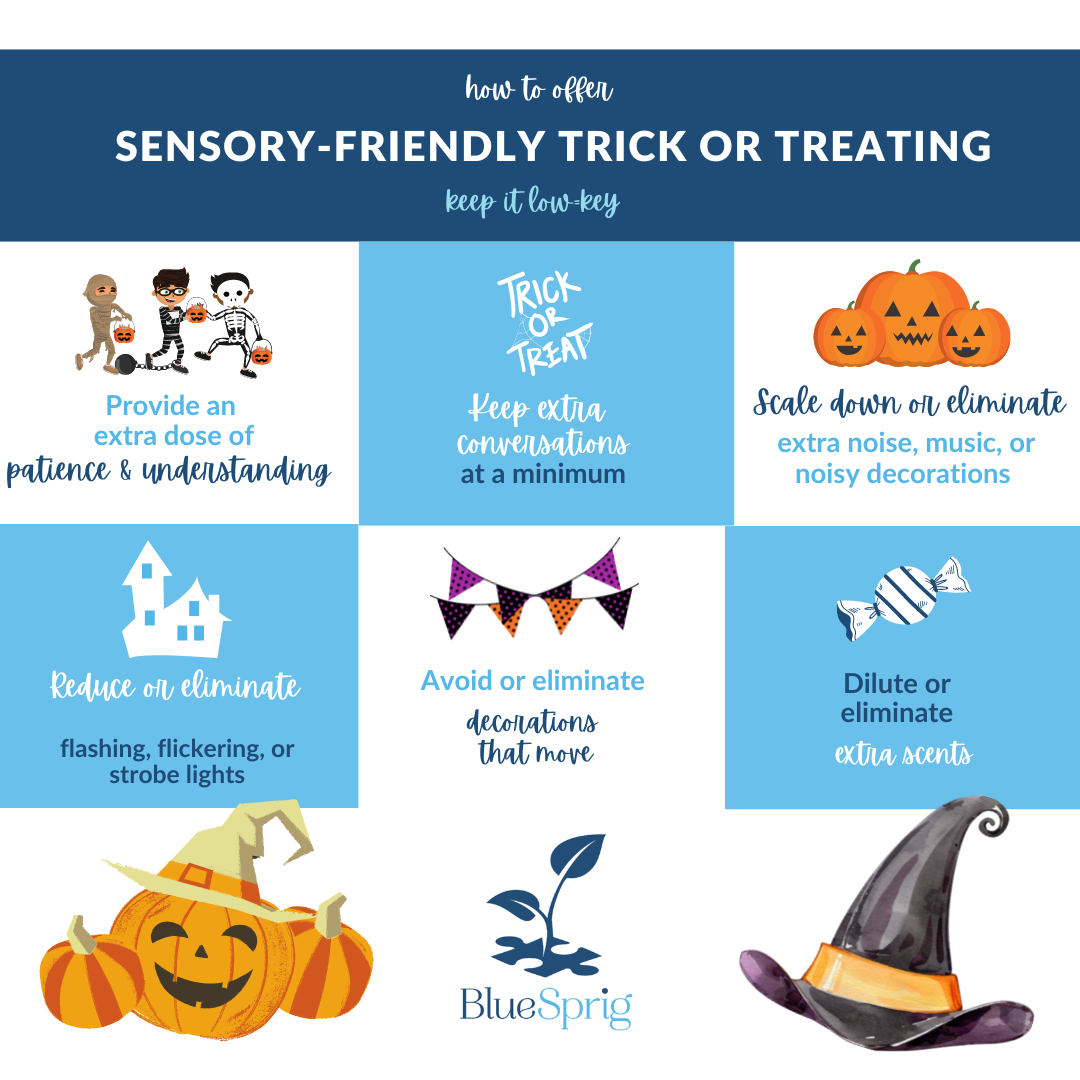
- Be patient at the door. A child who does not make eye contact, does not speak, or takes a little longer to respond may simply be doing their very best.
- Do not require a verbal script. If a child does not say “trick or treat,” that is okay. Hand over the treat with a smile.
- Offer non-food options like stickers, small toys, or glow sticks alongside candy so every child has something they can enjoy.
- Keep porch lighting steady where possible. Strobing or flickering decorations can be genuinely distressing for children with sensory sensitivities.
Awareness starts with small, practical gestures. When neighbors take a moment to be patient and flexible, it changes the whole experience for a child with autism and their family. The more communities embrace that, the more Halloween can be what it should be for every child: a little bit of magic and a lot of fun.
Your Child Deserves to Enjoy Every Holiday
Halloween is one moment in a whole year of milestones, celebrations, and everyday adventures that your child deserves to be part of. BlueSprig supports children and families year-round, in home, center, and community settings. We accept Medicaid and most major commercial insurance plans, including BlueCross BlueShield, Aetna, Anthem, and Cigna, so accessing the support your family needs is as straightforward as possible. Medicaid accepted in AZ, CA, CO, KS, MI, MO, NC, and OK.
Find an ABA Therapy Center Near You and take the first step when you are ready.
Frequently Asked Questions About Autism and Halloween
Why do many children with autism love Halloween?
Halloween offers something genuinely appealing for many children with autism: a structured, repeating activity with a clear beginning and end. Once the trick-or-treat routine is learned, it becomes predictable. The holiday also taps into special interests through costumes and characters, and the fantasy element can be a wonderful creative outlet for imaginative children.
What is the blue pumpkin for autism on Halloween?
The blue pumpkin is an autism awareness symbol that some families use on Halloween. A child carrying a blue pumpkin-shaped bucket signals to neighbors that they may have autism. It is a gentle way to invite patience and understanding at the door, particularly for children who may not speak or who interact differently during trick-or-treating.
How can I make trick-or-treating easier for my child with autism?
Start by practicing the routine at home before Halloween night. Plan a short, familiar route, bring a sensory kit with headphones and comfort items, use a visual schedule so your child knows what to expect, and build in an exit plan. Keeping the outing brief and low-pressure gives your child the best chance of a positive experience.
What are sensory-friendly Halloween activities?
Great options include pumpkin painting, a Halloween movie night at home, attending a trunk-or-treat event in a contained outdoor space, or hosting a small at-home party with trusted people. These activities bring the fun of the season without the unpredictability of door-to-door trick-or-treating.