Episode Description
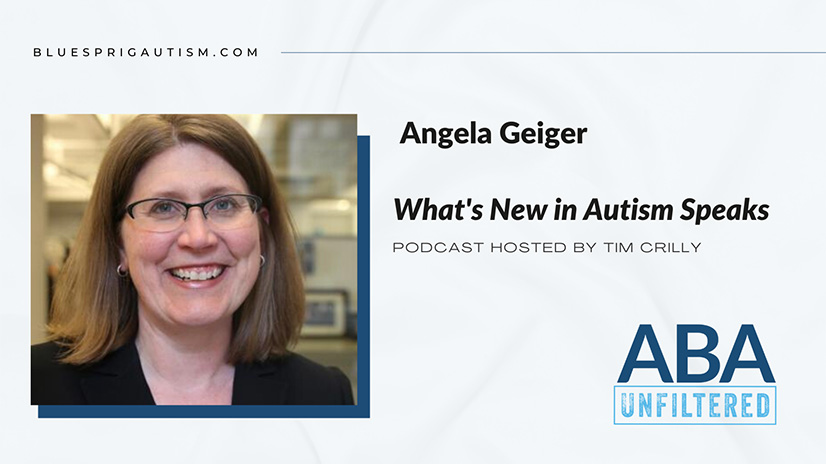
We are proud to welcome Angela Geiger, CEO of Autism Speaks to the podcast where she shares her background in nonprofit work and the Autism Speaks vision for inclusivity and kindness. She talks about how they have worked to help families cope during the pandemic by providing resources and how their Autism Response Team can be a vital resource for families. Angela and host Tim Crilly discuss advice for parents looking for autism services and how virtual reality may be effective in improving social skills for children on the autism spectrum.
Full transcript
0:10 Tim Crilly:
Hello and welcome to season two of ABA Unfiltered. I’m your host, Tim Crilly, and today we have the great fortune of speaking with Angela Geiger. She is the CEO at Autism Speaks, and somehow she agreed to come on and talk with us. And I’m really excited. She does have her PR person on with her, just listening to make sure we behave ourselves. So, you know, Angela, keep that in mind as we we travel through this conversation. But thank you so much for joining us. No real specific topic today, just really uh more about what Autism Speaks is up to and how as a resource they they can really enhance the services and the overall development of programming for families out there. So Angela, thank you so much. And if you don’t mind, maybe take a moment to introduce yourself and give us a little um insight into who you are and and and what what your main overall objective is at Autism Speaks.
1:06 Angela Geiger:
Sure. So I’ve been uh with Autism Speaks for about four and a half years. Uh it’ll be five in February. And uh it’s been a big learning experience for me. Um my whole career has been in nonprofits and particularly and up until now, really the cause and cure space. So this is my first foray into the disability community, which came with a lot of lessons I needed to learn and a lot of listening I needed to do. And um, part of why um I was recruited to come to Autism Speaks and why it was so interesting to me is that you know, Autism Speaks just celebrate, we just celebrated our 15th anniversary. I think people forget that how young this organization is, and um there’s been a lot of changes in that time, and so part of why um I was brought on board was to really look at what those changes were and to make Autism Speaks more reflective of the full autism community, and it’s something I’m really proud that we created a vision at the time. They just celebrated their 10th anniversary and created this vision um with stakeholders and community and people with autism to create this vision for the next 10. And then we’re now in our our first year of our second strategic plan that builds on that, and um, so that’s why I’m here and that’s what we’re doing.
2:27 Tim Crilly:
So, what what is that? What is the vision? What’s what was that pivot that you guys are looking to make from the first 10 through the next 10?
2:34 Angela Geiger:
Yeah, there were a couple really uh major changes, and all were reflective of what we heard from the community and how the community had changed over that time period. The first was, you know, if Autism Speaks is has historically been known for anything, it has been for raising awareness, you know, going blue and those kind of things, but there was a real pivot, as you say, from um from just raising awareness to awareness and understanding and acceptance. And that was a huge um, a huge pivot. The next was um that continuing our complete uh focus on research, but broadening it to not just um to really looking at life-enhancing breakthroughs, both for the long term, but also things that could help improve quality of life today. And um, and then the other thing that I kept hearing time and time again from practically everyone I talked to was really making sure that Autism Speaks was the place that anybody could go, regardless of where you were in the spectrum and also across the lifespan. So no matter where you were in age, and so all those three concepts were um morphed into the mission statement, um, the new mission statement that um really was the building block of everything else we’ve done.
4:00 Tim Crilly:
That’s great. I you know, I think you brought up the concept of acceptance, and I think that’s a huge, huge thing that people don’t think about as much anymore, which is great because I think the the level of awareness that groups like you guys have created. Uh, when I first started in the field, people were uh embarrassed or afraid to tell other people, even people in their family, that they were going through this. And if you think about that attitude and how that might you know isolate you even more, it really plays into that idea of quality of life. How can you achieve that as a family or as a caregiver if you’re not able to talk about it? And that’s something that we’ve actually been talking about at BlueSprig is you know, when you think about outcome measures, uh it’s not just about you know the goals that are being achieved and the progress that’s being made within that that client’s program. It’s also, well, how is this impacting the family? How is their mental health improved? How are they able to um report back to to folks to say, you know, I do feel better. This has worked because I’m able to do these things now that I wasn’t able to do. So that really that’s really in line with a lot of the uh the shift that’s going on in the community. So that’s really great to hear that you guys are putting a putting a focus on that. So I autism wasn’t a part of your your your career prior to this. So was there something specific that attracted you to it?
5:31 Angela Geiger:
Um, I know this is gonna sound odd, but I think the thing that um attracted me was mostly that my whole career has been about um taking on big challenges and and putting in big solutions. And you know, I’d I’d worked in um cancer and I’d worked in Alzheimer’s, and it really seemed that autism was kind of one of those that the next issue that really needed to be addressed in a much more systematic and population level way, so that um solutions could be put in place that helped both at the you know the advocacy level and the standards level and all those things so that communities could thrive.
6:13 Tim Crilly:
That’s great. You know, I think you know, obviously mission-driven work is something that you know it appeals to to people or or it doesn’t because it’s not easy and you’re looking and you’re you’re interacting with folks that are going through a lot, and you have to have the right type of personality to be to be involved in those sorts of things. So I think obviously you’ve you’ve you’ve dealt in that a lot, and I think it’s wonderful that that someone like that is is driving driving this this mission. Especially when you think about the year we we’ve had uh 2020 and the challenges that it’s created uh you know across you know everyone’s life. What have you guys really been focused on, or what have you learned through through this process of of you know, you know, COVID, perhaps families losing their services, or maybe choosing to put pauses on services, or you know, the the other challenges that arise from just an overall upheaval in the daily life? What’s sort of been the the um the talking points or the the direction that you guys are taking?
7:18 Angela Geiger:
Well, I have to tell you, we started off 2020 um with such enthusiasm. Um as I said, we just so silly. We just celebrated our 15th anniversary. We actually um had a significant rebrand of the organization, you know, shown by the iconic blue pin that everybody knows about Autism Speaks. And actually, I’ve got the the new pin on here that actually takes the that blue, keeps the iconic nature of it, but shows the diversity of the spectrum with different colors. And that really became the building block of all these other things. So in early February, we had a big party, celebrated everything, thought, oh, at least you got to see everybody right before you couldn’t see everybody.
8:03 Tim Crilly:
So that’s great.
8:04 Angela Geiger:
And one of the most important things is we launched we asked for what our birthday present, our anniversary present could be was to make 2020 the year of kindness. And so we have been um continuing our work on that, uh, creating a million um our goals, a million acts of kindness over the years. And uh let’s just say there’s been a lot of opportunities for kindness in this year. So, you know, then um then COVID hits and um, you know, our office is shut down. As you just said, community services shut down, everything, and we’ve absolutely moved into okay, what do we need to do for our families now? And one of the things that I thought I was really proud of is that our team created the um COVID-19 Autism Research Community Task Force, and it’s a coalition between Autism Speaks, the Autism Science Foundation, um, the International Society for Autism Research, and the Simons Foundation Research Initiative, and really came together and created this whole um list of resources and interventions and all sorts of things for families. Um, we also created uh virtual events, virtual training, and we just kept adding, and like every day we kept doing more and doing more, and so uh that pay, you know, everything’s sitting in one place on our website. It has been one of our most popular places people are going, and we continue to add to those resources, and there’s sections for families and for adults and for educators, there’s resources in multiple languages, and so um we also we have an autism response team, which is a group that takes phone calls and chats and emails, and um, our call volume went up so significantly because people didn’t know, okay, this is closed down, what do I do now? And um, one of the other things that we’re we’ve launched, and there’s more coming, are also a series of we do we have a program on on caregiver skill training. So it’s teaching parents or caregivers how to do these interventions when you can’t get to services, and they’re these lovely little vignettes um done cartoon style, and that really should demonstrate what you should be doing to um, you know, get down on the floor, be with your child, you know, play those kind of things. So those are the kind of things we did. We also increased, we have a program called CARES Grants, which are um direct assistance grants, and those uh we we had several very generous donors who added to that so that we were able to provide more grants directly.
10:51 Tim Crilly:
That’s that’s fantastic. Did you guys find yourself uh being contacted by any like funding sources, things like that? Were they seeking your advice on maybe what what they should be doing, or were they making where you feel like they were maybe making some of their decisions in independent of any sort of insight you guys might have as a as a group?
11:10 Angela Geiger:
Yeah, I don’t know how much they reached out to us, but what I will say is there were funding sources that we never had before that were interested in in helping to serve this community.
11:20 Tim Crilly:
Okay, that’s great. You know, oh go ahead, sorry. No, no, no, it’s just with telehealth and and the things that they started to allow that you know made made us a little nervous as providers to say, okay, how does this work? Just there’s no real guardrails or things like that. But you know, certain organizations were able to use it and use it very effectively. And it feels like in some cases it’s something that we will see moving forward. So it just it it made me wonder if maybe they were getting some secret advice from from folks like you guys.
11:52 Angela Geiger:
To be honest, on that front, um, yes, it’s actually been uh we’ve long had the autism treatment network, uh, which is uh currently 12 uh hospitals, children’s hospitals across the country who um work together to create clinical guidelines. Well, part of our strategic plan already, even before this happened, was to expand that to networks so that outside, you know, if you couldn’t get to one of those 12 hospitals, what else could happen? So creating both a learning network and this um, which telehealth is a part of, and it really um we’re seeing we part of what happened was we accelerated some of those programs because of the needs and uh have had some really good uh participation and examples so far and a lot of pickup.
12:39 Tim Crilly:
Yeah, so I mean, part of my my career I I spent on the uh healthcare side. I was with with a large um national health care group running the the autism program, and you know, it made me very popular and unpopular for different various reasons that we don’t have time for today. But I do know that when things, you know, when you when you want to see change like this, it’s a little scary for for folks on that side. So from our standpoint, it was really it was really powerful to see decisive decision making because of how it did impact these families and at least allow some level of continuity to their life, even if it was you know compacted, less care or whatever, but it still allowed some of these families to be tethered to their their normalcy. So that was really that was really important to us, you know, and and I see coming out of this, and I don’t know, you know, you know, where you guys stand on it or are moving forward, but I think we will see a shift in the way services are delivered. And uh, you know, when you look at the the the various technologies that are that are coming around, I I think it’s going to have a profound impact on families moving forward. So I don’t know if you guys have had a chance to sort of look into some of those new technologies as they they relate to to care, especially in the diagnostic field. But we’re excited to see where it goes.
14:04 Angela Geiger:
Yeah, you know, I would definitely say that one of the other things that happened was, you know, we we’ve maintained our our traditional advocacy priorities, but one of the other things shifted were um some of our particularly our state advocacy priorities in really making sure that some of those challenges you’re talking about, you know, to make sure that there was increased funding for home and community-based services, and you know, those educational supports are protected with the IDEA changes and you know, eligibility for economic impact payments. And so, you know, we’ve been doing webinars to educate um legislators but also parents, and we’ve done those so far in 25 states with a you know path to doing it everywhere. They’re incredibly well attended, and we’ve either preserved or actually in some states expanded what coverage looks like for um for people with autism and their and their families. So that’s something that also, you know, is one of those shifts, um, but is gonna pay off in the long run because they’re not just all pandemic time limited.
15:06 Tim Crilly:
Yeah, you know, and I think obviously it’s not just about the having to stay home and and not not have care. There’s also a giant um, you know, um financial impact that is, you know, you know, sort of ravaging some of these families and the ability to maybe not be able to pay for the care moving forward, or you’ve lost insurance and and now what do you do? So I think that’s something that uh really is gonna be uh a problem if we can’t sort of get things going back to normal in in some regard soon. So I don’t know if you guys have seen some of those sort of tragic stories and if an advice you might have to to folks that find themselves in that position.
15:49 Angela Geiger:
Yeah, you know, I think that um you know a lot of it depends by state, and so, you know, in an individual situation. And so uh, you know, calling that autism response team and help having someone help you walk through that. We also have great resources on on the website. And uh and the other thing I would say is one of the interesting things is that as we take these calls for what financial assistance people need, we were really surprised that the number one um request was for food assistance.
16:22 Tim Crilly:
Yeah. Yeah, that’s um it’s that’s heartbreaking. It it’s it’s really, you know, you you’re you’re dealing with certain things and you add that on top, the amount of stress and and worry, it’s probably unfathomable. But it’s great that there are folks like you out there that are on the other end of the phone. So that’s that’s really good to know. Uh, you know, you’ve brought up the um autism response team uh a few times, and I think it’s a wonderful thing. I I recently had a situation where a family member of mine found out that her her daughter had had been diagnosed. And I I mean, I’m not trying to, you know, pat myself on the back, but I’m a pretty well-connected guy. I I know a lot of BCBAs, I know a lot, you know, across the country. I’ve you know, I’ve I’ve lived a life or two in this community. And I had a really hard time helping her find services in a place where it didn’t feel like it should be hard. So it was a real eye-opening experience for me, someone who speaks the language, knows the people. And it took me about a month for her to find someone that could actually come out and you know, do that functional assessment for her. And maybe that seems quick. I I don’t really know, but you know, I it it it was a three three-month gap from the time she called me to the time she had someone show at her front door. So, what advice do you do you guys really give to to families that are just getting a diagnosis or you know are are very new to to services? What’s the the few things that they should be considering as they enter into this?
18:01 Angela Geiger:
Well, you know, I think the one of the pieces of advice is kind of what you did, which is the second you think there might be something, jump on it. And you know, you don’t need to have a diagnosis to get intervention, right? And so sometimes that diagnosis part is the longest part of this longest part, yeah. So really um, you know, working on that. I’m sure that this time frame made it even more difficult.
18:25 Tim Crilly:
Um sure, it did. That’s a good point.
18:28 Angela Geiger:
And um, but uh, you know, just kind of figuring out and sticking on it, and it is it’s it’s not an easy process. And there’s some places that are rich with services and there are others that aren’t. And uh it also, you know, we found that it also depended a lot where um COVID rates were, you know, what you were you were seeing. In some places, service was almost undisturbed for a period of time, and in others um uh it wasn’t. One of the things that we have been um encouraged to see is that um many but not all states have been prioritizing um kids with um IEPs in the coming back to school and coming back to classroom full-time, which I think is a really it’s a smart choice because first of all, those classrooms are by nature smaller.
19:19 Tim Crilly:
Small, and there’s no one else on campus, absolutely.
19:23 Angela Geiger:
And um, you know, I I can’t tell you how many stories I’ve heard of um from parents of you know, they’re they went from having, I don’t know, four, five, nine um external supports, you know, whether it’s aides in school or OT or PT, whatever it is, to mom or dad. You know, and that’s it. And that’s a lot.
19:47 Tim Crilly:
Yeah. Yeah. Uh, you know, we we had a uh a season one episode talking about, you know, this was before school was getting ready to start and everything, just talking about how how do you even manage an IEP at home? If a mom’s trying to keep uh, you know, kid in front of a computer, it’s really it’s it’s really not the most effective way to to to treat. And so the more that they can get on campus as we move forward in this will really be a have a huge impact for these families.
20:14 Angela Geiger:
So I will also say on the opposite end of the spectrum, we’ve also heard stories about kids um with autism who are just thriving because they’re sitting at home, they’re getting their work done, and then they get to do what they love to do, and they can handle it, and they actually are thrilled not to have to go through all this stuff. So, you know, again, it’s it’s autism, right? It’s a spectrum, and you just have to have individualized support.
20:41 Tim Crilly:
And that’s why I think you know, you go back to the telehealth question moving forward when it relates to you know just ABA therapy or you know, other types of therapy, it’s not gonna be right for everybody, but there will be a group of individuals that it really is almost perhaps a better, a better form of treatment for them. So that’s going to be really interesting to see how that unfolds over the next couple of years and and how this uh evolves because you know it it helps people see more more clients, it you know, makes better network access, things like that. So there’s a lot of solutions, you know, from a practical standpoint as well as a as a clinical one.
21:18 Angela Geiger:
Yeah. Some of the things you know that we’ve been looking at are um how virtual reality, for example, can be used to improve social skills and also employment, practicing for employment, and um also things like eye tracking and facial expressions to to track behavior to give you a more um objective evaluation of progress or where people need to do more work. And uh, one of the things that we’ve um started to do at Autism Speaks is explicitly include technology as part of our science grants. Um, because we do know, as you said, it’s it’s emerging and it can be um it’s certainly cost effective. And um and if you can get more real-time feedback, you know that that’s you know such an important part of progress.
22:04 Tim Crilly:
Yeah. So I you know I think it’s probably time to get a couple major health plans together to to start really talking about this, how we can all sit down as a community, because in the long run, it’s it’s going to be good for the families, but it’s also going to be good for them because you’re going to have stronger, more concrete data driving decisions based on you know what should what should be happening next for this this family and this individual. So I would love to to learn more about that. And that’s probably a rabbit hole I could go down for a whole separate conversation. And I don’t even understand most of it. So uh, but you know, that’s that’s that’s beside the point.
22:39 Angela Geiger:
Hey, if it’s okay, if you don’t mind just continuing on that 2020 and how sure, yeah, please. If I may, the other big thing obviously that happened in 2020 was this um imperative on social justice issues. And while Autism Speaks has, I think, always been known for being very respectful and responsive to diversity on the spectrum. Uh we realized in talking to internal staff and our and some of our stakeholders that we needed to do a better job across the board with diversity. And so uh we’ve uh put some, you know, the boards looking at it. We’ve got a team who is actually right now reviewing um firms to come in and help us do a both an internal and external assessment. Um, we are committed to doing um to growing in this area. And you know, we actually started out calling this diversity, um, inclusion, and um equity, but added access after we started doing some of the work because we realized, especially through our advocacy work, that it’s that access to care and to you know the financial kind of things we just talked about that are uh are really important. So um, you know, we’ve got a lot of work to do and a lot of listening to do, but it’s something we’re committed to getting better at.
24:07 Tim Crilly:
That’s great. We we actually have a similar thing going on here. We formed an internal group. Uh Keith, our CEO, was doing uh we’re we’re getting back to normal tour and drove to basically all of our clinics across the country. And it was right around the time that you know the um this movement really took took shape. So we actually formed a committee, and and if you go back and if you have a chance, we did an episode um last season about that that that group. So, you know, if there’s ever anyone over on your side that would like to to chat a little bit with with our team that that’s working on that as well, it you know, there could be some some lessons learned from each other. So that that’s fantastic, and it’s something that has been a long time coming. So it’s nice to see you know big powerful organizations really take heed and and really push that forward. So that’s really exciting. Okay, before I let you go, uh and I again I appreciate your time and and your your passion around around these topics, but I I’d be remiss if I didn’t ask, because we asked all of our guests. Um last season um we we finally I think came up with a solution for whether a hot dog is a sandwich, and we plan on really um producing that that that data and really taking that on tour on the on the lecture circuit, maybe get some some published uh some published journal articles about it. But this this year we’re moving on. We we need to we need to solve for for a different different question. So it’s a yes or no question. So you need to either decide yes or no, but then I need your rationale as to why you decided on yes or no. Is that okay?
25:47 Angela Geiger:
I guess so.
25:49 Tim Crilly:
Okay. Um is cereal soup?
25:54 Angela Geiger:
No.
25:57 Tim Crilly:
Oh, you want my rationale? Yeah, yeah, you need to you need to rationalize it.
26:01 Angela Geiger:
Uh because it’s cereal.
26:07 Tim Crilly:
See, you can’t you have to be able to write a definition as we know, usually we’re asking, you know, BCBAs that need to sort of define it, but um, so just you can you get give me one thing as to why? And it it can be arbitrary, I don’t care.
26:21 Angela Geiger:
I can’t really think of too many crunchy soups.
26:24 Tim Crilly:
Okay.
26:24 Angela Geiger:
Or that the main ingredients in cereal are main ingredients in soup. And you have to add the milk.
26:33 Tim Crilly:
Okay, fair enough. Fair enough. I I really appreciate it. And you know, at the end of season two, you’ll be able to listen and and know what what side of the uh the issue you you fell on. So, but you’re you’re the first you’re the first person that that will be be answering this in the uh in the podcast sphere. So uh you at least have the the um the honor of going first. So I really appreciate it. Uh Angela, it was so nice to meet you, and I really appreciate it. And you know, I I’d love to have you back in in in future years just to see where you guys are on your on your mission. But uh, as always, thank you to everybody tuning in to ABA Unfiltered, and I look forward to communicating with you in the future.
27:16 Angela Geiger:
Thank you.