Episode Description
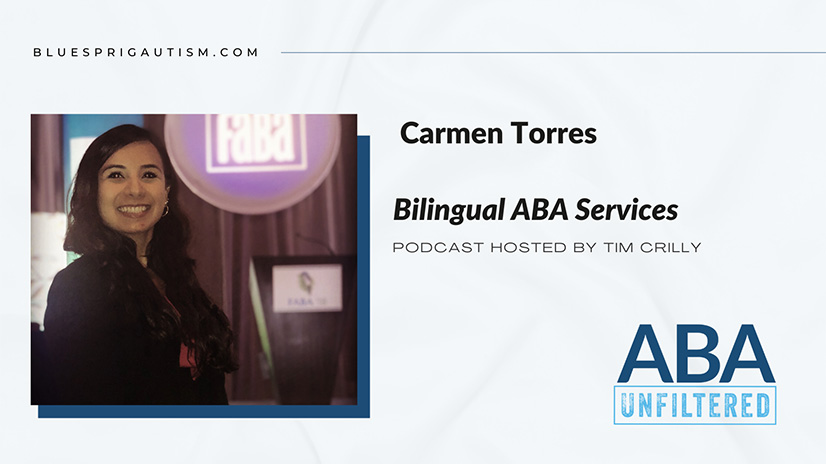
Carmen Torres, BCBA and Clinical Director at the BlueSprig center in Edinburg, Texas discusses her Mexican background, her unlikely introduction into the ABA world, and the challenges and benefits of operating in a largely bilingual community.
Full transcript
0:06 Tim Crilly:
Hello, and thank you for joining us on ABA Unfiltered. I’m your host, Tim Crilly, and today we are joined by Carmen Torres, Clinical Director from BlueSprig, to talk about her clinic as well as bilingual treatment in ABA. So I’m really excited to uh have Carmen join us to talk about this interesting topic. So, Carmen, thank you for thank you for coming on.
0:26 Carmen Torres:
Hi, thank you, Tim, uh, for having me.
0:29 Tim Crilly:
Could you uh just real quick for those listening, maybe introduce yourself so people have a sense of who you are?
0:35 Carmen Torres:
Yes, uh my name is Carmen Torres, like you mentioned. I’m a clinical director here in Edinburg, Texas, right down in the border. Our clinic is one of the three, almost four clinics that form South Texas. We have right now, through the pandemic, we are in phase two. So we are being able to provide both in-home and in-clinic services. And that’s that’s kind of like where I’m at.
1:00 Tim Crilly:
Okay, so you really said nothing about you, and you only talked about your clinic, which I’ve known you a little bit now. It doesn’t surprise me. So could you just give me one piece of information about yourself? Just I know it’s all about the the kids and the work, but just maybe just a little little little nugget.
1:17 Carmen Torres:
Well, I think that’s something that is or that makes me different is that before BlueSprig and before I was a BCBA, I was actually I’m I’m born and raised in Mexico. So I’m uh hardcore Mexican, which is not the same thing as Texas Mexicans.
1:34 Tim Crilly:
Okay. Um fair enough.
1:36 Carmen Torres:
That is a little bit different about me. It is one of the things that most that I feel the most proud of because, and I always say I’m not Hispanic, I’m I’m strictly Mexican. I don’t really have any other kind of background but that. And I think that it correlates with everything, like it makes everything that I am, that word to me, it means a lot because it takes over the way that I play, the way that I the things that I like, the food that I eat, um how I interact. So yes.
2:03 Tim Crilly:
And how you approach work.
2:04 Carmen Torres:
Yes, in how I approach work.
2:07 Tim Crilly:
Fair enough. Um, so can you tell me how did you end up getting sucked into the the BCBA world? What what attracted you to this?
2:14 Carmen Torres:
This is a very funny story, I think. Um, because I started my both of my parents are doctors, so I came to the United States to do my bachelor’s and I wanted to be a doctor. And I did my bachelor’s in in biology with chemistry, and I was pre-med and I was going to places being a doctor, and I realized in the middle of it that I didn’t really think that I had it in me to be as good, at least as my parents were, as far as doctors, and I wanted to kind of like make my own lane and find my own things. So in the university here in in Pan Am that is the one that that I was going to, they had just opened uh clinical psychology with ABA. And since I didn’t have any background in psychology, my my major was biology and chemistry. I heard that somebody said that I could get into the program easier if I put ABA.
3:08 Tim Crilly:
Okay.
3:09 Carmen Torres:
So I applied.
3:10 Tim Crilly:
Did you know what it was?
3:12 Carmen Torres:
I didn’t know anybody.
3:13 Tim Crilly:
Okay.
3:14 Carmen Torres:
Um and I was like, sure, I’ll apply if I don’t like it. I’ll just go and take the classes I’m already in. And I tried to push it as much as I could. Like they kept offering me, like, oh, there’s this house, and you can go and work with this kid. And I was like, nah, I’m not, I don’t really like it. Um, I always felt like I came all the way over here. I’m studying in the United States. The least thing that I want is to be taking care of children.
3:36 Tim Crilly:
Like, sure.
3:36 Carmen Torres:
I thought that it was very, it was very on the nose of like um what I was here for, but eventually it came to the place in the program that it was like, well, you need to do your practicum or you’re not gonna graduate. And my dad had helped me finance my education, so he was like, Yeah, no, you’re yeah, you’re graduating.
3:55 Tim Crilly:
Yeah.
3:57 Carmen Torres:
So I went and I did my practicum at the Rio Grande State Center, which is a facility for adults, and they live in there and they have all kinds of disabilities. And I I remember walking in the first day and saying, like, okay, I have to do this for 26 weeks and I’m done. It’s this is week one, and then 26, and then I’m done. And then I fell in love with it.
4:18 Tim Crilly:
I just felt but it started with adults for you.
4:21 Carmen Torres:
Yes, it started with adults.
4:22 Tim Crilly:
Wow, that’s very interesting. Do you get a chance? Do you have an opportunity to to work with any adults now, or is your clinic primarily children?
4:30 Carmen Torres:
It’s primarily children. We do have uh some adolescents, but it’s primarily children right now. I love working with all ages. It was actually working with adults that I fell in love with working with children because I found that there was a lot of areas in which, man, if somebody would have gotten here sooner, and I feel like we wouldn’t be here right now. Yes. I felt like those were the kids that we didn’t get to, we didn’t get to help that we were working as with adults. So I I really like both sides.
5:01 Tim Crilly:
Okay. And when did you um come across BlueSprig?
5:05 Carmen Torres:
I came across BlueSprig when it was still in our area, it was still The Shape of Behavior.
5:10 Tim Crilly:
So okay. I was you woke up, you woke up one morning and you were a BlueSprig person. Got it. Okay.
5:15 Carmen Torres:
Yes, kind of. Well, my my contract the first time it said The Shape of Behavior division of BlueSprig. And I was like, I really hope that I never have to answer any phones and be like The Shape of Behavior. So uh that’s how I first got introduced. I had heard of The Shape of Behavior in our area, and then I remember that when I went to the interview with my area clinical director, uh Megan, she told me, like, we’re transitioning, we’re becoming the new company, it’s gonna be bigger, it’s gonna be greater.
5:40 Tim Crilly:
And I was like, There’s gonna be a podcast someday. Yes, I’m sure that was that was top of the line for her.
5:46 Carmen Torres:
And I remember that she was like, just so that you get an idea, their mission is to change the world for children with autism. And I was like, Cool.
5:55 Tim Crilly:
Sure, I’ll believe it when I see it.
5:57 Carmen Torres:
Yeah, I was like, cool. Do you have insurance? Like she said, you really want to have insurance. So I don’t think, and I was just having a conversation with her, and I was telling her, like, I don’t think that when I said when I sat down in that interview, and when I said yes when they called me, I knew what was coming to me, uh, or what what that was going to mean. When I started working in the McAllen clinic, we had seven children. That’s all we had. And right now we have around 29, 30.
6:31 Tim Crilly:
29. Wow, that’s really great growth. So that’s amazing. With that, good transition. Would you say the the primary makeup of your clients are Spanish speaking, or is it a smaller percentage?
6:44 Carmen Torres:
I would say that the majority is bilingual.
6:47 Tim Crilly:
Okay.
6:47 Carmen Torres:
What why what I encounter during intakes and and like just meeting the families is that they will more frequently say, oh, language spoken at home. And for the most part, the people that are honest, they’ll tell me both. People that are, I don’t know, that they feel a little bit more shy in the intake, they’ll be like, English, we speak English. And then uh the kid will arrive and walk into the clinic, and we will be like, Oh, come over here. And the first thing like they’ll turn and be like, awa. And I was like, Okay. Or in the first parent training or family guidance session, mom will be like, Oh, yes, he’s having uh difficulty following direction. Oh, it’s because you’re telling him, come. We we we always call him like Ben, bam, bam. So it’s like, uh, I thought you said you only spoke English. And I think that it’s because our region a lot of the times doesn’t realize how immersed both cultures and both languages.
7:42 Tim Crilly:
Yeah. You know, a lot of families kind of go in and out of both, I would imagine. Yes. So with that, what sort of challenges do you feel like it creates for for you and your staff? You know, how much instruction do you do in Spanish? How much data collection has to be presented? You know, goal writing and all that is is in Spanish up front to to ensure that everyone involved is able to process the information, or do you do you not look at it that way?
8:11 Carmen Torres:
Yes and no. Yes, uh, I don’t write the goals in Spanish. Well, me being Mexican and Spanish being my first language, I don’t think that I ever not think in Spanish. So there’s always that part that it’s there, it’s part of the makeup of everything and how I approach a lot of the things that I do. But how much of the instruction is given to the therapist, I would say like at least 50%. Okay. Uh 50 to 70 percent of the instructions of the everyday conversation, of the redirection, uh, of the feedback, of the it’s in Spanish. Just because like it’s also how we feel more comfortable. I think that from my clinic, there’s maybe one person that isn’t like Spanish speaking, or maybe two, but they understand what I say when I say it in your sure, just through the tone and the look in your eye, yes, or they they might just not like be fluent or they feel like shy saying it, but they do understand, and a lot of the times it really becomes like a little bit of a headache because it’s so split. So I’ll go from a parent training that is fully in Spanish to a direction that is in English. And right now that we’re in homes, I can be speaking to the therapist in English, and then mom arrives and she asks me a question, so I have to be answering in Spanish, and then we go back to like teach that in English, and then it goes back in Spanish.
9:38 Tim Crilly:
It’s just like a so you you’re able to accommodate for both staff and and families and certainly provide caregiver support in whatever language feels most comfortable for that family.
9:50 Carmen Torres:
Yes, and it really goes to to the social validity of the whole thing because I know that a lot of the times people really ask about that, like, well, won’t that affect the child to develop language, especially with early learners that were working on communication, won’t that like kind of mess them up or confuse them? And I think that I think that that was something that it was very strongly believed before. And what we’ve come to realize as a region is that kids typical and neurotypically diverse, they grow up with these two languages. That is that is their normal. Their normal is to hear words in in both languages coming and going. And if we were not to provide that opportunity, then we’re really teaching them to something that makes no sense to them.
10:42 Tim Crilly:
Sure, because that’s not what’s happening when they when they leave the building or their yeah, that that makes total sense. Do you feel that you encounter any cultural challenges as it relates to the perception of therapy or the services that you’re providing? Do you do you run into any stigmas that that become problematic throughout some of the families we work with?
11:04 Carmen Torres:
Yes, I think that just because language might unite us, like in in the sense of like English unites Anglo-speaking countries, but not all Anglo-speaking countries have the same culture. And it’s the same thing for for Spanish-speaking countries or or regions. Like when I say like I’m Mexican, there’s a lot of my clients that speak Spanish, but they are not Mexican, and and they might either have other backgrounds, or they have grown up their whole life here, and their Spanish is different than my Spanish. And their culture, their beliefs, the food that they eat, what they celebrate or what they do, it’s it’s a little bit different. And we have to be accommodating of all of that, and the way that therapy is so intense and a lot of the times very immersed in all of that. Like we have to make their culture part of our culture so that we can teach that culture and that social environment for them to feel comfortable, the kids, in those kinds of scenarios, as a culture, a lot of the times. And I’m not, I don’t want to generalize and just make a stereotype of all of us, but a lot of the times we’re loud. A lot of the times.
12:21 Tim Crilly:
I can be pretty loud too.
12:23 Carmen Torres:
Yes, we might be loud, we are quite intrusive. Like this pandemic has really been difficult for us that we hug and we kiss, like just that’s our general uh salutation. Like we go and we kiss on the cheek. So those kinds of components we come from big families a lot of the times, or we make a big family, like even if your family might be small. There was this one time, one of the kids, and I came to the first intake, and the kid calling me like Tia, Tia, because which means aunt. Because every time he sees a new person, mom tells him to call them Tia, like this is your Tia. So he saw me there and he was like, Are you my Tia too? And I was like, No, sure, why not?
13:02 Tim Crilly:
Sure, let’s go.
13:04 Carmen Torres:
Um, also the way that you know we relate with food to a lot of things. Like, I know that right now that we have in-home services, it has been really hard. I’ve gotten so many phone calls of mom, like, can you just talk to whoever you need to talk? I need to be able to feed them.
13:18 Tim Crilly:
Like, this is just oh, like where the rules about the rules about RBTs and things like that. Yeah, I that’s that’s a great point, you know, and and and it’s a tricky one because sometimes that hard line saying no can actually be worse because of the perceived insult, you know, to that that person offering, you know, and I think that’s a that’s a really fair point, but rules are rules, I guess. I don’t know. I mean, but if no one reports it, who’s gonna know?
13:47 Carmen Torres:
Yes, and it’s just the way that we that we grew up, and that I feel like also a lot of the time families do feel so much more comfortable. I have a family in particular that always tell me, and we’ve seen an increase lately in our percentages of family guidance that and the hours that we’ve been able to meet. And one of the families was telling me, like, you know what is really important for me during family guidance? And I’m like, I don’t know what. And they’re like, I know you. I feel like I know you, I know where you come from, I know that I know what you’ve been.
14:20 Tim Crilly:
My thoughts are good, you know, and I can imagine families in a in a situation, you know, finding out a child has autism, it’s it’s stressful, obviously. But if you’re in an in an environment where there’s a you know a language barrier, the fact that you can add that element and you and and your entire team can do that, it must be just an extra sigh of relief for families that desperately need that. So that’s that’s a fantastic thing you guys are able to provide. So along those lines, what type of community outreach are you guys able to do from both a making sure families are finding the services they need, but also, you know, maybe recruiting a future workforce, uh, people that would never, just like you, would never know that it even existed or they have a skill or or something that might be perfect for for this line of work? Are you guys able to? I know it’s a little different right now, but you know, in the community, what sort of approaches do you guys use?
15:13 Carmen Torres:
We do, we try to maintain relationships with our university, that it’s here, and just actually one of the big strengths that we have here in our community is it’s parent groups, like parents that because of the lack of resources and because of the lack of of a community, they’ve made it upon themselves to create those communities. And some of the big groups that are in our area have language that is like you can really tell, because there’s some ones that are just like English-speaking groups, and then there’s like the Spanish-speaking groups, and and those really have made up, and and it’s that word of mouth from those families that has in part helped us grow as much as we have in the area because they have found that this has worked as ABA and that this place is a place where they can that they can call home because we’re able to cater to those things. That we, especially earlier on, that they didn’t know that we could do that before. We would have families that had either made their peace with the fact that he’s not gonna understand when I talk to him or when I speak to him, or when you know his grandmother speaks to him, because they’ve told me that I have to make a choice. And they’ve told me that the right choice is English, and that’s what I need to speak to him. And just kids and and families that really thought like my kid is not gonna be able to communicate with us and and understand some of those things, and especially if we even had a family that it was their intent, like they were here because of work, dad’s work, but they weren’t planning to stay in the United States, like they were planning to go back to Mexico, that’s where their family was, and it made absolutely no sense whatsoever to teach this child all these communication skills in a language that they were probably not really.
17:12 Tim Crilly:
Sure, use as they grow up, yeah.
17:14 Carmen Torres:
Yes, so everything like we’ve gone to and actually, you know, teaching all the little intrinsic things about language, like jokes or you know, just things like that that we’ve had the opportunity to teach, and it does take like a whole army and a whole like planning behind it. And we saw it initially, we noticed there was this child, and they were only Spanish speaking, and because we weren’t really prepared initially to how can how were we going to deal with that in the schedule? It ended up being one of the therapists that was assigned to this child, and she did not know Spanish. I had cards made for her, and like that would say, like, this is what you need to say, and this is the answer that needs to come out. So just like read it, like I would write it phonetically, like this is how it kind of has to sound. So she was asking something like, I don’t know, uh, tell me something that you wear, or something like that. Sure. And the child answered, but in like her first language was Spanish, that’s all that she really knew. So she answered and she answered like really quickly. And I was in the room, and the therapist thought that I wasn’t paying attention. So she just went, That sounds about right. And she was like, move on, and she had not answered anything like relatively close to her answer. She was like, That sounds about right, let’s move along. And I was like, What do you mean that sounds about right? That has nothing to do with it. And she’s like, I don’t know, I didn’t understand, but she seemed confident.
18:43 Tim Crilly:
It must have been right. It must have been right.
18:45 Carmen Torres:
And I was like, You wouldn’t do that if it was English, you know, because you know this language and you would have run and error correction procedure, and you know, and we need in true BlueSprig fashion, if we’re talking about leveling the playing field for all, it’s for all, not the ones that we understand or that speak the language that is the most convenient to us. And you know, it does take an army and it does take the therapists to push themselves harder. And you know, we’ve had therapists that it’s like, what is it that you call this thing again? Because I call it like, and then we all start coming up with like I call it this, you call it that, just trying to figure out what’s the name that we’re all going to be in agreement that we’re all going to call it like this. It has taken, I mean, great, great therapists, very flexible, very willing to embrace the whys and the why nots. Um and just the staff, because my area clinical director, you know, Megan, she doesn’t speak Spanish herself, but she has seen the need to support these families and and to provide us, the bilingual ones, with all of the supports. What do you need? Like, how can I help you? How can I be of assistance so that you guys can reach out and do what you guys need for these families and everything from making sure that we conduct our interviews in in Spanish, making sure that we’re able to provide family guidance in Spanish, everything that they might be needing.
20:09 Tim Crilly:
And I think it’s great, and I think you brought up a great point about you know, just the ability that the team gives you to be able to do that. And I know from a from a mission standpoint, that’s obviously very important to Keith and other folks in leadership positions. So it’s great to hear that it’s actually happening in the real world. So uh I I really appreciate you taking uh a couple minutes to to chat about you know your your community, your your clinic, and your people that you know you get to work with day in and day out. Before I let you go, one question. So need to put on your BCBA hat for a second. I don’t know if you ever take it off, but I need you to make sure it’s still on. It’s a yes or no question, and I would like an operational definition to support your answer to the question. So if you answer yes, I need to know why. If you answer no, I need to know why. Got it? Okay. Is a hot dog a sandwich?
20:56 Carmen Torres:
No, it is not a sandwich because a sandwich requires a different type of bread that is loaves, and it has two different pieces of bread and the set and the hot dog is together. So yes, it’s not.
21:12 Tim Crilly:
Yes, it’s not. Okay, fair enough. Thank you. Thank you. I I appreciate that. Um we’ve um we’ve had an array of answers. So when when this is all said and done, we’ll we’ll definitely have the definitive data on on whether or not a hot dog is a sandwich with many, many operational definitions. So that’s what I’m really looking forward to most about completing this the series on on uh ABA Unfiltered. So uh Carmen, thank you so much for joining. And for those of you tuning in, uh again, thank you for for checking us out and keep an eye out for uh future episodes.
21:42 Carmen Torres:
Thank you.