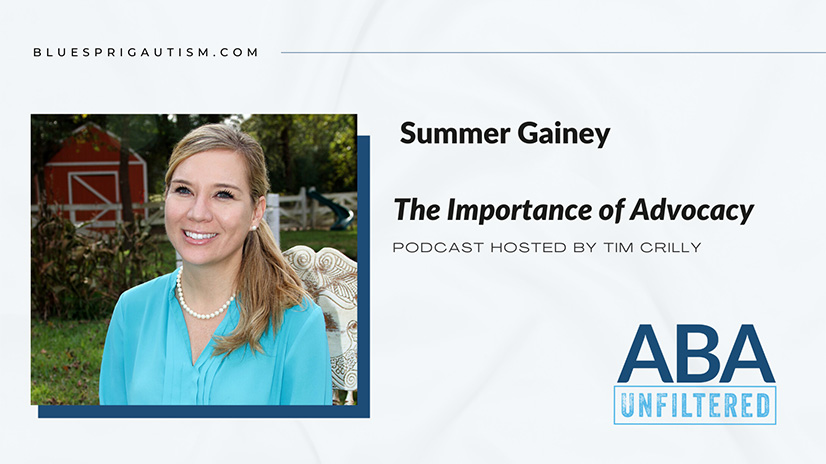
Episode Description
Dr. Summer Adami, Vice President of Research and clinical Outcomes at BlueSprig, joins the show and talks about the process she went through when her company was the first ABA therapy agency to be acquired by BlueSprig. She also discusses how her transition to BlueSprig provided her with the opportunity to pursue some of her greatest passions through a variety of initiatives within BlueSprig that relate to advocacy and research.
Full transcript
0:06 Tim Crilly:
Welcome to ABA Unfiltered. I’m your host, Tim Crilly, and today we’ll be talking with Dr. Summer Adami. I really appreciate you taking a couple of minutes to chat with us today. You know, a little bit about your career, where you’ve been, what you’ve done, and more importantly, what you’re up to now. So thank you for joining us.
0:22 Dr. Summer Adami:
Thank you. It’s my pleasure to be here. Yeah, so I’ll try to sum it up in just a couple of bullet points. I started working with children with autism at a Lovaas replication site in Raleigh, North Carolina at Meredith College. That site is still there. And then I moved to Texas and received my master’s and PhD from the University of Texas at Austin. During that time, I was able to concentrate solely on autism and developmental disabilities, and also had an opportunity to work within programs for early childhood intervention. And subsequently, in my doctoral program, I had an opportunity to work really closely with adults. So it was really fortunate to have a breadth of experiences across the age span.
1:04 Tim Crilly:
And that’s great. And I think that speaks volumes to your role and where you’ve been and what you’ve done, your ability to put yourself in a lot of different shoes and you’ve seen it all. I’ve known you for coming up on three years now, and your passion and your skills, obviously, but your passion is really what speaks the loudest about you. And I think that’s really why we wanted to have you on today is to really talk about a little bit about your journey within the BlueSprig sphere. We don’t want this to be all about the BlueSprig story. We do want to get into some of the exciting things you’re up to now. But could you just give us a little bit on, you know, how you ended up being the really the flagpole for ABA and BlueSprig?
1:42 Dr. Summer Adami:
I started my own company in 2015. And I did that as a result of visiting lots of other places and really wanting to go back to some of my original roots in applied behavior analysis, where you have the opportunity to work with a child in what would feel like a very natural environment, to work with the child, to work with the family on skills that are going to make a massive impact on their daily life, more importantly at home than in the center. So I wanted to do something where I would have a really small group of kids, hopefully provide really excellent services, and then have the next group of kids. So work myself out of a position of need with those kids, and you have some more kids coming in. So that then presented a challenge when other families needed help. So here I was in this tiny center. Then, you know, other families were contacting me. They needed some help. They heard about this tiny little place that’s providing services that really didn’t feel sterile, that really didn’t, you know, feel like what traditional ABA may feel like. And so then I did open up a second center, but at that point in time I realized most of my work was centered around trying to figure out how in the world to get insurance contracts through, how in the world to get credentialed, how in the world to provide these services for these kids and also advocate for them to receive these services and also be a clinician and a business owner. So at that point, I realized that most of the energy that I was putting into the center was again kind of pulling me away from why I originally went into the field.
3:13 Tim Crilly:
It was all admin.
3:14 Dr. Summer Adami:
Yeah, it was all admin. It was exactly, that’s exactly it. At that point in time, uh just happened to be whenever I met Keith Jones, who was our CEO, he approached me about buying my company. And it really wasn’t something that I considered, and but it also wasn’t something that I thought, well who would who would buy me?
3:31 Tim Crilly:
Who would buy me?
3:31 Dr. Summer Adami:
Yeah, who would buy me? I have to Wait, you want to buy what now? What exactly are you trying to buy? You know, what is going on here? Again, that’s it speaks to my naivety with the business piece of it too, right? I was asked for things that I didn’t even know existed within my company, such as what is my EBITDA? I have no idea what that is. Let me Google really quickly what that means. Maybe I can get back to you in a couple of weeks on an answer. Ask me what an antecedent intervention is. I got that one, right? Okay, so fast forward, and um we were able to procure the acquisition of my company. And what started as something tiny, so you know, really just kind of barely a pebble, has been able to grow exponentially. It’s been absolutely humbling to see the impact now and the reach that, you know, that BlueSprig has, but even, you know, that I’m able to have on kids that I never ever would have had access to, you know, if I weren’t part of a scale organization.
4:23 Tim Crilly:
Yeah, when you you start to talk to folks about what’s the biggest challenge, you know, what’s different about being an owner and all those things, it’s the fact that you got so far away from the things that attracted you to it in the first place, and you know, scheduling and billing and claims, and you know, it’s not why you decided to do it. If you had wanted to do that, you would have gone into the insurance billing world and instead of the ABA autism treatment world. So Yeah, exactly.
4:50 Dr. Summer Adami:
I thought I have a contract in place. If I provide the service, you guys pay for the service. I thought it was that easy. I naively went into it thinking that was the case. And I can appreciate now why there are challenges in place, and I can absolutely appreciate from being scale now why that does take a bit longer.
5:06 Tim Crilly:
Sure. And I, you know, full disclosure, uh, you and I have sat in on meetings with people in, you know, a similar space that that you were in. And I and I think, you know, when they hear you talk about it, you see the look on their face. Oh, okay, it’s okay to feel this way. So, you know, I think you’re really good at telling that story and explaining why in a post-acquisition world, while you can’t guarantee what it’ll be with every organization, if you pick the right partner, the things that you love about why you were doing it start to flow back into your daily life. I see that in you every day. You know, you’ve been able to sort of wear a bunch of hats back in the very beginning of this process when we all were wearing a bunch of hats. But you’ve seem to settle in on a few things. But today I was really kind of hoping we could really chat about the advocacy part because I know that is a giant passion for you. Just no child left behind sort of mentality. Everyone should be able to get services if they need service. So explain a little bit how that role started to come together for you at BlueSprig.
6:09 Dr. Summer Adami:
Yeah, absolutely. So, you know, it really was happenstance in the beginning. We were working on making sure that behavior analysts were licensed in Texas. Then once we were licensed in Texas, that opened up the opportunity for children that received the Medicaid benefit to receive services. And that wasn’t something that was happening in Texas ever. And there was a federal mandate out that it needed to happen, but you know, no one’s enforcing it. No one’s enforcing it just yet. And and honestly, I from now, having been a business owner and a clinician, there are 80,000 children that need services. I mean, that’s a massive price tag. But that said, it’s still something they’re entitled to. Sure. So I guess um, for me, having worked from, like I say, all the way from early diagnosis into adulthood, I’ve seen firsthand what happens whenever someone doesn’t receive services. I’ve seen that quality of life, and it’s not enviable. So what I then I guess became on fire to do was to make sure if there’s a vehicle for access for services, and these services can make an impact on long-term life and long-term quality of life and create that enviable life scenario, that’s what I wanted to do. And I think that we’re all entitled to that. And I think even written in some of our founding documents is that pursuit of happiness. And there is no happiness whenever there are no services, you know, later on in life, it’s so incredibly restrictive.
7:32 Tim Crilly:
You pass the cost into the future as opposed to you know spending it now. Yeah.
7:36 Dr. Summer Adami:
Absolutely. And and the cost is, you know, from a fiscal standpoint, dramatically decreased whenever you provide early intervention services.
7:44 Tim Crilly:
So I’ve seen pictures of you in various Capitol buildings around the country. Where have you been? What states have you really been able to get out and advocate in?
7:52 Dr. Summer Adami:
Yeah, so naturally home state, Texas, right?
7:55 Tim Crilly:
Sure.
7:55 Dr. Summer Adami:
But I will say that we are fortunate to be able to go into states where we’re probably never going to have a footprint. My actual home state is North Carolina. And so it’s very important to me for those children in North Carolina to have access to services. And right now there are significant barriers there. Because of those significant barriers, we may not practice there. If we do, it would probably be a tiny, tiny footprint. But I would say that being able to go to North Carolina, advocate for expansion of services for kids with autism, remove some of the barriers that are in place, to me speaks volumes for the opportunities that I now have. And it’s really expensive to do that. And I wouldn’t have been able to do that previously in my role at Lone Star because, well, one, I was doing a lot of admin stuff, but two, it’s expensive to fly on a dime, to fly on a moment’s notice and to go and do things that are there is no billable activity in advocacy.
8:46 Tim Crilly:
Absolutely.
8:46 Dr. Summer Adami:
For me anyway. I’m not a, you know, certainly not a paid advocate.
8:49 Tim Crilly:
So you can probably work on that. Your resume is increasing on that end. Um, you know, you do speak very eloquently and professionally when you are, you know, giving those impassioned speeches. I’ve I’ve seen some clips of that. So you’re probably well on your way. And folks listening out there, if there are issues your state is impacted with, you know, Summer’s a great contact. Um, not that I’m gonna blow up your email, but she’s a great person to really reach out to to understand maybe sometimes what the process is and what steps, what hoops people are gonna have to jump through. Now, obviously, with Autism Speaks and you know, organizations like that, it’s gotten better. I mean, we’re in a post-2012 world, you know, you’ve seen just dozens and dozens of states pass bills, you know, requiring ABA treatment, but we’re not there yet. It’s not a situation where anyone who needs it is is able to get it. And you know, I really applaud the fact that you’re doing that, and not to be as self-serving as as maybe sometimes uh we should be, but the fact that you’re unable to go out there and do that for places that we may never be involved in for, you know, so there’s no real financial stake for BlueSprig, but I think it speaks to one of our core values, or you know, really our mission statement is changing the world for all children. So I love that. It it makes me proud when I see that you’re out there doing those sorts of things. So what does that mean to you? Like, did it shock you when you first started to like sort of get permission to go do things like that?
10:11 Dr. Summer Adami:
Yeah, absolutely. Because most of the time, whenever you go and to do some type of testimony, you get three minutes. And so if you think about the cost of that three minutes, you have to fly out. Sometimes you have to spend the night, depending if it’s a really tiny place, you’re not gonna get a turnaround flight to take you right back home. And most of the time you hear about those hearings at the last moment. So it’s not that you had you were able to plan in advance, you know to purchase, you know, all of those things are incredibly costly. So yeah, I can remember, you know, I must be nervous the first couple of times, like, hey, I think there’s an opportunity here to go and to provide some testimony. I’m looking at the roster, I don’t think there’s anybody else lined up to really advocate for ABA services. Maybe can I go? And the answer has always been sure, absolutely. If it means that, you know, this could impact services for kids or adults, actually, because at times we’re not an adult-centered company, but at times I’ve needed to go and speak on you know behalf of adult services. And so to have that type of flexibility to basically roam the country and you know try to have an impact where I can has been huge. I want to speak to the other piece of this because we there are so many people within organizations like Autism Speaks, for example, where I’m an advocacy ambassador, that absolutely have it all buttoned up as far as speaking with legislators, as far as providing a very detailed rationale for why these services not only are important but are required or are medically necessary and that the children are entitled to. But the other piece of advocacy for our team is to work directly with providers and working with providers to talk about the outcomes for applied behavior analysis. And if our outcomes don’t necessarily reflect the work that is being put in, then that can act as a barrier that’s inadvertently there. We also, in addition to advocating directly with legislators to make sure that these doors are open for our kids, the other side of advocacy is working with other provider partners to make sure that we all understand how to best portray our outcomes as an industry. We’re still a really young industry.
12:13 Tim Crilly:
Sure, absolutely.
12:14 Dr. Summer Adami:
Yeah, so that I you know kind of wanted to touch on that briefly too, because that’s a big part of what we do is work directly hand in hand with other providers that may be struggling to show the actual progress that their clients are making and how do you do that at an aggregate level? And you know, within certain positions on other committees, advocacy team is absolutely supported to work with other providers and to work with other larger entities on how do we make ABA actually show the gains that are there.
12:44 Tim Crilly:
I think that topic is pretty fascinating because I think we’ll all admit any BCBA listening to this. Right now it’s probably we’ve been sort of joking that it’s probably just my mom listening. So you’re not my mom. Yeah, okay, perfect. We’re at three moms. I think Keith’s mom was gonna so we’re we’re up to we’re up to like four moms. I think you know the the moms would agree that we don’t really always see eye to eye as an industry. What you say is right might not be something that I say is right. And that does cause issues when you go out and you try to push forward a narrative, which I would probably agree with the narrative you’re trying to push, but you’re not always gonna have everyone on the same page. That’s another added challenge. So it is great to hear that it’s not just you, BlueSprig, out there, it’s you trying to get as many people to play nice in the sandbox because we all are trying to ultimately do the same thing. So that’s a great point. And I’m I’m glad you brought that up. So any recent things, uh, you know, sort of cases or, you know, process, whatever you want to call them that you’ve been involved in that you are most proud of? Any sort of wins in your saddlebag there?
13:47 Dr. Summer Adami:
Oh gosh, uh, great question. So currently I also serve on the executive committee for TxABA, which of course Texas is, you know, I think most people know it’s a fairly large state.
13:56 Tim Crilly:
So I’ve heard of it.
13:58 Dr. Summer Adami:
You’ve heard, yeah. So to have the opportunity to work directly with the organization that represents behavior analysts here in the country, or here in our state, here in the, you know, Texans most people say here in the city.
14:08 Tim Crilly:
Oh, I get it. I get it. I’m a cal I’m a Californian, so come on.
14:12 Dr. Summer Adami:
Yeah, yeah, yeah.
14:13 Tim Crilly:
We don’t pay attention to anything.
14:15 Dr. Summer Adami:
No, yeah, yeah. Through that organization, and you know, of course, again supported by BlueSprig, we have been working really hard on Medicaid for kids with autism here in Texas. I would say that the work from the public policy group that I’ve really been fortunate to be a part of is something that I’m really proud of. Um, right now we’re working directly with groups that hopefully will be able to provide some support for families to reach out to their legislators to say, hey, this was passed back in September, this act to make sure that we receive these services. Now, what is the plan for rolling this out? I’m really proud of having the opportunity to really empower families to get services for their kids. Some other things that we’ve also done is testify in Oklahoma during those rate hearings, testify regarding what is going to be something sustainable. And I think we could have easily gone in and advocated for a sustainable rate that is just a sustainable rate for a scale organization. But what I’m really proud of is that we don’t get behind that messaging. We want to make sure that a sustainable rate is a sustainable rate for a small company, a medium-sized company, or the fourth largest ABA provider in the country. So, you know, right now I’m really proud of the work that the public policy group for TxABA is doing and really proud to be supported to be a part of that group.
15:34 Tim Crilly:
Yeah, you know, and that’s a great point because anytime you’re talking about monetary benefit when working with children, it gets a little uncomfortable. But if people can’t afford to keep the lights on and then no one gets service. So it’s a great point that you have to be practical about the things you’re working towards achieving. And without that, no one has services, or you get very, very, very substandard care. And just checking a box to say, yep, you know, Timmy has services doesn’t really help Timmy. Timmy needs real training.
16:06 Dr. Summer Adami:
Excellent services. Absolutely, absolutely. Just to kind of you know add even a little more color to the picture for that topic, we have approximately 150,000 children in Texas that have autism. We have 2,500 licensed behavior analysts in Texas.
16:23 Tim Crilly:
Yeah, the math doesn’t add up.
16:24 Dr. Summer Adami:
So the math doesn’t really add up. So currently, even with only commercial insurance paying in Texas, there are wait lists at every single center across Texas. I’m projecting a little bit here. Sure. But I think it’s fairly safe to say that it’s really tough and challenging to get a full amount of services or what’s you know medically necessary and most impactful for the child. So if you have a subpar rate associated with a Medicaid benefit, then the competition is just not fair. It’s just again, uh going back to our values with a level playing field for all, if you have a benefit that’s not paying the sustainable rate and the benefit. You don’t have a benefit. That’s exactly it. It further impacts access to care. And so that’s the other piece of why it’s just incredibly important. We know many providers that they won’t be able to go in network with Medicaid if there’s not an appropriate rate that’ll cover costs. So and BlueSprig certainly can’t provide all of the services for all of the children with autism in Texas. We need for this to be something that’s workable for all providers.
17:26 Tim Crilly:
Yeah, it’s um it’s a heavy topic, uh, you know, but it’s it’s it’s wonderful that there are people like you and others out there putting in that work because it’s without it, God only knows where this industry would be or where these these families would be, you know, just going back the last 10 years or so, just the amount of work that’s been put into pushing this forward has been amazing. And like you said, we’re still a young group and there’s still a lot of work to be done. That’s an amazing, amazing task you’ve you’ve undertaken. I’d be remiss if I didn’t bring up the clinical advisory board that you’ve put together for BlueSprig. Can you just touch on that a little bit? How you guys work, what’s involved, you know, how does that in some cases maybe impact your advocacy work?
18:06 Dr. Summer Adami:
I like to refer to opportunities for improvement as having mirrors around. So whenever I first sat down with Keith and we talked about the advisory board, um we talked about making sure or trying to make sure that we had a board that truly would act as a mirror for the organization, that truly would find areas of necessary improvement, areas where we could make small changes but have a massive impact, but also areas where we may need to make a pretty significant change in order to even see just a little impact. So we really wanted to have a board that were going to be excellent, considered excellent in their field, but also provide that really raw feedback that will make us a better organization. Now, to that end, it seemed as if we may be overreaching in some of the giants that we wanted to bring into the board.
18:57 Tim Crilly:
No, no one ever asked me. I’m I don’t know why, but I have not been asked to be on this advisory page.
19:01 Dr. Summer Adami:
I’m sure I can find that um invitation.
19:03 Tim Crilly:
Oh shit sitting in your inbox. It just never is. It was a technical glitch.
19:07 Dr. Summer Adami:
It just I see, yeah, it’s real Tim, it’s it’s from here. And I yeah, I’ll I’ll get that right over. Yeah, yeah, that invitation lost in the mail, I’m sure. Darn mail system.
19:17 Tim Crilly:
Yeah, a lot of mail gets lost heading my way.
19:19 Dr. Summer Adami:
Especially anything for any professional.
19:21 Tim Crilly:
Um one wants yeah, yeah, okay. Well we won’t touch that one.
19:26 Dr. Summer Adami:
At any rate, so whenever I sat down with Keith and he thought, or he asked me to think of if you could put an advisory board together, who are some of the folks that you would want on that board? Naturally, we wanted some of the leaders in the field. Naturally, Dr. Dorothy Lerman came to mind. To me, I thought this is an incredible overreach, but you know, we would be so honored if she could come on board and we thought of Dr. Claudia Dozier as well. That’s you know, massively important in our field, and the contributions there have really just been monumental, but really industry forming. Yeah, and then of course, uh Terry Falcomata. Uh, I can’t say enough massively wonderful things about Terry. He met me in 2010 whenever I was entering into my doc program, and I needed to finish it quickly because I had my first little one was going to go into kindergarten in 2013. So that was my timeline. I needed to finish before she went into kindergarten. It seemed like a far-reaching goal at the time, but he was an absolute rock and my cheerleader and supporter all along the way. And he just also happens to be exceptionally talented in the area of severe challenging behavior, which is a particularly high level of interest area for me. I absolutely really have a heart for that particular area, severe challenging behavior. Terry is one of the experts in the field for that as well. So fortunately, he agreed to serving on the board. But I think the relationship that I have with Terry, he also makes sure to continue to be a mentor and to continue to keep you grounded and continue to provide that feedback that you know only your closest mentors can provide and to keep you humble. And then our advisory board was definitely stacked with some of the most influential folks in applied behavior analysis, but we needed a bit more of a balance for the medical side. And in steps Dr. Candace Allen. Dr. Candace Allen works with Texas Children’s Hospital as a developmental pediatrician, and so she’s really been a beautiful balance to the board. And she has participated in a way that has really just exceeded our expectations, and we’re really fortunate to have that side of the table come to the advisory boards to provide us with information regarding any particular medical issues that could also be impacting our kids. We know that 75% of children that have autism have some type of comorbid condition. And to have that level of expertise on our advisory board has just been huge.
21:52 Tim Crilly:
I’ve had a chance to to meet them, and you can tell when they’re in the room, people get excited. So I think that’s just one of the things that makes us a little bit different. And it’s a pleasure to sort of see how that works and how that, you know, might interact with you on the outside. Because obviously that carries weight when you’re talking to other folks, but also the way that they’re able to help us internally problem solve things and think about things or bring the latest research, whatever it might be.
22:19 Dr. Summer Adami:
That’s exactly it. And I’d be remiss if I didn’t bring up the fact that Dr. Lerman is just infinitely available. I mean, she has really just offered resources. She also offers her expertise. She offers feedback. She really has just been incredibly giving to the BlueSprig community. She has always been available, and she’s someone now that I consider a mentor and a friend. And I just I would absolutely be remiss if I didn’t say that out loud as well. Um contributions that she brings. Yeah.
22:50 Tim Crilly:
I hope her dean isn’t listening because they’re gonna like add two classes under her schedule now.
22:54 Dr. Summer Adami:
So well, you know, speaking of she invited me uh to teach actually uh at the University of Houston-Clear Lake.
23:02 Tim Crilly:
Perfect.
23:03 Dr. Summer Adami:
Yeah, well look, uh you know now when when Dr. Lerman asked, you say yes. Yeah. And I am so honored to have the opportunity to do so. So I am really excited about this.
23:13 Tim Crilly:
And yeah. Yes, I accept your offer to come and guest lecture.
23:17 Dr. Summer Adami:
Yes, thank you. Thank you.
23:18 Tim Crilly:
Let’s let me okay, let me find a send out some calendar calendar invites. I’ll I’ll be there.
23:22 Dr. Summer Adami:
All right, what are you gonna talk about? Because this is a behavior analytic course.
23:25 Tim Crilly:
So I make it up as I go along.
23:28 Dr. Summer Adami:
Oh, that’s great.
23:29 Tim Crilly:
It’s called Winging It 101.
23:31 Tim Crilly:
Yeah.
23:32 Tim Crilly:
Uh okay, Summer. I I really appreciate that. That’s a lot of great information. And obviously, just the work you’re doing, we can’t begin to thank you enough because I don’t have it in me. And it takes, you know, people like you to go out and do these things to make sure that we’re all able to do the things that we want to do and help the people we want to help. So thank you so much.
23:52 Dr. Summer Adami:
Of course.
23:53 Tim Crilly:
Before I let you go, I need you to put on your your clinical hat.
23:56 Dr. Summer Adami:
Oh, okay, okay.
23:57 Tim Crilly:
Okay. And I’m gonna ask you a yes or no question. You need to answer yes or no, but I also need an operational definition to support your answer.
24:06 Dr. Summer Adami:
Oh, yeah, okay, okay.
24:07 Tim Crilly:
So either yes or no, X is the reason. And give me a definition. So the question is is a hot dog a sandwich?
24:15 Dr. Summer Adami:
Yes. Operationally defined, a sandwich would be two slices or pieces of bread that can hold content.
24:27 Tim Crilly:
Okay. So yes. So Summer’s World North Carolina raised Texas now, a hot dog is a sandwich.
24:40 Dr. Summer Adami:
I would never call a hot dog a sandwich, but I think it can meet the operational definition.
24:45 Tim Crilly:
Okay.
24:45 Dr. Summer Adami:
Yeah, just to be clear.
24:47 Tim Crilly:
We we could talk a little bit offline about what your definition was, because it wasn’t great.
24:51 Dr. Summer Adami:
Oh, thank you.
24:52 Tim Crilly:
You said two slices of bread.
24:54 Dr. Summer Adami:
Yeah, but it’s kind of it’s sliced. It didn’t I didn’t say it has to be sliced all the way through.
25:00 Tim Crilly:
It’s one piece.
25:01 Dr. Summer Adami:
Okay. So I should have said two halves of bread. No, one. Oh, dang it, Tim. One bread. I failed. I failed.
25:09 Tim Crilly:
No, you didn’t. There’s no right or wrong answer. That’s why it’s that’s why it’s fun. And when you get world-class clinicians to try to define it, it’s even funnier.
25:16 Dr. Summer Adami:
So dang it. Okay.
25:18 Tim Crilly:
So well, thank you. Um, you know, thank you for being here. And to all you out there for tuning in, all four moms. We really appreciate you listening to um ABA Unfiltered. And we’ll be back soon with another episode.
25:30 Dr. Summer Adami:
Thank you guys so much. I truly appreciate the opportunity.